AI-Optimized Low Earth Orbit Satellite Edge Processor Market Insights
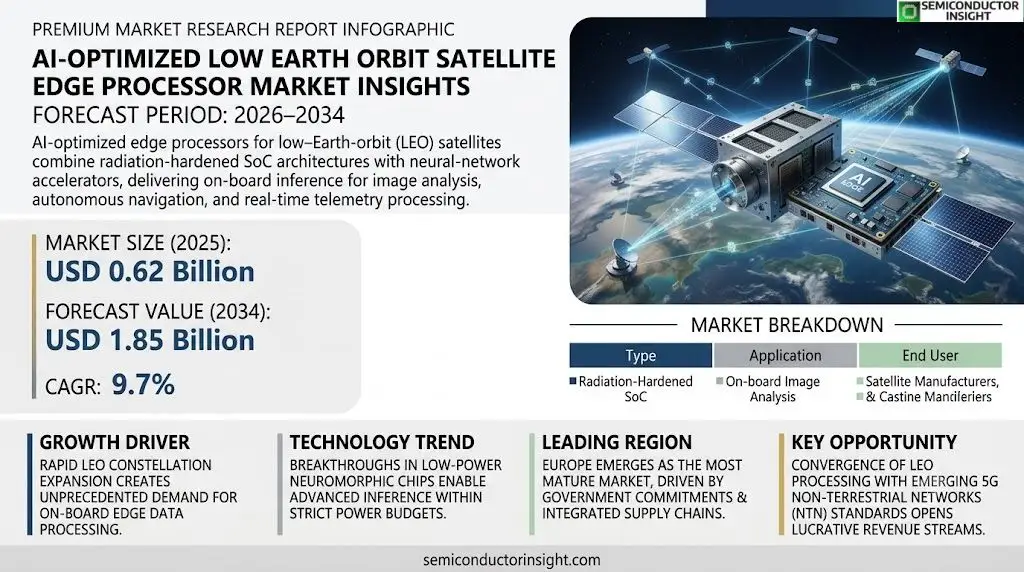
AI-Optimized Low Earth Orbit Satellite Edge Processor Market size was valued at USD 0.62 billion in 2025. The market is projected to grow from USD 0.68 billion in 2025 to USD 1.85 billion by 2034, exhibiting a CAGR of 9.7% during the forecast period.
AI‑optimized edge processors for low‑Earth‑orbit (LEO) satellites combine radiation‑hardened system‑on‑chip architectures with dedicated neural‑network accelerators, delivering on‑board inference for image analysis, autonomous navigation and real‑time telemetry processing.The market is accelerating because satellite constellations are expanding rapidly, telecom operators are investing heavily in broadband LEO services, and demand for low‑latency AI workloads such as earth observation analytics is rising. Furthermore, advances in semiconductor miniaturization and increased government funding for space infrastructure are driving adoption among leading aerospace manufacturers.
MARKET DRIVERS
Growing Need for Edge Computing in LEO Constellations
The rapid deployment of large‑scale Low Earth Orbit (LEO) satellite constellations is creating an unprecedented demand for on‑board data processing. Operators are seeking AI‑optimized edge processors that can handle terabytes of imagery and telemetry per day while reducing latency to under one second. Analysts project a 30% compound annual growth rate for the AI‑Optimized Low Earth Orbit Satellite Edge Processor Market through 2032, driven by real‑time analytics requirements for autonomous navigation and Earth observation.
Advancements in Low‑Power AI Accelerators
Recent breakthroughs in neuromorphic chips and sub‑watt AI accelerators enable sophisticated inference workloads within the strict power budgets of satellite platforms. These devices deliver up to 10× higher performance‑per‑watt compared with legacy processors, allowing manufacturers to embed intelligent decision‑making directly on the spacecraft. The resulting capability to filter and prioritize data before downlink reduces ground‑segment costs and accelerates commercial service delivery.
➤ “Edge AI is becoming the decisive factor for differentiating LEO services, shifting value from ground stations to the satellite itself.”
Finally, the convergence of AI software stacks with modular hardware architectures is shortening development cycles. Vendors can now ship pre‑qualified AI‑optimized processors in a 6‑month timeframe, enabling satellite operators to respond swiftly to emerging market opportunities such as real‑time maritime monitoring and on‑board disaster assessment.
MARKET CHALLENGES
Thermal Management Constraints
Spaceborne processors must operate in a harsh thermal environment where temperature swings exceed 150 °C per orbit. Maintaining processor reliability while running intensive AI workloads challenges designers to integrate advanced heat‑pipe and phase‑change materials. Over‑engineering thermal solutions can increase payload mass by 15%, eroding the cost advantage of LEO deployments.
Other Challenges
Supply Chain Complexity
The specialized semiconductor components required for AI edge processors are sourced from a limited number of foundries that also serve defense and automotive sectors. Recent geopolitical tensions have introduced lead‑time variability of 20‑30 days, prompting satellite manufacturers to maintain higher inventory buffers and affecting overall project schedules.
MARKET RESTRAINTS
Regulatory and Frequency Allocation Barriers
International regulations governing spectrum usage and orbital slots impose strict limits on the number of LEO satellites that can be launched in certain bands. These constraints slow the rollout of new constellations equipped with AI‑optimized processors, especially in regions where spectrum sharing agreements are still being negotiated. Consequently, market participants must budget additional compliance costs, which can reduce the net upside of early technology adoption.
MARKET OPPORTUNITIES
Integration with 5G‑Non‑Terrestrial Networks
The convergence of LEO satellite edge processing with emerging 5G non‑terrestrial network (NTN) standards opens a lucrative avenue for service providers. By embedding AI inference directly on satellites, operators can deliver ultra‑low‑latency connectivity for remote industrial IoT sites, enabling real‑time predictive maintenance without relying on terrestrial backhaul. This synergy is expected to generate a $2.5 billion revenue stream for the AI‑Optimized Low Earth Orbit Satellite Edge Processor Market by 2028, as telecom firms invest heavily in hybrid satellite‑ground architectures.
AI-Optimized Low Earth Orbit Satellite Edge Processor Market Trends
Rising Adoption Driven by Satellite Constellation Expansion
The deployment of large low‑Earth‑orbit (LEO) constellations is reshaping the demand profile for on‑board intelligence. Operators seek edge processors that can perform inference directly on the satellite, reducing the need for costly downlink bandwidth and enabling near‑real‑time decision making. As the number of active LEO nodes grows, manufacturers are standardizing AI‑optimized processor modules to ensure consistent performance across diverse payloads. This trend is evident in the accelerating integration of neural‑network accelerators within radiation‑hardened system‑on‑chip designs, which deliver the computational depth required for high‑resolution image analysis and autonomous navigation.
Other Trends
Advances in Radiation‑Hardened AI Chip Design
Recent semiconductor breakthroughs have produced silicon‑on‑insulator (SOI) and silicon‑carbide (SiC) technologies that tolerate the harsh space environment while maintaining the low power envelope needed for LEO platforms. These chips incorporate dedicated tensor cores that accelerate convolutional operations, allowing satellites to run complex analytics without exceeding thermal limits. The convergence of miniaturization and radiation tolerance is shortening development cycles, prompting aerospace firms to adopt AI‑optimized edge processors as a baseline component rather than a specialized add‑on.
Increasing Investment from Telecom Operators
Telecommunications companies that are building broadband LEO services are allocating significant capital to edge‑compute capabilities. Their priority is to deliver low‑latency user experiences for applications such as remote education, telemedicine, and real‑time IoT analytics. By embedding AI processors aboard satellites, these operators can preprocess data streams, filter irrelevant information, and prioritize high‑value traffic before it reaches ground stations. This strategic shift not only improves service quality but also creates a feedback loop where demand for more sophisticated on‑board AI fuels further investment in processor technology.
COMPETITIVE LANDSCAPE
Key Industry Players
Competitive dynamics among leading AI‑edge processor vendors for LEO satellites
The AI‑optimized low‑Earth‑orbit (LEO) satellite edge processor market is anchored by a handful of technology powerhouses that combine radiation‑hardening expertise with advanced neural‑network accelerators. NVIDIA leads the sector through its Jetson‑X series, which has been qualified for space‑flight and offers a compelling performance‑per‑watt ratio for on‑board inference tasks such as cloud‑cover detection and autonomous attitude control. Parallel to NVIDIA, Lockheed Martin leverages its heritage in radiation‑tolerant ASIC design to supply custom system‑on‑chip solutions for high‑throughput imaging constellations, positioning itself as the primary supplier for defense‑grade LEO platforms. The market structure reflects a dual‑track model: a few large integrators dominate volume contracts with telecom operators, while a growing cohort of specialist firms targets niche scientific and Earth‑observation missions that demand ultra‑low latency processing. This bifurcation creates a competitive landscape where scale, design‑for‑radiation, and AI algorithm optimization are the decisive differentiators.Beyond the marquee names, several niche players are shaping the ecosystem with differentiated architectures. Honeywell’s Space Systems division contributes hardened FPGA‑based edge processors that excel in real‑time telemetry compression. European firm Airbus Defence‑and‑Space offers the “SpaceEdge” line, integrating AI accelerators with its own satellite bus. Canadian startup GigaQuantum focuses on low‑power neuromorphic chips tailor‑made for on‑orbit data triage, while India’s Tata Group supplies cost‑effective, radiation‑tolerant processors for emerging regional constellations. Emerging companies such as Blue Canyon Technologies, Nova Labs, and Kongsberg Defence & Aerospace further expand the supplier pool, each emphasizing modularity and rapid integration for commercial LEO operators seeking bespoke AI capabilities.
List of Key AI-Optimized Low Earth Orbit Satellite Edge Processor Companies Profiled
- NVIDIA
- Lockheed Martin
- Honeywell Space Systems
- Airbus Defence and Space
- Blue Canyon Technologies
- Nova Labs
- Kongsberg Defence & Aerospace
- SpaceX
- Amazon Kuiper
- Tata Group Space
- GigaQuantum
- Boeing
- Northrop Grumman
- Raytheon Technologies
- Thales Alenia Space
Segment Analysis:
| Segment Category | Sub-Segments | Key Insights |
| By Type |
|
Radiation‑Hardened SoC is the leading segment because it delivers intrinsic resilience to the harsh LEO radiation environment, enabling long‑duration missions without costly redundancy. – Engineers prioritize deterministic performance for critical navigation and control loops. – Integration of hardened memory reduces error‑correction overhead, simplifying payload software stacks. – Proven heritage in legacy satellite platforms builds confidence for newer AI‑driven constellations. |
| By Application |
|
On‑board Image Analysis leads the application spectrum as satellite operators seek immediate insight from high‑resolution sensors. – Edge inference eliminates downlink bandwidth constraints for time‑critical scenes. – Enables autonomous detection of anomalies such as debris or climate events. – Supports iterative model updates that can be uploaded directly to the processor, shortening development cycles. |
| By End User |
|
Satellite Manufacturers dominate end‑user demand because they embed the processors directly into next‑generation LEO platforms. – Design teams emphasize modularity to accommodate diverse payloads. – Early‑stage validation of AI workloads accelerates certification timelines. – Close collaboration with semiconductor partners drives co‑development of radiation‑aware neural kernels. |
| By Architecture |
|
Monolithic ASIC is the preferred architecture for high‑volume constellations seeking optimal power‑performance trade‑offs. – Consolidates AI accelerators, memory, and radiation hardening into a single die, reducing board space. – Offers predictable thermal characteristics essential for compact satellite buses. – Streamlines supply chain logistics, enabling rapid scaling of launch schedules. |
| By Integration Level |
|
Integrated with Satellite Bus emerges as the dominant integration approach because it aligns processing capabilities directly with spacecraft control functions. – Reduces inter‑module latency, improving real‑time decision loops. – Simplifies power distribution architectures, conserving limited energy budgets. – Facilitates unified firmware updates across both bus and payload, enhancing operational agility. |
Regional Analysis: AI-Optimized Low Earth Orbit Satellite Edge Processor Market
Europe
European Union directives on spectrum and data use create a predictable environment for satellite edge processing, encouraging investment from both incumbents and startups.
Joint programmes between universities and industry accelerate algorithmic advances, ensuring that AI‑optimized processors meet emerging mission profiles.
Proximity of silicon fabs, design houses, and system integrators reduces time‑to‑market for cutting‑edge edge processors.
Alliances between satellite operators and AI firms create turnkey solutions that embed analytics directly into LEO payloads.
North America
North America remains a vigorous market, driven by high‑technology investments and a strong defense sector. U.S. agencies fund projects that embed AI edge processors into low‑earth‑orbit constellations for real‑time situational awareness. Commercial operators leverage the technology to differentiate services, particularly in remote sensing and autonomous logistics. While the market faces intense competition, the depth of venture capital and a mature ecosystem of semiconductor manufacturers sustain robust growth prospects.
Asia‑Pacific
The Asia‑Pacific region is quickly scaling its capabilities, with several emerging economies launching LEO constellations aimed at connectivity and data services. Governments prioritize satellite edge computing to support smart city initiatives and agricultural monitoring. Although regulatory standards are still evolving, the surge in private‑sector funding and collaborations with chip makers positions the region for accelerated adoption in the next decade.
South America
South America is exploring AI‑enabled satellite edge solutions to bridge connectivity gaps across vast rural territories. Regional telecom providers see the technology as a means to deliver low‑latency services without extensive ground infrastructure. Market development is modest but growing, propelled by public‑private partnerships that focus on disaster‑response capabilities and environmental monitoring.
Middle East & Africa
In the Middle East and Africa, strategic interest centers on using edge‑processed satellite data for security, oil‑and‑gas monitoring, and climate resilience. While the market is still nascent, significant sovereign wealth fund investments and partnerships with international aerospace firms hint at a future expansion as regulatory frameworks become clearer and the cost of AI‑optimized processors declines.
Report Scope
This market research report provides a comprehensive analysis of the AI-Optimized Low Earth Orbit Satellite Edge Processor Market , covering the forecast period 2026–2034. It offers detailed insights into market dynamics, technological advancements, competitive landscape, and key trends shaping the industry.
Key focus areas of the report include:
- Market Overview: The report begins with an overview outlining its current market scenario, key growth indicators, and industry transformation drivers. It discusses macroeconomic factors, demand–supply balance, regulatory landscape, and the strategic role of semiconductors in powering advancements across industries such as automotive, telecommunications, consumer electronics, and industrial automation.
- Market Size & Forecast: Historical data and future projections for revenue, unit shipments, and market value across major regions and segments.
- Segmentation Analysis: Detailed breakdown by product type, technology, application, and end-user industry to identify high-growth segments and investment opportunities.
- Regional Insights: Insights into market performance across North America, Europe, Asia-Pacific, Latin America, and the Middle East & Africa, including country-level analysis where relevant.
- Competitive Landscape: Profiles of leading market participants, including their product offerings, R&D focus, manufacturing capacity, pricing strategies, and recent developments such as mergers, acquisitions, and partnerships.
- Technology Trends & Innovation: Assessment of emerging technologies, integration of AI/IoT, semiconductor design trends, fabrication techniques, and evolving industry standards.
- Market Drivers & Restraints: Evaluation of factors driving market growth along with challenges, supply chain constraints, regulatory issues, and market-entry barriers.
- Stakeholder Insights: Insights for component suppliers, OEMs, system integrators, investors, and policymakers regarding the evolving ecosystem and strategic opportunities.
Primary and secondary research methods are employed, including interviews with industry experts, data from verified sources, and real-time market intelligence to ensure the accuracy and reliability of the insights presented.
FREQUENTLY ASKED QUESTIONS:
What is the current market size of AI-Optimized Low Earth Orbit Satellite Edge Processor Market?
-> AI-Optimized Low Earth Orbit Satellite Edge Processor Market was valued at USD 0.62 billion in 2025 and is expected to reach USD 1.85 billion by 2034.
Which key companies operate in AI-Optimized Low Earth Orbit Satellite Edge Processor Market?
-> Key players include Axalta Coating Systems, AkzoNobel, BASF SE, PPG, Sherwin-Williams, and 3M, among others.
What are the key growth drivers?
-> Key growth drivers include railway infrastructure investments, urbanization, and demand for durable coatings.
Which region dominates the market?
-> Asia-Pacific is the fastest-growing region, while Europe remains a dominant market.
What are the emerging trends?
-> Emerging trends include bio-based coatings, smart coatings, and sustainable rail solutions.

Get Sample Report PDF for Exclusive Insights
Report Sample Includes
- Table of Contents
- List of Tables & Figures
- Charts, Research Methodology, and more...
 Download Sample Report PDF