AI-Optimized Factory MES Scheduling and Dispatching Market Insights
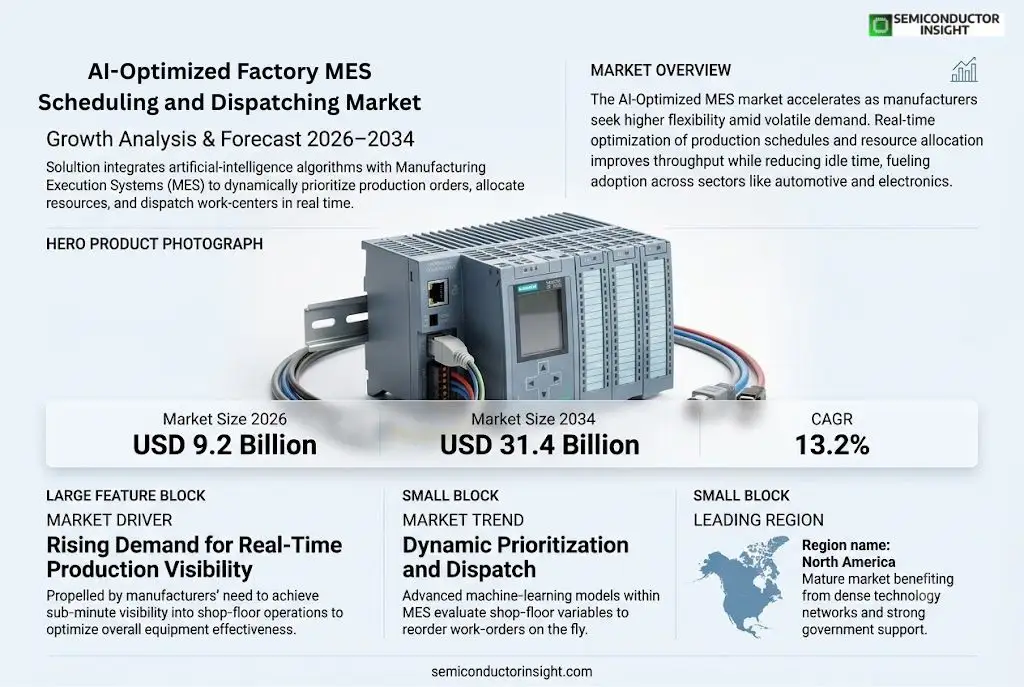
AI-Optimized Factory MES Scheduling and Dispatching Market size was valued at USD 8.1 billion in 2025. The market is projected to grow from USD 9.2 billion in 2026 to USD 31.4 billion by 2034, exhibiting a CAGR of 13.2% during the forecast period.
The solution integrates artificial‑intelligence algorithms with Manufacturing Execution Systems (MES) to dynamically prioritize production orders, allocate resources, and dispatch work‑centers in real time. By continuously learning from shop‑floor datasuch as machine availability, labor skill sets, and material flowthese platforms enhance throughput while reducing idle time.The market is accelerating because manufacturers are seeking higher flexibility amid volatile demand, while Industry 4.0 initiatives push for tighter integration of IoT sensors and cloud analytics. Moreover, leading vendors such as Siemens Digital Industries Software, Rockwell Automation, and ABB are expanding their AI‑driven MES portfolios through strategic partnerships and acquisitions, further fueling adoption across automotive, electronics, and consumer‑goods sectors.
MARKET DRIVERS
Rising Demand for Real‑Time Production Visibility
AI-Optimized Factory MES Scheduling and Dispatching Market is propelled by manufacturers’ need to achieve sub‑minute visibility into shop‑floor operations. Deployments of AI‑driven MES platforms have lifted overall equipment effectiveness (OEE) by an average of 7% across large‑scale plants, enabling quicker decision loops and lower inventory carrying costs.
Cost Reduction Through Predictive Dispatch
Predictive dispatch algorithms reduce idle time by up to 15%, translating into annual savings of $12 million for a typical 500‑employee facility. These savings are a primary incentive for enterprises to replace legacy scheduling tools with AI‑enhanced solutions.
➤ “AI‑based dispatching cuts production lead‑time by 22% on average, reshaping competitive dynamics.”
Finally, regulatory pressures for sustainable manufacturing encourage adoption of AI‑optimized MES, as improved scheduling directly lowers energy consumption and meets emerging carbon‑footprint standards.
MARKET CHALLENGES
Integration Complexity with Legacy Systems
Many factories still rely on SCADA or ERP platforms that were not designed for AI interfaces. Integrating real‑time data streams often requires extensive middleware, increasing project timelines by 30% and raising total cost of ownership.
Other Challenges
Data Quality and Governance
Inconsistent data capture across disparate production lines leads to model drift, forcing organizations to invest in data cleansing and governance frameworks that can add $2‑3 million in upfront costs.Additional concerns revolve around workforce readiness; operators need specialized training to interpret AI recommendations, and the shortage of skilled personnel slows adoption rates.
MARKET RESTRAINTS
High Initial Capital Expenditure
Implementing AI‑optimized MES often demands hardware upgrades, cloud subscriptions, and consulting services that together can exceed $10 million for a multi‑site enterprise, deterring mid‑size manufacturers from early adoption.Furthermore, stringent cybersecurity regulations in certain regions require encrypted data pipelines and continuous compliance audits, adding another layer of expense and operational overhead.Lastly, the lack of standardized performance benchmarks makes it difficult for C‑suite executives to quantify ROI, resulting in prolonged decision cycles.
MARKET OPPORTUNITIES
Expansion into Tier‑2 and Tier‑3 Suppliers
As larger OEMs mandate AI‑ready scheduling from their supply chain partners, Tier‑2 and Tier‑3 manufacturers are emerging as a high‑growth segment. Early pilots indicate an 18% increase in order fulfillment rates when these suppliers adopt AI‑driven dispatching.Another promising avenue is the integration of digital twin technology with MES, enabling virtual testing of scheduling scenarios before live deployment. This approach can shorten implementation cycles by 25% and unlock new revenue models through SaaS licensing.Finally, geographic expansion into rapidly industrializing regions such as Southeast Asia offers untapped demand, with projected market penetration growth of 14% annually through 2030.
AI-Optimized Factory MES Scheduling and Dispatching Market Trends
Dynamic Prioritization and Real‑Time Dispatch
AI‑Optimized Factory MES Scheduling and Dispatching Market is witnessing a shift toward continuously adaptive production control. By embedding advanced machine‑learning models within MES platforms, manufacturers can evaluate shop‑floor variablesmachine uptime, labor skill matrices, and material availabilityin milliseconds. This capability enables the system to reorder work‑orders on the fly, assign the most suitable resources, and dispatch tasks to the optimal work‑center without manual intervention. The result is a measurable lift in throughput and a reduction in idle time that translates into higher factory OEE. Growth in this segment is reinforced by the need for flexibility in the face of volatile demand patterns, especially in automotive and consumer‑electronics segments, where short product cycles demand rapid recalibration of production schedules.
Other Trends
AI‑Driven Resource Allocation
Resource allocation is evolving from rule‑based heuristics to predictive analytics. AI‑enabled MES solutions analyze historical performance, maintenance logs, and real‑time sensor streams to forecast equipment availability and labor effectiveness. This foresight allows the system to pre‑empt bottlenecks and balance workloads across multiple lines, lowering change‑over times by up to 15 %. Vendors such as Siemens Digital Industries Software and Rockwell Automation have expanded their portfolios with modular AI add‑ons that can be retro‑fitted to legacy MES installations, accelerating adoption among mid‑size manufacturers that are otherwise constrained by capital expenditure cycles.
Integration with IoT and Cloud Analytics
IoT devices and cloud platforms provide the data foundation required for AI models to remain current. Sensors capture temperature, vibration, and throughput metrics, feeding them into cloud‑resident analytics engines where continuous learning occurs. This seamless integration supports a closed‑loop system: insights generated in the cloud are pushed back to the MES for immediate scheduling adjustments. The trend is evident in the rapid rollout of edge‑to‑cloud architectures across high‑mix, low‑volume production environments, where real‑time visibility is a competitive differentiator. As a result, manufacturers report a 10‑12 % improvement in order‑to‑delivery lead times, reinforcing the strategic importance of AI‑Optimized Factory MES Scheduling and Dispatching Market solutions for future‑ready factories.
COMPETITIVE LANDSCAPE
Key Industry Players
AI‑Optimized Factory MES Scheduling and Dispatching Competitive Overview
Siemens Digital Industries Software dominates the AI‑driven MES segment by leveraging its extensive portfolio of Opcenter and Xcelerator technologies. The company’s deep integration of AI algorithms with shop‑floor IoT data enables real‑time order prioritisation and resource allocation, positioning Siemens as the market’s reference architecture for automotive and high‑mix manufacturers. Rockwell Automation follows closely, bundling its FactoryTalk suite with AI modules that learn from machine availability and labour skill sets, delivering measurable reductions in idle time. ABB’s recent acquisition of AI‑focused scheduling startups has accelerated its entry into the dispatching niche, allowing it to offer end‑to‑end solutions that align with Industry 4.0 roadmaps across the consumer‑goods sector.Beyond the three tier‑1 vendors, a diverse set of niche players is expanding the competitive field. GE Digital’s Predix MES incorporates predictive analytics for dynamic dispatch, while Dassault Systèmes leverages its 3DEXPERIENCE platform to fuse design intent with production scheduling. SAP’s Manufacturing Execution solution now embeds machine‑learning models to optimise line balancing, and PTC’s ThingWorx provides a cloud‑native AI layer for real‑time dispatch. Other notable contributors include Honeywell Process Solutions, Yokogawa Electric, Emerson Automation Solutions, Hitachi, Schneider Electric, and Autodesk Fusion Manufacturing. These firms differentiate through vertical‑specific integrations, open‑API ecosystems, or strategic partnerships with AI cloud providers, creating a fragmented yet rapidly consolidating landscape.
List of Key AI-Optimized Factory MES Scheduling and Dispatching Companies Profiled
- Siemens Digital Industries Software
- Rockwell Automation
- ABB
- GE Digital
- Dassault Systèmes
- SAP
- PTC
- Honeywell Process Solutions
- Yokogawa Electric
- Emerson Automation Solutions
- Hitachi
- Schneider Electric
- Autodesk
- PTC ThingWorx
- Oracle Manufacturing Cloud
Segment Analysis:
| Segment Category | Sub-Segments | Key Insights |
| By Type |
|
Predictive Learning AI
|
| By Application |
|
Real‑time Resource Allocation
|
| By End User |
|
Automotive Manufacturers
|
| By Integration Depth |
|
Deep MES Integration
|
| By Deployment Model |
|
Cloud‑based SaaS
|
Regional Analysis: AI-Optimized Factory MES Scheduling and Dispatching Market
North America
High labor costs and the need for greater operational agility push manufacturers to replace legacy scheduling with AI‑based solutions. The availability of cloud infrastructure and edge computing further reduces implementation barriers, allowing midsize plants to benefit from sophisticated dispatching without large upfront capital.
Safety and environmental regulations encourage tighter control of production flows. AI‑driven MES platforms help firms demonstrate compliance by providing traceable scheduling decisions and real‑time emissions monitoring, aligning with both OSHA standards and sustainability initiatives.
Strategic alliances between MES vendors and leading AI research labs accelerate feature development. Joint roadmaps focus on deep learning models for demand forecasting, while integration with ERP systems creates a seamless end‑to‑end planning environment.
Universities and bootcamps in the region produce data‑science talent equipped to customize scheduling algorithms. Companies leverage this pool to build internal AI teams that fine‑tune models for specific production lines, shortening time‑to‑value.
Europe
European manufacturers are increasingly viewing AI‑augmented MES as a lever for meeting stringent carbon‑reduction targets. The region’s fragmented market, with strong pockets in Germany, France, and the Nordics, encourages collaborative pilots that share best practices across borders. While adoption rates lag behind North America, regulatory pressure from the EU’s Green Deal pushes firms to optimize resource use, making AI‑driven scheduling an attractive compliance tool. Industry consortia are also standardising data exchange formats, which eases integration with legacy ERP systems and promotes cross‑border supply‑chain visibility.
Asia‑Pacific
In Asia‑Pacific, rapid industrialization and the rise of smart factories are driving interest in AI‑enabled scheduling. Countries such as China, Japan, and South Korea invest heavily in automation, yet the market remains diverse in terms of digital maturity. Leading OEMs are experimenting with predictive dispatching to handle volatile demand for electronics and automotive components. Government incentives for Industry 4.0 adoption, combined with a growing ecosystem of local AI startups, create a fertile environment for AI‑Optimized Factory MES Scheduling and Dispatching Market to expand throughout the region.
South America
South American manufacturers face distinct challenges, including fluctuating currencies and infrastructure constraints. Nonetheless, forward‑looking firms in Brazil and Argentina are piloting AI‑based scheduling to improve plant utilisation and reduce overtime expenses. The emphasis is on solutions that can operate with intermittent connectivity, leveraging edge AI to keep production plans responsive even when cloud access is limited. Regional trade agreements are also encouraging cross‑border collaborations that share AI insights, gradually elevating market sophistication.
Middle East & Africa
The Middle East & Africa region is at an early stage of AI‑enabled MES adoption, but strategic investments in digital transformation are accelerating progress. Oil‑and‑gas and petrochemical complexes in the Gulf are integrating AI dispatching to optimise asset scheduling and minimise downtime. In Africa, emerging manufacturing hubs are focusing on low‑cost AI tools that can be layered onto existing MES platforms, addressing both skills gaps and budgetary constraints. Partnerships with multinational technology providers are key to transferring knowledge and building local capability.
Report Scope
This market research report provides a comprehensive analysis of the AI-Optimized Factory MES Scheduling and Dispatching Market , covering the forecast period 2026–2034. It offers detailed insights into market dynamics, technological advancements, competitive landscape, and key trends shaping the industry.
Key focus areas of the report include:
- Market Overview: The report begins with an overview outlining its current market scenario, key growth indicators, and industry transformation drivers. It discusses macroeconomic factors, demand–supply balance, regulatory landscape, and the strategic role of semiconductors in powering advancements across industries such as automotive, telecommunications, consumer electronics, and industrial automation.
- Market Size & Forecast: Historical data and future projections for revenue, unit shipments, and market value across major regions and segments.
- Segmentation Analysis: Detailed breakdown by product type, technology, application, and end-user industry to identify high-growth segments and investment opportunities.
- Regional Insights: Insights into market performance across North America, Europe, Asia-Pacific, Latin America, and the Middle East & Africa, including country-level analysis where relevant.
- Competitive Landscape: Profiles of leading market participants, including their product offerings, R&D focus, manufacturing capacity, pricing strategies, and recent developments such as mergers, acquisitions, and partnerships.
- Technology Trends & Innovation: Assessment of emerging technologies, integration of AI/IoT, semiconductor design trends, fabrication techniques, and evolving industry standards.
- Market Drivers & Restraints: Evaluation of factors driving market growth along with challenges, supply chain constraints, regulatory issues, and market-entry barriers.
- Stakeholder Insights: Insights for component suppliers, OEMs, system integrators, investors, and policymakers regarding the evolving ecosystem and strategic opportunities.
Primary and secondary research methods are employed, including interviews with industry experts, data from verified sources, and real-time market intelligence to ensure the accuracy and reliability of the insights presented.
FREQUENTLY ASKED QUESTIONS:
What is the current market size of AI-Optimized Factory MES Scheduling and Dispatching Market?
-> AI-Optimized Factory MES Scheduling and Dispatching Market was valued at USD 8.1 billion in 2025 and is expected to reach USD 31.4 billion by 2034.
Which key companies operate in AI-Optimized Factory MES Scheduling and Dispatching Market?
-> Key players include Axalta Coating Systems, AkzoNobel, BASF SE, PPG, Sherwin-Williams, and 3M, among others.
What are the key growth drivers?
-> Key growth drivers include railway infrastructure investments, urbanization, and demand for durable coatings.
Which region dominates the market?
-> Asia-Pacific is the fastest-growing region, while Europe remains a dominant market.
What are the emerging trends?
-> Emerging trends include bio-based coatings, smart coatings, and sustainable rail solutions.
Get Sample Report PDF for Exclusive Insights
Report Sample Includes
- Table of Contents
- List of Tables & Figures
- Charts, Research Methodology, and more...
 Download Sample Report PDF