AI Mini LDE TV Market Insights
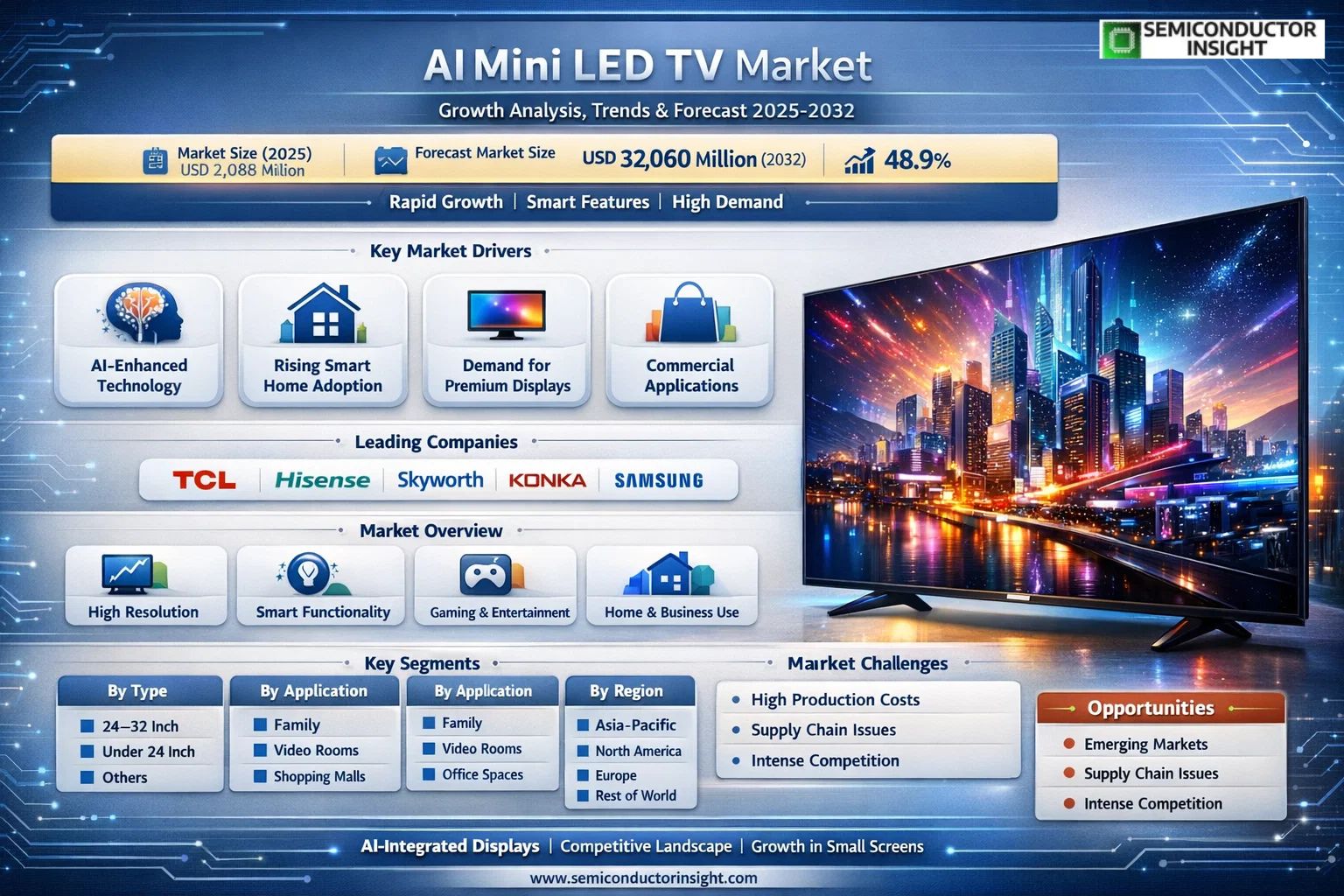
Global AI Mini LDE TV market size was valued at USD 2,088 million in 2025 and is projected to reach USD 32,060 million by 2032, exhibiting a CAGR of 48.9% during the forecast period.
Mini LED is an improved version of traditional LED backlight technology that increases the number of LEDs in the same space by reducing the size of the LEDs. AI Mini LDE TV is a Mini LED TV product that incorporates artificial intelligence technology. Through perfect technical logic and big data operations, the TV features language recognition, image recognition, natural language processing, and expert systems.
The market is experiencing rapid growth due to surging demand for premium compact displays, advancements in AI-driven smart features, and expanding applications in homes and commercial spaces. Furthermore, innovations in backlight technology and integration of voice/image recognition enhance user experiences, propelling adoption. Key players include Changhong, Skyworth, Hikvision, Konka, Hisense, TCL, Huawei, Sony, Xiaomi, and Samsung, offering diverse portfolios amid intense competition.
MARKET DRIVERS
Advancements in AI-Enhanced Display Technologies
AI Mini LED TV market is propelled by rapid innovations in artificial intelligence algorithms that optimize picture quality through real-time scene analysis and dynamic contrast adjustments. Mini LED backlighting, combined with AI-driven upscaling, delivers superior brightness levels exceeding 2000 nits, appealing to consumers seeking immersive 4K and 8K experiences. This integration enhances color accuracy by up to 95% in HDR content.
Growing Demand for Smart Home Entertainment
Consumer shift toward smart ecosystems drives adoption, with AI features like voice recognition and personalized content recommendations boosting user engagement. The market saw a 28% year-over-year growth in 2023, fueled by compatibility with platforms such as Alexa and Google Assistant in AI Mini LED TV market.
➤ Mini LED panels with AI processing reduce power consumption by 20-30% compared to traditional LCDs, supporting sustainability trends.
Furthermore, gaming sectors contribute significantly, as low-latency AI features enable 120Hz refresh rates and variable refresh rate support, positioning AI Mini LED TV market as a leader in next-gen entertainment.
MARKET CHALLENGES
High Production Costs and Pricing Pressures
Manufacturing AI Mini LED TV market products involves complex assembly of thousands of tiny LEDs and advanced AI chips, leading to costs 40-50% higher than conventional TVs. This results in premium pricing that limits penetration in price-sensitive segments.
Other Challenges
Supply chain vulnerabilities, particularly reliance on Asian semiconductor suppliers, exacerbate delays amid global chip shortages. Intense competition from OLED alternatives challenges market share in AI Mini LED TV market.
Technical Integration Hurdles
AI software optimization across diverse content sources remains inconsistent, with occasional glitches in real-time processing affecting reliability and consumer trust.Additionally, achieving uniform backlight control in smaller screen sizes poses engineering difficulties, hindering scalability.
MARKET RESTRAINTS
Premium Pricing Barriers
Elevated costs restrict AI Mini LED TV market to high-income demographics, with average prices hovering at $1500-$3000 per unit, compared to $500-$1000 for standard LEDs. This slows mass-market adoption despite superior performance.Regulatory hurdles on energy efficiency and e-waste further strain manufacturers, requiring costly compliance upgrades.Limited availability of native 8K content curbs full potential of AI upscaling features in AI Mini LED TV market.Intellectual property disputes over AI algorithms also impede innovation pace.
MARKET OPPORTUNITIES
Expansion into Emerging Markets
AI Mini LED TV market holds potential in Asia-Pacific and Latin America, where rising disposable incomes and urbanization drive demand for affordable premium TVs. Projected CAGR of 25% through 2028 offers entry points for localized production.Partnerships with streaming services can enhance AI content personalization, capturing 40% more subscribers.Development of compact models for commercial displays opens new revenue streams in hospitality and retail sectors.
AI Mini LDE TV Market Trends
Advancements in AI-Integrated Mini LED Technology
Mini LED technology enhances traditional LED backlighting by utilizing a higher density of smaller LEDs, delivering superior contrast and brightness in AI Mini LDE TV market. Manufacturers integrate artificial intelligence features such as language recognition, image recognition, natural language processing, and expert systems, powered by big data operations and advanced technical logic. This convergence drives improved user experiences through intelligent content adaptation and voice controls, positioning AI Mini LDE TV as a premium choice for modern consumers seeking immersive viewing.
Other Trends
Intensified Competition Among Key Manufacturers
Leading players like Changhong, Skyworth, Hikvision, Konka, Hisense, TCL, Huawei, Sony, Xiaomi, and Samsung dominate AI Mini LDE TV market through continuous innovation and strategic expansions. These companies focus on refining product offerings, addressing price dynamics, and responding to industry demands, which fosters a competitive landscape that accelerates technological progress and broadens market accessibility for diverse consumer segments.
Growth in Compact Screen Sizes an Versatile Applications
AI Mini LDE TV market sees notable momentum in the 24-inch to 32-inch segment alongside smaller sizes under 24 inches, catering to applications in family settings, video rooms, shopping malls, office spaces, and more. This trend reflects shifting preferences toward compact, high-performance displays that integrate AI capabilities for enhanced functionality across residential and commercial environments. Regional dynamics, particularly in Asia with strong contributions from China, Japan, and South Korea, further propel adoption as manufacturers tailor solutions to local needs and expand into North America and Europe.
COMPETITIVE LANDSCAPE
Key Industry Players
Leading Manufacturers in AI Mini LED TV market
AI Mini LED TV market is characterized by a dynamic competitive landscape dominated by established consumer electronics giants and innovative Chinese manufacturers. Leading players such as TCL, Hisense, and Samsung hold substantial market shares, leveraging advanced Mini LED backlighting combined with AI features like voice recognition, image processing, and personalized content recommendations. In 2025, the global top five players collectively accounted for a significant revenue portion, underscoring an oligopolistic structure where scale in production and R&D drives leadership. The market’s rapid growth, projected from US$2,088 million in 2025 to US$32,060 million by 2032 at a 48.9% CAGR, intensifies competition, with leaders focusing on premium segments like 24-32 inch models for family and commercial applications.
Beyond the frontrunners, niche players including Skyworth, Konka, Changhong, and Hikvision contribute through specialized AI integrations and cost-effective offerings tailored to regional demands, particularly in Asia-Pacific markets like China. International brands such as Sony, Xiaomi, Huawei, and Philips enhance diversity with high-end AI-driven picture optimization and smart ecosystem compatibility. Emerging competition from suppliers emphasizes supply chain efficiencies and innovations in Mini LED density for superior contrast and brightness. This fragmented yet consolidating landscape sees strategic partnerships and acquisitions accelerating, as companies vie for positions in high-growth applications like video rooms, shopping malls, and office spaces.
List of Key AI Mini LED TV Companies Profiled
- Changhong
- TCL
- Skyworth
- Hisense
- Hikvision
- Konka
- Sony
- Samsung
- Xiaomi
- Huawei
- Philips
- LG Electronics
- Sharp
- Panasonic
- Vizio
Segment Analysis:
| Segment Category | Sub-Segments | Key Insights |
| By Type |
|
24-inch to 32-inch
|
| By Application |
|
Family
|
| By End User |
|
Residential
|
| By Resolution |
|
4K UHD
|
| By Distribution Channel |
|
Online Retail
|
Regional Analysis: AI Mini LDE TV Market
Asia-Pacific
Concentrated R&D centers drive breakthroughs in AI algorithms for Mini LDE TVs, improving real-time image processing and adaptive lighting. Collaborations between tech firms and universities accelerate development of contextual AI features, enhancing user experiences in diverse environments.
Vast production facilities offer cost advantages and quick turnaround, enabling customized AI Mini LDE TV solutions. Vertical integration from panels to assembly minimizes delays, supporting scalable business strategies amid rising demand through 2034.
Urban consumers prioritize AI smartness, favoring TVs with gesture control and predictive analytics. Trends shift toward compact, high-end Mini LDE models for modern homes, bolstered by e-commerce proliferation and influencer-driven adoption.
Firms pursue mergers and joint ventures to expand AI capabilities, focusing on sustainability and interoperability. Strategic alliances with content providers ensure long-term relevance in the evolving AI Mini LDE TV market landscape.
North America
North America emerges as a key premium segment in AI Mini LDE TV market, characterized by high consumer spending power and innovation-driven demand. Tech-savvy users seek advanced AI features like multi-room synchronization and health-integrated content delivery. Business strategies emphasize premium branding and subscription ecosystems, with companies leveraging data analytics for targeted marketing from 2026-2034. Regulatory focus on data privacy shapes AI developments, ensuring secure personalization. While manufacturing lags, strong distribution networks and retail partnerships sustain growth. Trends highlight integration with IoT devices, positioning the region as a trendsetter for luxury AI Mini LDE TV experiences despite higher costs.
Europe
Europe’s AI Mini LDE TV market dynamics revolve around sustainability and stringent regulations, fostering eco-friendly innovations. Consumers favor energy-efficient models with AI-optimized power usage and recyclable materials. From 2026-2034, strategies prioritize compliance with green standards, driving partnerships for circular economy initiatives. Diverse markets like Germany and the UK lead in smart home compatibility, with AI enhancing multilingual interfaces and accessibility features. Fragmented competition encourages niche positioning, while rising disposable incomes boost adoption of high-contrast Mini LDE panels in compact living spaces.
South America
South America presents an emerging landscape for AI Mini LDE TV market, fueled by urbanization and digital inclusion efforts. Affordable AI features like voice assistants in local languages drive mass adoption. Business tactics from 2026-2034 focus on financing options and localized content to penetrate price-sensitive segments. Brazil and Mexico anchor growth through expanded retail and online channels. Challenges like economic volatility spur resilient supply strategies, with trends leaning toward durable, versatile models suited for varied climates and lifestyles.
Middle East & Africa
In the Middle East & Africa, AI Mini LDE TV market thrives on luxury demand and smart city projects. Affluent consumers in UAE and Saudi Arabia embrace AI-driven luxury displays for entertainment hubs. Strategies emphasize high-end customization and integration with regional smart ecosystems through 2034. Africa’s urbanization accelerates entry-level models with basic AI functionalities. Infrastructure investments bridge connectivity gaps, enabling seamless updates and cloud-based enhancements across diverse terrains.
Report Scope
This market research report provides a comprehensive analysis of AI Mini LDE TV market, covering the forecast period 2025–2032. It offers detailed insights into market dynamics, technological advancements, competitive landscape, and key trends shaping the industry.
Key focus areas of the report include:
- Market Overview: The report begins with an overview outlining its current market scenario, key growth indicators, and industry transformation drivers. It discusses macroeconomic factors, demand–supply balance, regulatory landscape, and the strategic role of Mini LED and AI technologies in powering advancements across industries such as home entertainment, commercial displays, office spaces, and smart video rooms.
- Market Size & Forecast: Historical data and future projections for revenue, unit shipments, and market value across major regions and segments.
- Segmentation Analysis: Detailed breakdown by product type, technology, application, and end-user industry to identify high-growth segments and investment opportunities.
- Regional Insights: Insights into market performance across North America, Europe, Asia-Pacific, Latin America, and the Middle East & Africa, including country-level analysis where relevant.
- Competitive Landscape: Profiles of leading market participants, including their product offerings, R&D focus, manufacturing capacity, pricing strategies, and recent developments such as mergers, acquisitions, and partnerships.
- Technology Trends & Innovation: Assessment of emerging technologies, integration of AI/IoT, semiconductor design trends, fabrication techniques, and evolving industry standards.
- Market Drivers & Restraints: Evaluation of factors driving market growth along with challenges, supply chain constraints, regulatory issues, and market-entry barriers.
- Stakeholder Insights: Insights for component suppliers, OEMs, system integrators, investors, and policymakers regarding the evolving ecosystem and strategic opportunities.
Primary and secondary research methods are employed, including interviews with industry experts, data from verified sources, and real-time market intelligence to ensure the accuracy and reliability of the insights presented.
FREQUENTLY ASKED QUESTIONS:
What is the current market size of AI Mini LDE TV Market?
-> AI Mini LDE TV market was valued at USD 2,088 million in 2025 and is expected to reach USD 32,060 million by 2032, at a CAGR of 48.9% during the forecast period.
Which key companies operate in AI Mini LDE TV Market?
-> Key players include Changhong, Skyworth, Hikvision, Konka, Hisense, TCL, Huawei, Sony, Xiaomi, Samsung, among others.
What are the key growth drivers?
-> Key growth drivers include improved Mini LED backlight technology, AI integration with language recognition, image recognition, natural language processing, and expert systems.
Which region dominates the market?
-> Asia dominates the market, particularly with key players from China.
What are the emerging trends?
-> Emerging trends include AI-enhanced Mini LED TVs, big data operations, and advanced display features for family, video rooms, shopping malls, and office spaces.
Get Sample Report PDF for Exclusive Insights
Report Sample Includes
- Table of Contents
- List of Tables & Figures
- Charts, Research Methodology, and more...
 Download Sample Report PDF