
AI ISP Camera Chips Market Insights
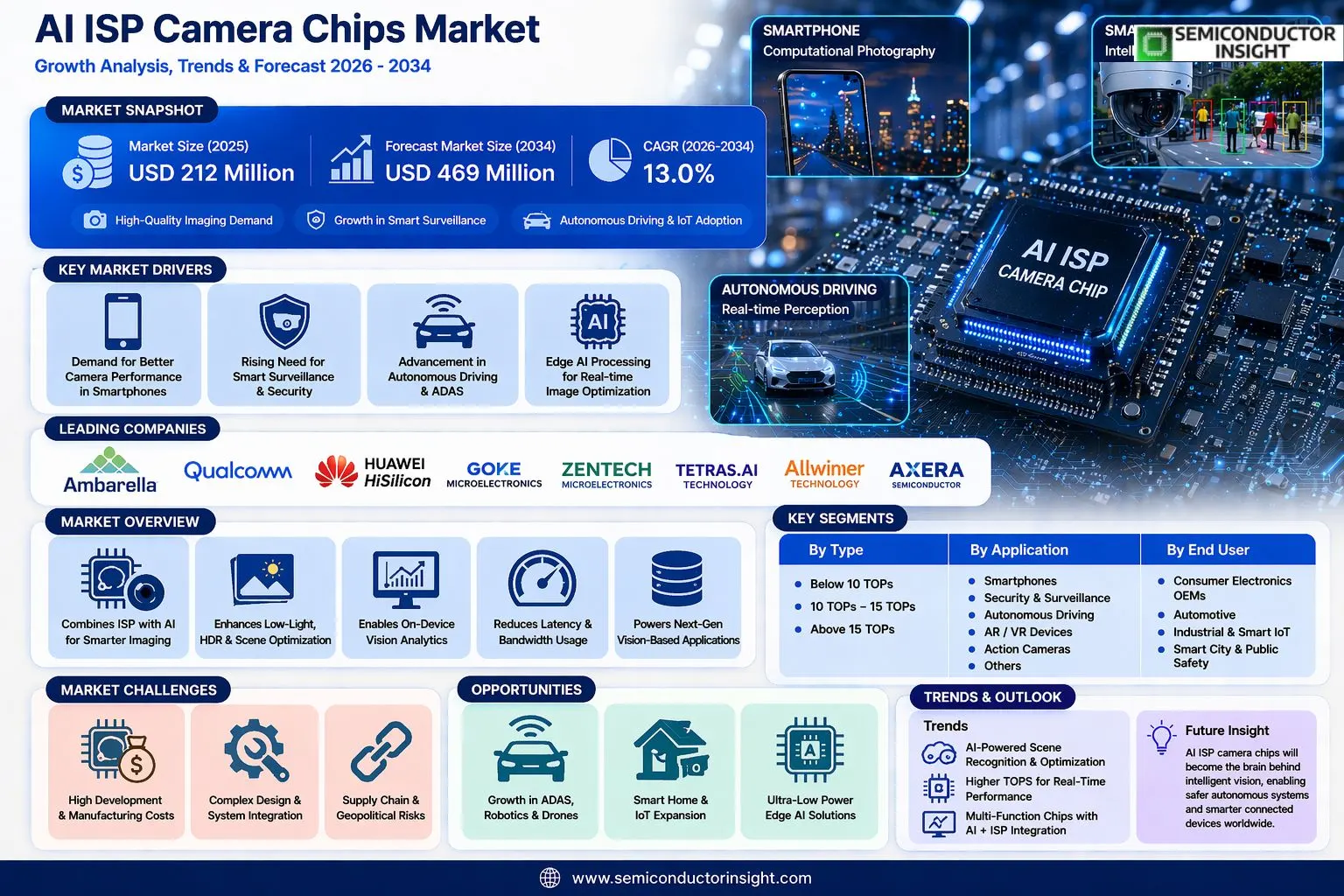
Global AI ISP camera chips market size was valued at USD 212 million in 2025. The market is projected to grow from USD 240 million in 2026 to USD 469 million by 2034, exhibiting a CAGR of 13.0% during the forecast period.
AI ISP camera chips are specialized integrated circuits that integrate artificial intelligence algorithms directly into the image signal processor (ISP). These chips are crucial for enabling real-time, intelligent image processing and are widely deployed in applications such as smartphones, security and surveillance systems, autonomous driving platforms, and smart IoT devices. Unlike traditional ISPs that handle basic functions like automatic exposure and noise reduction, an AI ISP leverages its built-in neural processing unit (NPU) or AI engine to perform advanced tasks. This includes automatically identifying and optimizing for specific scenes,such as night scenes, portraits, or fast-moving objects,to deliver significantly clearer, more detailed, and context-aware image quality without taxing the device’s main processor.
The market is experiencing rapid growth due to several converging factors. The insatiable demand for higher-quality computational photography in smartphones is a primary driver, while the security industry’s shift towards proactive, analytics-driven surveillance creates substantial demand. Furthermore, advancements in autonomous vehicles and ADAS rely heavily on these chips for real-time object detection and environmental understanding. Initiatives by key semiconductor players are also accelerating market expansion. For instance, companies like Ambarella have launched new CV3-AD series chips specifically for automotive AI perception, integrating powerful AI ISP capabilities. Other leading players shaping the competitive landscape include Qualcomm with its Snapdragon platforms, Huawei HiSilicon, Goke Microelectronics, and a growing cohort of specialized Chinese fabless firms like Zhejiang ZenTech and Axera Semiconductor.
MARKET DRIVERS
Surge in Demand for Intelligent Video Analytics
The proliferation of smart city projects, intelligent traffic management, and automated retail systems is a primary force propelling AI ISP camera chips market. These sectors require real-time, on-device processing of visual data for applications like facial recognition, object detection, and behavioral analysis. The integration of AI directly into the Image Signal Processor (ISP) enables low-latency, high-efficiency analytics without constant cloud dependency, making it essential for scalable, responsive surveillance and automation solutions.
Advancements in Semiconductor and Neural Processing
Continuous innovation in semiconductor manufacturing, allowing for more transistors on a chip, and the co-design of dedicated neural processing units (NPUs) are accelerating market growth. This enables AI ISP camera chips to deliver superior image quality in challenging lighting while simultaneously running complex AI models. The push for higher resolution sensors, like 4K and 8MP, further necessitates these advanced chips to manage the increased data flow efficiently and intelligently.
➤ The convergence of computational photography and machine learning is redefining edge intelligence, making AI ISP camera chip a cornerstone of modern visual sensing systems.
Furthermore, the rising emphasis on data privacy and security is shifting processing from the cloud to the edge. Local AI processing on the camera chip minimizes the transmission of raw video feeds, addressing privacy regulations and reducing bandwidth costs, which is a significant driver for adoption across consumer and enterprise segments of AI ISP camera chips market.
MARKET CHALLENGES
High Development Complexity and Cost
Designing and manufacturing AI ISP camera chips involves significant technical hurdles and financial investment. Integrating the traditional ISP pipeline with a high-performance AI accelerator requires deep expertise in both image processing and machine learning architectures. The cost of advanced node semiconductor fabrication and the lengthy development cycles create high barriers to entry, potentially limiting innovation to a few established players.
Other Challenges
Power and Thermal Constraints
Balancing high computational performance with strict power budgets, especially for battery-operated devices, remains a persistent challenge. Excessive heat generation can degrade image sensor performance and chip longevity.
Fragmented Software and Ecosystem
The lack of standardized development tools and software frameworks for AI ISP camera chips can slow down application deployment, requiring significant customization for different hardware platforms.
MARKET RESTRAINTS
Economic Sensitivity and Supply Chain Volatility
Global economic uncertainties can dampen capital expenditure in key end-user industries like automotive and industrial manufacturing, indirectly restraining AI ISP camera chips market. Furthermore, reliance on concentrated semiconductor supply chains creates vulnerability to geopolitical tensions and logistical disruptions, affecting production timelines and cost stability for chip manufacturers and OEMs alike.
MARKET OPPORTUNITIES
Expansion Beyond Traditional Surveillance
The application horizon for AI ISP camera chips is expanding rapidly into new verticals. In automotive, they are critical for advanced driver-assistance systems (ADAS) and autonomous vehicle perception. In healthcare, they enable diagnostic and patient monitoring tools. The consumer electronics segment, particularly smartphones and AR/VR devices, presents a massive opportunity for chips that enhance computational photography and immersive user experiences, driving the next wave of growth in AI ISP camera chips market.
Growth of Low-Power and Always-On Applications
The rise of the Internet of Things (IoT) and smart home devices fuels demand for ultra-low-power AI ISP camera chips capable of “always-on” sensing. These chips enable privacy-conscious, context-aware devices that can trigger actions only when needed, conserving energy. Innovations in chip architecture focused on energy efficiency will unlock opportunities in wearable tech, smart appliances, and industrial predictive maintenance systems.
Key Trends Shaping AI ISP Camera Chips Market
Advancements in On-Chip AI Processing Power
The market for AI ISP Camera Chips is experiencing a fundamental shift towards higher computational integration, where the distinction between the Image Signal Processor and the Neural Processing Unit is blurring. Manufacturers are aggressively developing chips with greater TOPS (Tera Operations Per Second) ratings to handle complex real-time AI tasks directly on the device. This trend moves beyond simple scene recognition to enabling sophisticated functions like semantic segmentation for autonomous driving, ultra-low-light imaging for security, and multi-object tracking in smart city applications, all while significantly reducing latency and power consumption compared to cloud-dependent solutions.
Other Trends
Expansion Beyond Smartphones into Diverse IoT
While premium smartphones remain a primary driver, the application scope for AI ISP Camera Chips is broadening rapidly. The security industry is adopting these chips for intelligent surveillance cameras that can perform anomaly detection and facial recognition at the edge. In smart driving, they are critical for processing feeds from multiple vehicular cameras for Advanced Driver-Assistance Systems (ADAS). Furthermore, emerging applications in smart home devices, industrial quality inspection, and AR/VR equipment are creating new, diversified demand streams for specialized AI ISP Camera Chips.
Emphasis on Energy Efficiency and Edge Deployment
A critical market trend is the intense focus on optimizing power efficiency to facilitate broader edge AI deployment. As more devices require always-on, intelligent vision capabilities, chip designers are innovating at the architecture level. This involves creating heterogenous cores that balance high-performance AI bursts with low-power background analysis, and developing advanced process node technologies. The goal is to deliver superior image quality and AI analytics within the strict thermal and power budgets of compact, battery-operated IoT devices, a key factor for market penetration.
Rise of Vertical Integration and Application-Specific Designs
The competitive landscape is evolving from general-purpose AI ISP solutions to more vertically integrated and application-specific designs. Leading players are developing chips tailored for particular market segments, such as automotive-grade chips with functional safety certifications or security chips with enhanced privacy-preserving features. This trend is encouraging closer collaboration between chip manufacturers, camera module makers, and end-device OEMs to create optimized, system-level solutions that deliver a compelling performance advantage in targeted applications within the broader AI ISP Camera Chips Market.
COMPETITIVE LANDSCAPE
Key Industry Players
A Market Consolidating Around Specialized AI Silicon and Integrated Giants
Global AI ISP camera chips market is defined by a blend of specialized vision processor innovators and large-scale semiconductor firms leveraging their ecosystem strength. Ambarella stands as a defining player, recognized for its leadership in computer vision and advanced imaging SoCs, securing a significant share of the revenue pie in 2025. Its chips are pivotal in security, automotive, and robotics, driving its competitive edge. The market structure is moderately consolidated, with the top five manufacturers historically commanding a substantial portion of global revenue. This concentration is fueled by high R&D barriers and the complex integration of dedicated neural processing units (NPUs) with traditional ISP pipelines, creating formidable entry challenges for new players.
Beyond the established leaders, a dynamic layer of significant players has emerged, often specializing in niche applications or regional markets. Companies like Goke Microelectronics and Allwinner Technology have carved strong positions in consumer-focused smart IoT and security applications. Meanwhile, firms such as Axera Semiconductor and Zhejiang ZenTech are gaining traction with competitive solutions in the smart driving and automotive camera spaces. The competitive dynamics are further intensified by the rapid innovation cycle, where advancements in low-power AI processing below 10 TOPS are critical for edge devices, and capabilities above 15 TOPS are becoming standard for high-end autonomous driving and smart city infrastructure.
List of Key AI ISP Camera Chips Companies Profiled
- Ambarella
- Qualcomm Technologies, Inc.
- Huawei HiSilicon
- Goke Microelectronics Co., Ltd.
- Zhejiang ZenTech Microelectronics Co., Ltd.
- Shenzhen Tetras.AI Technology Co., Ltd.
- Allwinner Technology Co., Ltd.
- Axera Semiconductor (Shanghai) Co., Ltd.
- Intel Corporation
- NVIDIA Corporation
- MediaTek Inc.
- Samsung Electronics Co., Ltd.
- Texas Instruments Incorporated
- Rockchip Electronics Co., Ltd.
- Socionext Inc.
Segment Analysis:
| Segment Category | Sub-Segments | Key Insights |
| By Type |
|
Below 10TOPs represents a critical and highly accessible segment, primarily valued for enabling AI-enhanced imaging in cost-sensitive, high-volume applications. This segment’s growth is driven by the democratization of AI features across consumer electronics and entry-level IoT devices, where it balances performance with rigorous power and cost constraints. The proliferation of smart home devices and basic security cameras fuels consistent demand, as manufacturers seek to integrate fundamental scene recognition and optimization without prohibitive expense. Chip designs in this tier focus on efficient AI processing for specific, optimized tasks rather than raw computational power. |
| By Application |
|
Security Industry serves as a dominant and innovation-driven application segment due to its relentless pursuit of enhanced situational awareness and automated threat detection. The integration of AI ISP chips transforms passive surveillance into proactive, intelligent systems capable of real-time facial recognition, anomalous behavior analysis, and superior low-light imaging. This segment demands chips with robust and reliable AI inference for continuous operation, driving advancements in on-device processing to reduce bandwidth and latency. The convergence of security with broader smart city and industrial automation initiatives further amplifies its strategic importance and technological requirements. |
| By End User |
|
Consumer Electronics OEMs constitute the largest and most competitive end-user segment, characterized by rapid innovation cycles and intense focus on product differentiation. These OEMs, particularly in smartphones and smart home devices, leverage AI ISP chips as a cornerstone for superior camera performance, using AI to enhance photographic results in diverse scenarios like night portraits and fast motion. The segment demands chips that offer a compelling balance of AI performance, power efficiency, and integration ease to meet sleek form factors and tight development schedules. Supplier relationships are crucial, with OEMs seeking chips that enable unique, marketable imaging features to capture consumer interest. |
| By Integration Level |
|
Integrated System-on-Chip (SoC) is the leading architectural approach, favored for its superior power efficiency, compact footprint, and streamlined system design. By combining AI ISP, central processor, and other key functionalities onto a single die, SoCs reduce complexity and bill-of-materials costs for high-volume applications like smartphones and embedded vision systems. This integration allows for tighter hardware-software co-design, optimizing data flow between the imaging pipeline and AI accelerators to minimize latency. The trend towards SoC integration reflects the industry’s move toward more holistic and application-specific processing solutions, though it requires significant upfront design investment. |
| By AI Functionality |
|
Object Detection & Tracking emerges as the foremost and most commercially impactful AI functionality, serving as a foundational capability for numerous advanced applications. This functionality is paramount in security for identifying persons or vehicles, in smart driving for pedestrian and obstacle awareness, and in consumer devices for enhanced autofocus and subject recognition. The demand for real-time, low-power, and highly accurate detection is pushing chip designs toward specialized neural processing units (NPUs) optimized for convolutional networks. Its versatility and critical role in enabling automated decision-making make it a primary focus for R&D and a key differentiator among chip vendors. |
Regional Analysis: AI ISP Camera Chips Market
Asia-Pacific
The concentrated electronics supply chain, from wafer production to final assembly, provides significant cost and speed advantages. Proximity to major OEMs allows for close collaboration on chip specification and system-level optimization for next-generation cameras, accelerating time-to-market for new AI ISP camera chips.
National and municipal governments are heavily investing in surveillance and urban management networks. This policy-driven demand mandates the use of cameras with superior low-light performance and onboard analytics, directly propelling the adoption of advanced AI ISP camera chips over traditional solutions.
The fiercely competitive smartphone and automotive markets in the region push for constant imaging improvements. Manufacturers integrate sophisticated AI ISP camera chips to enable computational photography, augmented reality features, and advanced driver-assistance systems (ADAS), creating a high-volume application driver.
A dense network of research institutions and a large pool of engineering talent specializing in computer vision and chip design fosters continuous innovation. This environment supports the development of specialized architectures for AI ISP camera chips market, optimizing for specific regional use cases and algorithms.
North America
North America remains a critical innovation and high-value segment driver for AI ISP camera chips market, primarily fueled by its advanced technology sector and stringent security requirements. The region is characterized by strong demand from enterprise security, critical infrastructure protection, and the burgeoning smart home ecosystem. Major technology firms and startups are pioneering developments in edge AI and computer vision, creating specifications that push the boundaries of what AI ISP camera chips can achieve in terms of processing efficiency and algorithm support. Investment in autonomous vehicles and robotics within the region also relies heavily on reliable, high-fidelity vision processing, supporting a premium segment of the market focused on performance and reliability over cost.
Europe
The European AI ISP camera chips market is shaped by a strong regulatory framework emphasizing data privacy and ethical AI, alongside robust industrial and automotive sectors. Demand is driven by applications in industrial automation, where machine vision for quality inspection requires consistent and accurate imaging under variable conditions, a core strength of advanced AI ISP processors. The automotive industry’s push towards higher levels of autonomy creates a steady requirement for sophisticated, safety-certified camera systems. Furthermore, the region’s focus on sustainable technology influences chip design priorities, favoring energy-efficient AI ISP camera chips that enable longer battery life in IoT and mobile surveillance devices, aligning with broader environmental directives.
South America
AI ISP camera chips market in South America is in a growth phase, primarily driven by urban security concerns and gradual modernization of commercial sectors. Investments in city surveillance projects in major metropolitan areas are creating foundational demand. The market is cost-sensitive, often adopting solutions that balance capability with affordability, which influences the types of AI ISP camera chips imported and deployed. Emerging applications in retail analytics and agricultural monitoring also present future growth avenues, though adoption relies on demonstrating clear return on investment and overcoming infrastructural challenges related to connectivity and system integration.
Middle East & Africa
This region presents a diverse landscape for AI ISP camera chips market, marked by ambitious smart city projects in the Gulf Cooperation Council (GCC) nations and growing security investments across the continent. The drive to develop economic hubs with integrated digital infrastructure is a key demand driver, requiring high-performance surveillance and traffic management systems. In other areas, focus is on essential security for critical assets and border monitoring. The market dynamics are bifurcated, with high-value, large-scale public projects coexisting with more gradual adoption in commercial and residential segments, where price sensitivity and power reliability are significant considerations for deploying AI-enabled camera systems.
Report Scope
This market research report provides a comprehensive analysis of the AI ISP Camera Chips Market , covering the forecast period 2026–2034. It offers detailed insights into market dynamics, technological advancements, competitive landscape, and key trends shaping the industry.
Key focus areas of the report include:
- Market Overview: The report begins with an overview outlining its current market scenario, key growth indicators, and industry transformation drivers. It discusses macroeconomic factors, demand–supply balance, regulatory landscape, and the strategic role of semiconductors in powering advancements across industries such as automotive, telecommunications, consumer electronics, and industrial automation.
- Market Size & Forecast: Historical data and future projections for revenue, unit shipments, and market value across major regions and segments.
- Segmentation Analysis: Detailed breakdown by product type, technology, application, and end-user industry to identify high-growth segments and investment opportunities.
- Regional Insights: Insights into market performance across North America, Europe, Asia-Pacific, Latin America, and the Middle East & Africa, including country-level analysis where relevant.
- Competitive Landscape: Profiles of leading market participants, including their product offerings, R&D focus, manufacturing capacity, pricing strategies, and recent developments such as mergers, acquisitions, and partnerships.
- Technology Trends & Innovation: Assessment of emerging technologies, integration of AI/IoT, semiconductor design trends, fabrication techniques, and evolving industry standards.
- Market Drivers & Restraints: Evaluation of factors driving market growth along with challenges, supply chain constraints, regulatory issues, and market-entry barriers.
- Stakeholder Insights: Insights for component suppliers, OEMs, system integrators, investors, and policymakers regarding the evolving ecosystem and strategic opportunities.
Primary and secondary research methods are employed, including interviews with industry experts, data from verified sources, and real-time market intelligence to ensure the accuracy and reliability of the insights presented.
FREQUENTLY ASKED QUESTIONS:
What is the current market size of AI ISP Camera Chips Market?
-> AI ISP Camera Chips Market was valued at USD 212 million in 2025 and is projected to reach USD 469 million by 2034, growing at a CAGR of 13.0% during the forecast period.
Which key companies operate in AI ISP Camera Chips Market?
-> Key players include Ambarella, Qualcomm, Huawei HiSilicon, Goke Microelectronics, Zhejiang ZenTech, Shenzhen Tetras.AI Technology, Allwinner Technology, and Axera Semiconductor, among others.
What are the key growth drivers?
-> Key growth drivers include the integration of AI algorithms into image signal processing for applications like smartphones, security monitoring, autonomous driving, and smart IoT devices, which demands higher image optimization and intelligent analysis.
Which region dominates the market?
-> The U.S. market size is estimated at USD million in 2025, while China is projected to reach USD million, indicating significant market opportunities in both North America and Asia.
What are the emerging trends?
-> Emerging trends include AI ISP chips enabling automatic scene recognition and optimization (e.g., night scenes, portraits, moving objects) and the development of chips across different computing power segments, such as Below 10TOPs, 10TOPs-15TOPs, and Above 15TOPs.

Get Sample Report PDF for Exclusive Insights
Report Sample Includes
- Table of Contents
- List of Tables & Figures
- Charts, Research Methodology, and more...
 Download Sample Report PDF





