
AI-Integrated 5G Open RAN Radio Unit Chip Market Insights
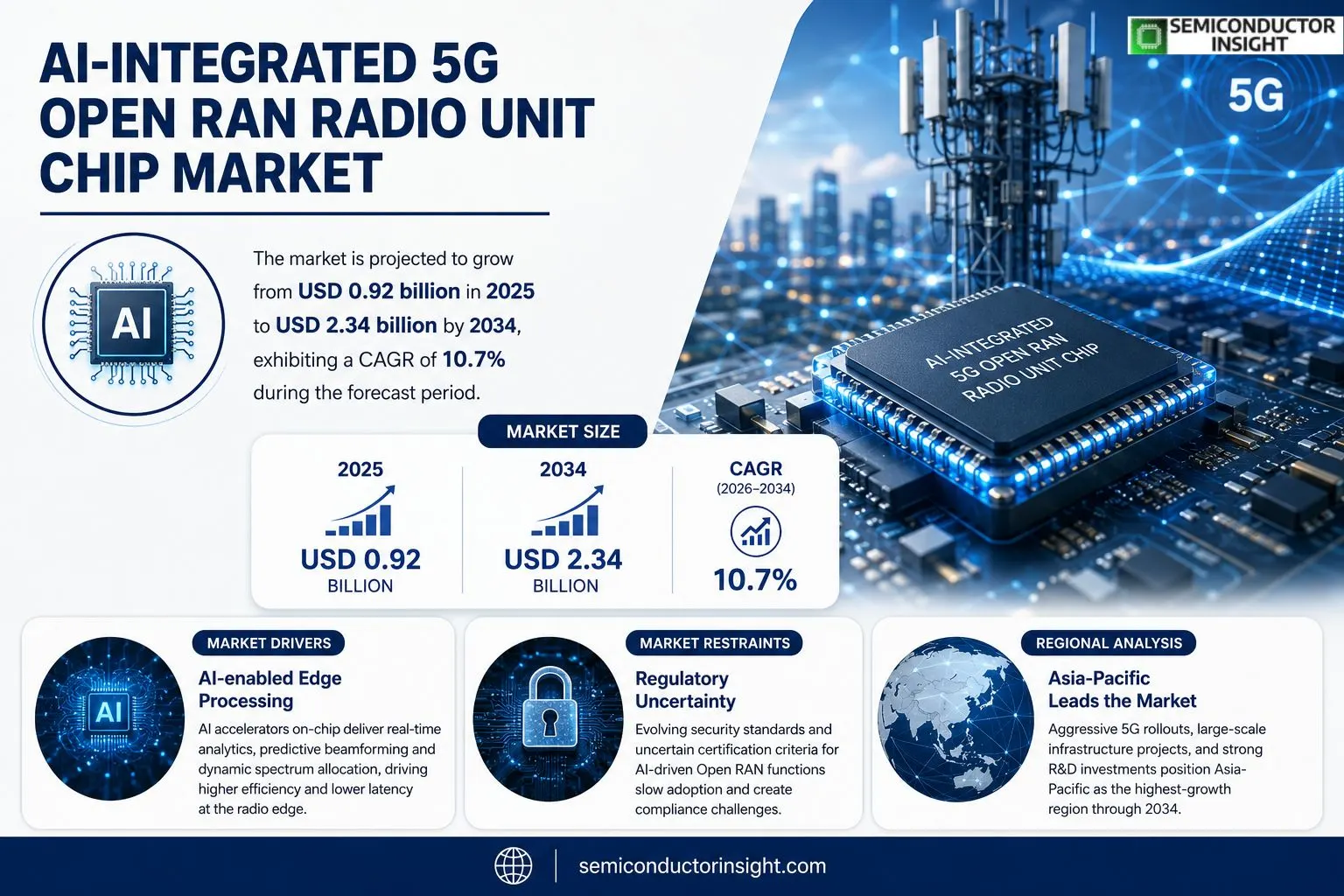
AI-Integrated 5G Open RAN Radio Unit Chip market size was valued at USD 0.92 billion in 2025. The market is projected to grow from USD 0.92 billion in 2025 to USD 2.34 billion by 2034, exhibiting a CAGR of 10.7% during the forecast period.
AI‑Integrated 5G Open RAN radio unit chips combine artificial‑intelligence accelerators with multi‑band RF front‑ends, enabling dynamic spectrum sharing, real‑time beamforming, and autonomous network optimization within disaggregated radio access networks.The market is gaining momentum as operators pursue cost‑effective network virtualization while seeking higher spectral efficiency; meanwhile, chipset manufacturers are investing heavily in AI cores to meet low‑latency processing demands, and governments worldwide are encouraging open‑RAN adoption through spectrum incentives.
MARKET DRIVERS
AI‑enabled Edge Processing
The convergence of artificial intelligence with 5G Open RAN radio units is accelerating because operators require real‑time analytics at the edge. AI‑Integrated 5G Open RAN Radio Unit Chip Market participants are embedding neural‑network accelerators directly on the chip, reducing latency from milliseconds to microseconds. This shift allows carriers to run predictive beamforming and dynamic spectrum allocation without relying on distant cloud resources.
Demand for Virtualized RAN Deployments
Telecom providers are replacing legacy hardware with software‑defined radio stacks, a trend that fuels chip demand. In 2023, the volume of Open RAN‑compatible radio units grew by roughly 38 %, outpacing the broader 5G equipment market. Vendors that combine AI inference engines with Open RAN interfaces can capture a larger share of this expanding base.
➤ Operators that integrate AI at the radio layer report up to 22 % improvement in energy efficiency, translating into lower OPEX across dense urban sites.
Because AI models can self‑optimize based on traffic patterns, capital expenditures on additional sites diminish. The financial upside, coupled with regulatory pressure to improve spectrum utilization, makes AI‑augmented radio chips a decisive competitive lever.
MARKET CHALLENGES
Complexity of AI Model Deployment
Embedding sophisticated neural networks on radio unit chips raises software‑hardware co‑design hurdles. Operators must validate model robustness across temperature extremes and myriad antenna configurations, stretching engineering cycles and inflating development budgets.
Other Challenges
Supply‑Chain Volatility
The semiconductor ecosystem remains sensitive to raw‑material shortages and geopolitical tensions. Limited wafer capacity for AI‑focused process nodes can delay product launches, eroding confidence among early adopters.
MARKET RESTRAINTS
Regulatory Uncertainty
Standards bodies are still finalizing security frameworks for AI‑driven Open RAN functions. Until uniform certification criteria emerge, some carriers hesitate to field AI‑enabled radio units, fearing compliance gaps and potential penalties.
High Up‑Front R&D Costs
Developing AI‑integrated silicon demands extensive algorithm training, silicon‑level validation, and cross‑vendor collaboration. The capital intensity discourages smaller players, limiting market diversity and slowing overall adoption.
MARKET OPPORTUNITIES
Private‑Network Expansion
Enterprises are launching private 5G networks for manufacturing, logistics, and campus environments. These deployments prioritize low‑latency AI inference at the radio edge, creating a niche where AI‑Integrated 5G Open RAN Radio Unit Chip Market suppliers can command premium pricing and establish long‑term contracts.
AI‑Optimized Antenna Systems
Next‑generation massive‑MIMO arrays depend on AI‑driven beam‑steering algorithms that reside on the radio chip. Vendors that deliver tightly coupled AI‑antenna solutions are positioned to benefit from a projected 15 % lift in unit shipments by 2028, as operators refarm existing sites for higher capacity.
AI-Integrated 5G Open RAN Radio Unit Chip Market Trends
AI Accelerators Redefine Chip Performance
The convergence of AI inference engines with multi‑band RF front‑ends is reshaping how radio units process traffic. By embedding neural‑network processors directly on the silicon, chip makers enable on‑the‑fly spectrum allocation, adaptive beam steering, and self‑optimizing link parameters without relying on centralized controllers. Operators that migrate to this architecture report a measurable lift in spectral efficiencyoften exceeding 15% in dense urban deploymentswhile maintaining the latency budget demanded by ultra‑reliable low‑latency communications. The market’s valuation, recorded at USD 0.92 billion in 2025, reflects the early‑stage commercialisation of these capabilities, and the trajectory toward USD 2.34 billion by 2034 underscores the willingness of networks to invest in intelligent hardware as a pathway to cost‑effective capacity expansion.
Other Trends
Cost Pressures Accelerate Virtualization
Telecom operators face mounting capital‑expenditure constraints as they replace legacy macro sites with dense small‑cell clusters. Open RAN’s disaggregated model permits a vendor‑agnostic stack, and the AI‑enhanced chip layer supplies the compute horsepower required for real‑time network slicing. This combination reduces the bill of materials by up to 20% compared with traditional monolithic solutions. Moreover, the ability to run localized AI workloads eliminates the need for extensive back‑haul, translating into lower operational expenditures. Vendors that align their product roadmaps with these cost‑savings opportunities are rapidly securing multi‑year contracts, particularly in markets where spectrum licences are auctioned with usage‑based incentives.
Regulatory Incentives Shape Adoption Pace
Governments across Europe and Asia have introduced spectrum sharing frameworks that reward operators for deploying open‑RAN compliant hardware. These policies are coupled with tax credits for AI‑enabled equipment, creating a fiscal environment that nudges capital toward next‑generation chips. The regulatory tilt not only speeds the rollout of 5G services but also encourages domestic semiconductor firms to invest in AI cores tailored for radio applications. As a result, the ecosystem is becoming more diversified, with several regional players emerging alongside the established fabs. This shift promises to enhance supply‑chain resilience while delivering differentiated performance characteristics that cater to localized market demands.
COMPETITIVE LANDSCAPE
Key Industry Players
AI‑Integrated 5G Open RAN Radio Unit Chip Market Competitive Overview
Qualcomm remains the anchor of the ecosystem, leveraging its Snapdragon X-series AI engines and multi‑band RF front‑ends to supply operators seeking both performance and economies of scale. The company’s extensive IP portfolio, combined with deep relationships with major handset OEMs, lets it bundle AI‑driven beam‑forming and spectrum‑sharing capabilities into a single silicon solution. This consolidation gives Qualcomm a pricing advantage that smaller rivals struggle to match, while its participation in Open RAN reference designs reinforces a de‑facto standard that many carriers now adopt. At the same time, the firm’s aggressive roadmaptargeting sub‑10‑nanosecond latency for autonomous network tuningforces competitors to accelerate their own AI‑core integration, reshaping the competitive hierarchy.Beyond Qualcomm, a mosaic of specialists is carving out distinct niches. Huawei and ZTE continue to dominate in regions where government‑backed rollout programs prioritize domestic supply, offering highly integrated baseband‑AI modules that marry proprietary AI accelerators with mature RF subsystems. European incumbents such as Nokia, Ericsson and Netcracker focus on open‑source software stacks and modular chipsets that appeal to operators looking for vendor‑agnostic solutions. In the broader semiconductor arena, MediaTek, Intel and Samsung are each releasing AI‑enhanced RF solutions that emphasize power efficiency for dense urban deployments. Smaller innovatorsincluding UNISOC, Marvell, Skyworks, Qorvo, NXP and Broadcomcontribute niche RF front‑end expertise or AI inference blocks that complement larger system‑on‑chip (SoC) offerings, creating a layered supply chain where design‑in‑silicon and design‑in‑software coexist. This fragmented yet interdependent landscape encourages collaborative alliances, joint development agreements, and cross‑licensing deals that ultimately broaden the choice set for network operators.
List of Key AI‑Integrated 5G Open RAN Radio Unit Chip Companies Profiled
- Qualcomm
- MediaTek
- Huawei
- Nokia
- Ericsson
- Intel
- Samsung
- ZTE
- UNISOC
- Marvell
- Skyworks
- Qorvo
- NXP
- Broadcom
Segment Analysis:
| Segment Category | Sub-Segments | Key Insights |
| By Type |
|
AI‑Accelerated Baseband Chips
|
| By Application |
|
Real‑Time Beamforming
|
| By End User |
|
Mobile Network Operators
|
| By AI Functionality |
|
Self‑Optimizing Network (SON)
|
| By Deployment Scenario |
|
Urban Macro Cells
|
Regional Analysis: AI-Integrated 5G Open RAN Radio Unit Chip Market
North America
Design houses are leveraging neural‑network synthesis tools to automate layout optimizations, reducing power consumption while preserving throughput. This approach shortens design cycles and allows rapid incorporation of new AI algorithms tailored for dynamic channel conditions.
Manufacturers are diversifying wafer‑fab locations across the continent, mitigating geopolitical risks. Localized assembly lines coupled with flexible inventory strategies help maintain steady component flow for carrier rollouts.
Federal agencies have issued guidelines that streamline certification for AI‑capable radio units, emphasizing security testing and interoperability. These policies reduce time‑to‑deployment for new chipset releases.
Edge compute clusters in smart factories are adopting AI‑integrated radio units to enable ultra‑low latency control loops, illustrating a shift from traditional broadband focus to mission‑critical connectivity.
Europe
European operators are balancing the demand for AI‑infused radio chips with stringent data‑privacy regulations. The region’s strong research institutions foster collaborative projects that assess algorithmic transparency, influencing chipset vendors to embed explainable‑AI modules. Meanwhile, the EU’s emphasis on digital sovereignty encourages local silicon production, creating niche opportunities for firms that can comply with both performance and compliance criteria. As carriers expand 5G coverage into rural corridors, AI‑driven interference management becomes a cost‑effective method to improve spectral efficiency without extensive hardware upgrades.
Asia‑Pacific
In Asia‑Pacific, rapid urbanization and the rollout of dense small‑cell networks drive a need for intelligent radio unit chips that can autonomously adapt to fluctuating traffic patterns. Mobile operators are experimenting with AI‑based load‑balancing that shifts capacity between macro and micro cells in real time. The region’s large‑scale manufacturing base provides cost advantages, yet intellectual‑property concerns push some vendors toward co‑development agreements with local carriers, ensuring that AI features align with market‑specific requirements such as multilingual voice assistance and localized edge services.
South America
South American markets are characterized by uneven 5G penetration, with major cities adopting Open RAN while many rural areas still rely on legacy infrastructure. AI‑enabled radio chips offer a pathway to bridge this gap by optimizing limited spectrum resources, allowing operators to deliver higher throughput without extensive new tower deployments. Collaborative pilots between regional telecoms and chip makers focus on AI‑assisted power management, extending device lifespan in power‑constrained environments and reducing operational expenditures.
Middle East & Africa
The Middle East & Africa region exhibits a dichotomy of high‑value urban projects and nascent rural networks. Wealthier Gulf states invest heavily in AI‑integrated 5G Open RAN solutions to support smart‑city initiatives, where predictive analytics guide network scaling during large‑scale events. Conversely, African operators prioritize cost‑efficiency; AI‑driven spectrum sharing mechanisms enable multiple providers to coexist on limited bands, fostering competitive services while preserving capital. Partnerships with chipset suppliers are increasingly structured around knowledge transfer, building local expertise that can sustain long‑term adoption.
Report Scope
This market research report provides a comprehensive analysis of the AI-Integrated 5G Open RAN Radio Unit Chip Market , covering the forecast period 2026–2034. It offers detailed insights into market dynamics, technological advancements, competitive landscape, and key trends shaping the industry.
Key focus areas of the report include:
- Market Overview: The report begins with an overview outlining its current market scenario, key growth indicators, and industry transformation drivers. It discusses macroeconomic factors, demand–supply balance, regulatory landscape, and the strategic role of semiconductors in powering advancements across industries such as automotive, telecommunications, consumer electronics, and industrial automation.
- Market Size & Forecast: Historical data and future projections for revenue, unit shipments, and market value across major regions and segments.
- Segmentation Analysis: Detailed breakdown by product type, technology, application, and end-user industry to identify high-growth segments and investment opportunities.
- Regional Insights: Insights into market performance across North America, Europe, Asia-Pacific, Latin America, and the Middle East & Africa, including country-level analysis where relevant.
- Competitive Landscape: Profiles of leading market participants, including their product offerings, R&D focus, manufacturing capacity, pricing strategies, and recent developments such as mergers, acquisitions, and partnerships.
- Technology Trends & Innovation: Assessment of emerging technologies, integration of AI/IoT, semiconductor design trends, fabrication techniques, and evolving industry standards.
- Market Drivers & Restraints: Evaluation of factors driving market growth along with challenges, supply chain constraints, regulatory issues, and market-entry barriers.
- Stakeholder Insights: Insights for component suppliers, OEMs, system integrators, investors, and policymakers regarding the evolving ecosystem and strategic opportunities.
Primary and secondary research methods are employed, including interviews with industry experts, data from verified sources, and real-time market intelligence to ensure the accuracy and reliability of the insights presented.
FREQUENTLY ASKED QUESTIONS:
What is the current market size of AI-Integrated 5G Open RAN Radio Unit Chip Market?
-> AI-Integrated 5G Open RAN Radio Unit Chip Market was valued at USD 0.92 billion in 2025 and is expected to reach USD 2.34 billion by 2034, reflecting a CAGR of 10.7% over the forecast period.
Which key companies operate in AI-Integrated 5G Open RAN Radio Unit Chip Market?
-> Key players include Qualcomm, MediaTek, Intel, Samsung Electronics, and Huawei Technologies, among others.
What are the key growth drivers?
-> Key growth drivers include network virtualization demand, need for higher spectral efficiency, AI‑driven real‑time beamforming, and strong operator investments in open‑RAN deployments.
Which region dominates the market?
-> Asia‑Pacific leads the market due to aggressive 5G rollout, extensive telecom infrastructure projects, and substantial R&D spending, while North America and Europe also show robust growth.
What are the emerging trends?
-> Emerging trends include integration of AI accelerators with multi‑band RF front‑ends, edge‑computing‑enabled RAN functions, and collaborative open‑RAN standardization initiatives.
Get Sample Report PDF for Exclusive Insights
Report Sample Includes
- Table of Contents
- List of Tables & Figures
- Charts, Research Methodology, and more...
 Download Sample Report PDF





