AI Insulin Pump Closed-Loop Control MCU Market Insights
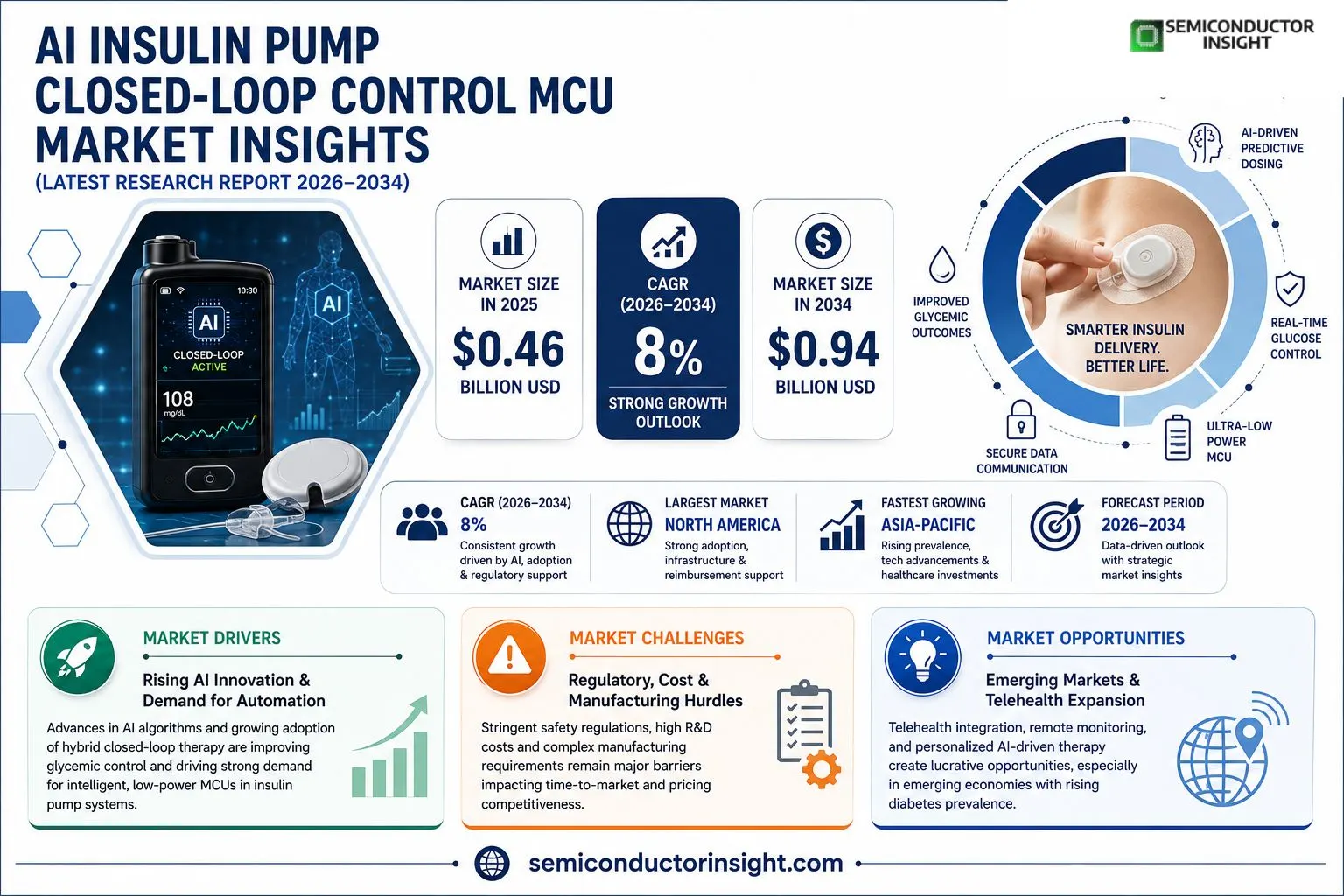
AI Insulin Pump Closed-Loop Control MCU market size was valued at USD 0.46 billion in 2025. The market is projected to grow from USD 0.46 billion in 2025 to USD 0.94 billion by 2034, exhibiting a CAGR of 8% during the forecast period.
AI Insulin Pump Closed-Loop Control MCUs are microcontroller units engineered to process continuous glucose sensor data, execute predictive dosing algorithms, and manage communication links within fully automated artificial pancreas systems. These MCUs combine low‑power semiconductor design with safety‑critical firmware to enable real‑time insulin delivery without manual intervention.The market is experiencing rapid growth because of expanding adoption of hybrid closed‑loop therapy worldwide and the rising prevalence of diabetes across all age groups. Furthermore, advances in ultra‑low‑power chip technology and increasing regulatory clearances for next‑generation automated insulin delivery devices are accelerating demand. Strategic collaborationssuch as the March 2024 partnership between a leading semiconductor firm and a major diabetes device manufacturerto co‑develop purpose‑built MCUs further fuel expansion. Key players including Medtronic plc, Tandem Diabetes Care, Roche Diabetes Care, Texas Instruments and STMicroelectronics are actively broadening their product portfolios.
MARKET DRIVERS
Advancements in AI Algorithms for Glucose Regulation
AI Insulin Pump Closed-Loop Control MCU Market is benefitting from rapid improvements in machine‑learning models that predict glucose trends with minute‑level precision. These algorithms enable tighter glycemic control, reducing the risk of hypo‑ and hyperglycemia for patients with type 1 and type 2 diabetes. Manufacturers are embedding these models directly into MCU chips, which shortens response time and improves reliability.
Increasing Demand for Automated Diabetes Management
Healthcare providers and insurers are endorsing automated insulin delivery systems as a cost‑effective way to lower long‑term diabetes complications. The shift toward value‑based care drives hospitals to adopt smart pumps that continuously calibrate insulin doses, creating a robust pipeline of orders for MCU suppliers.
➤ “Smart MCUs that combine AI with closed‑loop control are set to become the standard of care for diabetes management within the next five years.”
Ultimately, the convergence of sophisticated AI, supportive reimbursement policies, and heightened patient awareness is propelling growth throughout AI Insulin Pump Closed-Loop Control MCU Market.
MARKET CHALLENGES
Regulatory and Safety Concerns
Gaining clearance from agencies such as the FDA and EMA demands extensive clinical validation, which can extend product launch timelines by several years. Safety standards require redundant hardware and robust fail‑safe firmware, increasing development complexity for MCU vendors.
Other Challenges
Manufacturing Scalability
Scaling production of high‑precision MCUs while maintaining low defect rates remains difficult. Specialized semiconductor processes and strict quality controls raise per‑unit costs, limiting price competitiveness in emerging markets.
MARKET RESTRAINTS
High Development Costs
Designing AI‑enabled MCUs for closed‑loop insulin pumps requires multidisciplinary expertise in biomedical engineering, embedded systems, and data science. The capital outlay for R&D, clinical testing, and regulatory filing can exceed $50 million for a single platform, deterring entry of smaller firms.In addition, limited reimbursement structures in several regions mean that hospitals may prioritize lower‑cost solutions, restraining market penetration of premium AI MCU offerings.
MARKET OPPORTUNITIES
Emerging Markets and Telehealth Integration
Rapid broadband expansion and the rise of remote patient monitoring create new avenues for AI‑driven insulin pumps. MCUs that support over‑the‑air updates and secure data exchange can be leveraged by telehealth platforms, opening sizable revenue streams in Asia‑Pacific and Latin America.Furthermore, personalized therapy algorithms that adapt to individual lifestyle patterns are gaining interest. Companies that can embed such adaptive AI within their MCUs will differentiate themselves, capturing a larger share of the evolving AI Insulin Pump Closed-Loop Control MCU Market.
AI Insulin Pump Closed-Loop Control MCU Market Trends
Accelerating Adoption of Hybrid Closed‑Loop Therapy
AI Insulin Pump Closed-Loop Control MCU Market is witnessing rapid expansion as hybrid closed‑loop systems become standard of care for type 1 diabetes worldwide. In 2025 the market was valued at approximately USD 0.46 billion, and projections indicate a rise to about USD 0.94 billion by 2034. This growth is anchored in the increasing prevalence of diabetes across age groups, heightened physician confidence in automated insulin delivery, and measurable improvements in glycaemic outcomes reported in clinical studies. Manufacturers are leveraging low‑power semiconductor designs and safety‑critical firmware to meet the stringent reliability requirements of artificial pancreas platforms, thereby reinforcing market momentum.
Other Trends
Advances in Ultra‑Low‑Power Chip Design
Recent silicon‑on‑insulator (SOI) and fin‑FET innovations have reduced MCU power consumption to well below 1 mW while preserving processing speed for predictive dosing algorithms. These efficiencies extend battery life of wearable pumps, enable thinner device form factors, and support continuous operation without frequent rechargingkey criteria for patient adherence. The shift toward sub‑threshold operation also simplifies thermal management, a critical factor for implantable or long‑term wearable solutions.
Strategic Partnerships and Regulatory Momentum
Strategic collaborations are accelerating product introductions. A notable partnership formed in March 2024 between a leading semiconductor supplier and a major diabetes device manufacturer exemplifies how joint R&D reduces time‑to‑market for purpose‑built MCUs. Concurrently, regulatory agencies have granted clearances for several next‑generation closed‑loop devices, signalling confidence in the safety architecture of these microcontrollers. Key players such as Medtronic plc, Tandem Diabetes Care, Roche Diabetes Care, Texas Instruments and STMicroelectronics are expanding their portfolios to include integrated sensor‑fusion modules and secure communication interfaces, reinforcing the ecosystem around AI Insulin Pump Closed-Loop Control MCU Market.
COMPETITIVE LANDSCAPE
Key Industry Players
AI Insulin Pump Closed‑Loop Control MCU Market – Competitive Overview
The AI Insulin Pump Closed‑Loop Control MCU market is currently anchored by a handful of large medical‑device and semiconductor firms that possess deep regulatory experience and extensive diabetes‑care portfolios. Medtronic plc leads the segment with its integrated MiniMed® ecosystem, leveraging custom low‑power MCUs to deliver fully automated insulin dosing. Tandem Diabetes Care follows closely, having partnered with a major semiconductor supplier to embed purpose‑built MCUs in its t:slim X2 pump. Roche Diabetes Care and Abbott Laboratories also command significant market share, each embedding proprietary microcontrollers within hybrid closed‑loop platforms that blend sensor data with predictive algorithms. Texas Instruments and STMicroelectronics provide the core ultra‑low‑power silicon that underpins many of these solutions, benefiting from long‑term automotive‑grade reliability qualifications. The overall structure resembles an oligopoly where system integrators rely on a small pool of specialised ASIC and MCU providers to meet stringent safety and power‑efficiency requirements.Beyond the dominant players, a diverse set of niche innovators enriches the competitive landscape. Insulet Corp, known for its Omnipod® system, is expanding its MCU stack through collaborations with NXP Semiconductors to achieve sub‑microwatt consumption. Dexcom, while primarily a CGM manufacturer, is co‑developing sensor‑fusion firmware with Analog Devices to enhance closed‑loop responsiveness. Infineon Technologies and Broadcom are entering the space via strategic investments in AI‑accelerated MCUs for next‑generation artificial pancreas devices. Smaller but technically agile firms such as Samsung Electronics’ semiconductor division and Sony Semiconductor Solutions contribute advanced AI inference cores that enable real‑time dosing adjustments. These specialized contributors collectively raise the bar for algorithmic sophistication and power efficiency across the market.
List of Key AI Insulin Pump Closed‑Loop Control MCU Companies Profiled
- Medtronic plc
- Tandem Diabetes Care
- Roche Diabetes Care
- Texas Instruments
- STMicroelectronics
- Insulet Corp
- Dexcom
- Abbott Laboratories
- NXP Semiconductors
- Analog Devices
- Infineon Technologies
- Broadcom
- Samsung Electronics
- Sony Semiconductor Solutions
Segment Analysis:
| Segment Category | Sub-Segments | Key Insights |
| By Type |
|
Hybrid Closed-Loop MCU
These attributes make the hybrid approach the preferred entry point for manufacturers transitioning from manual to intelligent insulin delivery systems, fostering broader clinical acceptance. |
| By Application |
|
Adult Diabetes Management
This segment drives the majority of market momentum as manufacturers design MCUs that harmonise clinical efficacy with real‑world usability for the adult population. |
| By End User |
|
Endocrinologists & Diabetes Clinics
These professional users shape product specifications, pushing suppliers toward higher data fidelity and interoperable software ecosystems. |
| By Regulatory Landscape |
|
FDA Premarket Approval Pathway
Compliance with this pathway often sets a benchmark that other regions reference, shaping product roadmaps. |
| By Emerging Technologies |
|
Edge‑AI Model Optimization
The incorporation of these technologies signals a shift toward more autonomous and patient‑centric insulin delivery solutions, driving the next wave of innovation in the market. |
Regional Analysis: Europe
Europe
The European Medicines Agency (EMA) has released guidance that streamlines approval pathways for AI‑driven MCUs, emphasizing clinical validation and post‑market surveillance. This proactive stance reduces time‑to‑market while maintaining safety, encouraging manufacturers to launch sophisticated closed‑loop pumps across EU member states.
Companies such as Medtronic, Insulet, and local innovators like EmmaTech are investing heavily in AI MCU development. Their partnerships with European research institutes accelerate algorithm refinement and foster localized production capabilities, reinforcing market leadership.
High prevalence of type 1 diabetes, supportive reimbursement policies, and growing patient awareness of closed‑loop benefits drive demand. Healthcare providers are increasingly adopting AI‑enabled pumps to improve glycemic control and reduce long‑term complications.
Despite progress, challenges remain around data interoperability across national health systems and the need for continuous AI algorithm validation to meet diverse clinical practices across European markets.
North America
North America remains a significant market for AI Insulin Pump Closed-Loop Control MCU technology, propelled by robust venture capital investment and an aggressive push toward digital health transformation. The United States, in particular, benefits from the FDA’s flexible regulatory pathways that accommodate adaptive AI algorithms, encouraging rapid product iteration. Payers increasingly recognize the long‑term cost savings associated with tighter glucose management, leading to broader coverage for closed‑loop systems. Canadian healthcare entities, while more cautious, are adopting pilot programs that demonstrate the clinical efficacy of AI‑driven MCUs, setting the stage for wider acceptance. Collaborative ecosystems among tech firms, hospitals, and academia further accelerate innovation, positioning North America as a parallel hub of growth alongside Europe.
Asia‑Pacific
Asia‑Pacific exhibits fast‑rising interest in AI Insulin Pump Closed-Loop Control MCU solutions, driven by large diabetic populations in countries such as China, India, and Japan. Emerging regulatory frameworks are beginning to recognize the safety benefits of AI‑enhanced pumps, while governments launch public‑health initiatives to improve diabetes outcomes. Local manufacturers are entering the market, often partnering with leaders to incorporate advanced MCU capabilities. However, varied reimbursement structures and differing levels of digital health readiness create a fragmented adoption landscape that requires tailored market entry strategies.
South America
In South America, market momentum for AI Insulin Pump Closed-Loop Control MCU technology is moderate but growing, especially in Brazil and Argentina where diabetes prevalence is high. Healthcare systems are gradually incorporating tele‑medicine and remote monitoring, creating pathways for closed‑loop pump deployment. Limited regulatory clarity and constrained reimbursement budgets pose hurdles, yet public‑private partnerships are exploring cost‑effective models to introduce AI‑enabled insulin management to broader patient cohorts.
Middle East & Africa
The Middle East & Africa region shows nascent yet promising interest in AI Insulin Pump Closed-Loop Control MCU offerings. Wealthier Gulf Cooperation Council (GCC) nations are investing in advanced diabetes care infrastructure, while South Africa leads in pilot programs that test AI‑driven MCUs in public hospitals. Challenges include uneven healthcare funding, limited awareness of closed‑loop benefits, and the need for harmonized regulatory guidelines. Nonetheless, increasing digital health adoption suggests a gradual expansion of market opportunities over the coming years.
Report Scope
This market research report provides a comprehensive analysis of the AI Insulin Pump Closed-Loop Control MCU Market , covering the forecast period 2026–2034. It offers detailed insights into market dynamics, technological advancements, competitive landscape, and key trends shaping the industry.
Key focus areas of the report include:
- Market Overview: The report begins with an overview outlining its current market scenario, key growth indicators, and industry transformation drivers. It discusses macroeconomic factors, demand–supply balance, regulatory landscape, and the strategic role of semiconductors in powering advancements across industries such as automotive, telecommunications, consumer electronics, and industrial automation.
- Market Size & Forecast: Historical data and future projections for revenue, unit shipments, and market value across major regions and segments.
- Segmentation Analysis: Detailed breakdown by product type, technology, application, and end-user industry to identify high-growth segments and investment opportunities.
- Regional Insights: Insights into market performance across North America, Europe, Asia-Pacific, Latin America, and the Middle East & Africa, including country-level analysis where relevant.
- Competitive Landscape: Profiles of leading market participants, including their product offerings, R&D focus, manufacturing capacity, pricing strategies, and recent developments such as mergers, acquisitions, and partnerships.
- Technology Trends & Innovation: Assessment of emerging technologies, integration of AI/IoT, semiconductor design trends, fabrication techniques, and evolving industry standards.
- Market Drivers & Restraints: Evaluation of factors driving market growth along with challenges, supply chain constraints, regulatory issues, and market-entry barriers.
- Stakeholder Insights: Insights for component suppliers, OEMs, system integrators, investors, and policymakers regarding the evolving ecosystem and strategic opportunities.
Primary and secondary research methods are employed, including interviews with industry experts, data from verified sources, and real‑time market intelligence to ensure the accuracy and reliability of the insights presented.
FREQUENTLY ASKED QUESTIONS:
What is the current market size of AI Insulin Pump Closed-Loop Control MCU Market?
-> AI Insulin Pump Closed-Loop Control MCU Market was valued at USD 0.46 billion in 2025 and is expected to reach USD 0.94 billion by 2034, exhibiting a CAGR of 8% during the forecast period.
Which key companies operate in AI Insulin Pump Closed-Loop Control MCU Market?
-> Key players include Medtronic plc, Tandem Diabetes Care, Roche Diabetes Care, Texas Instruments, and STMicroelectronics, among others.
What are the key growth drivers?
-> Key growth drivers include expanding adoption of hybrid closed‑loop therapy, rising prevalence of diabetes, advances in ultra‑low‑power chip technology, increasing regulatory clearances, and strategic collaborations.
Which region dominates the market?
-> North America is the dominant region, while Asia‑Pacific is the fastest‑growing market.
What are the emerging trends?
-> Emerging trends include integration of AI/IoT for predictive dosing, miniaturization of MCUs, development of next‑generation safety‑critical firmware, and expansion of cloud‑connected diabetes management platforms.
Get Sample Report PDF for Exclusive Insights
Report Sample Includes
- Table of Contents
- List of Tables & Figures
- Charts, Research Methodology, and more...
 Download Sample Report PDF