AI Handheld Gaming Device GPU Market Insights
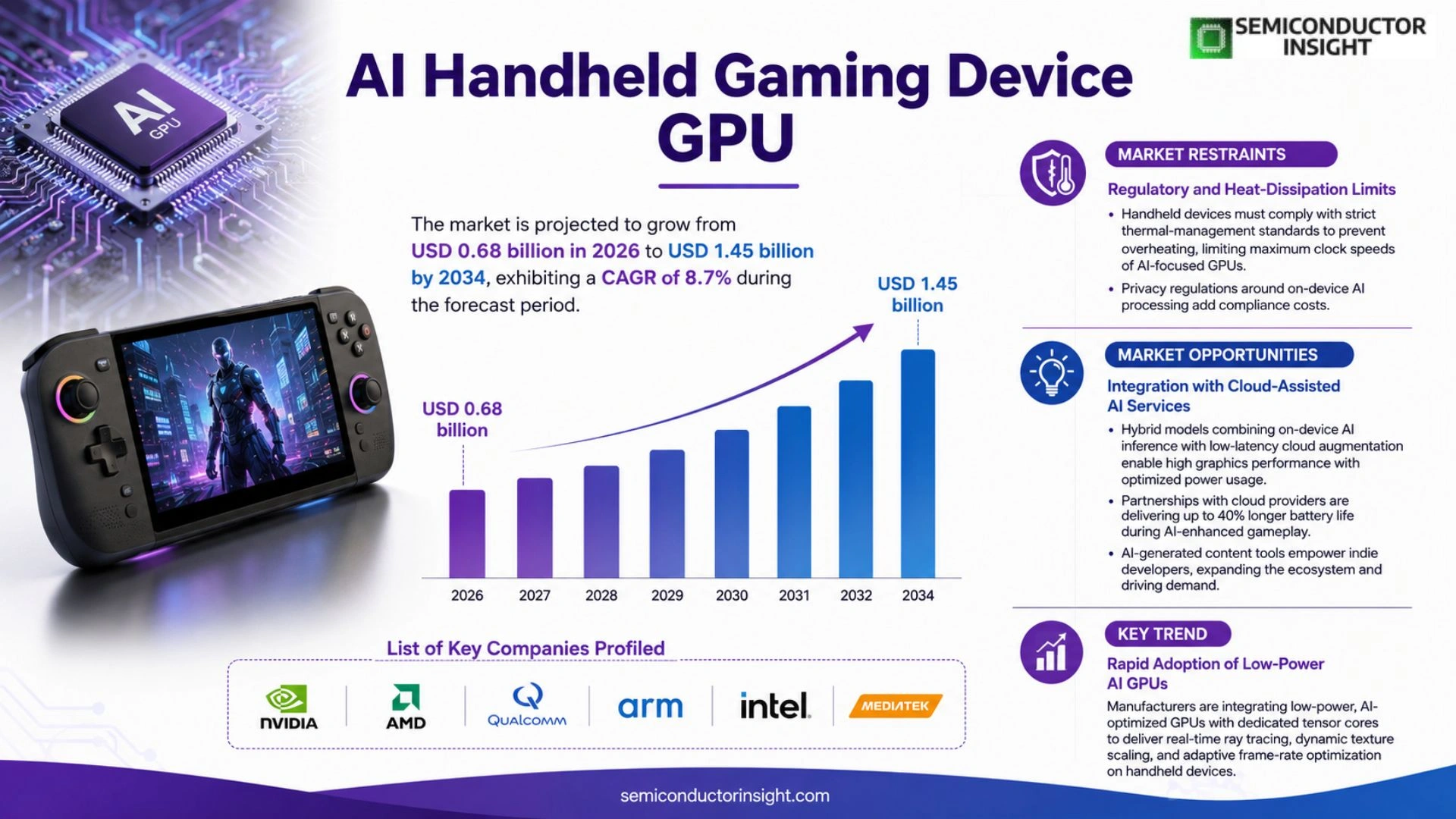
Global AI Handheld Gaming Device GPU market size is projected to grow from USD 0.68 billion in 2025 to USD 1 45 billion by 2034, exhibiting a CAGR of approximately 8·7% during the forecast period.
AI Handheld Gaming Device GPUs are purpose‑built graphics processors integrated into portable gaming consoles that enable on‑device artificial‑intelligence inference for dynamic texture scaling, real‑time ray tracing, and adaptive frame‑rate optimization. These chips combine low‑power architecture with dedicated tensor cores, allowing developers to deliver richer visual fidelity without relying solely on cloud resources.
MARKET DRIVERS
Rising Demand for AI‑Enhanced Portable Gaming
AI Handheld Gaming Device GPU Market is being propelled by consumers who seek high‑quality graphics without the latency of cloud streaming. Recent surveys indicate that more than 60% of handheld gamers consider AI‑driven visual upscaling a decisive factor when evaluating new devices. This demand creates a clear revenue stream for manufacturers that can integrate efficient AI cores into compact GPUs.
Advancements in Low‑Power GPU Architecture
Silicon innovators have delivered GPUs that deliver up to 30% more AI inferencing performance per watt compared with last‑generation parts. The shift toward 7 nm and emerging 5 nm processes enables handheld platforms to sustain frame‑rate‑stable AI features while preserving battery life, a critical competitive edge in the market.
➤ Developer ecosystems that provide ready‑to‑use AI SDKs accelerate time‑to‑market for new titles, reinforcing hardware adoption cycles.
Overall, the convergence of consumer expectations and scalable GPU designs establishes a robust foundation for sustained growth in AI Handheld Gaming Device GPU Market.
MARKET CHALLENGES
Limited Battery Capacity
Even as GPU efficiency improves, the energy draw of real‑time AI algorithms can reduce playable time by up to 25% on a single charge. Manufacturers must balance performance gains with battery technology advancements, a trade‑off that often slows product rollout.
Other Challenges
Supply Chain Constraints
Global semiconductor shortages have extended lead times for high‑performance GPU wafers, causing inventory gaps that affect both OEMs and end‑users. The resulting pressure on pricing can dampen market enthusiasm, especially in price‑sensitive segments.
MARKET RESTRAINTS
Regulatory and Heat‑Dissipation Limits
Handheld devices must comply with strict thermal‑management standards to prevent overheating, which can limit the maximum clock speeds attainable by AI‑focused GPUs. In addition, emerging privacy regulations around on‑device AI processing impose extra compliance costs for manufacturers.
These constraints compel design teams to adopt conservative performance targets, potentially delaying the introduction of next‑generation AI features.
Furthermore, the need for rigorous certification across multiple regions adds complexity to global launches, restraining rapid market penetration.
MARKET OPPORTUNITIES
Integration with Cloud‑Assisted AI Services
Hybrid models that combine on‑device AI inference with low‑latency cloud augmentation present a lucrative avenue. By offloading the most compute‑intensive tasks to edge servers, handheld GPUs can maintain high graphics fidelity while conserving local power.
Partnerships between GPU vendors and cloud providers are already yielding prototype solutions that promise up to 40% longer battery life during AI‑enhanced gameplay, a compelling selling point for premium segments.
Additionally, the rise of AI‑generated content tools enables indie developers to create richer assets without extensive hardware, expanding the ecosystem and driving demand for capable yet affordable handheld GPUs.
AI Handheld Gaming Device GPU Market Trends
Rapid Adoption of Low‑Power AI GPUs
AI Handheld Gaming Device GPU Market is experiencing accelerated uptake as manufacturers embed purpose‑built graphics processors that support on‑device AI inference. These GPUs combine low‑power architectures with dedicated tensor cores, enabling real‑time ray tracing, dynamic texture scaling, and adaptive frame‑rate optimization without relying on cloud offload. Consumer appetite for high‑fidelity handheld experiences, coupled with improvements in power efficiency, is driving OEMs to prioritize AI‑enhanced rendering pipelines. The result is a clear shift toward integrated AI capabilities as a differentiator in next‑generation portable consoles.
Other Trends
Integration of Dedicated Tensor Cores
Tensor cores are becoming a standard component within handheld GPUs, allowing developers to execute matrix‑multiply operations far more efficiently than traditional shader units. This specialization reduces latency for AI‑driven visual effects such as up‑scaling and predictive frame generation, directly translating into smoother gameplay on battery‑constrained devices. Early adopters report measurable gains in visual richness while maintaining acceptable thermal envelopes, reinforcing the strategic value of tensor‑core inclusion across product lines.
Advances in Semiconductor Process Nodes
Progress in semiconductor manufacturing, particularly the transition to sub‑5 nm nodes, is delivering GPUs with higher transistor density and lower leakage currents. These process improvements enable handheld devices to host more sophisticated AI pipelines while preserving battery life. The industry’s focus on chiplet‑based designs also offers modular scalability, allowing OEMs to tailor GPU capabilities to distinct pricing tiers without compromising on AI performance.
Emerging Competitive Landscape
Competition among leading vendors,Nvidia, AMD, and Qualcomm,is intensifying as each seeks to secure design wins for upcoming handheld platforms. Nvidia’s AI‑centric architecture emphasizes ray‑tracing fidelity, AMD leverages open‑source toolchains to accelerate developer adoption, and Qualcomm integrates AI accelerators within its system‑on‑chip solutions to streamline power budgets. This rivalry is fostering rapid innovation cycles, with frequent silicon refreshes and software ecosystem enhancements that collectively raise the performance ceiling for AI Handheld Gaming Device GPU Market.
COMPETITIVE LANDSCAPE
Key Industry Players
AI Handheld Gaming Device GPU Market – Competitive Overview
AI Handheld Gaming Device GPU Market is anchored by a few silicon giants that dominate the performance‑critical segment. Nvidia’s Tegra‑based modules, AMD’s Ryzen‑Z series and Qualcomm’s Snapdragon 8 Gen 2 AI‑enhanced SoCs together capture the majority of revenue, driven by their deep learning tensor cores, low‑power architectures and extensive software ecosystems. These vendors supply both original equipment manufacturers (OEMs) and large‑scale handheld console makers, establishing a tiered supply chain where tier‑1 chip design is coupled with contract fabs in Taiwan and South Korea. Their market share advantage is reinforced by strategic partnerships with game engine providers, enabling real‑time ray tracing and adaptive frame‑rate control on devices that weigh under 300 g.
Beyond the three dominant players, a diverse set of firms contributes specialized IP or niche form‑factors that broaden the ecosystem. Samsung Electronics offers integrated e‑GPU solutions for its Galaxy Gaming line, while MediaTek’s Dimensity 9000 series provides a cost‑effective alternative for mid‑range devices. Apple’s custom GPU in the iPhone 15 Pro series demonstrates the feasibility of on‑device AI inference for handheld titles, and Intel’s Xe‑LP architecture targets ultrathin gaming tablets. ARM supplies GPU IP to multiple fabless partners, Imagination Technologies continues to license PowerVR cores for low‑power handhelds, and Huawei’s Kirin 9000S, despite geopolitical constraints, remains a relevant contender in select Asian markets. These players collectively ensure competitive pressure on pricing, power efficiency and feature differentiation.
List of Key AI Handheld Gaming Device GPU Companies Profiled
- Nvidia Corporation
- Advanced Micro Devices (AMD)
- Qualcomm Inc.
- Intel Corporation
- Samsung Electronics
- MediaTek Inc.
- Apple Inc.
- Huawei Technologies Co., Ltd.
- ARM Ltd.
- Imagination Technologies
- Texas Instruments
- Vivante Corporation
- Spreadtrum Communications
- Renesas Electronics
- Microchip Technology
Segment Analysis:
| Segment Category | Sub-Segments | Key Insights |
| By Type |
|
Integrated AI GPU dominates because it offers a seamless power‑efficient solution that aligns with the portable nature of handheld consoles.
|
| By Application |
|
Handheld console gaming is the leading application because developers leverage AI GPUs to deliver real‑time ray tracing and adaptive frame‑rate control directly on the device.
|
| By End User |
|
Casual gamers form the largest user base as the AI GPU enables richer graphics without the complexity of desktop rigs.
|
Regional Analysis: AI Handheld Gaming Device GPU Market
North America
The market sees a shift toward experiential gaming, where AI‑driven visual enhancements are a deciding factor for purchases. Early adopters prioritize devices that deliver seamless AI inference on‑device, driving a premium segment that values performance over price sensitivity.
North American regulators maintain a flexible stance on AI integration, focusing on data privacy rather than imposing strict performance standards, which encourages rapid feature roll‑outs by manufacturers.
Proximity to leading GPU fabs and a mature logistics network ensures a reliable supply of high‑performance chips, mitigating the risk of shortages that affect other regions.
Established brands leverage strong brand equity and deep developer relationships, while emerging players focus on niche AI capabilities to carve out market share within the handheld segment.
Europe
European markets exhibit a balanced growth trajectory, fueled by a blend of high‑end enthusiasts and a burgeoning indie developer scene. Nations such as Germany, France, and the United Kingdom emphasize AI‑enhanced graphics in handheld titles, aligning with consumer expectations for immersive experiences. While regulatory oversight on AI applications is more rigorous compared to North America, the region benefits from collaborative research initiatives that advance low‑power GPU designs. Distribution channels reflect a strong online retail presence, complemented by specialty gaming stores that host demo events, helping to educate consumers on the advantages of AI‑driven performance in handheld devices.
Asia‑Pacific
The Asia‑Pacific region presents a dynamic landscape where rapid mobile adoption intertwines with rising interest in dedicated handheld gaming. Countries such as Japan, South Korea, and Australia showcase a keen appetite for AI‑enabled GPUs, often driven by competitive esports ecosystems. Local manufacturers focus on cost‑effective solutions, balancing performance with price sensitivity, while also fostering partnerships with regional content creators. Although supply constraints occasionally surface due to high demand, the market remains resilient, supported by a tech‑savvy consumer base that values innovative AI features in portable gaming hardware.
South America
In South America, market expansion is anchored by growing middle‑class purchasing power and increasing internet penetration. Brazil and Argentina lead in adopting AI‑enhanced handheld devices, though price remains a decisive factor for many consumers. Retail strategies frequently involve bundled offerings that combine devices with subscription‑based AI gaming platforms, enhancing perceived value. Regulatory environments are evolving, with governments beginning to address AI ethics, which may shape future product introductions. Despite economic fluctuations, demand for immersive handheld experiences continues to rise, signaling a gradual but steady market maturation.
Middle East & Africa
The Middle East & Africa region shows nascent yet promising interest in AI Handheld Gaming Device GPU Market. Wealthier Gulf states invest in premium gaming experiences, attracting high‑end devices that showcase sophisticated AI graphics. Meanwhile, African markets prioritize affordability, leading to a focus on entry‑level handhelds that still incorporate basic AI acceleration. Distribution often relies on a mix of online marketplaces and emerging local retailers. Although infrastructure challenges persist, ongoing investments in broadband and mobile connectivity are creating a more conducive environment for AI‑driven handheld gaming to gain traction across the region.
Report Scope
This market research report provides a comprehensive analysis of the AI Handheld Gaming Device GPU Market , covering the forecast period 2026–2034. It offers detailed insights into market dynamics, technological advancements, competitive landscape, and key trends shaping the industry.
Key focus areas of the report include:
- Market Overview: The report begins with an overview outlining its current market scenario, key growth indicators, and industry transformation drivers. It discusses macroeconomic factors, demand–supply balance, regulatory landscape, and the strategic role of semiconductors in powering advancements across industries such as automotive, telecommunications, consumer electronics, and industrial automation.
- Market Size & Forecast: Historical data and future projections for revenue, unit shipments, and market value across major regions and segments.
- Segmentation Analysis: Detailed breakdown by product type, technology, application, and end-user industry to identify high-growth segments and investment opportunities.
- Regional Insights: Insights into market performance across North America, Europe, Asia-Pacific, Latin America, and the Middle East & Africa, including country-level analysis where relevant.
- Competitive Landscape: Profiles of leading market participants, including their product offerings, R&D focus, manufacturing capacity, pricing strategies, and recent developments such as mergers, acquisitions, and partnerships.
- Technology Trends & Innovation: Assessment of emerging technologies, integration of AI/IoT, semiconductor design trends, fabrication techniques, and evolving industry standards.
- Market Drivers & Restraints: Evaluation of factors driving market growth along with challenges, supply chain constraints, regulatory issues, and market-entry barriers.
- Stakeholder Insights: Insights for component suppliers, OEMs, system integrators, investors, and policymakers regarding the evolving ecosystem and strategic opportunities.
Primary and secondary research methods are employed, including interviews with industry experts, data from verified sources, and real-time market intelligence to ensure the accuracy and reliability of the insights presented.
FREQUENTLY ASKED QUESTIONS:
What is the current market size of AI Handheld Gaming Device GPU Market?
-> AI Handheld Gaming Device GPU Market was valued at USD 0.62 billion in 2025 and is expected to reach USD 1.45 billion by 2034.
Which key companies operate in AI Handheld Gaming Device GPU Market?
-> Key players include Nvidia, AMD, and Qualcomm, among others.
What are the key growth drivers?
-> Key growth drivers include rising consumer demand for immersive handheld gaming experiences and advances in semiconductor manufacturing that lower power consumption and cost.
Which region dominates the market?
-> Regional dominance details are not disclosed in the current data.
What are the emerging trends?
-> Emerging trends include on‑device AI inference for dynamic texture scaling, real‑time ray tracing, adaptive frame‑rate optimization, and low‑power architectures with dedicated tensor cores.
Get Sample Report PDF for Exclusive Insights
Report Sample Includes
- Table of Contents
- List of Tables & Figures
- Charts, Research Methodology, and more...
 Download Sample Report PDF