AI for Process-Voltage-Temperature Variation Modeling Market Insights
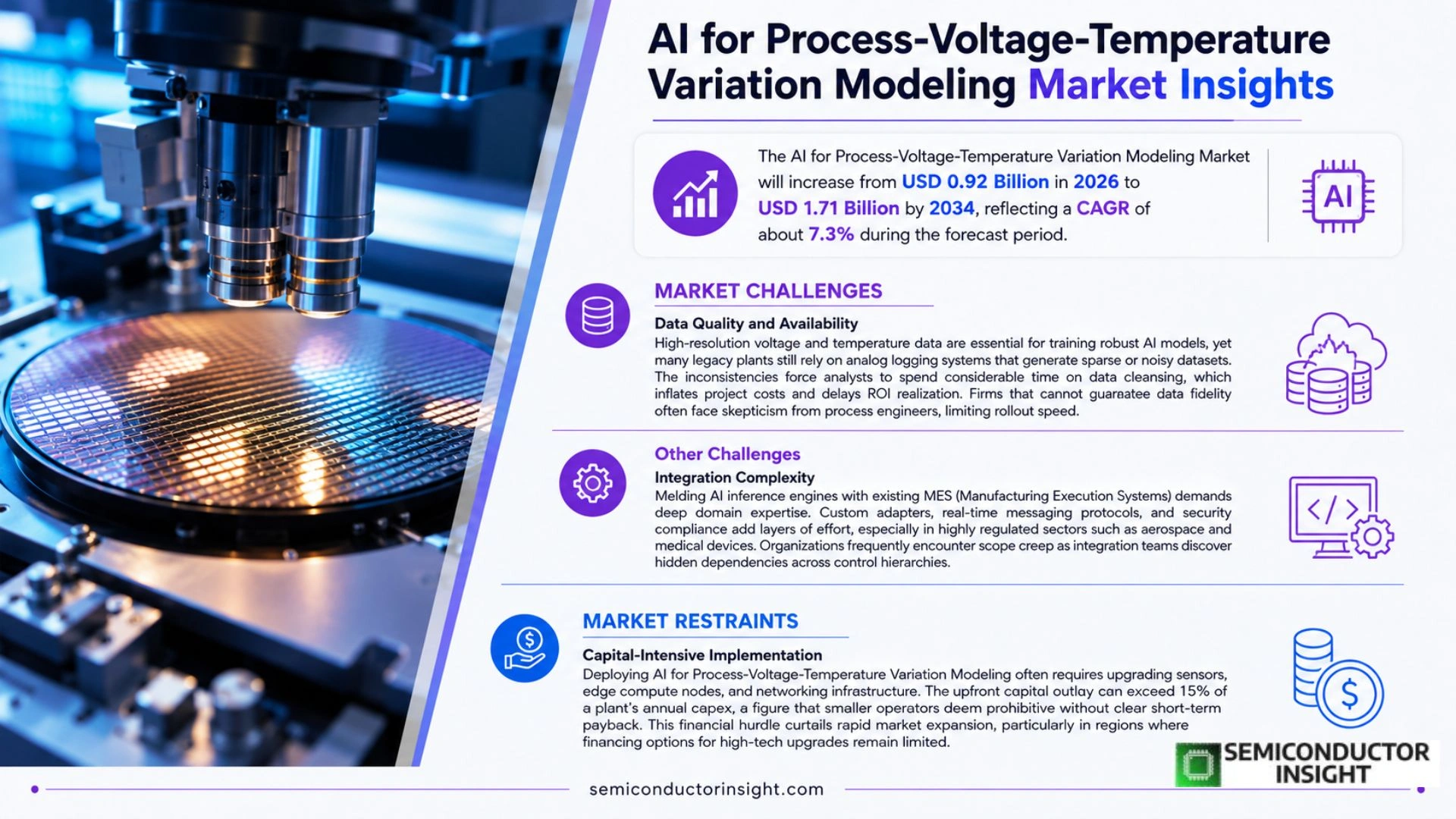
Global AI for Process‑Voltage‑Temperature variation modeling market size was USD 0.85 billion in 2025. It will increase from USD 0.92 billion in 2026 to USD 1.71 billion by 2034, reflecting a CAGR of about 7.3 % during the forecast period.
AI for Process‑Voltage‑Temperature variation modeling applies machine‑learning algorithms to predict semiconductor device behavior under fluctuating process parameters, supply voltage swings, and temperature changes. By integrating statistical process control data with physics‑based models, these solutions enable designers to anticipate performance shifts early in the development cycle.
The expansion of this niche stems from rising complexity of advanced nodes, where tighter design margins demand accurate PVT forecasts; moreover, increased adoption of edge computing chips intensifies the need for reliable variability analysis. Foundries are investing in AI‑enhanced simulation tools because traditional Monte Carlo methods become prohibitively time‑consuming at sub‑5nm geometries.
MARKET DRIVERS
Rising Demand for Real‑time Process Control
Manufacturers of semiconductor and advanced material devices are intensifying efforts to monitor voltage and temperature fluctuations as production lines become increasingly miniaturized. The ability to predict process variance in seconds rather than hours creates a decisive competitive edge, prompting fabs to allocate up to 12% of their digital‑transformation budgets toward AI‑enhanced modeling platforms. The AI for Process-Voltage-Temperature Variation Modeling Market therefore benefits from a clear upside tied to yield‑improvement initiatives.
Advances in Edge‑AI Chipsets
Recent breakthroughs in low‑power, high‑throughput AI accelerators enable sophisticated predictive algorithms to run directly on production equipment. This shift reduces data‑latency and eliminates costly cloud‑round‑trips, making it feasible for midsize fabs to adopt advanced variation models. Companies that embed these chipsets report a 30‑40% reduction in cycle‑time for critical process adjustments, reinforcing the value proposition of AI‑driven variation modeling.
➤ “Integrating AI models cut simulation time by roughly 40%, allowing operators to act on process drift before it impacts yield.”
Strategic partnerships between AI software vendors and equipment OEMs are accelerating market penetration. Joint go‑to‑market programs bundle sensor upgrades with pre‑trained models, lowering entry barriers for end users. As a result, the AI for Process-Voltage-Temperature Variation Modeling Market is witnessing a broader adoption curve that now includes Tier‑2 manufacturers seeking to close the performance gap with industry leaders.
MARKET CHALLENGES
Data Quality and Availability
High‑resolution voltage and temperature data are essential for training robust AI models, yet many legacy plants still rely on analog logging systems that generate sparse or noisy datasets. The inconsistencies force analysts to spend considerable time on data cleansing, which inflates project costs and delays ROI realization. Firms that cannot guarantee data fidelity often face skepticism from process engineers, limiting rollout speed.
Other Challenges
Integration Complexity
Melding AI inference engines with existing MES (Manufacturing Execution Systems) demands deep domain expertise. Custom adapters, real‑time messaging protocols, and security compliance add layers of effort, especially in highly regulated sectors such as aerospace and medical devices. Organizations frequently encounter scope creep as integration teams discover hidden dependencies across control hierarchies.
MARKET RESTRAINTS
Capital‑Intensive Implementation
Deploying AI for Process‑Voltage‑Temperature Variation Modeling often requires upgrading sensors, edge compute nodes, and networking infrastructure. The upfront capital outlay can exceed 15% of a plant’s annual capex, a figure that smaller operators deem prohibitive without clear short‑term payback. This financial hurdle curtails rapid market expansion, particularly in regions where financing options for high‑tech upgrades remain limited.
MARKET OPPORTUNITIES
AI‑Enabled Predictive Maintenance Services
Beyond immediate process control, AI models that anticipate voltage‑temperature anomalies can be packaged as subscription‑based predictive‑maintenance services. Such offerings transform a capital purchase into a recurring revenue stream, lowering the barrier for adoption while generating steady cash flow for providers. Early adopters report annual cost savings of 8‑10% on equipment downtime, an incentive strong enough to sway budget committees.
AI for Process-Voltage-Temperature Variation Modeling Market Trends
Advanced Node Complexity Fuels AI‑Driven PVT Modeling
The transition to sub‑5nm geometries has compressed design margins to a degree that traditional Monte Carlo simulations struggle to deliver timely outcomes. Engineers now require predictive accuracy that encompasses minute fluctuations in lithography, voltage regulation, and thermal environments. AI‑based models, by learning from historical statistical process control data and physics‑based equations, are increasingly seen as the only viable path to anticipate performance shifts early in the silicon lifecycle. This shift is reshaping supplier‑customer dialogues, with chip designers demanding turnkey AI solutions that can be embedded directly into existing EDA toolchains.
Other Trends
Edge Computing Chip Variability
Edge devices operate under wider temperature swings and power‑budget constraints than data‑center workloads, amplifying the relevance of precise PVT forecasts. Vendors targeting the burgeoning edge market are adopting AI‑enhanced variability analysis to guarantee that processors meet reliability targets without excessive over‑design. The result is a noticeable uptick in licensing agreements for AI modules that can run on modest compute resources, enabling on‑device validation of design tolerances.
Foundry Investment in AI‑Enhanced Simulation Platforms
Foundries are allocating a growing portion of R&D budgets toward AI‑augmented simulation environments. The rationale extends beyond speed; AI models can uncover non‑linear interactions among process steps that are invisible to conventional statistical methods. By integrating these insights, foundries shorten the iteration loop between design hand‑off and silicon tape‑out, which translates into faster time‑to‑market for their customers. Consequently, partnerships between AI start‑ups and major foundries are becoming a strategic priority, as each side leverages the other’s expertise to refine model fidelity.
COMPETITIVE LANDSCAPE
Key Industry Players
AI‑Enhanced PVT Variation Modeling Competition Intensifies
Synopsys dominates the AI‑augmented PVT modeling segment, leveraging its extensive design‑automation suite and a growing portfolio of machine‑learning add‑ons that embed statistical process data directly into device‑level simulations. The firm’s recent acquisition of a niche start‑up specializing in voltage‑fluctuation prediction has deepened its foothold among leading foundries, where the pressure to shrink node dimensions forces tighter tolerance budgets. Cadence Design Systems follows closely, differentiating itself through a cloud‑first approach that allows semiconductor designers to spin up large‑scale Monte Carlo replacements on demand, cutting turnaround times dramatically. Siemens EDA (formerly Mentor) occupies a complementary niche, pairing its long‑standing physical‑verification tools with AI kernels that learn from historic silicon outcomes, thereby providing a feedback loop that shortens design‑for‑manufacturability cycles. The competitive hierarchy reflects a clear split: large EDA vendors marshal capital to embed AI across the full design stack, while a handful of specialist firms concentrate on narrow, high‑value prediction algorithms.
Beyond the headline players, a diverse set of companies contributes critical capabilities that shape the market’s depth. ANSYS has introduced a physics‑based AI module that reconciles circuit‑level temperature gradients with process variation data, a feature prized by advanced‑node foundries such as TSMC and GlobalFoundries. Intel’s internal AI‑driven modelling team is rapidly commercialising tools that align with its own silicon roadmaps, creating a potential source of competition for traditional EDA houses. Samsung Semiconductor and ARM (now part of NVIDIA) each embed proprietary AI layers into their chipset design flows, targeting the burgeoning edge‑computing segment where voltage stability is non‑negotiable. Keysight Technologies, Bosch, Texas Instruments, Analog Devices, and NXP Semiconductors round out the ecosystem by offering application‑specific AI analytics that translate raw PVT forecasts into actionable design recommendations for automotive and IoT markets.
List of Key AI for Process-Voltage-Temperature Variation Modeling Companies Profiled
- Synopsys
- Cadence Design Systems
- Siemens EDA (Mentor)
- ANSYS
- TSMC
- GlobalFoundries
- Intel
- Samsung Semiconductor
- ARM (NVIDIA)
- Keysight Technologies
- Bosch
- Texas Instruments
- Analog Devices
- NXP Semiconductors
- Applied Materials
Segment Analysis:
| Segment Category | Sub-Segments | Key Insights |
| By Type |
|
Deep Learning Neural Networks
|
| By Application |
|
Yield Prediction and Enhancement
|
| By End User |
|
Chip Design Houses
|
| By Deployment Model |
|
Hybrid Architectures
|
| By Industry Vertical |
|
Advanced Node Foundry Services
|
Regional Analysis: AI for Process-Voltage-Temperature Variation Modeling Market
Federal agencies have issued guidance that clarifies liability for AI‑generated design insights, fostering greater confidence among design houses. State‑level incentives for clean‑energy chip production also nudge firms toward predictive models that reduce waste and improve thermal management, aligning compliance with cost efficiency.
Automotive power‑electronics, data‑center processors, and renewable‑energy converters are the primary adopters, each demanding tighter voltage‑tolerance specifications. AI‑enhanced modeling enables these sectors to iterate designs rapidly, responding to fast‑evolving performance targets without extensive prototype inventories.
Silicon Valley, Austin, and the Boston corridor host clusters where academic labs collaborate with venture‑backed firms. These ecosystems accelerate transfer of cutting‑edge machine‑learning techniques into practical design tools, generating a feedback loop that continually refines model accuracy.
Private equity and corporate R&D budgets are earmarked for AI‑driven simulation platforms. The capital influx supports both proprietary software development and open‑source initiatives, broadening access to high‑fidelity variation models across the supply chain.
Europe
European manufacturers are leveraging AI for variation modeling to satisfy stringent energy‑efficiency directives. Cross‑border collaborations under the EU’s Horizon framework have produced shared datasets that improve model robustness for wide‑temperature operation. While funding mechanisms favor sustainable semiconductor solutions, firms must navigate a fragmented standards landscape, prompting the emergence of niche consultancy services that harmonize AI outputs with regional compliance needs.
Asia‑Pacific
In Asia‑Pacific, rapid capacity expansion in foundries is prompting early adoption of AI‑enhanced modeling to manage yield under high‑volume production. Governments in China, South Korea, and Taiwan are investing heavily in AI research tied to semiconductor reliability, creating a pipeline of talent adept at marrying physical simulation with deep learning. The market, however, contends with varying levels of data maturity, leading larger players to form consortiums that pool process data for collective benefit.
South America
South American entrants are focusing on cost‑effective AI tools to compensate for limited access to expensive test infrastructure. Partnerships with North American vendors enable technology transfer, while regional accelerators fund startups that tailor generic models to local manufacturing constraints. The emphasis on affordable solutions is reshaping the value chain, encouraging a service‑oriented approach where modeling expertise is outsourced.
Middle East & Africa
The Middle East & Africa region is at an early stage of integrating AI into voltage‑temperature variation workflows. Emerging smart‑grid projects and defense applications drive interest in reliable semiconductor design, yet the scarcity of comprehensive process data slows widespread deployment. International collaborations and training programs are beginning to seed expertise, suggesting a gradual buildup of capabilities over the next decade.
Report Scope
This market research report provides a comprehensive analysis of the AI for Process-Voltage-Temperature Variation Modeling Market , covering the forecast period 2026–2034. It offers detailed insights into market dynamics, technological advancements, competitive landscape, and key trends shaping the industry.
Key focus areas of the report include:
- Market Overview: The report begins with an overview outlining its current market scenario, key growth indicators, and industry transformation drivers. It discusses macroeconomic factors, demand–supply balance, regulatory landscape, and the strategic role of semiconductors in powering advancements across industries such as automotive, telecommunications, consumer electronics, and industrial automation.
- Market Size & Forecast: Historical data and future projections for revenue, unit shipments, and market value across major regions and segments.
- Segmentation Analysis: Detailed breakdown by product type, technology, application, and end-user industry to identify high-growth segments and investment opportunities.
- Regional Insights: Insights into market performance across North America, Europe, Asia-Pacific, Latin America, and the Middle East & Africa, including country-level analysis where relevant.
- Competitive Landscape: Profiles of leading market participants, including their product offerings, R&D focus, manufacturing capacity, pricing strategies, and recent developments such as mergers, acquisitions, and partnerships.
- Technology Trends & Innovation: Assessment of emerging technologies, integration of AI/IoT, semiconductor design trends, fabrication techniques, and evolving industry standards.
- Market Drivers & Restraints: Evaluation of factors driving market growth along with challenges, supply chain constraints, regulatory issues, and market-entry barriers.
- Stakeholder Insights: Insights for component suppliers, OEMs, system integrators, investors, and policymakers regarding the evolving ecosystem and strategic opportunities.
Primary and secondary research methods are employed, including interviews with industry experts, data from verified sources, and real-time market intelligence to ensure the accuracy and reliability of the insights presented.
FREQUENTLY ASKED QUESTIONS:
What is the current market size of AI for Process-Voltage-Temperature Variation Modeling Market?
-> AI for Process‑Voltage‑Temperature variation modeling market will increase from USD 0.92 billion in 2026 to USD 1.71 billion by 2034, reflecting a CAGR of about 7.3 %
Which key companies operate in AI for Process-Voltage-Temperature Variation Modeling Market?
-> Key players include Synopsys, Cadence Design Systems, Mentor Graphics (Siemens), Applied Materials, Intel, and TSMC, among others.
What are the key growth drivers?
-> Key growth drivers include rising complexity of advanced nodes, increased adoption of edge‑computing chips, and the need for faster, more accurate PVT variability analysis.
Which region dominates the market?
-> Asia‑Pacific is the fastest‑growing region, while North America remains a dominant market due to strong semiconductor R&D investment.
What are the emerging trends?
-> Emerging trends include AI‑enhanced PVT predictive models, integration of digital twins in semiconductor design, and the use of cloud‑based simulation platforms for sub‑5nm technologies.

Get Sample Report PDF for Exclusive Insights
Report Sample Includes
- Table of Contents
- List of Tables & Figures
- Charts, Research Methodology, and more...
 Download Sample Report PDF