AI for Multi-Patterning Decomposition Market Insights
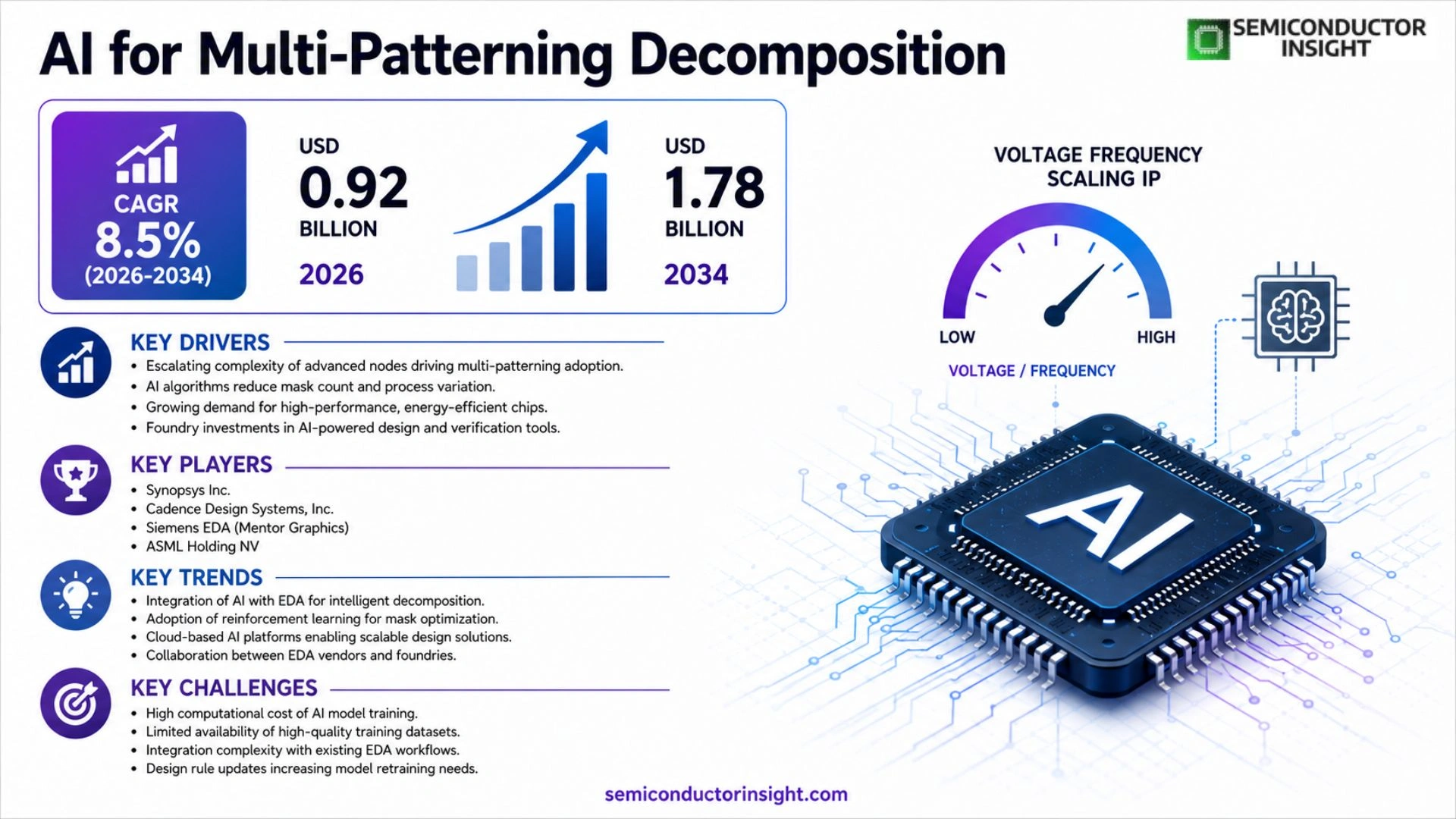
Global AI for Multi-Patterning Decomposition market size was valued at USD 0.85 billion in 2025. The market is forecasted to rise from USD 0.92 billion in 2026 to USD 1.78 billion by 2034, delivering a compound annual growth rate of 8.5% throughout the forecast horizon.
The technology revolves around algorithms that translate complex lithographic patterns into simplified masks suitable for multi‑patterning steps such as double‑patterning, self‑aligned quadruple patterning, and directed self‑assembly. By leveraging machine learning models trained on extensive design libraries, the decomposition engine reduces mask count, shortens cycle time, and improves overlay accuracy,critical parameters for sub‑10 nm node production.
The market is gaining momentum because semiconductor manufacturers are intensifying investments in advanced nodes while seeking cost‑effective alternatives to traditional mask generation workflows. Moreover, recent collaborations,such as the partnership announced in March 2024 between a leading EDA vendor and a major foundry,to integrate AI‑driven decomposition modules into existing design‑for‑manufacturing suites are accelerating adoption. Established players including Synopsys, Cadence Design Systems and Mentor Graphics continue expanding their portfolios with dedicated AI decomposition solutions.
MARKET DRIVERS
Advancements in Lithography Complexity
The semiconductor industry has migrated to sub‑45 nm nodes where single‑exposure lithography can no longer meet pitch requirements. Designers now rely on multi‑patterning strategies that multiply mask steps, inflating cycle time and cost. AI for Multi-Patterning Decomposition Market addresses this bottleneck by automating the allocation of pattern sections, reducing manual intervention, and delivering tighter overlay control. The resulting throughput improvement is measurable,some fabs report a 20‑25 % cut in mask‑generation time after deploying AI‑enabled decomposition workflows.
Algorithmic Efficiency Gains
Deep‑learning and reinforcement‑learning architectures have matured to the point where they can evaluate millions of layout permutations within seconds. This computational velocity translates into lower electricity consumption and fewer silicon‑hour expenses. Companies that have integrated these models see double‑digit reductions in defect density, a critical factor as yield windows narrow at advanced nodes. The ability to predict optimal pattern splits before silicon fabrication gives manufacturers a strategic edge in time‑to‑market.
➤ “When AI reliably predicts the most efficient pattern breakdown, the entire mask‑making schedule contracts, freeing capacity for new product introductions.”
Beyond pure speed, the predictive power of AI introduces a data‑driven culture on the fab floor. Engineers can benchmark alternative decomposition routes, justify cost allocations, and align process development with business objectives. This analytical shift reinforces the relevance of AI for Multi-Patterning Decomposition Market as a cornerstone of next‑generation manufacturing strategies.
MARKET CHALLENGES
Data Scarcity and Labeling Overheads
High‑resolution layout datasets required for training robust models are often proprietary and fragmented across vendors. Curating a labeled corpus that captures the full spectrum of pattern interactions can consume months of engineering effort. Without a representative training set, AI algorithms risk overfitting to niche designs, limiting their applicability to broader product families.
Other Challenges
Integration with Legacy Toolchains
Most fabs operate on entrenched EDA stacks that were not conceived for AI plug‑ins. Bridging modern inference engines with these legacy environments demands custom adapters, extensive validation, and rigorous change‑control procedures. The transition cost, both in time and resources, can deter early adoption despite clear long‑term benefits.
MARKET RESTRAINTS
High Capital Expenditure for AI Infrastructure
Deploying the GPU clusters or specialized AI accelerators needed for real‑time decomposition incurs substantial upfront spending. For midsize foundries, allocating budget to hardware that may become obsolete within a few process generations poses a financial dilemma. This capital intensity slows the diffusion of AI solutions across the industry spectrum.
Talent Shortage in AI‑Driven Lithography
Expertise at the intersection of photolithography physics and machine‑learning methodology remains scarce. Firms must either invest heavily in upskilling existing staff or compete for a limited pool of niche specialists. The talent gap restricts the speed at which organizations can operationalize advanced decomposition algorithms.
MARKET OPPORTUNITIES
Emerging Foundry Partnerships
Leading foundries are opening collaborative programs that invite AI vendors to co‑develop decomposition modules tailored to upcoming 3‑nm and 2‑nm processes. These alliances provide early‑access data feeds and jointly certify algorithmic outputs, accelerating market acceptance. Participants gain a foothold in a high‑value niche where supply‑chain differentiation is paramount.
Additionally, the rise of heterogeneous integration,combining logic, memory, and photonic components on a single wafer,creates new patterning challenges. AI‑enhanced decomposition can reconcile competing design rules across domains, opening a revenue stream for solution providers willing to adapt their models to multi‑disciplinary layouts. Companies that capture this cross‑segment demand will shape the next wave of growth in AI for Multi-Patterning Decomposition Market.
AI for Multi-Patterning Decomposition Market Trends
AI‑Driven Mask Reduction Gains Traction
The industry is observing a shift toward algorithmic mask synthesis that directly addresses the cost pressure of sub‑10 nm production. By converting intricate lithographic layouts into a smaller set of masks, the decomposition engine trims the number of photomasks required for each multi‑patterning cycle. This reduction translates into lower material spend and fewer mask‑repair iterations, which in turn accelerates time‑to‑fab. The improvement in overlay precision,derived from machine‑learning models that have absorbed vast design libraries,helps maintain yield targets that become increasingly fragile at tighter pitches. Manufacturers that embed this capability into their design‑for‑manufacturing flow report a noticeable compression of the overall cycle, allowing more design iterations within a fixed product schedule.
Other Trends
Strategic Partnerships Accelerate Adoption
A partnership announced in March 2024 between a leading EDA supplier and a major foundry illustrates how ecosystem collaboration is becoming a catalyst for broader uptake. The joint effort integrates AI‑based decomposition modules into an existing suite, offering a seamless plug‑in that aligns with the foundry’s process‑specific design rules. Such alliances reduce integration risk for end users and create a de‑facto standard that other vendors can reference. In parallel, incumbents like Synopsys, Cadence Design Systems and Mentor Graphics continue to deepen their AI portfolios, positioning themselves as one‑stop providers for both design and mask generation. The competitive pressure generated by these moves is prompting smaller players to explore niche specializations, such as directed self‑assembly optimization, further diversifying the solution space.
Competitive Landscape Expands with AI Integration
The widening of the competitive arena is reshaping procurement strategies across the semiconductor supply chain. Buyers are no longer evaluating tools solely on functionality; they now weigh integration depth, data‑security provisions, and the ability to support future node transitions. Companies that can demonstrate a modular architecture,allowing customers to scale from double‑patterning to self‑aligned quadruple patterning without wholesale software replacements,are gaining preference. This trend nudges firms to invest in flexible APIs and cloud‑enabled licensing models, which lower upfront capital outlay while preserving access to the latest algorithmic enhancements. As a result, the market is moving toward a service‑oriented paradigm where continual model refinement, fed by production feedback, becomes a core value proposition.
COMPETITIVE LANDSCAPE
Key Industry Players
AI for Multi-Patterning Decomposition: Competitive Overview
Synopsys remains the de‑facto benchmark in AI‑driven decomposition, leveraging its extensive design‑automation suite to embed machine‑learning kernels directly into mask synthesis workflows. The firm’s recent acquisition of a niche start‑up specialised in neural‑network‑based lithography prediction has tightened its control over the end‑to‑end value chain, allowing customers to shrink mask inventories while preserving yield at sub‑10 nm nodes. Cadence Design Systems counters with a modular architecture that decouples the AI engine from its traditional routing and verification blocks, offering foundries a plug‑in that can be scaled across multiple process generations. Siemens EDA (formerly Mentor Graphics) differentiates through a close partnership network with wafer‑fab equipment manufacturers, ensuring its decomposition algorithms are tightly aligned with lithography optics and overlay metrology. Together, these three vendors anchor a market structure where integration depth, data‑rich training sets, and co‑development agreements dictate competitive positioning.
Beyond the primary EDA powerhouses, a cohort of specialists and semiconductor OEMs is shaping the ecosystem. ASML’s computational lithography team supplies AI‑enhanced OPC that dovetails with decomposition modules, while Applied Materials contributes process‑aware data that refines model accuracy. TSMC, GlobalFoundries and Intel are investing in in‑house AI capabilities to augment vendor solutions, effectively becoming co‑creators of the technology stack. Parallel players such as KLA Corporation and Lam Research furnish defect‑inspection analytics that feed back into the learning loop, improving overlay control. Finally, AI infrastructure leaders,including Nvidia, Arm Ltd., Google DeepMind and IBM Research,provide the GPU and algorithmic foundations that make high‑throughput decomposition feasible at scale.
List of Key AI for Multi-Patterning Decomposition Companies Profiled
- Synopsys Inc.
- Cadence Design Systems, Inc.
- Siemens EDA (Mentor Graphics)
- ASML Holding NV
- Applied Materials, Inc.
- Taiwan Semiconductor Manufacturing Co.
- GlobalFoundries Inc.
- Intel Corporation
- Samsung Electronics Co., Ltd.
- KLA Corporation
- Lam Research Corporation
- Nvidia Corporation
- Arm Ltd.
- Google DeepMind
- IBM Research
Segment Analysis:
| Segment Category | Sub-Segments | Key Insights |
| By Type |
|
Pattern‑Recognition AI
|
| By Application |
|
Directed Self‑Assembly
|
| By End User |
|
Foundries
|
| By Technology |
|
Hybrid AI‑Physics Models
|
| By Integration Mode |
|
Embedded AI Modules
|
Regional Analysis: AI for Multi-Patterning Decomposition Market
Europe
The convergence of high‑NA EUV adoption and AI‑enabled design automation creates a fertile environment for multi‑patterning decomposition. OEMs cite rapid cycle‑time reductions and the ability to push feature sizes below 7 nm as primary incentives for integrating these algorithms into their workflow.
Mid‑tier fabs in France and Italy have piloted AI‑based decomposition pilots, reporting measurable gains in mask utilization. Larger players are transitioning from pilot to full‑scale deployment, leveraging cloud‑native inference engines to scale across multiple production lines.
EU directives on sustainable manufacturing compel manufacturers to improve yield efficiency. AI for Multi-Patterning Decomposition aligns with those objectives, positioning it as a compliance‑friendly technology that also lowers operational carbon footprints.
Leading vendors include a mix of AI specialists and traditional EDA firms. Strategic alliances between German AI startups and established silicon equipment manufacturers have accelerated solution rollout across the continent.
North America
In the United States, AI for Multi-Patterning Decomposition Market is shaped by a high concentration of leading chip designers and a robust venture capital ecosystem. Companies leverage advanced machine‑learning frameworks to tailor decomposition strategies for leading‑edge nodes, especially in fabs focused on 5 nm and beyond. The emphasis on intellectual property protection drives firms to develop in‑house models rather than rely on off‑the‑shelf tools, fostering a culture of bespoke algorithmic innovation. Meanwhile, the West Coast’s emphasis on software‑centric semiconductor solutions augments cross‑industry collaborations, integrating AI expertise from autonomous‑vehicle and cloud‑computing sectors into lithography workflows.
Asia‑Pacific
Asia‑Pacific remains a hotbed of production capacity, and manufacturers there are increasingly viewing AI for Multi-Patterning Decomposition as a lever to manage soaring wafer‑per‑day targets. Chinese and Taiwanese fabs prioritize throughput gains, applying AI to automate pattern split decisions that once required manual engineering effort. The region’s rapid talent pipeline in data science bolsters the creation of localized models that reflect native process variations. However, divergent standards across countries introduce integration challenges, prompting consortium‑level efforts to harmonize data formats and model exchange protocols.
South America
South American semiconductor activity, while limited in volume, is gaining strategic relevance through niche specialty‑process nodes. Emerging design houses in Brazil are experimenting with AI‑driven decomposition to offset limited access to high‑cost EUV tools. By extracting more value from existing immersion lithography equipment, these firms can remain competitive in markets such as automotive and aerospace where custom patterning is essential. Government incentives for high‑technology adoption further encourage local players to explore AI solutions as part of broader digital‑transformation agendas.
Middle East & Africa
The Middle East & Africa region is at an early stage of adopting AI for Multi-Patterning Decomposition, with a focus on research collaborations rather than full production deployment. Investment funds in the United Arab Emirates are backing AI‑focused semiconductor startups that aim to create cloud‑based decomposition services for global customers. In Africa, emerging university programs are fostering expertise in photolithography and AI, laying groundwork for future participation in the value chain. Although current market impact is modest, the region’s strategic positioning as a data‑center hub could accelerate demand for locally optimized patterning solutions.
Report Scope
This market research report provides a comprehensive analysis of the AI for Multi-Patterning Decomposition Market , covering the forecast period 2026–2034. It offers detailed insights into market dynamics, technological advancements, competitive landscape, and key trends shaping the industry.
Key focus areas of the report include:
- Market Overview: The report begins with an overview outlining its current market scenario, key growth indicators, and industry transformation drivers. It discusses macroeconomic factors, demand–supply balance, regulatory landscape, and the strategic role of semiconductors in powering advancements across industries such as automotive, telecommunications, consumer electronics, and industrial automation.
- Market Size & Forecast: Historical data and future projections for revenue, unit shipments, and market value across major regions and segments.
- Segmentation Analysis: Detailed breakdown by product type, technology, application, and end-user industry to identify high-growth segments and investment opportunities.
- Regional Insights: Insights into market performance across North America, Europe, Asia-Pacific, Latin America, and the Middle East & Africa, including country-level analysis where relevant.
- Competitive Landscape: Profiles of leading market participants, including their product offerings, R&D focus, manufacturing capacity, pricing strategies, and recent developments such as mergers, acquisitions, and partnerships.
- Technology Trends & Innovation: Assessment of emerging technologies, integration of AI/IoT, semiconductor design trends, fabrication techniques, and evolving industry standards.
- Market Drivers & Restraints: Evaluation of factors driving market growth along with challenges, supply chain constraints, regulatory issues, and market-entry barriers.
- Stakeholder Insights: Insights for component suppliers, OEMs, system integrators, investors, and policymakers regarding the evolving ecosystem and strategic opportunities.
Primary and secondary research methods are employed, including interviews with industry experts, data from verified sources, and real-time market intelligence to ensure the accuracy and reliability of the insights presented.
FREQUENTLY ASKED QUESTIONS:
What is the current market size of AI for Multi-Patterning Decomposition Market?
-> AI for Multi-Patterning Decomposition Market was valued at USD 0.85 billion in 2025 and is expected to reach USD 1.78 billion by 2034, representing a compound annual growth rate of 8.5%.
Which key companies operate in AI for Multi-Patterning Decomposition Market?
-> Key players include Synopsys, Cadence Design Systems and Mentor Graphics, among others.
What are the key growth drivers?
-> Key growth drivers include increased investments in advanced semiconductor nodes, demand for cost‑effective mask generation, and integration of AI modules into existing EDA workflows.
Which region dominates the market?
-> Asia‑Pacific is the largest and fastest‑growing region, driven by major foundries and OEM concentration.
What are the emerging trends?
-> Emerging trends include AI‑enhanced decomposition algorithms, tighter integration with design‑for‑manufacturing suites, and collaborations between EDA vendors and leading foundries.

Get Sample Report PDF for Exclusive Insights
Report Sample Includes
- Table of Contents
- List of Tables & Figures
- Charts, Research Methodology, and more...
 Download Sample Report PDF