AI for Chemical Mechanical Polishing Endpoint Detection Market Insights
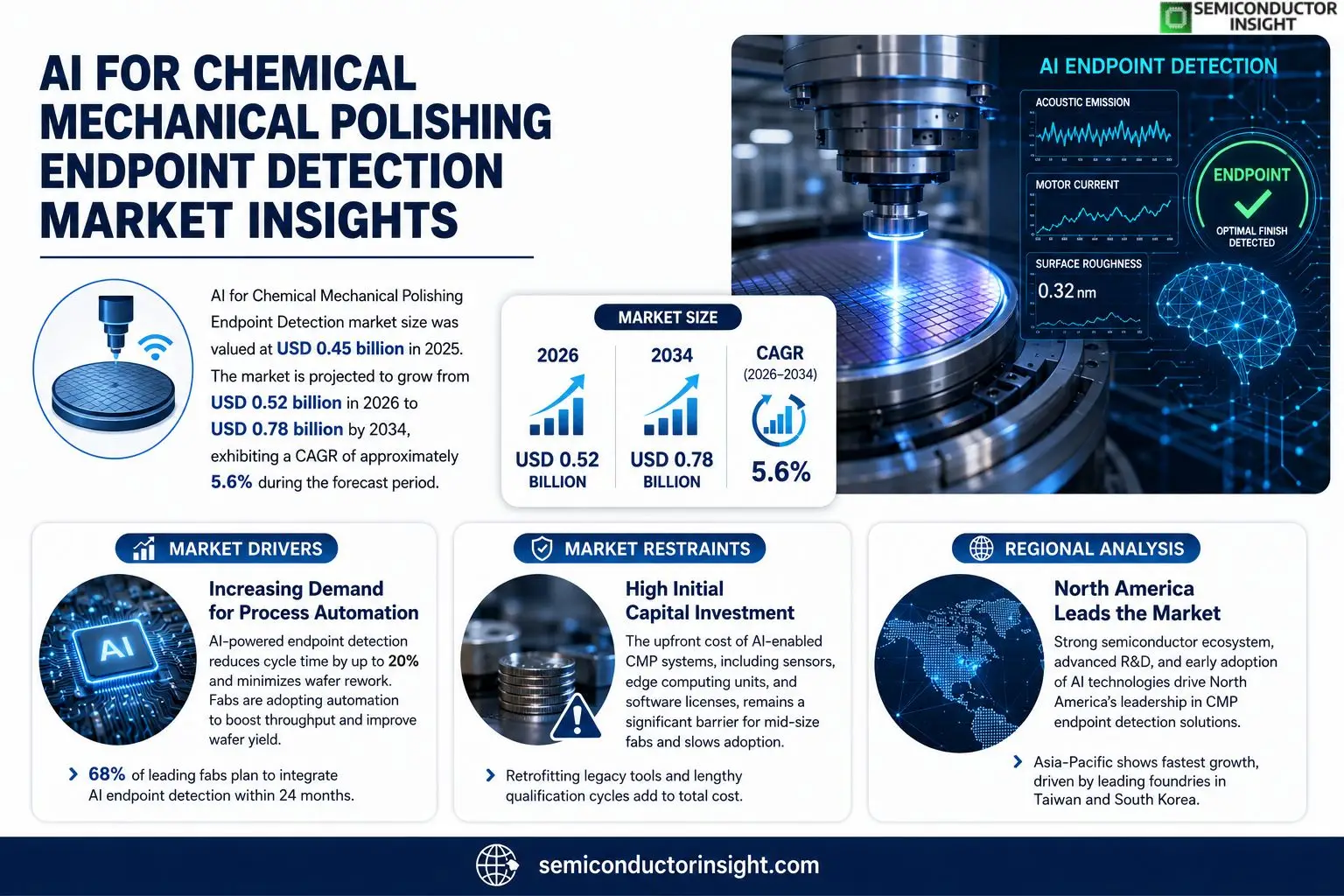
AI for Chemical Mechanical Polishing Endpoint Detection market size was valued at USD 0.45 billion in 2025. The market is projected to grow from USD 0.52 billion in 2026 to USD 0.78 billion by 2034, exhibiting a CAGR of approximately 5.6% during the forecast period.
AI‑driven endpoint detection systems integrate machine‑learning algorithms with real‑time sensor data to determine the optimal polishing finish in semiconductor wafer manufacturing. By analyzing acoustic emission, motor current, and surface‑roughness signals, these solutions automate the decision‑making process that traditionally relied on manual inspection.The market is gaining traction because semiconductor fabs are seeking higher yield and lower cycle time, while the cost of false‑stop events remains high. Leading equipment manufacturers such as Applied Materials, Tokyo Electron, and Lam Research have begun embedding AI modules into their CMP toolsets, further accelerating adoption.
MARKET DRIVERS
Increasing Demand for Process Automation
The semiconductor fabrication industry is accelerating the shift toward fully automated production lines. AI for Chemical Mechanical Polishing Endpoint Detection Market solutions enable real‑time monitoring of polishing progress, reducing cycle time by up to 20% and minimizing wafer rework. This efficiency gain is a primary catalyst for adoption across high‑volume fabs.
Advancements in AI‑Driven Metrology
Recent breakthroughs in deep‑learning algorithms allow precise correlation of acoustic and optical signals with surface planarity. Manufacturers can now predict endpoint with ±2 nm accuracy, a level of precision unattainable by conventional threshold methods. The resulting yield improvement fuels further investment in AI‑enabled polishing tools.
➤ Industry surveys indicate that 68 % of leading fabs plan to integrate AI endpoint detection within the next 24 months.
In addition, the growing emphasis on sustainability drives the need for consumable‑saving technologies. By terminating the process at the optimal point, AI reduces slurry usage by an estimated 15 % and lowers energy consumption, aligning with corporate ESG targets.
MARKET CHALLENGES
Integration Complexity with Legacy CMP Tools
Many existing CMP stations lack the sensor interfaces required for seamless AI deployment. Retrofitting these units often involves custom hardware development, which increases capital expense and prolongs implementation timelines.
Other Challenges
Data Quality Constraints
Effective endpoint detection relies on high‑fidelity training datasets. Variability in wafer material, slurry composition, and pad wear can introduce noise, making model generalization difficult without extensive data engineering.
MARKET RESTRAINTS
High Initial Capital Investment
The upfront cost of AI‑enabled CMP systems, including sensors, edge computing units, and software licenses, remains a significant barrier for mid‑size fabs. Budget constraints often prioritize immediate yield gains over longer‑term automation benefits.
Regulatory and Qualification Hurdles
Compliance with industry standards such as ITRS and internal qualification protocols adds procedural overhead. Validation cycles can extend rollout periods, especially when AI models must be verified for each new wafer platform.
Limited Skilled Workforce
Deploying and maintaining AI solutions requires expertise in both semiconductor metrology and machine learning. The scarcity of professionals who bridge these domains slows adoption rates in regions with tight talent pools.
MARKET OPPORTUNITIES
Emerging 3‑nm and Below Process Nodes
As device geometry contracts to sub‑3 nm dimensions, the tolerance window for polishing narrows dramatically. AI‑driven endpoint detection offers the granularity needed to meet these stringent specifications, creating a sizeable growth avenue for vendors.
Cloud‑Based Analytics Platforms
Scalable cloud services that aggregate polishing data across multiple fabs enable continuous model refinement. This service model reduces the per‑unit cost of AI adoption and opens recurring revenue streams for technology providers.
Strategic Partnerships with Equipment OEMs
Collaborations between AI specialists and CMP equipment manufacturers accelerate the bundling of turnkey solutions. Such alliances can shorten time‑to‑market, providing a competitive edge to fabs that embrace integrated AI capabilities.
AI for Chemical Mechanical Polishing Endpoint Detection Market Trends
Integration of AI with Real‑Time Sensor Data
AI for Chemical Mechanical Polishing Endpoint Detection Market is being reshaped by systems that fuse machine‑learning algorithms with live sensor feeds from semiconductor fabs. By continuously analyzing acoustic‑emission, motor‑current and surface‑roughness signals, these platforms determine the precise moment to terminate polishing, eliminating the reliance on manual visual inspection. The result is a tighter control loop that boosts wafer yield, reduces cycle time, and minimizes the costly false‑stop events that have traditionally plagued CMP operations. Early deployments show a noticeable improvement in process repeatability, and manufacturers are expanding the data sets used to train models, further refining prediction accuracy across diverse process windows.
Other Trends
Adoption by Major Equipment Manufacturers
Leading tool makers such as Applied Materials, Tokyo Electron and Lam Research have begun embedding AI modules directly into their CMP product lines. These integrations are not limited to endpoint detection; they also support predictive maintenance and real‑time process optimization, aligning with broader Industry 4.0 initiatives. The strategic move by these companies signals confidence in the technology’s scalability and its ability to meet the stringent reliability standards of high‑volume fabs. As more equipment vendors release AI‑enhanced solutions, the competitive pressure encourages smaller players to partner with software specialists, accelerating the diffusion of intelligent polishing controls across the ecosystem.
Cost Reduction and Yield Improvement
From an economic perspective, AI for Chemical Mechanical Polishing Endpoint Detection Market delivers measurable cost savings by curbing unnecessary polishing cycles and reducing wafer scrap rates. The automated decision‑making process cuts labor intensity and shortens operator training cycles, while the consistent endpoint precision contributes directly to higher product yields. Looking ahead, the industry is likely to prioritize the scalability of AI models, ensuring they can handle the growing volume of sensor data generated by next‑generation CMP tools. Continuous refinement of algorithms, combined with tighter integration into fab execution systems, will reinforce the market’s trajectory toward more efficient and higher‑quality semiconductor manufacturing.
COMPETITIVE LANDSCAPEKey Industry Players
AI‑Driven Endpoint Detection Transforming CMP Processes
In the AI for Chemical Mechanical Polishing (CMP) endpoint detection market, a handful of large semiconductor equipment manufacturers dominate the competitive landscape. Applied Materials, Tokyo Electron and Lam Research have leveraged their extensive CMP tool portfolios to embed machine‑learning modules directly into new product generations. Their solutions combine acoustic emission, motor‑current and surface‑roughness analytics, enabling fabs to reduce false‑stop events and improve wafer yield. The scale of their R&D investments and service networks creates a high barrier to entry, positioning these three firms as the primary drivers of market growth and standard‑setting for AI‑enabled CMP control.Beyond the tier‑one players, a growing cohort of specialist firms and technology providers adds depth to the ecosystem. KLA Corporation and Nanometrics supply high‑precision metrology platforms that feed real‑time data into AI algorithms, while Hitachi High‑Tech and Advantest contribute advanced sensor‑fusion software. Emerging entrants such as Camtek, Bosch Semiconductor Manufacturing Solutions, and NanoCision focus on niche detection capabilities, often targeting specific wafer sizes or process nodes. These companies, together with research‑oriented units from IBM and Siemens, expand the competitive set by offering complementary analytics, customization options, and open‑architecture integration pathways.
List of Key AI for Chemical Mechanical Polishing Endpoint Detection Companies Profiled
- Applied Materials
- Tokyo Electron
- Lam Research
- KLA Corporation
- Nanometrics
- Hitachi High‑Tech
- Advantest
- Camtek
- Bosch Semiconductor Manufacturing Solutions
- NanoCision
- IBM Research
- Siemens Digital Industries Software
Segment Analysis:
| Segment Category | Sub-Segments | Key Insights |
| By Type |
|
AI‑Integrated Sensor Fusion drives the most rapid adoption; it unifies acoustic, motor‑current, and surface‑roughness signals into a coherent decision framework. • Enables real‑time adjustment of polishing parameters, reducing manual intervention. • Enhances wafer yield consistency by detecting subtle endpoint cues that human operators often miss. |
| By Application |
|
Advanced logic node CMP emerges as the leading application; the tight tolerance requirements of leading‑edge logic wafers benefit most from AI‑driven endpoint precision. • Facilitates tighter control of critical dimension variation. • Reduces cycle‑time penalties associated with over‑polishing or premature stop. |
| By End User |
|
Semiconductor Foundries lead adoption due to scale and pressure for yield improvement. • Leverage AI to harmonize multiple toolsets across high‑volume production lines. • Seek continuous process intelligence to differentiate services for fab‑as‑a‑service models. |
| By Technology |
|
Edge‑computing embedded AI is the dominant technology choice; processing data directly within the CMP tool eliminates latency and supports real‑time decision making. • Aligns with industry trends toward autonomous tool operation. • Provides robust operation even in environments with limited connectivity. |
| By Deployment Model |
|
Standalone tool‑integrated AI continues to dominate early deployments; it offers immediate performance gains without extensive IT overhead. • Facilitates incremental upgrades of existing CMP equipment. • Allows manufacturers to evaluate AI benefits before committing to broader servitization models. |
Regional Analysis: AI for Chemical Mechanical Polishing Endpoint Detection Market
North America
The push for sub‑10 nm node scaling fuels demand for precise CMP control, prompting fabs to adopt AI for endpoint detection. Enhanced defect predictability and reduced re‑work costs are compelling benefits that drive investment across the continent.
Recent breakthroughs in deep‑learning architectures enable real‑time analysis of sensor streams, allowing AI models to adjust polishing pressure on the fly. Integration with existing fab automation platforms streamlines deployment.
Minimal regulatory barriers in North America support rapid prototyping and scaling of AI‑enabled CMP solutions, while industry consortia provide best‑practice guidelines that accelerate adoption.
Leading equipment suppliers are forming strategic alliances with AI startups, combining hardware expertise with proprietary algorithms to offer end‑to‑end CMP endpoint detection packages.
Europe
European semiconductor hubs in Germany and the Netherlands are progressively integrating AI for CMP endpoint detection to meet stringent quality standards demanded by automotive and industrial sectors. Collaborative research programs funded by the EU emphasize model interpretability, ensuring that AI decisions can be audited and aligned with safety regulations. While adoption lags behind North America, the region’s focus on sustainability drives interest in AI‑enabled processes that lower chemical usage and energy consumption, positioning Europe as a growing contender in the market.
Asia‑Pacific
Asia‑Pacific exhibits a diverse adoption curve, with Taiwan and South Korea leading in AI‑driven CMP innovations due to their massive foundry footprints. Manufacturers are leveraging extensive data sets from high‑volume production to train robust detection models, targeting yield improvements for emerging memory technologies. Emerging players in India and Southeast Asia are beginning to explore pilot projects, attracted by the prospect of reducing manual inspection costs and accelerating time‑to‑revenue.
South America
In South America, the market remains nascent, with a handful of electronics manufacturers experimenting with AI for endpoint detection as part of broader digital transformation initiatives. The primary focus is on building local expertise and establishing testing labs that can validate AI models against regional process variations. Partnerships with North American firms are common, facilitating technology transfer and capacity building.
Middle East & Africa
The Middle East & Africa region is in the early stages of exploring AI for CMP endpoint detection, primarily driven by investment in semiconductor fabrication zones in the United Arab Emirates and Saudi Arabia. Government‑backed programs aim to develop a skilled workforce capable of handling AI‑enabled equipment, while regional fabs prioritize reliability and cost‑efficiency. Though adoption is limited, strategic initiatives signal a long‑term commitment to integrating advanced analytics into polishing processes.
Report Scope
This market research report provides a comprehensive analysis of the AI for Chemical Mechanical Polishing Endpoint Detection Market , covering the forecast period 2026–2034. It offers detailed insights into market dynamics, technological advancements, competitive landscape, and key trends shaping the industry.
Key focus areas of the report include:
- Market Overview: The report begins with an overview outlining its current market scenario, key growth indicators, and industry transformation drivers. It discusses macroeconomic factors, demand–supply balance, regulatory landscape, and the strategic role of semiconductors in powering advancements across industries such as automotive, telecommunications, consumer electronics, and industrial automation.
- Market Size & Forecast: Historical data and future projections for revenue, unit shipments, and market value across major regions and segments.
- Segmentation Analysis: Detailed breakdown by product type, technology, application, and end-user industry to identify high-growth segments and investment opportunities.
- Regional Insights: Insights into market performance across North America, Europe, Asia-Pacific, Latin America, and the Middle East & Africa, including country-level analysis where relevant.
- Competitive Landscape: Profiles of leading market participants, including their product offerings, R&D focus, manufacturing capacity, pricing strategies, and recent developments such as mergers, acquisitions, and partnerships.
- Technology Trends & Innovation: Assessment of emerging technologies, integration of AI/IoT, semiconductor design trends, fabrication techniques, and evolving industry standards.
- Market Drivers & Restraints: Evaluation of factors driving market growth along with challenges, supply chain constraints, regulatory issues, and market-entry barriers.
- Stakeholder Insights: Insights for component suppliers, OEMs, system integrators, investors, and policymakers regarding the evolving ecosystem and strategic opportunities.
Primary and secondary research methods are employed, including interviews with industry experts, data from verified sources, and real-time market intelligence to ensure the accuracy and reliability of the insights presented.
FREQUENTLY ASKED QUESTIONS:
What is the current market size of AI for Chemical Mechanical Polishing Endpoint Detection Market?
-> AI for Chemical Mechanical Polishing Endpoint Detection Market was valued at USD 450 million in 2025 and is expected to reach USD 780 million by 2034.
Which key companies operate in AI for Chemical Mechanical Polishing Endpoint Detection Market?
-> Key players include Applied Materials, Tokyo Electron, and Lam Research, among others.
What are the key growth drivers?
-> Key growth drivers include higher wafer yield, reduced cycle time, and the high cost of false‑stop events.
Which region dominates the market?
-> Regional dominance details are not disclosed in the provided data.
What are the emerging trends?
-> Emerging trends include integration of machine‑learning algorithms with real‑time sensor data (acoustic emission, motor current, surface‑roughness) for automated endpoint detection.
Get Sample Report PDF for Exclusive Insights
Report Sample Includes
- Table of Contents
- List of Tables & Figures
- Charts, Research Methodology, and more...
 Download Sample Report PDF