AI Fab Automated Material Handling System Market Insights
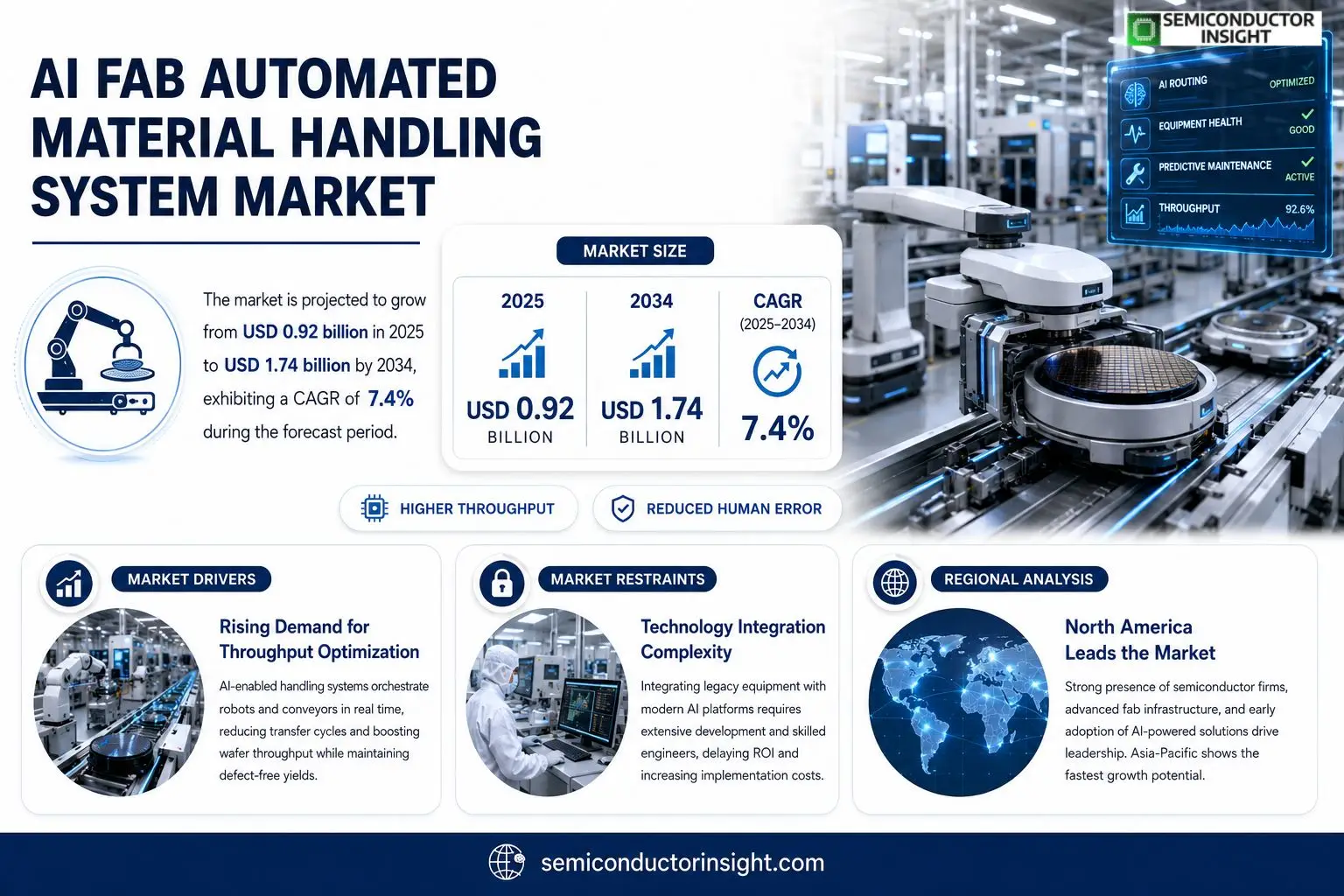
AI Fab Automated Material Handling System market size was valued at USD 0.85 billion in 2025. The market is projected to grow from USD 0.92 billion in 2025 to USD 1.74 billion by 2034, exhibiting a CAGR of 7.4% during the forecast period.
AI Fab Automated Material Handling Systems comprise intelligent conveyance robots, vision‑guided transport units and predictive maintenance platforms designed specifically for semiconductor fabrication environments where precision handling of wafers and substrates is critical.The market is gaining momentum because fab operators are seeking higher throughput while reducing human error; meanwhile advances in edge‑AI chips enable real‑time decision making on the shop floor. Companies such as Applied Materials, Tokyo Electron and Siemens are expanding their offerings through integrated AI control software and have announced collaborations with technology partners to accelerate deployment of smart handling solutions.
MARKET DRIVERS
Rising Demand for Throughput Optimization
The semiconductor fabrication environment is under pressure to push wafer throughput while maintaining defect‑free yields. AI‑enabled Fab material handling systems respond by orchestrating robot arms, conveyors, and storage modules in a synchronized fashion, thereby shaving seconds off each transfer cycle. This time saving compounds across thousands of daily moves, directly translating into higher output per shift.
Integration of AI for Predictive Maintenance
Predictive analytics now sit at the core of equipment reliability strategies. By continuously mining sensor streams, AI models flag wear patterns before they trigger unscheduled stoppages. Facilities that have adopted such capabilities report a noticeable decline in downtime, allowing planners to tighten production schedules without inflating safety buffers.
➤ Operators that embed AI‑driven handling logic into their fab floor can compress change‑over windows by up to 15 %, freeing capacity for higher‑value product runs.
Beyond efficiency, the ability to reconfigure material flow in real time equips fabs with the flexibility to switch between process nodes without costly hardware overhauls, a strategic advantage as product roadmaps accelerate.
MARKET CHALLENGES
Technology Integration Complexity
Legacy handling assets often operate on proprietary protocols that clash with modern AI platforms. Bridging this gap requires extensive middleware development, a task that stretches internal engineering resources and can delay ROI realization.
Other Challenges
Capital Expenditure Pressure
The upfront cost of retrofitting a fab with AI‑powered conveyors and vision‑guided robots is substantial. Budget committees, accustomed to incremental upgrades, must now justify large, lump‑sum outlays against projected efficiency gains, a negotiation that can stall project timelines.Furthermore, the scarcity of engineers proficient in both semiconductor processes and advanced machine‑learning pipelines creates a talent bottleneck that hampers swift deployment.
MARKET RESTRAINTS
Regulatory and Compliance Constraints
Fabs operate under strict clean‑room classifications and safety certifications. Introducing autonomous material handling equipment necessitates re‑validation of airflow patterns, contamination controls, and emergency stop mechanisms, a process that can add months to commercialization cycles.In parallel, data‑privacy mandates governing the collection of equipment telemetry demand robust cybersecurity frameworks, increasing the engineering overhead for system integrators.Finally, the need to align system upgrades with the fab’s production schedule means that many installations are forced into narrow maintenance windows, limiting the flexibility of rollout plans.
MARKET OPPORTUNITIES
Smart Retrofit Solutions
Vendors that package AI algorithms with plug‑and‑play sensor kits are well positioned to capture the segment of fabs seeking incremental upgrades rather than full‑scale replacements. These solutions minimize downtime and lower the barrier to entry for AI adoption.A parallel opening exists in the realm of as‑a‑service offerings, where manufacturers lease AI‑enhanced handling capabilities and pay per processed wafer. This model shifts capital risk to suppliers while delivering immediate performance benefits to fabs.Lastly, the convergence of edge computing with AI‑driven material handling enables on‑site decision making without reliance on high‑latency cloud links, an advantage for fabs in regions with constrained network infrastructure.
AI Fab Automated Material Handling System Market Trends
Integration of Edge‑AI for Real‑Time Wafer Transfer
Fab operators are increasingly turning to edge‑AI chips embedded within conveyance robots to make split‑second routing decisions. By processing sensor data locally, these systems can adjust robot trajectories the instant a wafer deviates from its intended path, eliminating the latency that traditional PLC‑based controls introduce. The reduction in handling errors translates directly into higher equipment uptime and lower scrap rates, which are critical metrics for semiconductor foundries operating at tight margins. Moreover, the ability to capture and analyze handling patterns on‑site supports predictive maintenance, allowing service teams to intervene before a robot’s joint wear escalates into costly downtime. This convergence of AI inference at the device level with precision material handling is redefining throughput optimization strategies across high‑mix, high‑volume fabs.
Other Trends
Modular Robot Platforms
Vendors are releasing robot architectures built from interchangeable modules—actuation, vision, and AI compute units—that can be reconfigured as production lines evolve. This modularity shortens engineering cycles when fabs retrofit lines for new wafer sizes or introduce novel substrate materials. Customers benefit from a pay‑as‑you‑grow model: they add or upgrade modules without a complete system replacement, preserving capital expenditures. The design philosophy also eases integration with existing equipment, as standardized mechanical interfaces reduce custom tooling requirements. Early adopters report up to a 15 % reduction in changeover time, highlighting how flexibility in hardware translates into tangible operational savings.
Collaborative Ecosystem Between Equipment Vendors and AI Startups
Major players such as Applied Materials, Tokyo Electron and Siemens are forging alliances with niche AI firms that specialize in computer‑vision algorithms for wafer inspection. These partnerships accelerate the infusion of cutting‑edge analytics into handling equipment, enabling real‑time defect detection while wafers are in motion. The collaborative model also spreads development risk; equipment manufacturers contribute industrial reliability expertise, while startups supply agile software innovation. As a result, AI Fab Automated Material Handling System Market is witnessing a faster rollout of end‑to‑end smart solutions, positioning fabs to meet escalating demand for higher yield and faster time‑to‑market.
COMPETITIVE LANDSCAPEKey Industry Players
AI Fab Automated Material Handling System Market – Competitive Overview
The market is anchored by a handful of firms that have fused deep semiconductor expertise with advanced AI capabilities. Applied Materials leverages its extensive wafer‑processing portfolio to embed predictive‑maintenance algorithms directly into its conveyance robots, creating a seamless data loop that cuts cycle‑time variability. Tokyo Electron follows a comparable route, pairing its proven lithography support tools with vision‑guided transport units that react in milliseconds to substrate misalignments. Siemens distinguishes itself through an open‑architecture control platform, enabling fab operators to integrate third‑party edge‑AI chips and scale solutions across multiple production lines. These three companies collectively shape the supply chain, dictate price benchmarks, and set functional standards that newer entrants must meet to gain traction.Beyond the primary tier, a diverse cohort of specialists addresses niche requirements and regional preferences. ASML contributes wafer‑handling modules that dovetail with its extreme‑ultraviolet lithography systems, while Lam Research supplies substrate‑exchange equipment tuned for high‑density plasma reactors. KLA Corp focuses on inspection‑linked logistics, ensuring that defect‑detection data informs immediate transport decisions. Companies such as Nikon and Hitachi High‑Technologies provide precision‑aligned robotic arms for delicate thin‑film processes. Bosch Sensortec, Mitsubishi Electric, Advantest, Infineon and several domestic manufacturers round out the ecosystem, each offering proprietary sensor suites or AI accelerators that enhance accuracy and reduce downtime. Their collective activity enriches the competitive fabric, driving incremental innovation and giving fab managers a broader menu of integration options.
List of Key AI Fab Automated Material Handling System Companies Profiled
- Applied Materials
- Tokyo Electron
- Siemens
- ASML
- Lam Research
- KLA Corp
- Nikon
- Hitachi High‑Technologies
- Bosch Sensortec
- Mitsubishi Electric
- Advantest
- Infineon Technologies
Segment Analysis:
| Segment Category | Sub-Segments | Key Insights |
| By Type |
|
Intelligent Conveyance Robots
|
| By Application |
|
Wafer Transfer
|
| By End User |
|
Foundries
|
| By Technology |
|
Edge‑AI Embedded Controllers
|
| By Integration Level |
|
Integrated AI Control Suites
|
Regional Analysis: AI Fab Automated Material Handling System Market
North America
Suppliers are embedding collaborative robots that communicate directly with AI Fab platforms, enabling real‑time load balancing across workstations. This synergy reduces idle time and supports rapid product changeovers, a critical advantage for high‑mix production lines.
Predictive models analyze vibration and temperature data from handling equipment, forecasting wear before failure occurs. Clients cite the ability to schedule maintenance during planned downtimes as a primary driver of operational resilience.
Edge compute nodes colocated with conveyors perform inference locally, eliminating latency associated with cloud round‑trips. This architecture facilitates instantaneous route optimization for high‑value semiconductor wafers.
New systems embed energy‑use analytics, allowing plant managers to align material handling decisions with broader carbon‑reduction targets while preserving throughput.
Europe
European manufacturers are amplifying AI Fab capabilities to meet stricter environmental legislation and the growing demand for advanced packaging. Germany’s “Industrie 4.0” roadmap encourages the fusion of AI with material handling, prompting local vendors to develop modular platforms that can be retrofitted into legacy lines. In the Benelux region, a wave of cross‑border collaborations is giving rise to shared data ecosystems, where real‑time handling metrics are exchanged to harmonize supply‑chain flows. The strategic emphasis on precision and traceability drives firms to adopt AI‑driven verification stations that scrutinize each component as it moves through the fab, reducing rework and safeguarding product integrity.
Asia-Pacific
The Asia‑Pacific arena, anchored by Taiwan, South Korea, and China, showcases a rapid shift from volume‑centric to value‑centric production models. Confronted with escalating labor costs, manufacturers are turning to AI Fab Automated Material Handling System solutions to automate repetitive transport tasks and free skilled labor for higher‑order engineering work. Regional policy incentives, especially in Singapore’s Smart Nation initiative, subsidize AI‑enabled equipment purchases, accelerating market penetration. Nevertheless, disparate standards across the sub‑regions create integration challenges, prompting vendors to prioritize flexible APIs that can bridge different legacy protocols.
South America
In South America, Brazil’s semiconductor resurgence is anchored by government grants that emphasize technology transfer. Companies are experimenting with AI‑guided buffer zones that dynamically allocate storage based on real‑time demand forecasts, thereby shortening lead times for niche devices. While capital availability remains constrained compared with North America, strategic partnerships with multinational equipment makers are offsetting the funding gap, allowing local fabs to access the latest handling intelligence without prohibitive upfront costs.
Middle East & Africa
The Middle East & Africa segment is witnessing nascent adoption of AI Fab material handling as part of broader diversification plans away from hydrocarbon reliance. United Arab Emirates’ free‑zone initiatives invite foreign manufacturers who bring AI‑centric handling solutions to the region, fostering a knowledge spill‑over effect. African markets, still early in the adoption curve, are focusing on modular, low‑cost AI add‑ons that can be layered onto existing conveyor infrastructure, delivering incremental efficiency gains while preserving budgetary discipline.
Report Scope
This market research report provides a comprehensive analysis of the AI Fab Automated Material Handling System Market , covering the forecast period 2026–2034. It offers detailed insights into market dynamics, technological advancements, competitive landscape, and key trends shaping the industry.
Key focus areas of the report include:
- Market Overview: The report begins with an overview outlining its current market scenario, key growth indicators, and industry transformation drivers. It discusses macroeconomic factors, demand–supply balance, regulatory landscape, and the strategic role of semiconductors in powering advancements across industries such as automotive, telecommunications, consumer electronics, and industrial automation.
- Market Size & Forecast: Historical data and future projections for revenue, unit shipments, and market value across major regions and segments.
- Segmentation Analysis: Detailed breakdown by product type, technology, application, and end-user industry to identify high-growth segments and investment opportunities.
- Regional Insights: Insights into market performance across North America, Europe, Asia-Pacific, Latin America, and the Middle East & Africa, including country-level analysis where relevant.
- Competitive Landscape: Profiles of leading market participants, including their product offerings, R&D focus, manufacturing capacity, pricing strategies, and recent developments such as mergers, acquisitions, and partnerships.
- Technology Trends & Innovation: Assessment of emerging technologies, integration of AI/IoT, semiconductor design trends, fabrication techniques, and evolving industry standards.
- Market Drivers & Restraints: Evaluation of factors driving market growth along with challenges, supply chain constraints, regulatory issues, and market-entry barriers.
- Stakeholder Insights: Insights for component suppliers, OEMs, system integrators, investors, and policymakers regarding the evolving ecosystem and strategic opportunities.
Primary and secondary research methods are employed, including interviews with industry experts, data from verified sources, and real-time market intelligence to ensure the accuracy and reliability of the insights presented.
FREQUENTLY ASKED QUESTIONS:
What is the current market size of AI Fab Automated Material Handling System Market?
-> AI Fab Automated Material Handling System Market was valued at USD 0.85 billion in 2025 and is expected to reach USD 1.74 billion by 2034, exhibiting a CAGR of 7.4% during the forecast period.
Which key companies operate in AI Fab Automated Material Handling System Market?
-> Key players include Applied Materials, Tokyo Electron, and Siemens, among others.
What are the key growth drivers?
-> Key growth drivers include the need for higher throughput, reduction of human error, and advances in edge‑AI chips enabling real‑time decision‑making on the shop floor.
Which region dominates the market?
-> The reference does not specify a dominant region.
What are the emerging trends?
-> Emerging trends include intelligent conveyance robots, vision‑guided transport units, and predictive maintenance platforms tailored for semiconductor fabs.
Get Sample Report PDF for Exclusive Insights
Report Sample Includes
- Table of Contents
- List of Tables & Figures
- Charts, Research Methodology, and more...
 Download Sample Report PDF