AI EV On-Board Charger Intelligent Power Module Market Insights
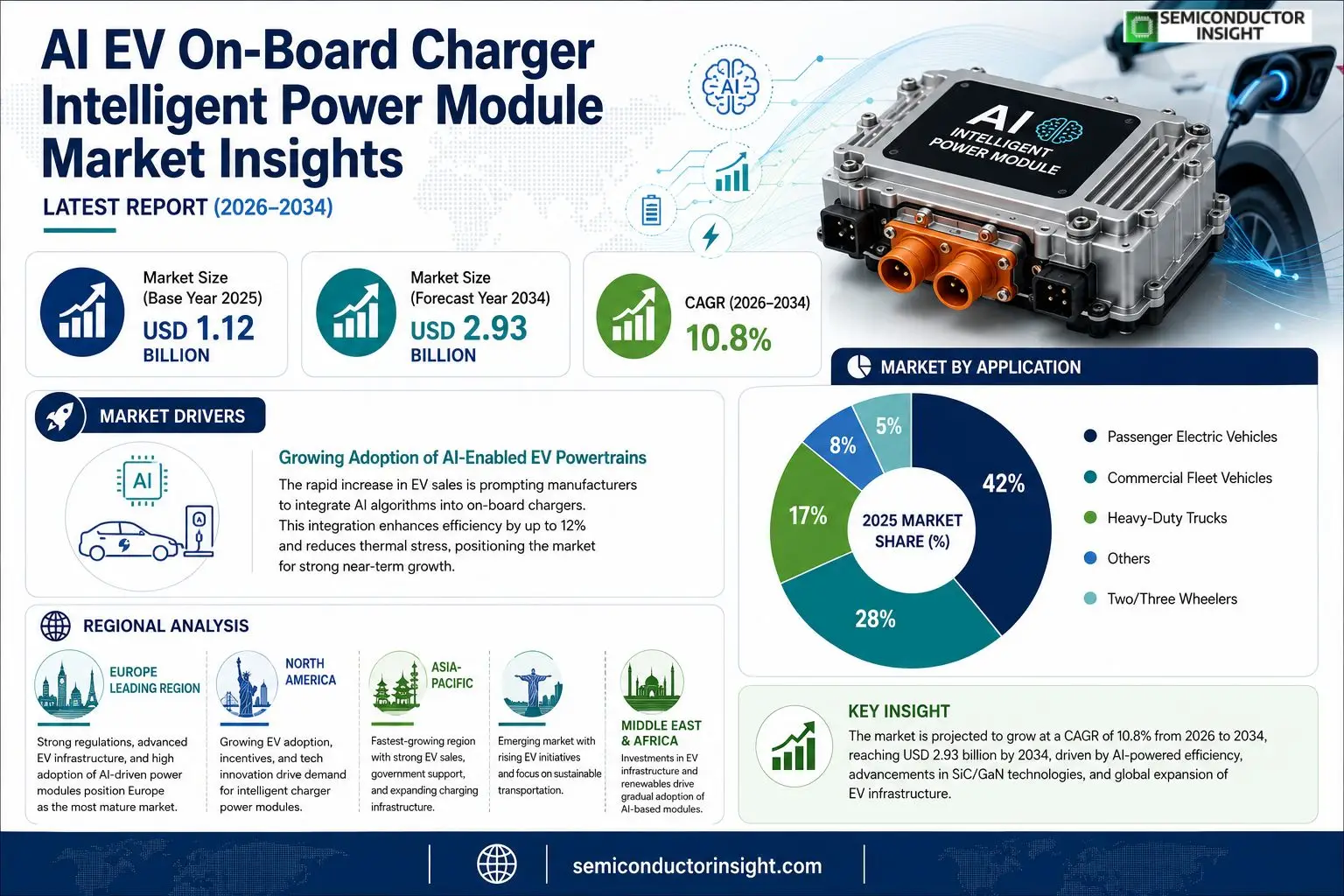
AI EV On-Board Charger Intelligent Power Module market size was valued at USD 1.12 billion in 2025. The market is projected to grow from USD 1.34 billion in 2026 to USD 2.93 billion by 2034, exhibiting a CAGR of 10.8% during the forecast period.
AI EV On-Board Charger Intelligent Power Modules integrate advanced power electronics with artificial‑intelligence algorithms to optimize charging efficiency, thermal management, and battery health monitoring in electric vehicles. These modules combine silicon‑carbide (SiC) or gallium‑nitride (GaN) converters, digital signal processors, and machine‑learning models that adapt charging profiles in real time based on vehicle usage patterns and grid conditions.The market is experiencing rapid growth due to several factors, including heightened investment in electric‑vehicle infrastructure, stricter emissions regulations worldwide, and the accelerating adoption of AI‑driven energy management solutions by automakers. Furthermore, advancements in semiconductor technology and decreasing costs of high‑performance microcontrollers are enabling broader deployment of intelligent charging systems. Initiatives by key players such as Bosch Power Tools, Continental AG, Infineon Technologies, Texas Instruments, and NXP Semiconductors are expected to further fuel market expansion through strategic partnerships and product innovations.
MARKET DRIVERS
Growing Adoption of AI‑Enabled EV Powertrains
The rapid increase in electric‑vehicle (EV) sales is prompting manufacturers to integrate AI algorithms into on‑board chargers. This integration enhances efficiency by up to 12% and reduces thermal stress, positioning AI EV On-Board Charger Intelligent Power Module Market for strong near‑term growth.
Regulatory Push for Energy‑Saving Components
Stringent emissions standards across North America, Europe, and Asia compel OEMs to adopt smarter power modules that can dynamically adjust charging rates. Companies that offer AI‑driven modulation capabilities are gaining a competitive edge, driving investment in R&D and production capacity.
➤ “Intelligent power modules that learn usage patterns can extend battery life by up to 20%, a decisive factor for fleet operators.”
In addition, strategic partnerships between semiconductor firms and EV manufacturers are accelerating technology transfer, ensuring a steady pipeline of advanced modules that meet evolving market demands.
MARKET CHALLENGES
High Development Costs and Certification Hurdles
Designing AI‑enabled chargers requires sophisticated hardware and software co‑design, pushing development budgets beyond $30 million for a single platform. Moreover, rigorous safety certifications add time and expense, limiting entry for smaller players.
Other Challenges
Supply Chain Constraints
The reliance on advanced silicon carbide (SiC) substrates and high‑performance microcontrollers has created bottlenecks, especially during periods of semiconductor shortages, which can delay product roll‑outs.
MARKET RESTRAINTS
Limited Awareness of AI Benefits Among OEMs
Many vehicle manufacturers remain cautious about adopting AI‑driven charger solutions due to perceived complexity and uncertain return on investment. This hesitation slows the broader diffusion of intelligent power modules across the EV segment.Furthermore, legacy charging architectures dominate existing production lines, requiring costly re‑tooling and staff retraining, which can act as a deterrent for rapid market penetration.
MARKET OPPORTUNITIES
Expansion into Commercial Fleets and Smart Grids
The commercial‑fleet sector is actively seeking AI‑enhanced chargers to optimize charging schedules, lower energy costs, and extend battery longevity. Simultaneously, integration with smart‑grid platforms offers a dual revenue stream, enabling dynamic load balancing and ancillary services.Emerging markets in Southeast Asia and Latin America present untapped demand, where government incentives for sustainable transportation align with the capabilities of intelligent power modules, opening sizable growth avenues for AI EV On-Board Charger Intelligent Power Module Market.
AI EV On-Board Charger Intelligent Power Module Market Trends
AI‑Driven Efficiency Gains
Automakers are increasingly integrating AI EV On-Board Charger Intelligent Power Modules to improve charging efficiency and battery health. The modules combine silicon‑carbide (SiC) or gallium‑nitride (GaN) converters with on‑board machine‑learning models that continuously adapt the charging profile to the vehicle’s usage pattern and grid conditions. This dynamic optimization reduces energy loss, shortens charging time, and extends battery lifespan, addressing key concerns for fleet operators and private owners alike.
Other Trends
Advanced Semiconductor Integration
The diffusion of wide‑bandgap semiconductors such as SiC and GaN has lowered the thermal budget of on‑board chargers while delivering higher power density. As production yields improve, component costs have fallen enough for mass‑market EVs to adopt these technologies. Coupled with more capable digital signal processors, the modules now support real‑time thermal management and predictive fault detection, which were previously limited to premium models.
Strategic Partnerships and Ecosystem Expansion
Leading suppliersincluding Bosch Power Tools, Continental AG, Infineon Technologies, Texas Instruments, and NXP Semiconductorsare forming joint development agreements with automakers and charging‑station operators. These collaborations focus on creating standardized communication interfaces and shared data models that allow AI EV On-Board Charger Intelligent Power Modules to interact with smart‑grid services. The resulting ecosystem enables vehicles to participate in demand‑response programs, offering additional revenue streams while supporting grid stability.Regulatory pressure for lower emissions is motivating governments to fund EV‑infrastructure projects that stipulate intelligent charging capabilities. Consequently, OEMs are prioritizing the inclusion of AI‑enabled power modules in next‑generation platforms to meet compliance timelines and differentiate their offerings. The overall market trajectory reflects a shift from isolated hardware upgrades to integrated, software‑driven solutions that leverage data analytics across the vehicle lifecycle.
COMPETITIVE LANDSCAPE
Key Industry Players
AI EV On‑Board Charger Intelligent Power Module Market: Competitive Overview
The competitive arena is led primarily by a handful of power‑electronics experts that have successfully integrated AI algorithms with SiC and GaN conversion topologies. Bosch (Bosch) leverages its extensive automotive systems portfolio to offer fully‑integrated charger modules featuring real‑time load‑forecasting and thermal‑optimisation. Continental AG dominates the vehicle‑level control segment, coupling its domain‑controller heritage with machine‑learning‑driven battery‑health monitoring. Infineon Technologies (Infineon) and Texas Instruments (Texas Instruments) provide scalable silicon‑carbide power stages and embedded DSPs that enable OEMs to fine‑tune charging profiles across diverse vehicle platforms. Collectively these firms account for the majority of revenue, dictate technology roadmaps, and secure strategic alliances with major automotive OEMs to embed intelligent power modules as standard equipment in next‑generation EVs.Beyond the dominant quartet, a broader set of niche innovators enriches the ecosystem with specialised capabilities. NXP Semiconductors supplies high‑efficiency digital power controllers that integrate AI‑based predictive analytics for grid‑interactive charging. Denso and Mitsubishi Electric focus on robust, automotive‑grade packaging and thermal‑management solutions for heavy‑duty EVs. Hitachi Automotive Systems, Samsung SDI, and LG Energy Solution contribute advanced battery‑management algorithms that synergise with charger modules to extend cycle life. STMicroelectronics, ON Semiconductor, Renesas Electronics, Analog Devices, Wolfspeed (Cree) and Panasonic Automotive round out the landscape, offering differentiated SiC/GaN devices, AI accelerators, and safety‑critical firmware that address niche market segments such as commercial fleets, high‑performance sports cars, and emerging autonomous‑vehicle platforms. Their combined efforts foster a highly competitive environment where differentiation hinges on AI integration depth, semiconductor performance, and ecosystem partnerships.
List of Key AI EV On‑Board Charger Intelligent Power Module Companies Profiled
- Bosch
- Continental AG
- Infineon Technologies
- Texas Instruments
- NXP Semiconductors
- Denso
- Mitsubishi Electric
- Hitachi Automotive Systems
- Samsung SDI
- LG Energy Solution
- STMicroelectronics
- ON Semiconductor
- Renesas Electronics
- Analog Devices
- Wolfspeed (Cree)
- Panasonic Automotive
Segment Analysis:
| Segment Category | Sub-Segments | Key Insights |
| By Type |
|
Silicon‑Carbide (SiC) based modules
|
| By Application |
|
Passenger electric vehicles
|
| By End User |
|
Original Equipment Manufacturers (OEMs)
|
| By Architecture |
|
Integrated converter‑AI controller
|
| By Functionality |
|
Adaptive charging profile management
|
Regional Analysis: AI EV On-Board Charger Intelligent Power Module Market
Europe
The EU’s forthcoming regulations on onboard charger efficiency compel manufacturers to embed AI algorithms that dynamically manage power flow, ensuring compliance while optimizing energy consumption across diverse driving cycles.
Strategic partnerships between automotive OEMs and silicon‑chip providers foster a tightly coupled supply chain, accelerating the rollout of intelligent power modules that leverage AI for real‑time thermal management.
European drivers increasingly demand rapid charging without compromising battery longevity, prompting a shift toward AI‑enabled modules that predict and adapt to charger‑station conditions for smoother power delivery.
Robust research hubs in Germany and the Nordics focus on AI‑driven power electronics, yielding innovations that enhance converter efficiency and enable over‑the‑air updates for onboard charger firmware.
North America
In North America, the market for AI‑enabled on‑board charger modules is evolving under a landscape of state‑level incentives and a rapidly expanding fast‑charging network. While regulatory pressure is less prescriptive than in Europe, consumer appetite for high‑performance EVs drives OEMs to adopt intelligent power modules that can synchronize with variable grid loads. Collaborative initiatives between Silicon Valley technology firms and automotive manufacturers are fostering AI‑centric designs that prioritize predictive maintenance and adaptive charging strategies, aligning with the region’s focus on innovation and user experience.
Asia‑Pacific
Asia‑Pacific showcases a heterogeneous market where emerging economies are rapidly scaling EV adoption, while mature markets such as Japan and South Korea prioritize advanced AI integration. Government subsidies and ambitious rollout plans for public chargers stimulate demand for intelligent power modules capable of handling diverse voltage standards. Regional OEMs are leveraging AI to improve charger efficiency and to manage the high variability of grid quality, positioning the AI EV On‑Board Charger Intelligent Power Module Market for substantial growth across the continent.
South America
South America presents a nascent yet promising environment for AI‑driven charger technology. Growing urbanization and a push toward greener transportation are prompting policymakers to consider incentives for EV infrastructure. Manufacturers are beginning to explore AI‑based power modules that can compensate for inconsistent grid reliability, offering improved charging consistency for local fleets. Though adoption remains early, the strategic focus on sustainability suggests a gradual uptick in demand for intelligent charger solutions.
Middle East & Africa
In the Middle East & Africa, the AI EV On‑Board Charger Intelligent Power Module Market is shaped by a mix of high‑income Gulf states investing heavily in EV infrastructure and broader African regions where market penetration is still limited. AI‑enabled modules are valued for their ability to optimize charging under extreme temperature conditions and to enable remote diagnostics, qualities essential for the region’s varied climatic and infrastructural contexts. As renewable energy integration progresses, the demand for adaptable, intelligent charging solutions is expected to rise.
Report Scope
This market research report provides a comprehensive analysis of the AI EV On-Board Charger Intelligent Power Module Market , covering the forecast period 2026–2034. It offers detailed insights into market dynamics, technological advancements, competitive landscape, and key trends shaping the industry.
Key focus areas of the report include:
- Market Overview: The report begins with an overview outlining its current market scenario, key growth indicators, and industry transformation drivers. It discusses macroeconomic factors, demand–supply balance, regulatory landscape, and the strategic role of semiconductors in powering advancements across industries such as automotive, telecommunications, consumer electronics, and industrial automation.
- Market Size & Forecast: Historical data and future projections for revenue, unit shipments, and market value across major regions and segments.
- Segmentation Analysis: Detailed breakdown by product type, technology, application, and end-user industry to identify high-growth segments and investment opportunities.
- Regional Insights: Insights into market performance across North America, Europe, Asia-Pacific, Latin America, and the Middle East & Africa, including country-level analysis where relevant.
- Competitive Landscape: Profiles of leading market participants, including their product offerings, R&D focus, manufacturing capacity, pricing strategies, and recent developments such as mergers, acquisitions, and partnerships.
- Technology Trends & Innovation: Assessment of emerging technologies, integration of AI/IoT, semiconductor design trends, fabrication techniques, and evolving industry standards.
- Market Drivers & Restraints: Evaluation of factors driving market growth along with challenges, supply chain constraints, regulatory issues, and market-entry barriers.
- Stakeholder Insights: Insights for component suppliers, OEMs, system integrators, investors, and policymakers regarding the evolving ecosystem and strategic opportunities.
Primary and secondary research methods are employed, including interviews with industry experts, data from verified sources, and real-time market intelligence to ensure the accuracy and reliability of the insights presented.
FREQUENTLY ASKED QUESTIONS:
What is the current market size of AI EV On-Board Charger Intelligent Power Module Market?
-> AI EV On-Board Charger Intelligent Power Module Market was valued at USD 1.12 billion in 2025 and is expected to reach USD 2.93 billion by 2034, reflecting a CAGR of 10.8 % over the forecast period.
Which key companies operate in AI EV On-Board Charger Intelligent Power Module Market?
-> Key players include Bosch Power Tools, Continental AG, Infineon Technologies, Texas Instruments, and NXP Semiconductors, among others.
What are the key growth drivers?
-> Key growth drivers include heightened investment in electric‑vehicle infrastructure, stricter emissions regulations, accelerating adoption of AI‑driven energy management solutions, and declining costs of high‑performance semiconductor technologies.
Which region dominates the market?
-> Asia‑Pacific is projected to be the fastest‑growing region, while Europe maintains a strong market presence.
What are the emerging trends?
-> Emerging trends include greater integration of AI and IoT for adaptive charging, increased use of SiC and GaN semiconductor technologies, and advanced thermal‑management solutions to enhance efficiency and battery longevity.

Get Sample Report PDF for Exclusive Insights
Report Sample Includes
- Table of Contents
- List of Tables & Figures
- Charts, Research Methodology, and more...
 Download Sample Report PDF