AI-Enhanced Chip Inductor Design and EM Simulation Market Insights
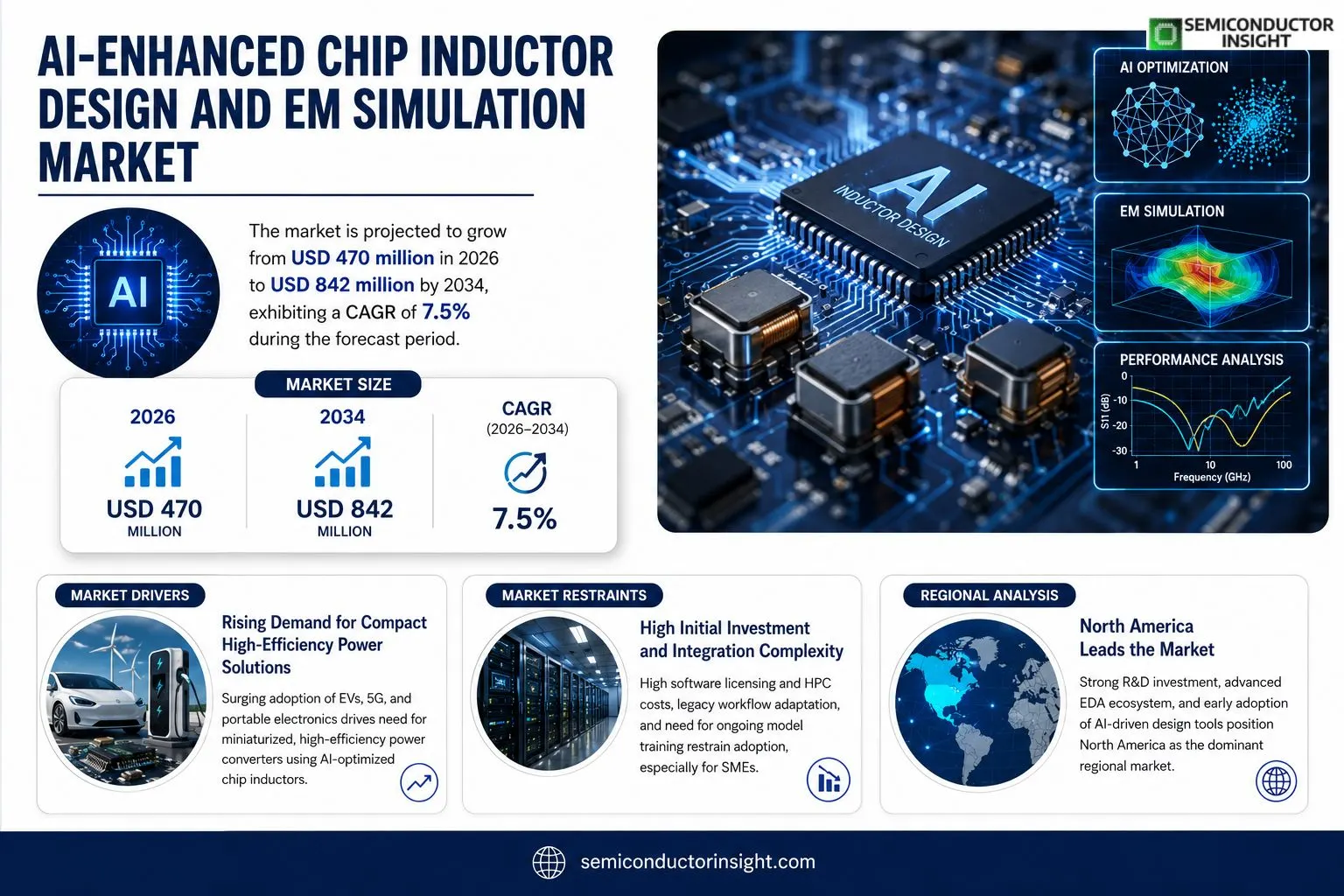
AI‑enhanced chip inductor design and electromagnetic (EM) simulation market size was valued at USD 452 million in 2025. The market is projected to grow from USD 470 million in 2026 to USD 842 million by 2034, exhibiting a CAGR of 7.5% during the forecast period.
Chip inductors are miniature passive components employed in power‑management modules, RF front‑ends, and automotive electronics. AI‑driven design tools accelerate layout optimization by predicting parasitic effects, while advanced EM simulation platforms enable accurate high‑frequency performance verification before silicon fabrication.The market is gaining momentum because of rising demand for compact high‑efficiency power converters in electric vehicles, expanding deployment of 5G infrastructure, and increasing investment in AI‑based EDA solutions. Furthermore, strategic collaborationssuch as the 2023 partnership between Cadence Design Systems and Murata Manufacturing to embed generative AI algorithms into inductance modelingare expected to further accelerate growth.
MARKET DRIVERS
Rising Demand for Miniaturized Power Solutions
AI-Enhanced Chip Inductor Design and EM Simulation Market is being propelled by the rapid adoption of compact power modules in consumer electronics, electric vehicles, and renewable‑energy converters. Engineers require tighter design cycles and higher performance, which AI‑driven optimization delivers through faster convergence on inductance values and loss reduction.
Advancements in Machine Learning Algorithms
Modern deep‑learning frameworks enable predictive modeling of electromagnetic fields, allowing designers to simulate complex three‑dimensional geometries with fewer mesh elements. As a result, development time shrinks by up to 40 % and cost per design iteration drops markedly, encouraging broader adoption across the supply chain.
➤ “AI integration cuts prototype cycles from weeks to days, directly boosting time‑to‑market for high‑efficiency inductors.”
Furthermore, regulatory pressure for higher energy‑efficiency standards in portable devices is prompting OEMs to seek AI‑assisted design tools that guarantee compliance while maintaining miniaturization goals. These combined forces are establishing a robust growth trajectory for the market.
MARKET CHALLENGES
Complexity of Multiphysics Integration
Integrating electromagnetic simulation with thermal, mechanical, and reliability analyses remains a technical hurdle. Many AI platforms lack seamless data exchange protocols, forcing designers to rely on manual post‑processing, which can introduce errors and extend validation periods.
Other Challenges
Talent Scarcity
Skilled professionals who understand both advanced AI methodologies and high‑frequency inductor physics are limited, creating a bottleneck for firms aiming to implement these sophisticated tools at scale.
MARKET RESTRAINTS
High Initial Investment Costs
Deploying AI‑enhanced simulation suites often requires substantial upfront licensing fees and the acquisition of high‑performance computing infrastructure. Small and midsize enterprises find these expenditures prohibitive, limiting market penetration.In addition, legacy design workflows entrenched in traditional EM tools create resistance to change, as organizations weigh the perceived risk of transitioning to AI‑driven platforms against proven, if slower, processes.The need for ongoing software updates and model retraining further adds to the total cost of ownership, making cost‑sensitivity a persistent restraint.
MARKET OPPORTUNITIES
Expansion into Emerging Automotive Powertrains
Electric and hybrid vehicle architectures increasingly rely on high‑frequency power converters, where chip inductors are critical for reducing size and improving efficiency. AI‑enhanced design tools can accelerate the qualification of inductors that meet stringent automotive standards, opening a sizable revenue channel for vendors.Another avenue lies in the integration of cloud‑based AI services, which can democratize access to powerful simulation capabilities for smaller design houses, lowering barriers to entry and fostering a broader ecosystem of adopters.Finally, collaborations between semiconductor manufacturers and AI software firms present an opportunity to embed predictive optimization directly into silicon design flows, creating a value‑added proposition that differentiates products in a competitive marketplace.
AI-Enhanced Chip Inductor Design and EM Simulation Market Trends
Growing Demand for Compact Power Solutions
AI-Enhanced Chip Inductor Design and EM Simulation Market is being reshaped by the accelerating need for high‑efficiency power converters in electric‑vehicle platforms. Design engineers are turning to AI‑driven layout tools that predict parasitic losses early in the development cycle, reducing the number of physical prototypes. Concurrently, electromagnetic simulation suites that incorporate machine‑learning models deliver frequency‑domain accuracy comparable to full‑wave solvers while cutting simulation time by more than half. This combination shortens time‑to‑market for power‑management modules and improves overall system reliability, a critical factor for automotive OEMs seeking to meet tightening efficiency standards.
Other Trends
5G Infrastructure Expansion
Deployment of 5G base stations creates a parallel demand for chip inductors that operate reliably at microwave frequencies. AI‑enhanced EM simulation tools are now routinely used to evaluate high‑Q inductive structures under the tight bandwidth constraints imposed by 5G front‑end designs. The ability to iterate design variants rapidly enables manufacturers to align component performance with the aggressive form‑factor goals of telecom equipment providers, driving a noticeable uptick in orders for AI‑optimised inductor libraries.
Strategic Partnerships Foster Tool Adoption
A notable collaboration in 2023 between Cadence Design Systems and Murata Manufacturing introduced generative‑AI algorithms directly into inductance modeling workflows. The joint solution allows designers to input performance targets and receive multiple geometry options that satisfy both electrical and mechanical constraints. Early field reports indicate a reduction of design cycle length by roughly 30 % for complex power‑management modules, reinforcing the market’s confidence in AI‑augmented design environments. As more EDA vendors align with component manufacturers, the ecosystem around AI‑enhanced chip inductor design and EM simulation is expected to broaden, delivering incremental efficiency gains across a range of end‑use applications.
COMPETITIVE LANDSCAPE
Key Industry Players
AI‑Enhanced Chip Inductor Design and EM Simulation Market – Competitive Outlook
The market is anchored by a handful of large EDA platforms that have integrated generative‑AI capabilities into inductance modeling, most notably Cadence Design Systems, which leverages its long‑standing simulation suite to offer predictive layout optimization. Cadence’s 2023 strategic partnership with Murata Manufacturing brings verified device libraries and AI‑driven parasitic extraction, creating a de‑facto standard for high‑frequency power‑module design. Together they command a sizable share of the design‑tool revenue, while downstream component makers such as Texas Instruments and Analog Devices shape the demand curve by embedding AI‑ready design guidelines in their product roadmaps. This duopoly of software and silicon providers defines a tiered ecosystem where OEMs and contract manufacturers rely on consolidated workflows to shorten time‑to‑market for automotive and 5G power‑management solutions.Beyond the incumbents, a cohort of specialized players is expanding the competitive set. TDK Corporation and Murata continue to innovate on magnetic materials, offering AI‑optimized core geometries that feed directly into simulation loops. Vishay Intertechnology, AVX Corporation, and Taiyo Yuden provide niche chip‑inductor families targeting ultra‑compact IoT modules, while Wurth Elektronik and Rohm Semiconductor focus on automotive‑grade reliability and thermal management. European firms such as STMicroelectronics, Infineon Technologies, and NXP Semiconductors are integrating AI‑assisted EM solvers into their design‑for‑manufacturing pipelines, positioning themselves for the emerging electric‑vehicle power‑train segment. Qorvo and Samsung Electronics add further depth by delivering AI‑compatible RF front‑end modules that benefit from precise inductance modeling, reinforcing the market’s diversified yet interlinked nature.
List of Key AI-Enhanced Chip Inductor Design and EM Simulation Companies Profiled
- Cadence Design Systems
- Murata Manufacturing
- TDK Corporation
- Texas Instruments
- Analog Devices
- Infineon Technologies
- STMicroelectronics
- NXP Semiconductors
- Vishay Intertechnology
- AVX Corporation
- Taiyo Yuden
- Wurth Elektronik
- Rohm Semiconductor
- Qorvo
- Samsung Electronics
Segment Analysis:
| Segment Category | Sub-Segments | Key Insights |
| By Type |
|
AI‑Driven Topology Optimization
|
| By Application |
|
Power Management Modules
|
| By End User |
|
Consumer Electronics Manufacturers
|
| By Technology Trend |
|
Generative AI Modeling
|
| By End‑Use Industry |
|
Electric Vehicles
|
Regional Analysis: AI-Enhanced Chip Inductor Design and EM Simulation Market
North America
Strong demand for miniaturized power modules, coupled with AI‑enabled optimization, propels design activity. Companies leverage predictive analytics to reduce inductance losses, supporting high‑efficiency power conversion across sectors.
Integration of deep‑learning frameworks within EM simulation tools allows rapid parametric sweeps, delivering accurate field predictions while cutting computational expense.
Leading semiconductor manufacturers and specialist software vendors form strategic alliances, co‑developing AI‑augmented design suites that are quickly adopted by downstream OEMs.
The region is poised to consolidate its lead through continued investment in AI research labs, fostering next‑generation generative design capabilities that will reshape chip inductor development.
Europe
European markets exhibit a collaborative approach, with industry consortia driving standards for AI‑enhanced electromagnetic analysis. Nations such as Germany and France prioritize sustainability, encouraging the adoption of low‑loss inductors in renewable energy converters. While funding levels are modest compared with North America, regulatory incentives and a strong focus on cross‑border research projects sustain steady growth, positioning Europe as a hub for precision engineering and niche applications in aerospace and medical devices.
Asia‑Pacific
The Asia‑Pacific region benefits from rapid manufacturing scale‑up and a burgeoning pool of engineering talent. Countries like China, South Korea, and Japan are embedding AI capabilities into domestic chip inductor design workflows to meet aggressive cost targets. Market participants emphasize integration with silicon‑photonic platforms, leveraging AI to manage thermal challenges in densely packed modules. Although the ecosystem is still maturing, the sheer volume of production and aggressive government initiatives ensure a swift escalation in adoption rates.
South America
South America remains in the early adoption phase, with Brazil leading regional interest through university‑industry partnerships that explore AI‑driven EM simulation for automotive electrification. Market growth is tempered by limited access to advanced software tools, yet incremental investments in digital infrastructure are gradually lowering entry barriers. Analysts anticipate that as suppliers expand localized support, South American firms will increasingly incorporate AI‑enhanced design practices to improve component reliability.
Middle East & Africa
The Middle East & Africa exhibits cautious progress, driven largely by renewable energy projects that require efficient power conversion solutions. Investment in AI research hubs in the United Arab Emirates and South Africa is fostering a nascent talent pool focused on electromagnetic modeling. While overall market size remains modest, strategic collaborations with European and North American firms are introducing best‑practice AI tools, laying the groundwork for broader regional uptake in the coming years.
Report Scope
This market research report provides a comprehensive analysis of the AI-Enhanced Chip Inductor Design and EM Simulation Market , covering the forecast period 2026–2034. It offers detailed insights into market dynamics, technological advancements, competitive landscape, and key trends shaping the industry.
Key focus areas of the report include:
- Market Overview: The report begins with an overview outlining its current market scenario, key growth indicators, and industry transformation drivers. It discusses macroeconomic factors, demand–supply balance, regulatory landscape, and the strategic role of semiconductors in powering advancements across industries such as automotive, telecommunications, consumer electronics, and industrial automation.
- Market Size & Forecast: Historical data and future projections for revenue, unit shipments, and market value across major regions and segments.
- Segmentation Analysis: Detailed breakdown by product type, technology, application, and end-user industry to identify high-growth segments and investment opportunities.
- Regional Insights: Insights into market performance across North America, Europe, Asia-Pacific, Latin America, and the Middle East & Africa, including country-level analysis where relevant.
- Competitive Landscape: Profiles of leading market participants, including their product offerings, R&D focus, manufacturing capacity, pricing strategies, and recent developments such as mergers, acquisitions, and partnerships.
- Technology Trends & Innovation: Assessment of emerging technologies, integration of AI/IoT, semiconductor design trends, fabrication techniques, and evolving industry standards.
- Market Drivers & Restraints: Evaluation of factors driving market growth along with challenges, supply chain constraints, regulatory issues, and market-entry barriers.
- Stakeholder Insights: Insights for component suppliers, OEMs, system integrators, investors, and policymakers regarding the evolving ecosystem and strategic opportunities.
Primary and secondary research methods are employed, including interviews with industry experts, data from verified sources, and real-time market intelligence to ensure the accuracy and reliability of the insights presented.
FREQUENTLY ASKED QUESTIONS:
What is the current market size of AI-Enhanced Chip Inductor Design and EM Simulation Market?
-> AI-Enhanced Chip Inductor Design and EM Simulation Market was valued at USD 452 million in 2025 and is expected to reach USD 842 million by 2034.
Which key companies operate in AI-Enhanced Chip Inductor Design and EM Simulation Market?
-> Key players include Cadence Design Systems, Murata Manufacturing, and other leading AI‑EDA and semiconductor firms.
What are the key growth drivers?
-> Key growth drivers include rising demand for compact high‑efficiency power converters in electric vehicles, expanding 5G infrastructure, and increasing investment in AI‑based EDA solutions.
Which region dominates the market?
-> Adoption is strong across North America, Europe, and Asia‑Pacific, with notable activity in regions driving electric‑vehicle penetration and 5G rollout.
What are the emerging trends?
-> Emerging trends include integration of generative AI into inductance modeling, AI‑driven layout optimization, and advanced high‑frequency EM simulation techniques.
Get Sample Report PDF for Exclusive Insights
Report Sample Includes
- Table of Contents
- List of Tables & Figures
- Charts, Research Methodology, and more...
 Download Sample Report PDF