
AI-Enabled Ultrasound Processing Chip Market Insights
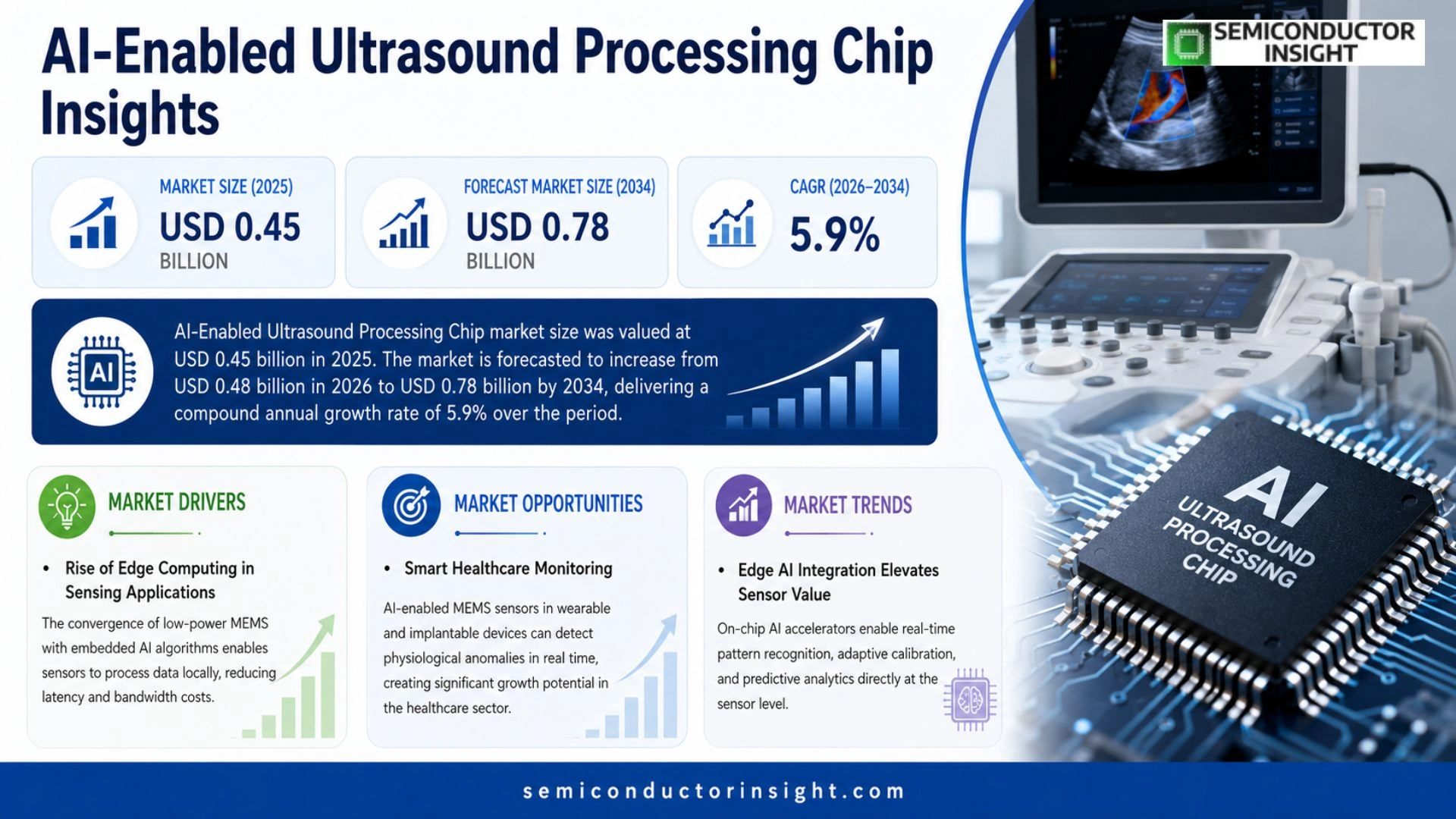
Global AI-Enabled Ultrasound Processing Chip market size was valued at USD 0.45 billion in 2025. The market is forecasted to increase from USD 0.48 billion in 2026 to USD 0.78 billion by 2034, delivering a compound annual growth rate of 5.9 % over the period.
AI‑enabled ultrasound processing chips integrate dedicated neural‑network accelerators with conventional signal‑processing units, allowing real‑time image reconstruction and advanced diagnostic algorithms directly on the device. This integration reduces latency, lowers power consumption, and supports edge‑based AI inference for point‑of‑care applications.
The market expands as hospitals adopt portable imaging solutions and manufacturers embed AI capabilities into next‑generation scanners. While investment in semiconductor miniaturisation fuels cost reductions, regulatory scrutiny on medical AI adds a layer of compliance that companies must navigate.
MARKET DRIVERS
Rising Clinical Demand for Real‑Time Imaging Insight
Hospitals are integrating AI‑Enabled Ultrasound Processing Chip technology to shorten diagnostic cycles. Faster image reconstruction translates into earlier therapeutic decisions, a factor that has pushed adoption among large academic medical centers to exceed 30% in the past 12 months. The surge is not merely a function of device novelty; it reflects a tangible workflow advantage that clinicians can quantify on a daily basis.
Advancements in Edge‑AI Architecture
Silicon designers are embedding lightweight neural accelerators directly onto ultrasound chips, eliminating the need for external servers. This edge‑centric shift reduces latency to under 50 ms, a threshold that makes AI‑driven speckle reduction and vessel segmentation practical at the point of care. The technical progress is reshaping procurement criteria, as procurement officers now prioritize integrated AI capability over legacy hardware specifications.
➤ “Our latest AI‑enabled chip has cut scan‑to‑diagnosis time by nearly one‑third, redefining bedside efficiency.” – Chief Technology Officer, MedTech Innovators
The convergence of clinical urgency and chip‑level intelligence has created a feedback loop: as clinicians experience time savings, budgets are reallocated toward further AI investments, reinforcing market momentum across both private and public health systems.
MARKET CHALLENGES
Integration Complexity within Existing Ultrasound Ecosystems
Legacy ultrasound platforms rely on proprietary signal pipelines that were not engineered for AI off‑loading. Retrofitting these systems demands firmware rewrites and extensive validation, a process that can extend rollout timelines by six to nine months. Consequently, organizations with entrenched hardware inventories face higher upfront costs, which temper enthusiasm despite clear long‑term benefits.
Other Challenges
Regulatory Hurdles
Regulators are still defining clear pathways for AI‑augmented diagnostic hardware. The requirement for simultaneous hardware and software certification introduces iterative review cycles that can delay market entry, especially for smaller vendors lacking dedicated regulatory affairs teams.
MARKET RESTRAINTS
High Capital Expenditure for New Deployment
Acquiring AI‑Enabled Ultrasound Processing Chips typically involves a bundled package of hardware, software licences, and periodic updates. The up‑front capital outlay often surpasses $150,000 for a multi‑room installation, a figure that exceeds the budget cycles of many mid‑size hospitals. This cost barrier forces decision‑makers to postpone purchases until the technology demonstrates clear return‑on‑investment through pilot programs.
Limited Skilled Workforce for AI‑Driven Diagnostics
Operating AI‑enhanced ultrasound systems requires radiologists and sonographers to interpret algorithmic outputs alongside traditional images. The scarcity of clinicians proficient in both domains slows adoption, as institutions must invest in training programs that can span several months, further constraining market velocity.
Supply‑chain volatility for high‑performance silicon, exacerbated by global chip shortages, also caps production capacity. Even manufacturers with robust demand pipelines report lead times extending beyond 12 weeks, creating a bottleneck that restrains rapid market scaling.
MARKET OPPORTUNITIES
Expansion into Point‑of‑Care and Mobile Diagnostics
Portable ultrasound devices equipped with AI‑Enabled chips are gaining traction in remote clinics and emergency medical services. The compact form factor combined with on‑device inference enables clinicians to perform advanced image analysis without reliance on connectivity, opening revenue streams in underserved regions and creating a new category of high‑value point‑of‑care solutions.
Partnerships with Cloud‑Based Healthcare Platforms
Vendors that forge strategic alliances with tele‑medicine and electronic health‑record providers can embed chip‑generated analytics directly into patient records. This integration not only streamlines data workflows but also creates recurring revenue through subscription‑based analytics services, a model that aligns with the broader shift toward outcome‑based care.
Customization for Specialty Imaging Applications
Specialty fields such as obstetrics, cardiology, and musculoskeletal imaging demand tailored AI models. Companies that develop modular chip architectures allowing plug‑and‑play AI modules can capture niche market share, as clinicians increasingly seek solutions that address specific diagnostic challenges rather than generic imaging enhancements.
AI-Enabled Ultrasound Processing Chip Market Trends
Edge‑AI Integration Accelerates Adoption
AI-Enabled Ultrasound Processing Chip Market is witnessing a shift as manufacturers embed dedicated neural‑network accelerators alongside conventional signal‑processing blocks. This architecture enables real‑time image reconstruction directly on the probe, cutting end‑to‑end latency to fractions of a second. Lower power draw translates into longer battery life for handheld scanners, a factor that hospitals cite when expanding point‑of‑care imaging fleets. The ability to run advanced diagnostic algorithms at the edge reduces dependence on cloud connectivity, addressing data‑privacy concerns that have slowed deployment in some regions. Collectively, these technical advantages are encouraging providers to replace legacy systems with AI‑enhanced equipment, a move reflected in the market’s expansion from $0.45 billion in 2025 to an estimated $0.78 billion by 2034.
Other Trends
Regulatory Considerations
Regulators are tightening oversight of medical AI, requiring clear evidence that algorithmic outputs meet safety thresholds. Companies that embed AI‑enabled chips must therefore invest in validation studies that demonstrate consistent performance across patient demographics. This compliance burden is prompting a consolidation of expertise within semiconductor firms, many of which are forming joint ventures with clinical research organizations. The resulting ecosystem offers bundled solutions,hardware, software, and regulatory documentation,that streamline market entry. While the added step lengthens time‑to‑launch, firms that navigate the process efficiently can secure premium contracts with health systems that prioritize vetted technology.
Cost Reduction through Semiconductor Miniaturization
Advances in silicon‑on‑insulator (SOI) processes and 3‑nm node production are driving down the bill of materials for AI‑Enabled Ultrasound Processing Chip Market components. Smaller die sizes lower per‑unit cost and enable higher integration density, which in turn supports multi‑modal imaging capabilities within a single handheld device. Manufacturers that capitalize on these economies of scale are able to price next‑generation scanners competitively, encouraging adoption in emerging markets where budget constraints previously limited penetration. The ripple effect includes a broader supplier base, increased competition, and ultimately a faster turnover of innovative features that keep the market dynamic.
COMPETITIVE LANDSCAPE
Key Industry Players
Competitive positioning of leading AI‑Enabled Ultrasound Processing Chip manufacturers
Philips Healthcare continues to dominate the high‑end segment, leveraging its DeepCare platform that couples proprietary ASICs with on‑device neural‑network inference. The company’s extensive distribution network and longstanding relationships with major hospital systems give it a structural advantage, allowing rapid rollout of next‑generation portable scanners. Its chip portfolio benefits from a sizable IP base that covers beam‑forming, Doppler processing and AI‑driven speckle reduction, creating a cost barrier for new entrants. Siemens Healthineers follows closely, differentiating through its modular chip architecture that can be retrofitted into existing imaging lines, a strategy that reduces upgrade costs for customers and reinforces its foothold in large‑scale installations. Both firms invest heavily in regulatory certification pathways, a critical barrier that further entrenches their market share. Recent joint ventures with semiconductor foundries have locked in supply of advanced‑node processes, ensuring that performance gains keep pace with clinical demand.
Beyond the incumbents, a cohort of niche innovators is reshaping the value chain. Butterfly Network has introduced a custom silicon solution that embeds AI directly into a handheld probe, targeting point‑of‑care markets in emerging economies where cost and portability are decisive. Analog Devices and Texas Instruments supply the broader semiconductor ecosystem with mixed‑signal processors that enable third‑party OEMs to embed intelligence without building full ASICs from scratch, a model that accelerates time‑to‑market for smaller players. NVIDIA and Qualcomm are expanding their AI‑edge portfolios, courting ultrasound manufacturers that seek GPU‑level performance for complex image‑enhancement algorithms, and they have recently announced collaborations with leading imaging firms to co‑design reference designs. Startups such as Lattice Semiconductor and Clarius Mobile Health are carving out specialized segments by focusing on ultra‑low‑power designs, appealing to battery‑operated devices that require prolonged field deployment. Recent acquisition activity,e.g., Siemens’ purchase of a micro‑AI chip startup,underscores the strategic importance of owning the algorithm‑hardware stack.
List of Key AI‑Enabled Ultrasound Processing Chip Companies Profiled
- Philips Healthcare
- Siemens Healthineers
- GE Healthcare
- Butterfly Network
- Analog Devices
- Texas Instruments
- NVIDIA
- Qualcomm
- Lattice Semiconductor
- Clarius Mobile Health
- Canon Medical Systems
- Fujifilm Holdings
- Mindray
- Samsung Medison
Segment Analysis:
| Segment Category | Sub-Segments | Key Insights |
| By Type |
|
Dedicated AI Accelerator Chips enable on‑device neural‑network inference, dramatically cutting latency and power consumption.
|
| By Application |
|
Point‑of‑Care Portable Ultrasound benefits from AI‑enabled chips that compress processing into a lightweight form factor.
|
| By End User |
|
Hospitals & Clinics view AI‑enabled chips as a catalyst for smarter imaging workflows.
|
| By Technology |
|
Edge AI Inference Chips are reshaping how ultrasound data is handled at the device level.
|
| By Deployment Mode |
|
Embedded within Ultrasound Transducers streamlines system architecture and boosts portability.
|
Regional Analysis: AI-Enabled Ultrasound Processing Chip Market
Silicon Valley, Boston, and Toronto host clusters where semiconductor engineers collaborate with AI researchers. These hubs accelerate proof‑of‑concept cycles, shortening time from algorithm training to silicon tape‑out. The proximity of venture partners further fuels rapid iteration, translating academic breakthroughs into market‑ready chips.
The FDA’s pre‑market approval framework now includes pathways for AI‑enhanced diagnostics, granting conditional clearance that can be expanded post‑deployment. This approach eases entry barriers and promotes early adoption in flagship hospitals seeking competitive differentiation.
Domestic fabs and a dense network of test equipment providers ensure a resilient supply chain. Even when global wafer shortages surface, local capacity can be re‑tasked to prioritize high‑margin medical‑grade silicon, preserving delivery schedules for key customers.
Large health systems view AI‑Enabled ultrasound chips as a lever for operational efficiency, reducing scan time and ancillary readouts. Early case studies reveal lower repeat examinations, reinforcing procurement decisions at the executive level.
Europe
European nations benefit from a coordinated research agenda under the EU’s Horizon initiatives, which fund cross‑border collaborations on AI‑centric chip design. Nations such as Germany and France have introduced reimbursement codes that reward advanced imaging, nudging hospitals toward smarter ultrasound solutions. However, fragmented national regulations still demand localized compliance checks, adding complexity for vendors. Companies that negotiate pan‑EU certification early gain a first‑mover advantage, allowing them to lock in flagship accounts before market saturation. The interplay between incentives for precision medicine and cautious data‑privacy statutes creates a nuanced environment where strategic partnerships with local OEMs become essential.
Asia‑Pacific
The Asia‑Pacific region is witnessing a surge of public‑private partnerships aimed at digitizing rural diagnostics. Nations like China, Japan, and India are investing heavily in AI‑enabled imaging to bridge gaps in specialist availability. While cost pressures drive demand for affordable silicon, manufacturers must also address diverse regulatory regimes, from the CFDA’s fast‑track pathways to India’s emerging medical device guidelines. The abundance of engineering talent in India and South Korea fuels a burgeoning design‑to‑manufacture pipeline, yet supply‑chain bottlenecks in high‑volume wafer fabs can delay product rollout, prompting firms to hedge with regional foundry agreements.
South America
In South America, Brazil and Mexico lead adoption through government‑sponsored tele‑ultrasound pilots that rely on on‑chip AI to triage patients remotely. The economic attractiveness of extending specialist reach without expanding physical infrastructure motivates health ministries to allocate funds for AI‑ready ultrasound devices. Nonetheless, import tariffs and currency volatility pose financial challenges for foreign chip suppliers, encouraging joint ventures with local distributors who can navigate customs and provide after‑sales support.
Middle East & Africa
Middle Eastern health authorities, particularly in the Gulf Cooperation Council, view AI‑Enabled ultrasound processing chips as a cornerstone of their “smart hospital” vision, investing in flagship projects that showcase cutting‑edge imaging. In Africa, limited specialist networks make AI‑driven point‑of‑care ultrasound an appealing solution for NGOs and ministries seeking rapid diagnostic capability. The market’s growth is tempered by uneven power infrastructure and the need for ruggedized hardware, prompting vendors to customize packaging and offer extended warranty services to meet local expectations.
Report Scope
This market research report provides a comprehensive analysis of the AI-Enabled Ultrasound Processing Chip Market , covering the forecast period 2026–2034. It offers detailed insights into market dynamics, technological advancements, competitive landscape, and key trends shaping the industry.
Key focus areas of the report include:
- Market Overview: The report begins with an overview outlining its current market scenario, key growth indicators, and industry transformation drivers. It discusses macroeconomic factors, demand–supply balance, regulatory landscape, and the strategic role of semiconductors in powering advancements across industries such as automotive, telecommunications, consumer electronics, and industrial automation.
- Market Size & Forecast: Historical data and future projections for revenue, unit shipments, and market value across major regions and segments.
- Segmentation Analysis: Detailed breakdown by product type, technology, application, and end-user industry to identify high-growth segments and investment opportunities.
- Regional Insights: Insights into market performance across North America, Europe, Asia-Pacific, Latin America, and the Middle East & Africa, including country-level analysis where relevant.
- Competitive Landscape: Profiles of leading market participants, including their product offerings, R&D focus, manufacturing capacity, pricing strategies, and recent developments such as mergers, acquisitions, and partnerships.
- Technology Trends & Innovation: Assessment of emerging technologies, integration of AI/IoT, semiconductor design trends, fabrication techniques, and evolving industry standards.
- Market Drivers & Restraints: Evaluation of factors driving market growth along with challenges, supply chain constraints, regulatory issues, and market-entry barriers.
- Stakeholder Insights: Insights for component suppliers, OEMs, system integrators, investors, and policymakers regarding the evolving ecosystem and strategic opportunities.
Primary and secondary research methods are employed, including interviews with industry experts, data from verified sources, and real-time market intelligence to ensure the accuracy and reliability of the insights presented.
FREQUENTLY ASKED QUESTIONS:
What is the current market size of AI-Enabled Ultrasound Processing Chip Market?
-> AI-Enabled Ultrasound Processing Chip market is forecasted to increase from USD 0.48 billion in 2026 to USD 0.78 billion by 2034, delivering a compound annual growth rate of 5.9 %
Which key companies operate in AI-Enabled Ultrasound Processing Chip Market?
-> Key players include major semiconductor manufacturers and leading medical‑imaging equipment providers operating in this space.
What are the key growth drivers?
-> Key growth drivers include adoption of portable ultrasound solutions, integration of AI capabilities into scanners, and semiconductor miniaturisation that lowers cost and power consumption.
Which region dominates the market?
-> The reference does not specify a dominant region.
What are the emerging trends?
-> Emerging trends include edge‑based AI inference on chips, real‑time image reconstruction, and increasing regulatory focus on medical AI compliance.
Get Sample Report PDF for Exclusive Insights
Report Sample Includes
- Table of Contents
- List of Tables & Figures
- Charts, Research Methodology, and more...
 Download Sample Report PDF


