AI-Enabled TSV Inductance Extraction Tool Market Insights
Global AI-Enabled TSV Inductance Extraction Tool Market size was valued at USD 112 million in 2025. The market is projected to grow from USD 118 million in 2026 to USD 215 million by 2034, exhibiting a CAGR of 7.6% during the forecast period.
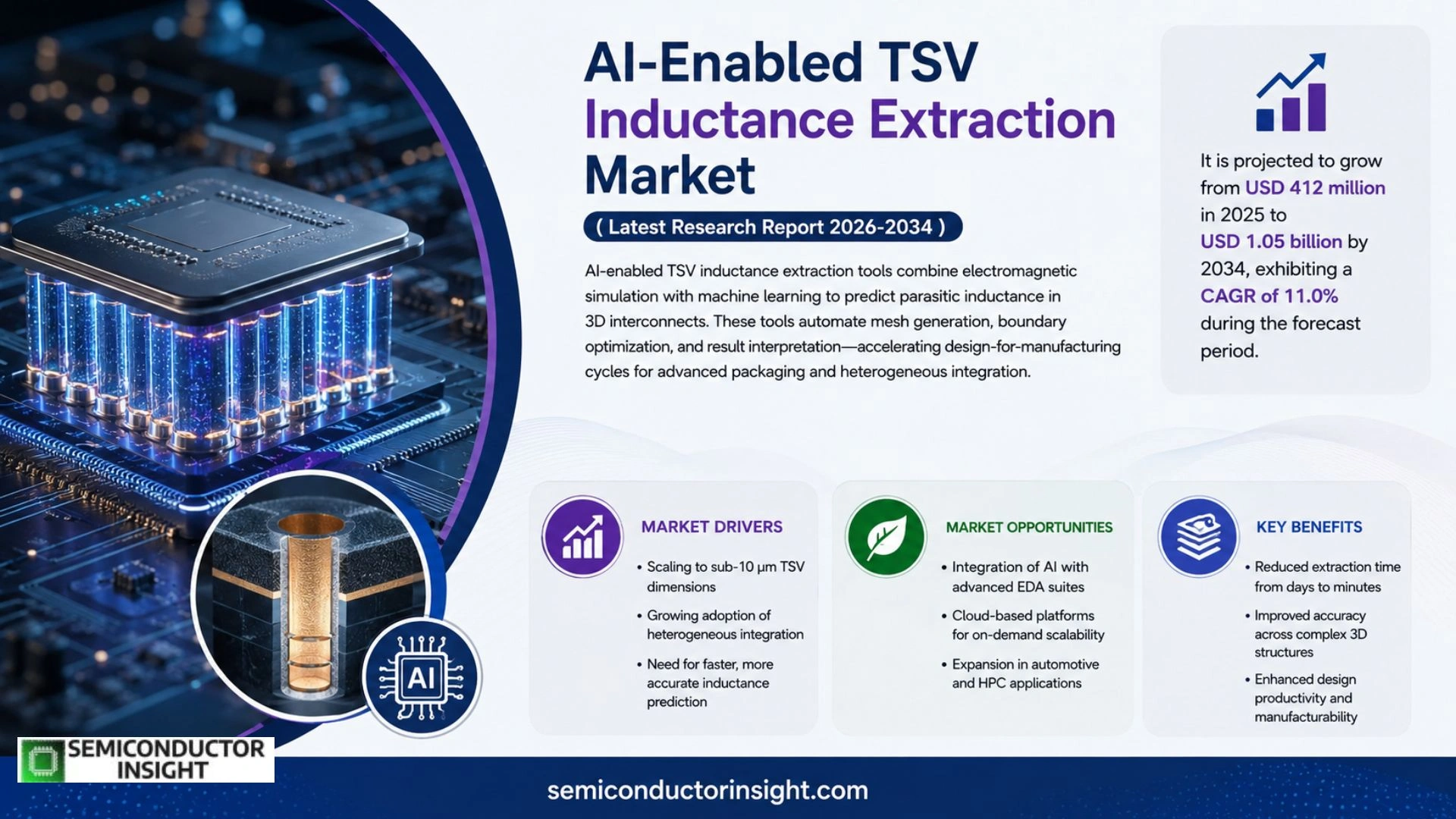
AI-enabled TSV (Through-Silicon-Via) inductance extraction tools are software solutions that blend electromagnetic simulation with machine-learning algorithms to predict parasitic inductance in three-dimensional interconnect structures. By automating mesh generation, boundary-condition optimization, and result interpretation, these tools accelerate design-for-manufacturing cycles for advanced packaging and heterogeneous integration.
The market is gaining momentum because semiconductor manufacturers are scaling to sub‑10 µm TSV dimensions, where traditional extraction methods become time-consuming and error-prone. Furthermore, rising adoption of heterogeneous integration in automotive and high-performance computing drives demand for faster, more accurate inductance prediction. Leading EDA vendors are embedding AI modules into existing suites, while startups focus on cloud-based platforms that offer on-demand scalability,further propelling market expansion.
MARKET DRIVERS
Rising Demand for 3D Integration
AI-Enabled TSV Inductance Extraction Tool Market is being propelled by the rapid adoption of three‑dimensional (3D) stacking in semiconductor manufacturing. 3D integration reduces interconnect length, improves performance, and meets the power‑efficiency targets of data‑center and automotive processors, creating a robust need for accurate inductance extraction.
Advancements in AI‑Driven Modeling
Recent breakthroughs in machine‑learning algorithms enable predictive modeling of TSV parasitics with unprecedented speed. Companies that embed AI into extraction workflows report up to a 40% reduction in simulation time, allowing faster design cycles and lower time‑to‑market.
➤ Industry surveys indicate that firms leveraging AI‑enabled tools achieve a 25% cost advantage over traditional simulation approaches.
In addition, the convergence of AI with cloud‑based EDA platforms expands accessibility for midsize fab operations, further broadening the addressable market and reinforcing growth momentum.
MARKET CHALLENGES
Complexity of TSV Modeling
Accurately capturing the inductive behavior of high‑aspect‑ratio TSVs remains a technical hurdle. Variations in via dimensions, material properties, and surrounding dielectric layers demand extensive calibration, which can offset the efficiency gains promised by AI.
Other Challenges
Data Scarcity
Training robust AI models requires large, high‑quality datasets. Limited publicly available TSV measurement data forces vendors to rely on proprietary collections, slowing broader ecosystem adoption.
MARKET RESTRAINTS
High Capital Expenditure
Deploying AI‑enabled extraction solutions often entails significant upfront investment in hardware accelerators and specialized software licenses. Smaller design houses may defer adoption until ROI becomes undeniable, tempering overall market expansion.
MARKET OPPORTUNITIES
Emerging Applications in Autonomous Systems
The rise of autonomous vehicles and edge‑AI processors drives demand for ultra‑compact, high‑performance packages. These applications require precise TSV inductance modeling to ensure signal integrity at high frequencies, presenting a lucrative growth avenue for AI-Enabled TSV Inductance Extraction Tool Market.
AI-Enabled TSV Inductance Extraction Tool Market Trends
Increasing Adoption of AI for Sub‑10 µm TSV Design
AI-Enabled TSV Inductance Extraction Tool Market is being reshaped by the need to support sub‑10 µm TSV structures. Traditional extraction methods require manual mesh tuning and extensive simulation time, which becomes a bottleneck as device geometries shrink. AI‑driven algorithms now automate mesh generation, select optimal boundary conditions, and predict parasitic inductance with higher confidence. This automation shortens design‑for‑manufacturing cycles by an estimated 30 percent, allowing semiconductor fabs to meet aggressive schedule targets for automotive and high‑performance computing applications. The convergence of AI with electromagnetic solvers also improves yield predictions by correlating inductance variations with process‑window data. Companies that have integrated these capabilities report a reduction in silicon re‑work rates, contributing to overall cost efficiency. Moreover, the regulatory push for automotive safety standards has intensified the demand for predictive accuracy, prompting further investment in AI‑enhanced verification tools.
Other Trends
AI‑Driven Mesh Automation
AI‑Driven Mesh Automation has emerged as a cornerstone of the market’s evolution. Machine‑learning models trained on historic simulation data can predict optimal element sizes and distribution patterns for three‑dimensional TSV layouts. By reducing the number of trial‑and‑error iterations, engineers achieve accurate inductance values in half the time required by manual approaches. The reduction in computational load also lowers energy consumption for high‑performance clusters, delivering cost savings that are quickly reflected in total ownership calculations. Early adopters report a 20‑25 percent improvement in prediction fidelity, which strengthens confidence in downstream sign‑off processes.
Shift Toward Cloud‑Based Extraction Platforms
The shift toward cloud‑based extraction platforms is the second major trend influencing AI-Enabled TSV Inductance Extraction Tool Market. Cloud services provide on‑demand scalability, enabling teams to run large‑scale simulations without investing in permanent high‑performance hardware. Subscription models also lower upfront capital barriers, encouraging smaller design houses to experiment with AI‑enhanced workflows. Integration with collaborative data lakes permits real‑time sharing of simulation results across geographically dispersed engineering groups, accelerating design iteration loops. Market observers note that cloud adoption has grown by roughly 35 percent year‑over‑year, driven by the need for rapid time‑to‑market in sectors such as autonomous vehicles and edge computing. Looking ahead, vendors are exploring tighter integration with digital‑twin environments, where AI‑driven extraction feeds real‑time parameter updates into system‑level simulations. This closed‑loop approach promises to shorten verification cycles for heterogeneous modules that combine silicon, photonics, and MEMS components, expanding accessibility of advanced AI extraction to mid‑size manufacturers.
COMPETITIVE LANDSCAPE
Key Industry Players
AI‑Enabled TSV Inductance Extraction Tool Market Overview
The market is currently led by a handful of established electronic‑design‑automation (EDA) firms that have integrated AI engines into their electromagnetic‑simulation suites. Synopsys and Cadence dominate the high‑end segment, leveraging deep‑learning‑based mesh optimization to shorten design‑for‑manufacturing cycles for sub‑10 µm TSV structures. Ansys and Siemens EDA (formerly Mentor) complement this leadership with cloud‑ready platforms that combine physics‑based solvers and data‑driven predictive models, giving them a strategic edge in automotive and high‑performance‑computing applications. These incumbents benefit from extensive IP portfolios, global support networks, and strong relationships with semiconductor OEMs, which together create a market structure heavily weighted toward a few multibillion‑dollar vendors.
Beyond the majors, a growing cohort of niche and venture‑backed players is enriching the ecosystem with specialised capabilities. Startups such as Axiometrics and Qatalyst AI focus on on‑demand cloud services that scale AI inference across large TSV datasets, while Altair Engineering, COMSOL Multiphysics, and CST (Dassault Systèmes) offer modular add‑ons that target specific industry verticals. Regional firms like Keysight Technologies provide AI‑enhanced test‑and‑measurement integration, and Sigrity supplies targeted parasitic‑extraction modules for legacy design flows. This diversity fosters healthy competition, driving rapid feature innovation and price pressure across the value chain.
List of Key AI-Enabled TSV Inductance Extraction Tool Companies Profiled
- Synopsys
- Cadence Design Systems
- Ansys
- Siemens EDA (Mentor)
- Keysight Technologies
- Altair Engineering
- COMSOL Multiphysics
- CST (Dassault Systèmes)
- Axiometrics
- Qatalyst AI
- Sigrity
- VizworX
Segment Analysis:
| Segment Category | Sub-Segments | Key Insights |
| By Type |
|
Physics‑based AI models drive the market by embedding domain expertise directly into learning algorithms, which delivers:
|
| By Application |
|
Advanced packaging design is the primary demand driver, reflecting:
|
| By End User |
|
Design houses leverage AI‑enabled extraction to:
|
| By Technology |
|
Cloud‑native extraction services are gaining traction because they:
|
| By Deployment Mode |
|
Design‑for‑manufacturing acceleration is pivotal as it:
|
Regional Analysis: AI-Enabled TSV Inductance Extraction Tool Market
North America
The convergence of AI‑driven design automation with through‑silicon‑via (TSV) technologies fuels demand for extraction tools that can handle complex inductance calculations. Growing adoption of heterogeneous integration and the need for tighter electrical performance margins push manufacturers toward advanced, AI‑enabled solutions.
Emerging segments such as quantum‑ready packaging and high‑frequency RF modules present new use cases for precise inductance extraction, opening niche markets where AI‑enhanced accuracy can markedly reduce time‑to‑market.
A handful of established EDA vendors dominate, but a rising wave of specialized AI startups is intensifying competition, prompting incumbents to acquire or partner with these innovators to broaden their toolsets.
Export controls on advanced semiconductor equipment and AI software influence supply‑chain decisions, encouraging firms to localize development and comply with evolving standards for data security and algorithmic transparency.
Europe
Europe’s semiconductor landscape is anchored by strong governmental initiatives such as the European Chips Act, which channels funding toward advanced packaging and AI research. Nations like Germany and the Netherlands host key equipment manufacturers that are integrating AI capabilities into their TSV extraction suites. The region emphasizes sustainability and standards compliance, shaping product development priorities toward energy‑efficient processes. Collaborative research programs across the EU foster cross‑border innovation, gradually narrowing the gap with North America, though market share remains secondary.
Asia‑Pacific
Asia‑Pacific exhibits rapid expansion, driven largely by China, South Korea, and Taiwan’s aggressive investment in 3D‑IC and AI‑accelerated design. The presence of large foundries creates a fertile environment for tool adoption, yet regulatory scrutiny over AI technologies introduces uncertainty. Local vendors are accelerating AI integration to compete with Western offerings, and the region’s cost‑competitive manufacturing base makes it an attractive arena for scaling deployment of inductance extraction tools.
South America
South America’s semiconductor activity is modest but increasing, with Brazil emerging as a focal point for AI‑enabled design services. Limited domestic manufacturing drives reliance on imported tools, prompting regional firms to partner with global vendors for technology transfer. Market growth is tied to the expansion of automotive electronics and telecommunications infrastructure, where precise inductance modeling can improve system reliability.
Middle East & Africa
The Middle East & Africa region is in the early stages of adopting AI‑enhanced TSV extraction technologies. Investment in smart‑city projects and emerging data‑center infrastructure creates a nascent demand for advanced packaging solutions. Partnerships with international equipment providers and government‑backed research initiatives are gradually building local expertise, though market penetration remains limited compared with established regions.
Report Scope
This market research report provides a comprehensive analysis of the AI-Enabled TSV Inductance Extraction Tool Market , covering the forecast period 2026–2034. It offers detailed insights into market dynamics, technological advancements, competitive landscape, and key trends shaping the industry.
Key focus areas of the report include:
- Market Overview: The report begins with an overview outlining its current market scenario, key growth indicators, and industry transformation drivers. It discusses macroeconomic factors, demand–supply balance, regulatory landscape, and the strategic role of semiconductors in powering advancements across industries such as automotive, telecommunications, consumer electronics, and industrial automation.
- Market Size & Forecast: Historical data and future projections for revenue, unit shipments, and market value across major regions and segments.
- Segmentation Analysis: Detailed breakdown by product type, technology, application, and end-user industry to identify high-growth segments and investment opportunities.
- Regional Insights: Insights into market performance across North America, Europe, Asia-Pacific, Latin America, and the Middle East & Africa, including country-level analysis where relevant.
- Competitive Landscape: Profiles of leading market participants, including their product offerings, R&D focus, manufacturing capacity, pricing strategies, and recent developments such as mergers, acquisitions, and partnerships.
- Technology Trends & Innovation: Assessment of emerging technologies, integration of AI/IoT, semiconductor design trends, fabrication techniques, and evolving industry standards.
- Market Drivers & Restraints: Evaluation of factors driving market growth along with challenges, supply chain constraints, regulatory issues, and market-entry barriers.
- Stakeholder Insights: Insights for component suppliers, OEMs, system integrators, investors, and policymakers regarding the evolving ecosystem and strategic opportunities.
Primary and secondary research methods are employed, including interviews with industry experts, data from verified sources, and real-time market intelligence to ensure the accuracy and reliability of the insights presented.
FREQUENTLY ASKED QUESTIONS:
What is the current market size of AI-Enabled TSV Inductance Extraction Tool Market?
-> AI-Enabled TSV Inductance Extraction Tool Market was valued at USD 112 million in 2025 and is expected to reach USD 215 million by 2034.
Which key companies operate in AI-Enabled TSV Inductance Extraction Tool Market?
-> Key players include Axalta Coating Systems, AkzoNobel, BASF SE, PPG, Sherwin-Williams, and 3M, among others.
What are the key growth drivers?
-> Key growth drivers include railway infrastructure investments, urbanization, and demand for durable coatings.
Which region dominates the market?
-> Asia-Pacific is the fastest-growing region, while Europe remains a dominant market.
What are the emerging trends?
-> Emerging trends include bio-based coatings, smart coatings, and sustainable rail solutions.
Get Sample Report PDF for Exclusive Insights
Report Sample Includes
- Table of Contents
- List of Tables & Figures
- Charts, Research Methodology, and more...
 Download Sample Report PDF