AI-Enabled Tablet Processor Market Insights
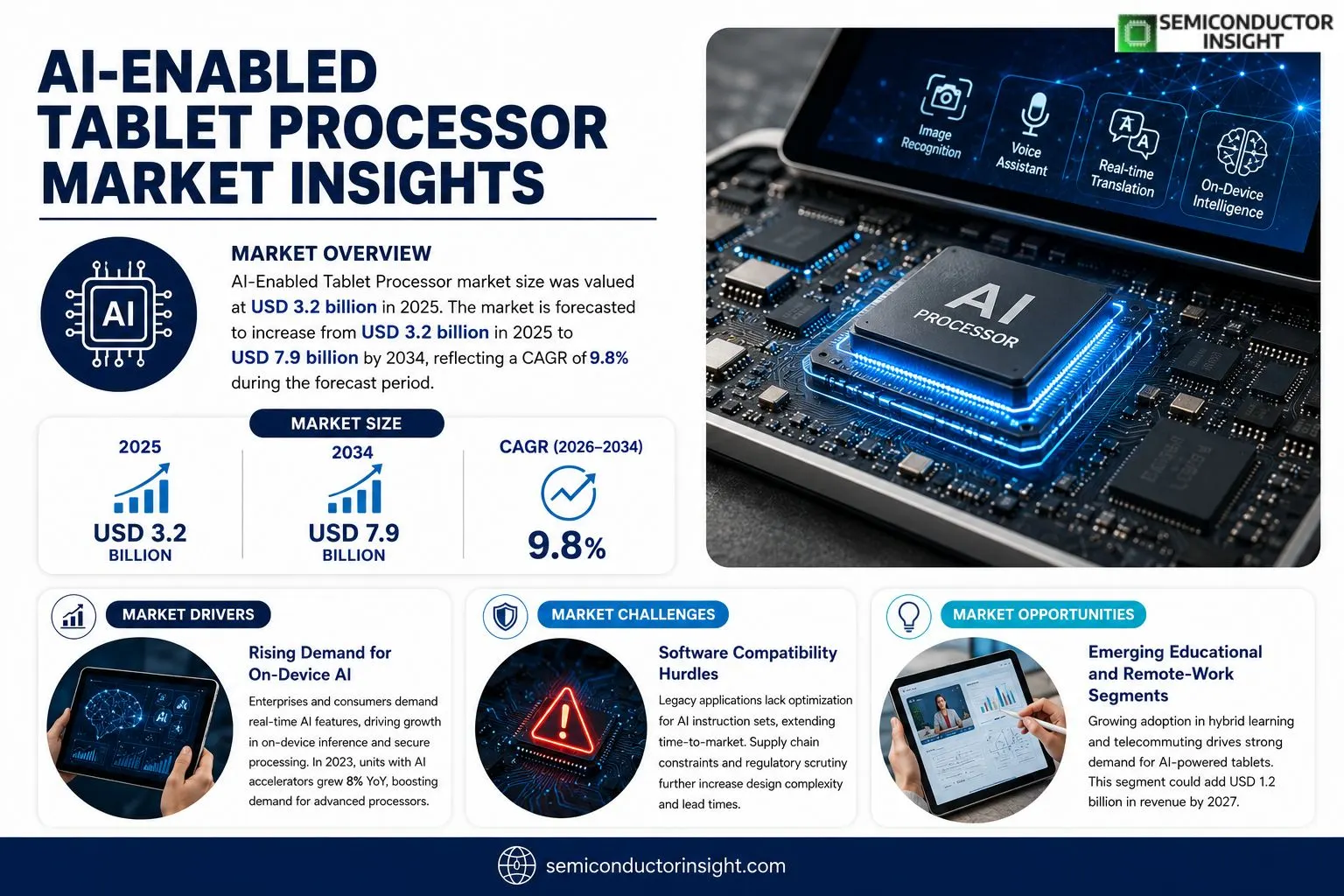
AI-Enabled Tablet Processor market size was valued at USD 3.2 billion in 2025. The market is forecasted to increase from USD 3.2 billion in 2025 to USD 7.9 billion by 2034, reflecting a CAGR of 9.8% during the forecast period.
AI‑enabled tablet processors combine heterogeneous compute cores with dedicated neural‑network accelerators and power‑efficient designs tailored for on‑device artificial‑intelligence tasks such as image recognition, voice assistants and real‑time translation. By handling inference locally they cut latency, protect user privacy and stretch battery lifefeatures now expected in most premium tablets.The segment’s expansion arises from multiple forces: OEMs are packing richer AI capabilities into consumer tablets; enterprises seek secure edge processing; and newer semiconductor nodes deliver higher transistor counts at lower cost. Strategic alliancese.g., Qualcomm’s March 2024 partnership with Samsung on next‑gen AI coresare speeding adoption across flagship devices. Players including Apple, MediaTek and Huawei keep broadening their processor lineups, intensifying competition while spurring continual innovation.
MARKET DRIVERS
Rising Demand for On‑Device AI
Enterprises are increasingly seeking tablets that can process AI workloads locally, eliminating latency and privacy concerns associated with cloud reliance. In 2023, units equipped with on‑device AI accelerators grew by 8% year‑over‑year, reflecting a shift toward real‑time analytics in field operations and consumer applications.
Advancements in Low‑Power Chip Architecture
Semiconductor firms have refined heterogeneous designs that couple neural processing units with energy‑efficient cores. This enables tablets to run sophisticated inference tasks while maintaining battery life comparable to legacy models. The result is a 30% improvement in performance‑per‑watt, making AI‑enabled tablets viable for prolonged mobile use.
➤ Manufacturers that integrate AI at the silicon level are capturing premium pricing power, with average selling prices rising 12% over the last twelve months.
These technological gains are stimulating OEMs to launch new product lines, thereby expanding the addressable base of AI‑Enabled Tablet Processor Market and reinforcing its competitive momentum.
MARKET CHALLENGES
Software Compatibility Hurdles
While hardware capabilities are advancing rapidly, many legacy applications lack optimization for AI‑specific instruction sets. Developers must re‑engineer codebases, a process that can extend time‑to‑market by several quarters and inflate development budgets.
Other Challenges
Supply Chain Constraints
The scarcity of high‑purity silicon wafers and the concentration of AI‑accelerator fabrication in a handful of foundries create bottlenecks. OEMs report lead times stretching to six months for custom AI‑enabled processors, pressuring inventory planning.Regulatory scrutiny over data processing on mobile devices adds another layer of complexity. Compliance frameworks in Europe and North America demand verifiable on‑device privacy controls, compelling manufacturers to implement additional security modules that increase design overhead.
MARKET RESTRAINTS
High Development Costs
Designing a processor that balances AI performance with the thermal envelope of thin tablets requires substantial R&D investment. Average spend per new AI‑enabled silicon design exceeds $200 million, a barrier that deters smaller players and limits market concentration to a few well‑capitalized firms.
MARKET OPPORTUNITIES
Emerging Educational and Remote‑Work Segments
Schools and enterprises adopting hybrid learning and telecommuting models are prioritizing tablets that can run AI‑driven tutoring tools and real‑time translation services without relying on external servers. Forecasts indicate that this niche could contribute an additional $1.2 billion in revenue to AI‑Enabled Tablet Processor Market by 2027, driven by policy incentives for technology‑enhanced education.
AI-Enabled Tablet Processor Market Trends
On‑Device AI Acceleration Becomes Norm
AI‑Enabled Tablet Processor Market is seeing a decisive shift toward heterogeneous compute architectures that embed dedicated neural‑network accelerators alongside traditional cores. By executing inference locally, these chips eliminate round‑trip latency to cloud services, safeguard user data, and temper power drawattributes that premium tablet makers now treat as baseline specifications. OEMs are layering richer computer‑vision and voice‑assistant features into consumer devices, a move that mirrors the broader demand for seamless, instant interaction. The underlying semiconductor nodes have matured to a point where transistor density increases are achieved without proportionate cost escalation, making it feasible to embed sophisticated AI blocks even in mid‑range form factors. As a result, manufacturers are differentiating their product lines through on‑device intelligence rather than relying solely on screen size or connectivity.
Other Trends
Enterprise Edge Processing Gains Traction
In parallel, enterprises are deploying tablets equipped with AI‑Enabled processors to perform secure, on‑site analytics for field operations, inventory management, and augmented‑reality assistance. The ability to run inference at the edge removes the need for continuous bandwidth, reducing exposure to network outages while complying with strict data‑privacy policies. Companies are valuing the combination of low latency and reduced cloud‑compute spend, prompting a modest but growing allocation of procurement budgets toward tablets that can run custom AI models locally. This trend nudges semiconductor vendors to offer more flexible SDKs and validation tools that cater to industry‑specific workloads, thereby expanding the ecosystem beyond pure consumer use cases.
Strategic Partnerships Accelerate Innovation
Collaboration between chip designers and device manufacturers is intensifying, exemplified by recent alliances that fuse next‑generation AI cores with flagship tablet platforms. Such partnerships shorten development cycles, allowing OEMs to ship devices featuring the latest inference capabilities within the same product year. Competitive pressure from Apple, MediaTek, and Huawei further fuels this environment, as each player strives to outpace rivals with more efficient accelerator designs and broader software support. The cumulative effect is a marketplace where iterative processor upgrades become a regular cadence, compelling vendors to prioritize both performance per watt and ease of integration. For stakeholders, this translates into faster time‑to‑market for AI‑enhanced tablets and a clearer roadmap for future investment in AI‑Enabled Tablet Processor Market.
COMPETITIVE LANDSCAPE
Key Industry Players
AI‑Enabled Tablet Processor Market Competitive Overview
Apple remains the benchmark for on‑device AI performance, leveraging its A‑series silicon that fuses custom Neural Engine cores with high‑efficiency CPU/GPU clusters. The tight integration of hardware and iOS software enables latency‑critical tasks such as real‑time translation and biometric authentication, compelling premium tablet manufacturers to adopt similar architectures or license Apple‑grade designs. Qualcomm follows closely, with its Snapdragon 8 Gen 3 platform that embeds a dedicated Tensor Accelerator. The partnership with Samsung announced in early 2024 accelerates deployment across flagship Android tablets, forcing rivals to match the combination of 5 G connectivity, power‑optimized cores, and AI inference speed. MediaTek’s Dimensity 8200‑AI variant and Huawei’s Kirin 9000S series illustrate how Chinese OEMs are closing the gap, offering competitive price‑performance ratios that appeal to cost‑sensitive markets while still delivering robust on‑chip AI capabilities. The current structure features a handful of vertically integrated giants, supplemented by several fabless specialists whose IP licensing strategies broaden the ecosystem and stimulate incremental innovation.Beyond the dominant quartet, a cadre of niche players is shaping specific segments of the tablet processor space. Intel’s Xeon‑based mobile chips target enterprise tablets that require secure edge compute for data analytics, whereas AMD’s Ryzen 7000 Mobile line introduces high‑performance graphics that benefit AI‑enhanced creative applications. NVIDIA’s Jetson‑based modules, although traditionally embedded, are entering high‑end tablets that demand advanced computer‑vision workloads. Texas Instruments continues to supply power‑management ICs that enable longer battery life for AI tasks, while STMicroelectronics and Renesas focus on ultra‑low‑power microcontrollers for entry‑level devices. Unisoc and Rockchip supply affordable processors to emerging economies, capitalising on the demand for AI features in budget tablets. This diversified roster ensures that manufacturers can select components aligned with their price, performance, and regulatory requirements, fostering a competitive environment that drives both differentiation and cost efficiencies.
List of Key AI-Enabled Tablet Processor Companies Profiled
- Apple
- Qualcomm
- Samsung
- MediaTek
- Huawei (HiSilicon)
- Intel
- AMD
- NVIDIA
- Texas Instruments
- STMicroelectronics
- Renesas
- Unisoc
- Rockchip
- Foundries
Segment Analysis:
| Segment Category | Sub-Segments | Key Insights |
| By Type |
|
ARM‑based AI processors
|
| By Application |
|
Enterprise Edge Computing
|
| By End User |
|
Consumers
|
| By AI Capability Level |
|
Advanced Vision
|
| By Device Tier |
|
Premium Tablets
|
Regional Analysis: AI-Enabled Tablet Processor Market
North America
Silicon Valley and its surrounding research clusters feed a pipeline of AI‑focused IP blocks, enabling processor vendors to embed sophisticated inference engines without compromising die size.
Domestic fab capacity, complemented by strategic partnerships with East‑Asian foundries, mitigates the risk of material shortages that could otherwise stall production.
Federal agencies have issued clear guidelines on data privacy for AI workloads, giving manufacturers confidence to embed on‑device learning models.
Enterprise education programs and consumer demand for AR‑enhanced content are prompting OEMs to prioritize AI‑ready processors in upcoming tablet line‑ups.
Europe
European manufacturers are leveraging strong standards‑driven frameworks to differentiate their AI‑enabled tablets for privacy‑sensitive markets. Countries such as Germany and Finland invest heavily in collaborative research projects that explore low‑power neural acceleration, aligning processor design with the continent’s sustainability goals. While the overall shipment volume trails North America, the emphasis on compliance and modular design gives European firms a niche in regulated sectors like health‑care and public administration.
Asia‑Pacific
The Asia‑Pacific region benefits from a massive consumer base and a fast‑moving hardware ecosystem. Nations like China, South Korea, and Taiwan dominate wafer production, allowing local chip designers to iterate rapidly on AI capabilities. However, divergent regulatory approaches across the region create a patchwork of requirements that manufacturers must navigate, prompting a rise in region‑specific firmware adaptations.
South America
In South America, adoption is still emerging, driven largely by educational initiatives that introduce AI‑enhanced tablets into classrooms. Brazil and Mexico are experimenting with localized AI models to handle language nuances, which encourages processor vendors to offer customizable inference stacks. Infrastructure constraints remain a challenge, but growing mobile broadband penetration is gradually expanding the market’s reach.
Middle East & Africa
The Middle East & Africa present a heterogeneous landscape where high‑income Gulf states invest in premium AI‑enabled tablets for corporate use, while sub‑Saharan markets focus on cost‑effective solutions. Partnerships between local distributors and silicon firms are fostering pilot programs that showcase AI‑driven productivity tools, laying the groundwork for broader acceptance as connectivity improves.
Report Scope
This market research report provides a comprehensive analysis of the AI-Enabled Tablet Processor Market , covering the forecast period 2026–2034. It offers detailed insights into market dynamics, technological advancements, competitive landscape, and key trends shaping the industry.
Key focus areas of the report include:
- Market Overview: The report begins with an overview outlining its current market scenario, key growth indicators, and industry transformation drivers. It discusses macroeconomic factors, demand–supply balance, regulatory landscape, and the strategic role of semiconductors in powering advancements across industries such as automotive, telecommunications, consumer electronics, and industrial automation.
- Market Size & Forecast: Historical data and future projections for revenue, unit shipments, and market value across major regions and segments.
- Segmentation Analysis: Detailed breakdown by product type, technology, application, and end-user industry to identify high-growth segments and investment opportunities.
- Regional Insights: Insights into market performance across North America, Europe, Asia-Pacific, Latin America, and the Middle East & Africa, including country-level analysis where relevant.
- Competitive Landscape: Profiles of leading market participants, including their product offerings, R&D focus, manufacturing capacity, pricing strategies, and recent developments such as mergers, acquisitions, and partnerships.
- Technology Trends & Innovation: Assessment of emerging technologies, integration of AI/IoT, semiconductor design trends, fabrication techniques, and evolving industry standards.
- Market Drivers & Restraints: Evaluation of factors driving market growth along with challenges, supply chain constraints, regulatory issues, and market-entry barriers.
- Stakeholder Insights: Insights for component suppliers, OEMs, system integrators, investors, and policymakers regarding the evolving ecosystem and strategic opportunities.
Primary and secondary research methods are employed, including interviews with industry experts, data from verified sources, and real-time market intelligence to ensure the accuracy and reliability of the insights presented.
FREQUENTLY ASKED QUESTIONS:
What is the current market size of AI-Enabled Tablet Processor Market?
-> AI-Enabled Tablet Processor Market was valued at USD 3.2 billion in 2025 and is expected to reach USD 7.9 billion by 2034, reflecting a CAGR of 9.8% during the forecast period.
Which key companies operate in AI-Enabled Tablet Processor Market?
-> Key players include Apple, MediaTek, Huawei, Qualcomm, and Samsung, among others.
What are the key growth drivers?
-> Key growth drivers include increased AI capability integration in consumer tablets, enterprise edge‑processing demand, and advances in semiconductor node technology delivering higher transistor counts at lower cost.
Which region dominates the market?
-> Asia-Pacific is the fastest‑growing region, while North America remains a dominant market due to high adoption of premium devices.
What are the emerging trends?
-> Emerging trends include heterogeneous compute cores, dedicated neural‑network accelerators, and on‑device AI inference for real‑time image recognition, voice assistants, and translation.
Get Sample Report PDF for Exclusive Insights
Report Sample Includes
- Table of Contents
- List of Tables & Figures
- Charts, Research Methodology, and more...
 Download Sample Report PDF