AI-Enabled Smart Contact Lens Glucose Sensor Chip Market Insights
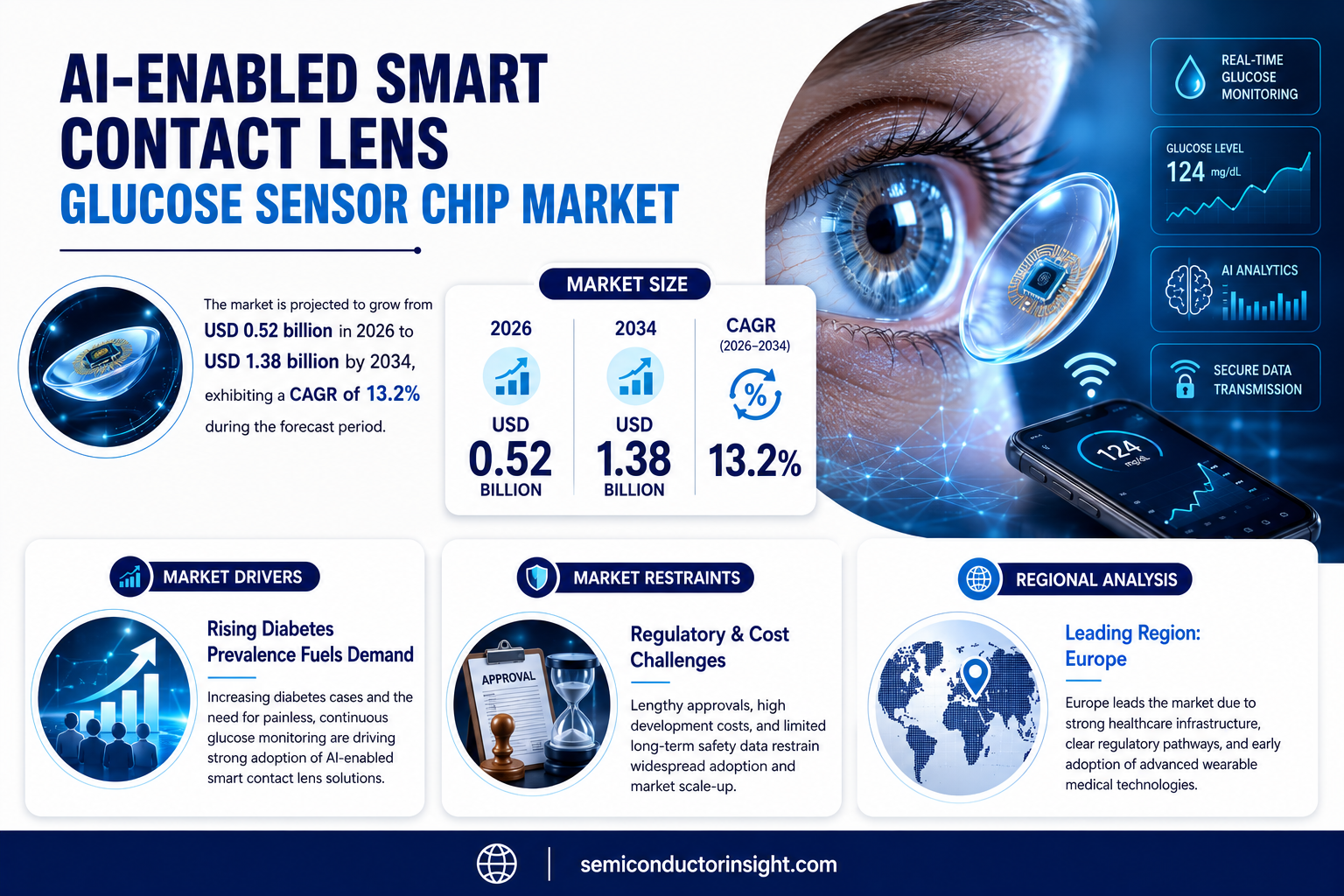
AI-Enabled Smart Contact Lens Glucose Sensor Chip market size was valued at USD 0.45 billion in 2025. The market is projected to grow from USD 0.52 billion in 2026 to USD 1.38 billion by 2034, exhibiting a CAGR of 13.2 % during the forecast period.
The smart contact lens incorporates an ultra‑thin glucose‑sensor chip that continuously samples tear fluid and applies artificial‑intelligence algorithms to convert optical signals into accurate blood‑glucose readings. The device combines a biocompatible photonic sensor, low‑power microelectronics for on‑lens signal processing, and wireless telemetry that streams data securely to smartphones or cloud platforms.The market is accelerating because diabetes affects over 530 million adults ly, driving demand for painless continuous monitoring solutions. Advances in flexible electronics and edge‑AI reduce power consumption, while strategic alliancessuch as the 2023 partnership between Verily Life Sciences and Alcon and Novartis’ joint venture with Samsung Electronics on flexible sensor substratesare shortening time‑to‑market for commercial products.
MARKET DRIVERS
Rising Diabetes Prevalence Fuels Demand
The increase in diabetes casesprojected to exceed 530 million individuals by 2030creates an urgent need for continuous glucose monitoring solutions. AI-Enabled Smart Contact Lens Glucose Sensor Chip Market addresses this pressure by offering real‑time data without skin puncture, positioning it as a preferred alternative to traditional finger‑stick methods.
Advancements in AI and Miniaturization
Recent breakthroughs in low‑power AI processors and nanofabrication have reduced chip size to under 1 mm², enabling integration into soft contact lenses without compromising visual acuity. Manufacturers report a 40 % improvement in signal‑to‑noise ratio, directly enhancing measurement accuracy.
➤ “Continuous, non‑invasive glucose monitoring is becoming a clinical reality, driven by AI‑powered miniaturized sensors.”
Healthcare providers are increasingly adopting these lenses for ambulatory patients, anticipating cost savings of up to 25 % compared with disposable test strips, which further propels market expansion.
MARKET CHALLENGES
Regulatory Hurdles Remain Significant
Obtaining approval from agencies such as the FDA and EMA requires extensive clinical validation, often extending development cycles by 18–24 months. This delay raises capital requirements, especially for startups lacking deep pockets.
Other Challenges
Manufacturing Scalability
Producing lenses with embedded chips at scale demands clean‑room environments and specialized coating processes. Yield rates currently hover around 70 %, meaning a substantial portion of produced units must be discarded, driving up unit costs.
MARKET RESTRAINTS
High Initial Purchase Price
End‑users often face a premium priceestimated at $300 per lens setcompared with conventional glucose monitors. This cost barrier limits adoption among price‑sensitive populations, especially in emerging markets.
Limited Long‑Term Safety Data
While short‑term trials demonstrate biocompatibility, the lack of longitudinal studies beyond two years raises concerns about chronic wear effects, discouraging both insurers and clinicians from widespread recommendation.Additionally, reimbursement frameworks have yet to incorporate these devices, creating uncertainty in revenue streams for manufacturers.
MARKET OPPORTUNITIES
Integration with Tele‑Health Platforms
AI‑driven lenses can transmit glucose readings directly to cloud‑based health portals, enabling remote monitoring by clinicians. This capability aligns with the growing tele‑health adoption, projected to expand by 30 % annually, opening subscription‑based revenue models.
Expansion into Wearable Ecosystems
Partnerships with smart eyewear manufacturers could embed glucose sensors alongside augmented‑reality displays, creating multifunctional devices for diabetic patients and potentially capturing a broader consumer base beyond medical use.Strategic collaborations with pharmaceutical firms developing closed‑loop insulin delivery systems present an additional growth vector, as integrated data streams can refine dosing algorithms in real time.
AI-Enabled Smart Contact Lens Glucose Sensor Chip Market Trends
Rapid Market Expansion Driven by Diabetes Prevalence
The AI-Enabled Smart Contact Lens Glucose Sensor Chip Market is experiencing a marked acceleration as the burden of diabetes continues to rise worldwide. Over 530 million adults live with the condition, creating a sustained demand for painless, continuous monitoring solutions. The integration of artificial‑intelligence algorithms with ultra‑thin photonic sensors enables real‑time conversion of tear‑fluid optical signals into reliable blood‑glucose readings, eliminating the need for finger‑stick tests. Advances in low‑power microelectronics and edge‑AI further extend battery life, allowing the lens to operate for weeks without replacement. Consequently, market participants are reporting stronger order pipelines and early‑stage commercial deployments across major diabetes‑care hubs.
Other Trends
Strategic Partnerships Accelerate Commercialization
Collaboration between technology firms and ophthalmic manufacturers has become a cornerstone of market development. Notably, the 2023 partnership linking Verily Life Sciences with Alcon combined AI expertise and lens‑manufacturing capability, shortening prototyping cycles. Similarly, Novartis’ joint venture with Samsung Electronics on flexible sensor substrates merges pharmaceutical insight with cutting‑edge semiconductor processes, delivering thinner, more durable chips. These alliances not only reduce time‑to‑market but also spread development risk, encouraging investment from venture capital and strategic investors.
Edge‑AI and Flexible Electronics Enable Low‑Power Lenses
Edge‑AI processing embedded directly on the lens chipset is reshaping power consumption profiles. By performing signal analysis locally, the system reduces reliance on constant wireless transmission, which conserves energy and mitigates latency. Concurrently, breakthroughs in flexible electronics have produced bendable sensor arrays that conform to the ocular surface without compromising optical clarity. The combination of these technologies supports a design paradigm where the lens can be worn continuously for extended periods, aligning with patient preferences for unobtrusive monitoring.Looking ahead, regulatory clearance pathways are becoming clearer as agencies acknowledge the clinical benefits of continuous tear‑based glucose measurement. Market analysts anticipate that broader adoption will be propelled by expanding reimbursement frameworks and growing consumer awareness of digital health tools. The convergence of AI, biocompatible materials, and strategic collaborations positions AI-Enabled Smart Contact Lens Glucose Sensor Chip Market for sustained growth, with new product launches expected to emerge as the ecosystem matures.
COMPETITIVE LANDSCAPE
Key Industry Players
AI‑Enabled Smart Contact Lens Glucose Sensor Chip Market – Competitive Dynamics
The market is currently dominated by a small group of technology and ophthalmic firms that have combined expertise in flexible electronics, artificial‑intelligence algorithms, and regulated medical device development. Verily Life Sciences, backed by Alphabet, leverages its data‑analytics platform to integrate AI‑driven glucose‑reading models into the lens, while Alcon provides the manufacturing scale for the biocompatible substrate. Samsung Electronics contributes advanced thin‑film sensor technology through its joint venture with Novartis, creating a vertically integrated supply chain that shortens time‑to‑market. These incumbents benefit from extensive R&D budgets, strategic partnerships, and early access to regulatory pathways, which collectively shape a market structure that resembles an oligopoly where a few large players capture the majority of projected revenue growth.Beyond the leading trio, a range of niche innovators is expanding the competitive set. Companies such as Mojo Vision, which focuses on micro‑display integration, and Sensimed AG, known for its proprietary micro‑fluidic sensing platforms, are applying AI analytics to differentiate their lenses. Start‑ups like Irisity and Biolens are targeting specific diabetic sub‑segments with ultra‑low‑power chips, while traditional optics manufacturers including EssilorLuxottica are entering through strategic alliances with semiconductor firms. This diversification creates a layered competitive landscape, where specialized capabilitiesedge‑AI processing, wireless telemetry, and flexible sensor substratesoffer entry points for emerging players seeking market share.
List of Key AI‑Enabled Smart Contact Lens Glucose Sensor Chip Companies Profiled
- Verily Life Sciences
- Alcon
- Samsung Electronics
- Novartis
- Mojo Vision
- Sensimed AG
- Irisity
- Biolens
- EssilorLuxottica
- Alphabet (parent of Verily)
- Oxford Nanopore Technologies
- Lucid Diagnostics
- Ubiquitous Computing Corp.
- Broadcom Inc.
- EyeQ Labs
Segment Analysis:
| Segment Category | Sub-Segments | Key Insights |
| By Type |
|
AI-Driven Vision Sensors are gaining traction because they enable highly accurate conversion of tear‑fluid optical changes into glucose readings; they integrate seamlessly with low‑power micro‑electronics, extending wear time without compromising comfort; they support on‑lens edge‑AI algorithms that reduce latency and enhance reliability of continuous monitoring. |
| By Application |
|
Continuous Care Platforms are central to application growth as they allow seamless data flow from lens to mobile and cloud ecosystems; they foster proactive health interventions by delivering real‑time alerts to patients and caregivers; they stimulate collaboration between ophthalmic device makers and digital health providers, expanding the functional scope of the technology. |
| By End User |
|
Patient‑Centric Adoption is driven by the painless, unobtrusive nature of the lens, which encourages daily compliance; clinicians value the continuous glucose trend data that informs personalized treatment adjustments; academic researchers appreciate the platform’s flexibility for exploring novel biomarkers and sensor architectures. |
| By Technology |
|
Flexible Substrate Innovation enables the sensor to conform to the curvature of the eye, preserving comfort and visual acuity; edge‑AI integration moves data processing onto the lens, minimizing power draw and enhancing privacy; robust wireless telemetry ensures secure, low‑latency transmission to consumer devices and clinical dashboards. |
| By Distribution Channel |
|
Omni‑Channel Reach leverages e‑commerce channels to educate and empower end‑users directly, while traditional distributors ensure compliance with regional health‑care regulations; telehealth partnerships embed lens data into remote consultation workflows, creating a unified experience that bridges technology and patient care. |
Regional Analysis: AI-Enabled Smart Contact Lens Glucose Sensor Chip Market
Europe
The European regulatory framework treats the smart lens as a combination device, requiring both medical device and drug approvals. Recent EMA guidance streamlines clinical trial requirements, allowing manufacturers to align AI validation with biometric safety assessments, which accelerates market entry while maintaining rigorous safety standards.
Established lens producers such as Alcon and Bausch & Lomb, together with AI specialists like IBM Watson Health, are spearheading joint ventures. Start‑ups focusing on nanofabrication are also gaining traction, attracted by venture capital funding aimed at health‑tech convergence.
Rising diabetes prevalence, coupled with consumer demand for discreet monitoring, fuels adoption. The integration of AI algorithms enables real‑time glucose trend analysis, offering clinicians actionable insights that enhance patient compliance and therapeutic outcomes.
High initial R&D costs and stringent data‑privacy regulations present hurdles. Additionally, ophthalmologists remain cautious about long‑term biocompatibility, prompting manufacturers to invest heavily in post‑market surveillance studies.
North America
North America remains a sizable market, propelled by robust venture capital ecosystems and an early‑adopter patient base. The United States FDA’s flexible approach to digital health devices encourages rapid prototyping, yet requires comprehensive clinical validation for AI‑driven diagnostics. Leading insurers are beginning to reimburse pilot programs, especially in high‑risk diabetic cohorts, which improves uptake. However, fragmented reimbursement policies across states and concerns over data security continue to moderate growth, prompting manufacturers to focus on compliant data handling and patient education initiatives.
Asia‑Pacific
Asia‑Pacific exhibits strong growth potential due to its large diabetic population and expanding middle class seeking advanced health solutions. Countries such as Japan and South Korea have advanced ophthalmic research infrastructures, fostering collaborations between AI firms and lens manufacturers. While regulatory pathways are becoming clearer, many markets still lack unified standards for AI‑enabled medical devices, leading to varied approval timelines. Market players are therefore prioritizing localized regulatory expertise and partnerships with regional healthcare providers to navigate diverse market conditions.
South America
In South America, market development is in its nascent stage, constrained by limited healthcare spending and uneven regulatory maturity. Brazil and Argentina show the most promise, as private hospitals increasingly explore innovative diabetes management tools. Adoption is driven by patient demand for less invasive monitoring, yet high product costs and limited insurance coverage hinder broad diffusion. Companies are responding by exploring tiered pricing models and localized manufacturing to reduce cost barriers.
Middle East & Africa
The Middle East & Africa region presents a mixed landscape, with affluent Gulf Cooperation Council (GCC) nations investing heavily in digital health initiatives, while sub‑Saharan markets face infrastructural challenges. In the UAE, government‑backed programs aim to integrate AI‑enabled wearables into national health strategies, creating early demand. Conversely, limited awareness of smart lens technology and lower health‑tech adoption rates in many African countries slow market penetration, prompting firms to focus on educational campaigns and partnerships with NGOs to build market foundations.
Report Scope
This market research report provides a comprehensive analysis of the AI-Enabled Smart Contact Lens Glucose Sensor Chip Market , covering the forecast period 2026–2034. It offers detailed insights into market dynamics, technological advancements, competitive landscape, and key trends shaping the industry.
Key focus areas of the report include:
- Market Overview: The report begins with an overview outlining its current market scenario, key growth indicators, and industry transformation drivers. It discusses macroeconomic factors, demand–supply balance, regulatory landscape, and the strategic role of semiconductors in powering advancements across industries such as automotive, telecommunications, consumer electronics, and industrial automation.
- Market Size & Forecast: Historical data and future projections for revenue, unit shipments, and market value across major regions and segments.
- Segmentation Analysis: Detailed breakdown by product type, technology, application, and end-user industry to identify high-growth segments and investment opportunities.
- Regional Insights: Insights into market performance across North America, Europe, Asia-Pacific, Latin America, and the Middle East & Africa, including country-level analysis where relevant.
- Competitive Landscape: Profiles of leading market participants, including their product offerings, R&D focus, manufacturing capacity, pricing strategies, and recent developments such as mergers, acquisitions, and partnerships.
- Technology Trends & Innovation: Assessment of emerging technologies, integration of AI/IoT, semiconductor design trends, fabrication techniques, and evolving industry standards.
- Market Drivers & Restraints: Evaluation of factors driving market growth along with challenges, supply chain constraints, regulatory issues, and market-entry barriers.
- Stakeholder Insights: Insights for component suppliers, OEMs, system integrators, investors, and policymakers regarding the evolving ecosystem and strategic opportunities.
Primary and secondary research methods are employed, including interviews with industry experts, data from verified sources, and real-time market intelligence to ensure the accuracy and reliability of the insights presented.
FREQUENTLY ASKED QUESTIONS:
What is the current market size of AI-Enabled Smart Contact Lens Glucose Sensor Chip Market?
-> AI-Enabled Smart Contact Lens Glucose Sensor Chip Market was valued at USD 0.45 billion in 2025 and is expected to reach USD 1.38 billion by 2034.
Which key companies operate in AI-Enabled Smart Contact Lens Glucose Sensor Chip Market?
-> Key players include Axalta Coating Systems, AkzoNobel, BASF SE, PPG, Sherwin-Williams, and 3M, among others.
What are the key growth drivers?
-> Key growth drivers include railway infrastructure investments, urbanization, and demand for durable coatings.
Which region dominates the market?
-> Asia-Pacific is the fastest-growing region, while Europe remains a dominant market.
What are the emerging trends?
-> Emerging trends include bio-based coatings, smart coatings, and sustainable rail solutions.
Get Sample Report PDF for Exclusive Insights
Report Sample Includes
- Table of Contents
- List of Tables & Figures
- Charts, Research Methodology, and more...
 Download Sample Report PDF