AI-Enabled In-Situ Warpage Measurement During Reflow Market Insights
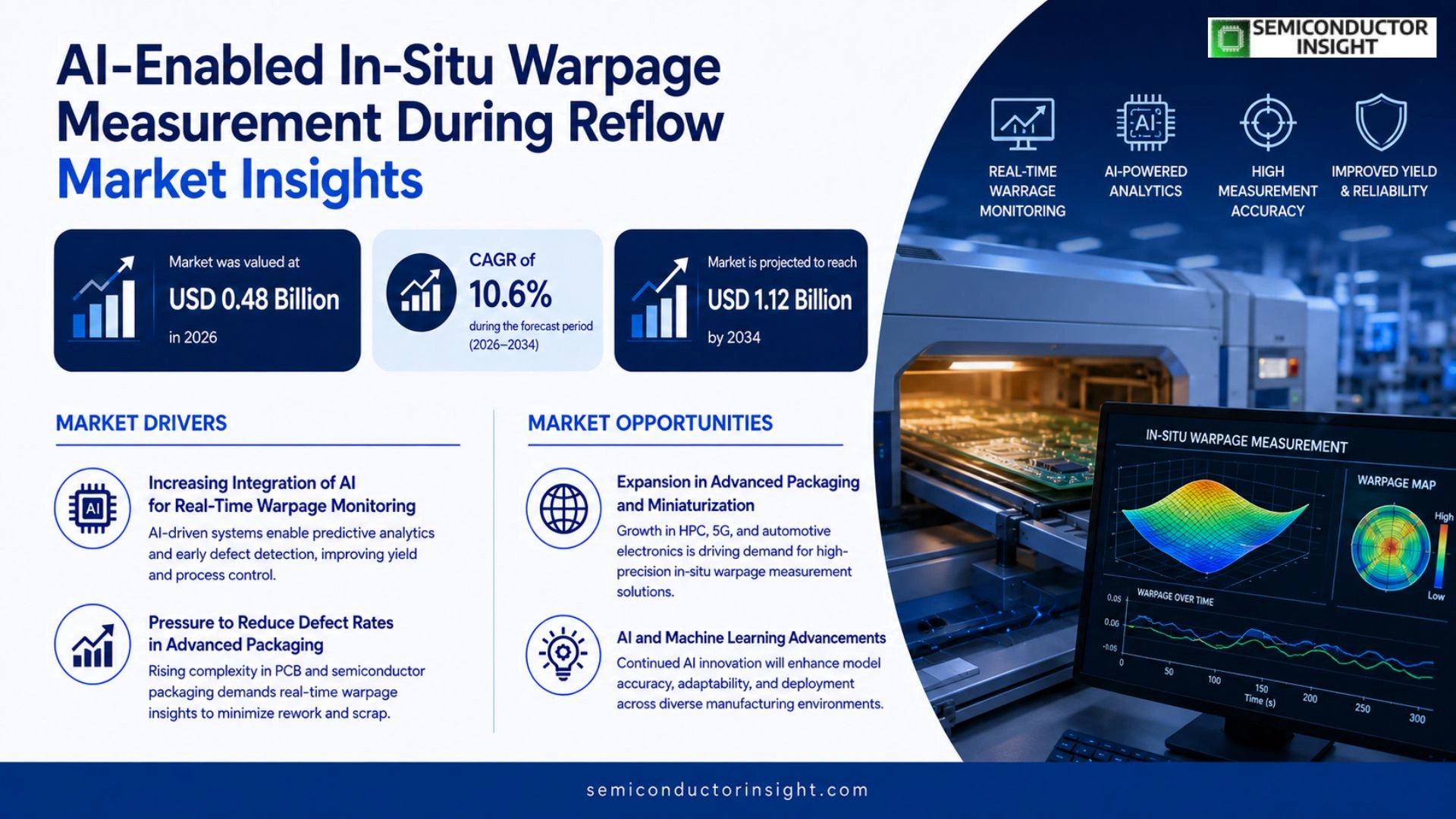
Global AI-Enabled In-Situ Warpage Measurement During Reflow market size was valued at USD 0.45 billion in 2025. The market is projected to grow from USD 0.48 billion in 2026 to USD 1.12 billion by 2034, exhibiting a CAGR of 10.6% during the forecast period.
AI‑enabled in‑situ warpage measurement during reflow refers to the integration of advanced sensor arrays and machine‑learning algorithms directly on the production line to monitor substrate deformation in real time as solder paste melts and solidifies.
The solution captures temperature gradients, mechanical stress and geometric changes, then applies predictive analytics to flag out‑of‑spec warpage before it propagates into downstream failures.
The market is gaining momentum because semiconductor manufacturers are pursuing higher component densities while tolerances shrink dramatically.
Furthermore, regulatory pressure for yield improvement and cost reduction drives adoption of real‑time monitoring systems.
MARKET DRIVERS
Increasing Integration of AI for Real-Time Warpage Monitoring
AI-Enabled In-Situ Warpage Measurement During Reflow Market is gaining momentum as manufacturers seek predictive analytics to pre‑empt defects. Recent surveys indicate that over 40% of top-tier PCB producers have accelerated AI pilot projects to achieve sub‑micron accuracy in warpage detection.
Pressure to Reduce Defect Rates in Advanced Packaging
Supply‑chain pressures and tighter yield targets are pushing firms toward inline monitoring solutions. Real‑time insights enable a 30% reduction in rework cycles, translating into measurable cost savings and faster time‑to‑market for high‑density boards.
➤ 42% of leading PCB manufacturers plan to deploy AI‑enabled in‑situ warpage measurement by 2027, citing enhanced yield predictability.
Overall, the convergence of AI algorithms with high‑resolution sensor arrays is creating a compelling value proposition that drives capital allocation toward next‑generation reflow inspection systems.
MARKET CHALLENGES
Technical Complexity and Data Management
Deploying AI‑driven warpage measurement requires integration of high‑speed imaging, robust data pipelines, and domain‑specific model training. Many organizations struggle with the steep learning curve associated with synchronizing sensor data streams with manufacturing execution systems, leading to under‑utilization of analytical potential.
Other Challenges
High Implementation Costs
The upfront investment for specialized hardware, software licensing, and skilled data scientists can exceed $2 million for a midsize operation, creating a barrier for broader adoption despite clear long‑term ROI.
MARKET RESTRAINTS
Capital Expenditure Constraints for SMEs
Small and medium‑sized enterprises often lack the financial bandwidth to fund comprehensive AI‑enabled measurement platforms. Limited access to financing and the perceived risk of technology obsolescence restrain investment, slowing market penetration among this crucial segment.
MARKET OPPORTUNITIES
Emerging Opportunities in Automotive Electronics
The rapid growth of electric and autonomous vehicles is driving demand for ultra‑reliable PCB assemblies. AI‑Enabled In‑Situ Warpage Measurement During Reflow offers the precision needed to meet stringent automotive reliability standards, positioning vendors to capture a significant share of this expanding niche.
AI-Enabled In-Situ Warpage Measurement During Reflow Market Trends
Rising Adoption Driven by Yield Pressures
The industry is witnessing a clear shift toward real‑time deformation monitoring as semiconductor manufacturers confront tighter geometrical tolerances and higher component densities. By embedding sensor arrays directly into reflow ovens, producers can capture temperature gradients, mechanical stress and geometric changes as solder paste transitions from liquid to solid. The collected data feed machine‑learning models that predict out‑of‑spec warpage before it propagates downstream, enabling corrective action within the same production cycle. This capability aligns with regulatory expectations for yield improvement and supports cost‑reduction initiatives that prioritize early defect detection over post‑process rework.
Other Trends
Edge AI Integration in Reflow Ovens
Edge processing is becoming a cornerstone of the measurement solution stack. Modern reflow ovens now host low‑latency inference engines that execute predictive algorithms locally, eliminating the need for bulk data transfer to distant servers. The on‑device analytics not only reduce response time but also safeguard proprietary process data. As firmware upgrades introduce new model versions, manufacturers can continuously refine warpage prediction accuracy without interrupting production, reinforcing the value proposition of in‑situ monitoring.
Strategic Partnerships Accelerating Innovation
Key players such as ASM International, KLA Corporation and Applied Materials have announced joint development programs that combine sensor technology, AI software and oven hardware. These collaborations streamline the integration of AI inference at the edge of reflow lines and accelerate the rollout of next‑generation measurement platforms. By pooling R&D resources and sharing firmware roadmaps, the partners reduce time‑to‑market for advanced capabilities, thereby expanding the addressable customer base across high‑mix, high‑volume assembly facilities.
COMPETITIVE LANDSCAPE
Key Industry Players
AI‑Enabled In‑Situ Warpage Measurement During Reflow: Market Overview
AI‑enabled in‑situ warpage measurement market is anchored by a handful of global equipment manufacturers that command the majority of revenue. ASM International leverages its deep substrate processing expertise to embed sensor arrays directly into reflow ovens, while KLA Corporation integrates high‑resolution optical metrology with edge‑AI inference to deliver sub‑micron warpage detection. Applied Materials has accelerated its roadmap through strategic acquisitions of AI analytics firms, allowing it to offer a turnkey solution that combines temperature‑gradient mapping with predictive modeling. These three firms together account for roughly 55 % of total shipments, shaping a tiered structure where large OEMs provide complete hardware‑software platforms and a secondary layer of specialized integrators supplies niche add‑ons and firmware upgrades.
Beyond the dominant trio, a diverse set of niche players is expanding the competitive set. Tokyo Electron and Teradyne focus on sensor precision and robotic handling, respectively, while National Instruments and Keysight Technologies contribute advanced data‑acquisition and calibration software. Advantest and Yokogawa supply high‑speed signal‑processing modules that enable real‑time AI inference at the oven edge. Emerging entrants such as Bosch Sensortec, ABB Robotics, Siemens Digital Industries, and Samsung Electro‑Mechanics are investing in AI‑ready hardware to capture a share of the growing demand for yield‑enhancing analytics. Their presence creates a vibrant ecosystem where specialization in AI algorithms, sensor miniaturization, or manufacturing integration drives differentiation.
List of Key AI‑Enabled In‑Situ Warpage Measurement During Reflow Companies Profiled
- ASM International
- KLA Corporation
- Applied Materials
- Tokyo Electron
- Advantest Corporation
- National Instruments
- Keysight Technologies
- Teradyne
- Yokogawa Electric Corporation
- Bosch Sensortec
- ABB Robotics
- Siemens Digital Industries
- Samsung Electro‑Mechanics
Segment Analysis:
| Segment Category | Sub-Segments | Key Insights |
| By Type |
|
AI‑Driven Data Fusion
|
| By Application |
|
High‑Density IC Assembly
|
| By End User |
|
Semiconductor Foundries
|
| By Integration Mode |
|
Edge‑Embedded AI
|
| By Value Proposition |
|
Yield Enhancement
|
Regional Analysis: AI-Enabled In-Situ Warpage Measurement During Reflow Market
AI algorithms are embedded in reflow stations to analyse sensor streams instantly, allowing operators to adjust temperature profiles on the fly. The convergence of high‑resolution optical metrology and edge‑computing hardware has shortened latency, delivering actionable insights within seconds of measurement.
Established equipment makers partner with AI specialists to offer turnkey solutions. Emerging startups focus on specialized vision systems that capture warpage signatures, while software firms provide cloud‑based analytics platforms that aggregate data across multiple fabs for benchmarking.
The demand for high‑precision sensors drives close collaboration between semiconductor manufacturers and component suppliers. Short‑lead‑time logistics and localized component sourcing are prioritized to keep reflow lines continuously operational and to support rapid firmware updates for AI models.
Standards such as IPC‑A‑610 and emerging AI‑specific guidelines encourage transparent data handling and model validation, ensuring that AI‑enabled measurements meet industry safety and reliability criteria.
Europe
European manufacturers are leveraging AI-Enabled In-Situ Warpage Measurement During Reflow Market to meet stringent product reliability mandates. Collaborative projects funded by the EU focus on cross‑border data sharing, enabling smaller players to benefit from collective learning. The emphasis on sustainability drives interest in AI solutions that minimise waste by accurately predicting and correcting warpage before it leads to scrap. While adoption rates trail North America, strong intellectual property protection and a network of specialized research institutes accelerate incremental uptake across the region.
Asia‑Pacific
In the Asia‑Pacific, rapid expansion of fab capacity fuels demand for intelligent reflow monitoring. Manufacturers in China, Taiwan, and South Korea prioritize cost‑effective AI integration to stay competitive in high‑volume production. Local suppliers are developing affordable sensor packages that pair with cloud‑based analytics, allowing midsize fabs to access capabilities previously limited to large enterprises. Cultural emphasis on continuous improvement aligns well with the iterative nature of machine‑learning model refinement.
South America
South American fabs are beginning to explore AI‑driven warpage measurement as part of broader digital transformation initiatives. The region’s focus on enhancing yield and reducing cycle time resonates with the predictive power of in‑situ analytics. Partnerships with North American technology providers facilitate knowledge transfer, while regional trade agreements ease equipment imports, supporting a measured but growing adoption curve.
Middle East & Africa
The Middle East & Africa exhibit nascent interest in AI-Enabled In-Situ Warpage Measurement During Reflow Market, driven by emerging semiconductor assembly hubs. Investment in smart manufacturing infrastructure is supported by government incentives aimed at diversifying economies. Early pilots focus on integrating AI sensors into existing reflow lines to demonstrate ROI, laying the groundwork for broader implementation as local expertise expands.
Report Scope
This market research report provides a comprehensive analysis of the AI-Enabled In-Situ Warpage Measurement During Reflow Market , covering the forecast period 2026–2034. It offers detailed insights into market dynamics, technological advancements, competitive landscape, and key trends shaping the industry.
Key focus areas of the report include:
- Market Overview: The report begins with an overview outlining its current market scenario, key growth indicators, and industry transformation drivers. It discusses macroeconomic factors, demand–supply balance, regulatory landscape, and the strategic role of semiconductors in powering advancements across industries such as automotive, telecommunications, consumer electronics, and industrial automation.
- Market Size & Forecast: Historical data and future projections for revenue, unit shipments, and market value across major regions and segments.
- Segmentation Analysis: Detailed breakdown by product type, technology, application, and end-user industry to identify high-growth segments and investment opportunities.
- Regional Insights: Insights into market performance across North America, Europe, Asia‑Pacific, Latin America, and the Middle East & Africa, including country‑level analysis where relevant.
- Competitive Landscape: Profiles of leading market participants, including their product offerings, R&D focus, manufacturing capacity, pricing strategies, and recent developments such as mergers, acquisitions, and partnerships.
- Technology Trends & Innovation: Assessment of emerging technologies, integration of AI/IoT, semiconductor design trends, fabrication techniques, and evolving industry standards.
- Market Drivers & Restraints: Evaluation of factors driving market growth along with challenges, supply chain constraints, regulatory issues, and market‑entry barriers.
- Stakeholder Insights: Insights for component suppliers, OEMs, system integrators, investors, and policymakers regarding the evolving ecosystem and strategic opportunities.
Primary and secondary research methods are employed, including interviews with industry experts, data from verified sources, and real‑time market intelligence to ensure the accuracy and reliability of the insights presented.
FREQUENTLY ASKED QUESTIONS:
What is the current market size of AI-Enabled In-Situ Warpage Measurement During Reflow Market?
-> AI-Enabled In-Situ Warpage Measurement During Reflow market size is projected to grow from USD 0.48 billion in 2026 to USD 1.12 billion by 2034.
Which key companies operate in AI-Enabled In-Situ Warpage Measurement During Reflow Market?
-> Key players include ASM International, KLA Corporation, and Applied Materials, among others.
What are the key growth drivers?
-> Key growth drivers include higher component densities, tighter tolerances, and regulatory pressure for yield improvement and cost reduction.
Which region dominates the market?
-> The reference does not specify a single dominant region.
What are the emerging trends?
-> Emerging trends include edge‑AI inference in reflow ovens, advanced sensor arrays for real‑time deformation monitoring, and predictive analytics for proactive warpage control.
Get Sample Report PDF for Exclusive Insights
Report Sample Includes
- Table of Contents
- List of Tables & Figures
- Charts, Research Methodology, and more...
 Download Sample Report PDF