AI-Enabled DFM Rule Checking Market Insights
Global AI-Enabled DFM Rule Checking market size was valued at USD 0.78 billion in 2025. The market is forecasted to rise from USD 0.82 billion in 2026 to USD 1.45 billion by 2034, exhibiting a CAGR of 7.6% during the forecast period.
AI‑enabled Design‑for‑Manufacturability (DFM) rule checking merges machine‑learning models with conventional rule libraries to automatically spot manufacturability concerns in PCB layouts, IC packages, and mechanical assemblies. By analysing geometric data against patterns derived from historic failure records, the system proposes corrective actions instantly.
The upward trend reflects expanding adoption of high‑density interconnect designs and tighter time‑to‑market pressures. Companies such as Siemens Digital Industries Software, Ansys Inc., and Cadence Design Systems introduced AI‑augmented DFM modules between 2023 and 2024, accelerating uptake across automotive and consumer electronics sectors.
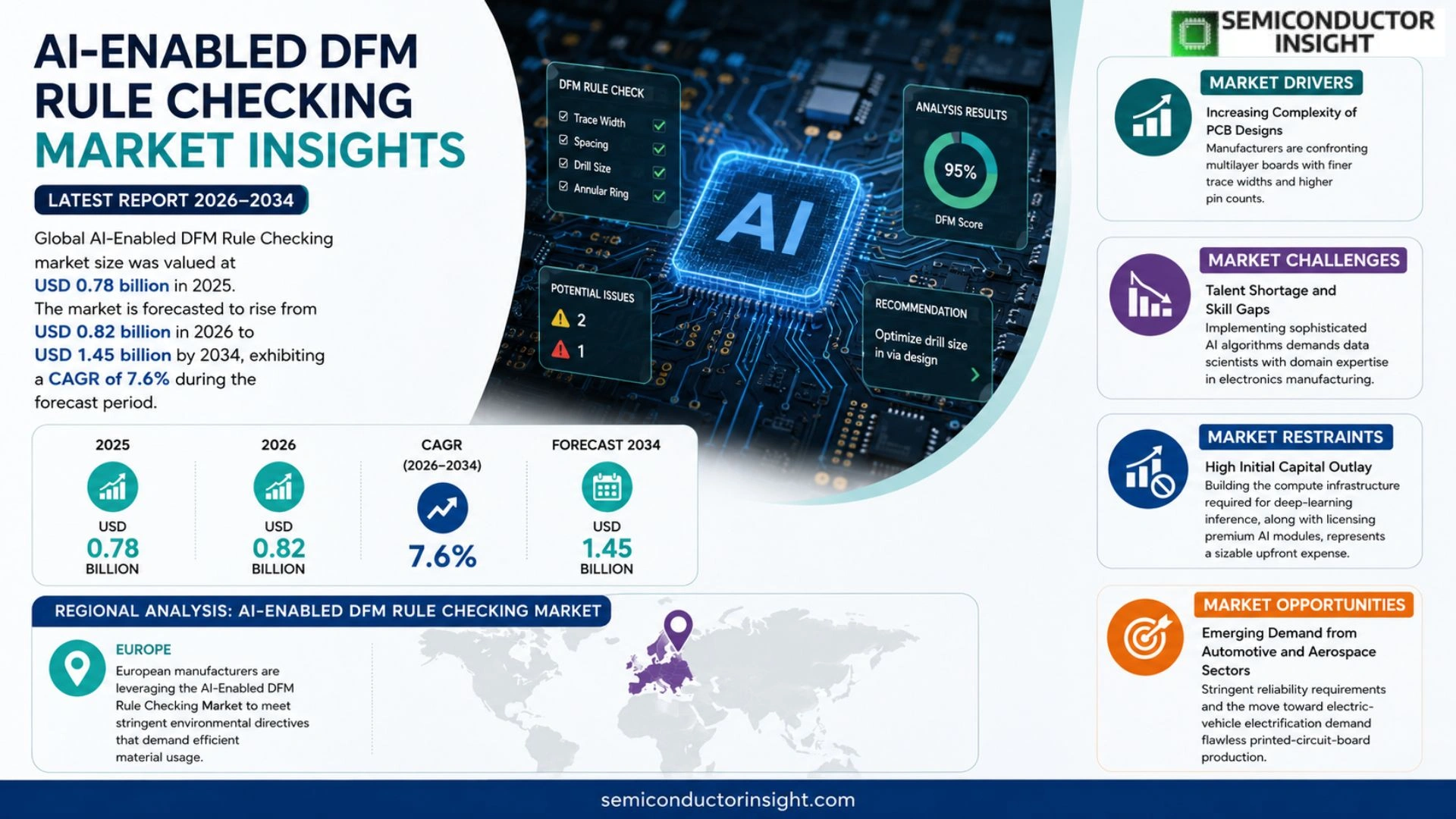
MARKET DRIVERS
Increasing Complexity of PCB Designs
Manufacturers are confronting multilayer boards with finer trace widths and higher pin counts. Design‑for‑Manufacturing (DFM) rule checking that relies on static heuristics cannot keep pace, prompting firms to turn to AI‑augmented solutions. In the AI‑Enabled DFM Rule Checking Market, the shift reduces re‑work cycles and preserves yield, a factor that directly improves profit margins.
Integration of Machine Learning in Design Automation
Machine‑learning models trained on historical defect data now predict rule violations before layout completion. This pre‑emptive insight shortens the prototype phase and frees engineering resources for innovation rather than remediation. Companies that embed these models into their electronic design automation (EDA) suites report a noticeable lift in design throughput.
➤ Deploying AI cuts iteration loops, allowing faster time‑to‑market without sacrificing reliability.
Beyond speed, AI‑driven DFM checks provide consistency across geographically dispersed design teams, fostering a unified quality standard. The emerging capability to continuously learn from new production feedback creates a virtuous cycle that reinforces competitive advantage.
MARKET CHALLENGES
Talent Shortage and Skill Gaps
Implementing sophisticated AI algorithms demands data scientists with domain expertise in electronics manufacturing. The scarcity of such hybrid talent forces many firms to rely on external consultants, inflating project costs and extending deployment timelines.
Other Challenges
Regulatory and Data Security Concerns
Data exchanged between design houses and AI service providers often includes proprietary schematics. Stringent export‑control regulations and heightened cybersecurity awareness create barriers to seamless cloud integration, slowing broader adoption.
MARKET RESTRAINTS
High Initial Capital Outlay
Building the compute infrastructure required for deep‑learning inference, along with licensing premium AI modules, represents a sizable upfront expense. Smaller design firms often lack the financial bandwidth to undertake such investments, limiting market penetration.
Limited Interoperability with Legacy EDA Tools
Many legacy platforms were not built with open APIs, making integration of AI‑enabled DFM engines cumbersome. The need for custom middleware not only raises implementation costs but also introduces potential points of failure that deter risk‑averse adopters.
MARKET OPPORTUNITIES
Emerging Demand from Automotive and Aerospace Sectors
Stringent reliability requirements and the move toward electric‑vehicle electrification demand flawless printed‑circuit‑board production. AI‑enabled DFM rule checking offers the precision needed to meet these standards, positioning vendors to capture a growing slice of the AI‑Enabled DFM Rule Checking Market.
Cloud‑Based SaaS Models Enable Scalable Adoption
Subscription services hosted on secure cloud environments remove the need for heavy on‑premises hardware, lowering the entry barrier for midsize enterprises. Pay‑as‑you‑go pricing aligns costs with usage, making advanced rule checking financially viable for a broader customer base.
Partnerships with Semiconductor Foundries Expand Service Portfolio
Collaborations that embed AI‑driven DFM verification into the foundry’s design‑for‑manufacturing workflow create a one‑stop compliance ecosystem. Such alliances accelerate feedback loops and open cross‑selling opportunities for both hardware manufacturers and software providers.
AI-Enabled DFM Rule Checking Market Trends
AI Integration Elevates Design‑for‑Manufacturability Validation
The infusion of machine‑learning algorithms into rule‑checking engines has reshaped how manufacturers evaluate PCB layouts, IC packages and mechanical assemblies. By continuously learning from historic failure patterns, the technology flags non‑conformities in real time and suggests corrective geometry adjustments. This capability shortens the iteration loop, which matters most to firms racing against compressed product‑launch timelines. Early adopters report a noticeable reduction in re‑work cycles, translating into lower material waste and steadier production line uptime. The heightened reliability of AI‑enhanced checks also mitigates downstream warranty costs, a concern that has grown louder across high‑mix, low‑volume manufacturers.
Other Trends
Automotive Electronics Adoption
Automotive OEMs have intensified scrutiny of electronic subsystems as electric‑vehicle platforms demand denser interconnects and tighter thermal margins. The AI‑Enabled DFM Rule Checking Market has become a strategic tool for these players, enabling them to validate complex power‑train control modules without extensive physical prototyping. Suppliers that embed AI‑augmented verification into their design flow enjoy faster compliance with safety standards, which in turn accelerates supplier qualification cycles. The ripple effect is a more agile supply chain where component selections can be adjusted on‑the‑fly without jeopardizing overall system integrity.
Consumer Device Miniaturization Influences Tool Evolution
Smartphone and wearable manufacturers are pushing component footprints to their technical limits, creating a fertile environment for AI‑powered DFM solutions. The market’s emphasis on ultra‑compact form factors forces designers to confront clearance, routing and heat‑dissipation challenges earlier in the concept stage. When the rule‑checking software suggests layout refinements before silicon tape‑out, teams can avoid costly redesigns that would otherwise surface late in the prototype phase. This shift encourages a design culture where predictive analytics become as integral as traditional simulation, ultimately fostering faster time‑to‑market for next‑generation consumer gadgets.
COMPETITIVE LANDSCAPE
Key Industry Players
AI‑Enabled DFM Rule Checking – Competitive Overview
Siemens Digital Industries Software commands a dominant position, largely because its portfolio integrates a long‑standing DFM engine with a proprietary machine‑learning layer introduced in 2023. This hybrid solution is embedded across the company’s Xpedition suite, allowing automotive OEMs and high‑mix electronics manufacturers to automate failure detection without redesign cycles. The depth of Siemens’ rule library, combined with a broad global support network, creates a barrier to entry that shapes the market’s concentration. Ansys entered the arena with its Discovery Live DFM accelerator, leveraging physics‑based simulation data to feed predictive models. By aligning AI insights with its existing multiphysics platform, Ansys has attracted customers focused on thermal‑aware layout verification, especially in power electronics. Cadence Design Systems rounds out the top tier, embedding AI‑driven checks within its Allegro and OrCAD environments; the firm’s emphasis on rapid rule updates resonates with fast‑paced consumer device programs that cannot tolerate long validation windows.
Beyond the three market leaders, a cluster of niche specialists is gaining traction by targeting specific verticals. Zuken’s CR-8000 AI extension concentrates on complex automotive wiring harnesses, where rule density is exceptionally high. Synopsys has repurposed its verification IP to deliver AI‑enhanced DFM for semiconductor package design, appealing to foundries seeking yield improvements. Altium’s cloud‑based PCB designer now offers a subscription‑only AI rule engine, which lowers adoption cost for small and medium‑size enterprises. Dassault Systèmes leverages its 3DEXPERIENCE platform to combine mechanical assembly constraints with electronic DFM, a synergy valued by aerospace suppliers. Altair Engineering’s HyperWorks suite introduces a data‑driven DFM module that capitalises on its existing optimisation tools, while PTC’s Creo AI add‑on focuses on additive‑manufacturing tolerances. Autodesk’s Fusion 360 AI plug‑in targets makers and rapid‑prototyping shops, and Keysight Technologies supplies a validation‑hardware loop that complements software‑only rule checking by feeding real‑world measurements back into the learning algorithm.
List of Key AI-Enabled DFM Rule Checking Companies Profiled
- Siemens Digital Industries Software
- Ansys Inc.
- Cadence Design Systems
- Zuken
- Synopsys
- Altium Limited
- Dassault Systèmes
- Altair Engineering
- PTC
- Autodesk
- Keysight Technologies
- Mentor Graphics (Siemens EDA)
Segment Analysis:
| Segment Category | Sub-Segments | Key Insights |
| By Type |
|
Hybrid AI‑Manual
|
| By Application |
|
Printed Circuit Board (PCB) DFM
|
| By End User |
|
Automotive Electronics
|
| By Technology |
|
Deep Learning Pattern Recognition
|
| By Industry |
|
Original Equipment Manufacturers (OEM)
|
Regional Analysis: AI-Enabled DFM Rule Checking Market
AI models trained on historical DFM data are now embedded in standard EDA suites, enabling designers to receive instantaneous rule violations. Early‑stage adoption is propelled by the availability of pre‑configured neural networks that require minimal customization, accelerating the rollout across midsize design houses.
Recent updates to industry reliability standards have introduced mandatory AI‑assisted verification checkpoints. Compliance teams in North America are fast‑tracking these requirements, creating a market pull for rule‑checking solutions that can be audited and certified.
Established EDA vendors are forming strategic alliances with AI startups, bundling rule‑checking capabilities with existing design tools. This partnership model intensifies rivalry while expanding the functional envelope of the overall offering.
By surfacing manufacturability risks during schematic capture, customers achieve appreciable reductions in silicon iteration cycles. The downstream impact includes lower tape‑out expenses and a stronger competitive position in fast‑moving technology nodes.
Europe
European manufacturers are leveraging AI-Enabled DFM Rule Checking Market to meet stringent environmental directives that demand efficient material usage. The region’s emphasis on sustainability drives a preference for tools that can predict yield loss before physical prototyping. Collaborative projects between German automotive chip designers and French AI research labs illustrate a cross‑border approach to embedding rule‑checking intelligence within heterogeneous system‑on‑chip (SoC) designs. While adoption rates trail North America, the focus on precision engineering and long‑term reliability ensures a steady increase in market relevance across the continent.
Asia‑Pacific
Asia‑Pacific’s rapid expansion of semiconductor fabs creates a fertile ground for AI‑driven DFM rule checking. Foundries in Taiwan and South Korea demand highly automated verification to keep pace with sub‑10 nm production. Local design houses are integrating cloud‑based rule services to offset talent shortages, capitalizing on cost‑effective AI infrastructure provided by regional cloud providers. The competitive pressure to reduce cycle time fuels a strategic shift toward predictive analytics, positioning the region as a burgeoning hub for next‑generation design validation.
South America
In South America, emerging electronics manufacturers view AI‑enabled rule checking as a means to bridge the gap with more established global players. Investment in training programs focused on machine‑learning applications for DFM is beginning to reshape the talent landscape. Companies are adopting modular AI components that can be scaled with limited capital, allowing them to enhance design quality without extensive upfront expenditures. The region’s growth trajectory is anchored in its ability to harness cost‑efficient AI services to improve yield and meet international client expectations.
Middle East & Africa
Middle East & Africa’s market activity reflects a cautious yet strategic engagement with AI‑enabled DFM rule checking. Government‑backed technology parks in the United Arab Emirates are piloting AI verification platforms to support local semiconductor initiatives. In Africa, a handful of startups are exploring AI models to address design challenges unique to low‑power and ruggedized devices. While the overall market share remains modest, the focus on capacity building and localized solution development hints at a gradual rise in adoption as regional ecosystems mature.
Report Scope
This market research report provides a comprehensive analysis of the AI-Enabled DFM Rule Checking Market , covering the forecast period 2026–2034. It offers detailed insights into market dynamics, technological advancements, competitive landscape, and key trends shaping the industry.
Key focus areas of the report include:
- Market Overview: The report begins with an overview outlining its current market scenario, key growth indicators, and industry transformation drivers. It discusses macroeconomic factors, demand–supply balance, regulatory landscape, and the strategic role of semiconductors in powering advancements across industries such as automotive, telecommunications, consumer electronics, and industrial automation.
- Market Size & Forecast: Historical data and future projections for revenue, unit shipments, and market value across major regions and segments.
- Segmentation Analysis: Detailed breakdown by product type, technology, application, and end-user industry to identify high-growth segments and investment opportunities.
- Regional Insights: Insights into market performance across North America, Europe, Asia-Pacific, Latin America, and the Middle East & Africa, including country-level analysis where relevant.
- Competitive Landscape: Profiles of leading market participants, including their product offerings, R&D focus, manufacturing capacity, pricing strategies, and recent developments such as mergers, acquisitions, and partnerships.
- Technology Trends & Innovation: Assessment of emerging technologies, integration of AI/IoT, semiconductor design trends, fabrication techniques, and evolving industry standards.
- Market Drivers & Restraints: Evaluation of factors driving market growth along with challenges, supply chain constraints, regulatory issues, and market-entry barriers.
- Stakeholder Insights: Insights for component suppliers, OEMs, system integrators, investors, and policymakers regarding the evolving ecosystem and strategic opportunities.
Primary and secondary research methods are employed, including interviews with industry experts, data from verified sources, and real-time market intelligence to ensure the accuracy and reliability of the insights presented.
FREQUENTLY ASKED QUESTIONS:
What is the current market size of AI-Enabled DFM Rule Checking Market?
-> AI-Enabled DFM Rule Checking market is forecasted to rise from USD 0.82 billion in 2026 to USD 1.45 billion by 2034, exhibiting a CAGR of 7.6%
Which key companies operate in AI-Enabled DFM Rule Checking Market?
-> Key players include Siemens Digital Industries Software, Ansys Inc., and Cadence Design Systems, among others.
What are the key growth drivers?
-> Growth is driven by expanding adoption of high‑density interconnect designs, tighter time‑to‑market pressures, and increasing demand in automotive and consumer‑electronics sectors.
Which region dominates the market?
-> The reference does not specify a dominant region; however, adoption is notable across major technology hubs globally.
What are the emerging trends?
-> Emerging trends include AI‑augmented DFM modules, integration of machine‑learning models with traditional rule libraries, and broader application across PCB, IC package, and mechanical assembly design workflows.

Get Sample Report PDF for Exclusive Insights
Report Sample Includes
- Table of Contents
- List of Tables & Figures
- Charts, Research Methodology, and more...
 Download Sample Report PDF