AI Edge Server Accelerator Card Market Insights
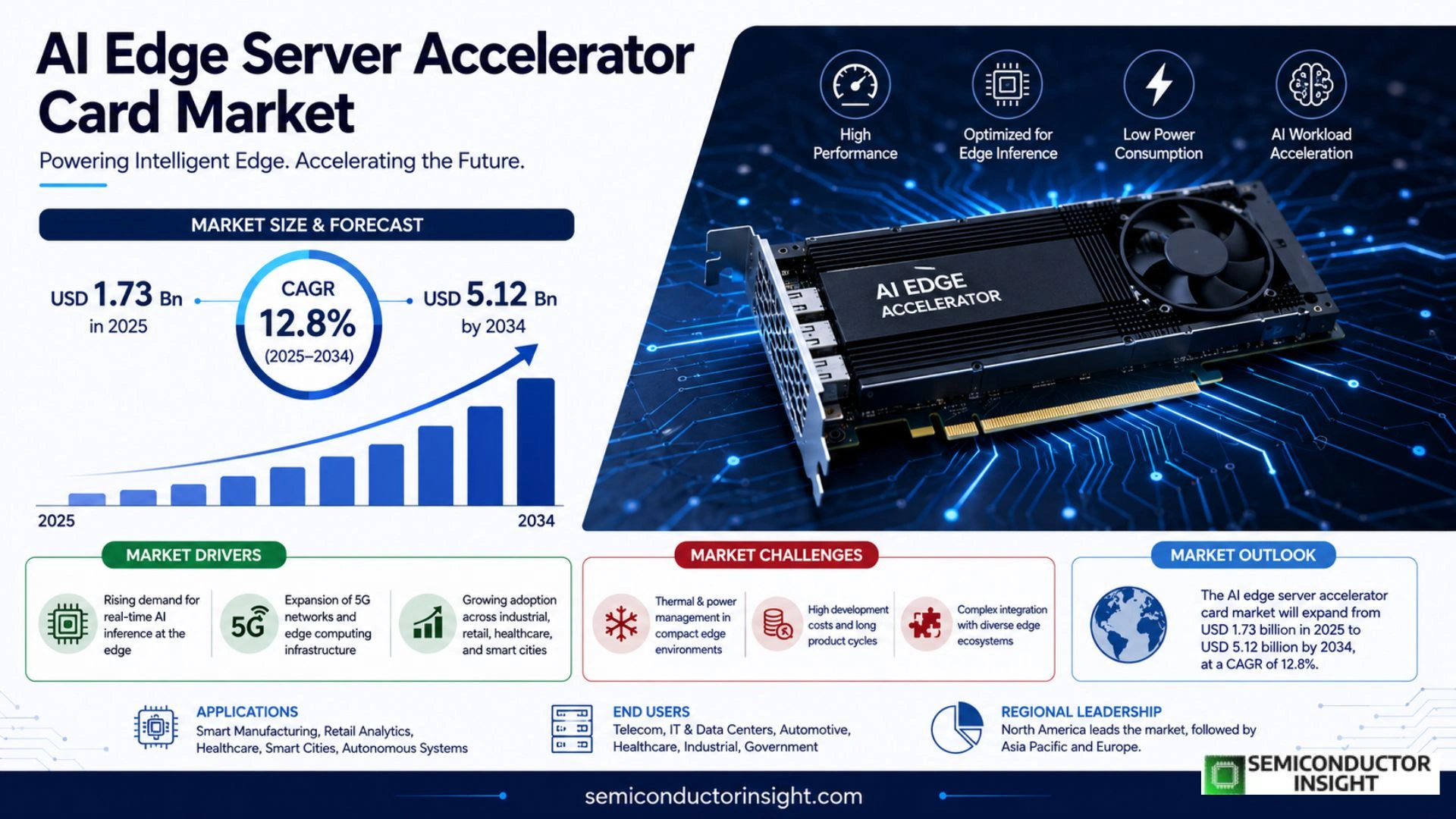
Global AI Edge Server Accelerator Card Market size was valued at USD 1.73 billion in 2025. The market will expand from USD 1.73 billion in 2025 to USD 5.12 billion by 2034, reflecting a CAGR of 12.8% during the forecast period.
AI Edge Server Accelerator Cards are high‑performance compute modules,typically based on GPUs, FPGAs or ASICs,designed for deployment in edge‑located servers where latency‑critical inference workloads run close to data sources such as sensors or cameras.
The upward trajectory stems from enterprises seeking sub‑millisecond response times for applications ranging from autonomous vehicles to smart manufacturing lines; consequently, major vendors have accelerated product rollouts,Nvidia introduced its EGX platform in early 2024 and Intel expanded its portfolio after acquiring Habana Labs,while firms like AMD, Xilinx and Qualcomm continue broadening ecosystem support.
MARKET DRIVERS
Surge in Edge AI Deployments
The proliferation of low‑latency AI workloads,such as real‑time video analytics, autonomous robotics and augmented reality,has compelled enterprises to relocate inference engines from cloud data‑centers to the edge. By situating accelerator cards within edge servers, firms cut round‑trip times by up to 70 %, a capability that directly translates into higher operational efficiency and new revenue streams. This shift fuels the overall expansion of AI Edge Server Accelerator Card Market.
Regulatory Incentives for On‑Premise AI
Governments across North America and Europe are issuing tax credits and funding programmes that reward on‑site AI processing, citing data‑sovereignty and privacy concerns. Companies that embed accelerator cards in local edge nodes can claim up to 15 % of capital expenditure, making capital‑intensive hardware upgrades financially attractive. This policy environment accelerates vendor roadmaps and drives procurement cycles.
➤ “Edge‑centric AI is no longer a niche; it is rapidly becoming the default architecture for latency‑critical services”
As AI models continue to grow in parameter count, the compute density offered by modern accelerator cards,often exceeding 200 TOPS per watt,becomes a decisive factor for manufacturers seeking to differentiate their edge platforms. The confluence of performance demands, fiscal incentives and strategic positioning creates a robust propulsion mechanism for market participants.
MARKET CHALLENGES
Technical Integration Hurdles
Edge environments are typically heterogeneous, featuring legacy CPUs, diverse operating systems and constrained cooling solutions. Integrating high‑performance accelerator cards requires redesigning firmware, updating drivers and validating thermal envelopes, which can extend deployment timelines by several months. Vendors that fail to provide seamless integration kits risk losing contracts to more adaptable rivals.
Other Challenges
Supply‑Chain Constraints
The semiconductor shortage that began in 2020 continues to affect wafers used for AI‑focused ASICs. While volume forecasts suggest a gradual easing, current lead times for edge‑grade accelerator cards hover around 12‑18 weeks, limiting the ability of service providers to meet sudden demand spikes.
MARKET RESTRAINTS
High Power Consumption Limits Uptake
Despite advances in efficiency, many accelerator cards still draw upwards of 150 W under peak load. For remote installations powered by limited‑capacity UPS systems or renewable sources, this energy draw can exceed operational budgets, prompting decision‑makers to postpone or scale back acquisitions. The power envelope thus acts as a practical ceiling on market penetration in energy‑sensitive sectors.
MARKET OPPORTUNITIES
Emerging 5G Edge Use Cases
The rollout of 5G networks unlocks a wave of ultra‑low‑latency services,smart factories, connected vehicles and immersive media,that rely on on‑device AI inference. Accelerator cards optimized for 5G edge nodes can deliver sub‑millisecond response times, positioning them as essential components of the next‑generation service ecosystem. Companies that align product roadmaps with 5G‑driven workloads are poised to capture a significant share of the forthcoming demand.
AI Edge Server Accelerator Card Market Trends
Edge Latency Demands Accelerating Card Adoption
Enterprises are prioritising sub‑millisecond response times for workloads that run at the network perimeter, such as autonomous‑vehicle perception and real‑time quality inspection on production lines. Those use cases compel data‑center operators to relocate inferencing from cloud cores to edge‑located servers, where AI Edge Server Accelerator Card Market solutions,primarily GPU, FPGA and ASIC modules,provide the compute density required for instantaneous decision‑making. Vendor activity reflects this pressure: Nvidia’s EGX platform debuted in early 2024, Intel broadened its edge portfolio after the Habana Labs acquisition, while AMD, Xilinx and Qualcomm are extending driver stacks to support heterogeneous workloads. The shift reshapes procurement cycles, nudging buyers toward modular cards that can be upgraded without overhauling entire server chassis, thereby preserving capital while meeting ever‑tighter latency budgets.
Other Trends
Hybrid Cloud Integration
Clients are linking edge accelerator cards with centralized cloud resources to construct a seamless compute continuum. By off‑loading only the most latency‑sensitive inference to the edge and routing bulk training or batch analytics to public or private clouds, organizations achieve a balanced cost‑performance profile. This model drives demand for standardized APIs and orchestration layers that can dynamically shift workloads based on network conditions, power availability, or security policies. As a result, system integrators are bundling accelerator cards with software‑defined networking fabrics, enabling automated placement decisions that align with service‑level agreements. The ability to fluidly move workloads reinforces the business case for investing in edge‑ready hardware, as it mitigates the risk of siloed deployments and maximises return on investment.
Ecosystem Expansion and Custom Silicon
The competitive landscape is evolving beyond off‑the‑shelf GPU offerings toward purpose‑built silicon that targets specific inference patterns. Start‑ups and established chip makers alike are unveiling ASICs tuned for vision‑oriented models, while FPGA vendors are delivering pre‑programmed IP blocks that reduce development time for niche applications such as predictive maintenance in heavy‑industry settings. This diversification expands AI Edge Server Accelerator Card Market’s value chain, encouraging OEMs to adopt a mix‑and‑match strategy that aligns chip capabilities with workload characteristics. For end users, the ripple effect is clearer visibility into performance per watt, finer control over thermal envelopes, and a broader menu of pricing tiers. Companies that align product roadmaps with this silicon shift can differentiate their edge platforms and capture premium contracts that demand both speed and efficiency.
COMPETITIVE LANDSCAPE
Key Industry Players
AI Edge Server Accelerator Card Market – Competitive Overview
The upper tier of AI Edge Server Accelerator Card market is dominated by a handful of incumbents whose product roadmaps align closely with the latency‑sensitive demands of edge deployments. Nvidia, leveraging its EGX platform launched in early 2024, has cemented a leadership position by bundling high‑throughput GPUs with a software stack that simplifies orchestration across distributed edge nodes. Intel, after integrating Habana Labs’ ASIC expertise, now offers a diversified portfolio that spans GPUs, FPGAs, and purpose‑built inference chips, allowing OEMs to select the optimal silicon for power‑constrained environments. AMD, reinforced by its acquisition of Xilinx, supplies a hybrid of GPU and adaptive FPGA solutions that appeal to manufacturers looking for reconfigurable performance. Qualcomm’s expansion of its Snapdragon AI Engine into server form factors adds a mobile‑grade power efficiency profile that resonates with telecom operators rolling out edge compute at cell sites. Collectively, these firms shape a market structure where scale, ecosystem support, and rapid product cycles form the primary competitive axes, compelling smaller players to differentiate through niche architectures or vertical‑specific optimizations.
Beyond the headline names, a cohort of specialized vendors is carving out relevance by targeting particular workloads or price points. Graphcore’s Intelligence Processing Unit emphasizes fine‑grained parallelism for transformer inference, attracting research‑intensive cloud‑edge hybrids. Cerebras delivers wafer‑scale engines that, while costly, promise unprecedented throughput for high‑resolution video analytics at the edge. Tenstorrent focuses on a tensor‑core design that balances latency and energy consumption, positioning itself as a bridge between data‑center GPUs and ultra‑low‑power ASICs. Start‑ups such as Hailo, Mythic, and Syntiant concentrate on sub‑watt AI accelerators designed for smart cameras and IoT gateways, enabling manufacturers to embed inference without redesigning power budgets. Google’s Edge TPU, integrated into numerous development boards, provides a familiar software ecosystem that eases migration for developers already invested in TensorFlow Lite. Samsung and Huawei, leveraging their foundry capabilities, have introduced proprietary edge‑centric chips that aim to capture regional demand in Asia‑Pacific telecom and industrial automation projects. This layered competitive fabric forces the market leaders to continuously innovate while offering partnership pathways for niche players to access broader distribution channels.
List of Key AI Edge Server Accelerator Card Companies Profiled
- Nvidia Corporation
- Intel Corporation
- Advanced Micro Devices (AMD)
- Qualcomm Incorporated
- Graphcore Ltd.
- Cerebras Systems
- Tenstorrent
- Hailo
- Mythic
- Syntiant
- Google (Edge TPU)
- Samsung Electronics
- Huawei Technologies
Segment Analysis:
| Segment Category | Sub-Segments | Key Insights |
| By Type |
|
GPU‑based accelerators are perceived as the leading segment because they combine high parallel compute density with a mature software ecosystem. • Developers gravitate toward familiar CUDA frameworks, which shortens time‑to‑value for new edge AI workloads. • Their flexibility supports a broad range of inference models, from vision to language processing, fostering rapid adoption across industries. • Continuous innovation in power‑efficiency allows deployment in constrained edge settings without sacrificing performance. |
| By Application |
|
Smart manufacturing emerges as the dominant application segment. • Edge accelerators enable real‑time quality inspection, allowing defects to be identified instantly on the production line. • Integration with sensor networks creates closed‑loop feedback that optimizes process parameters without central cloud latency. • The need for deterministic inference drives preference for low‑power, high‑throughput cards that can be embedded directly in machinery. |
| By End User |
|
Telecommunications is the leading end‑user segment. • Operators embed accelerator cards in edge nodes to support on‑device inference for network optimization and customer experience analytics. • The push for ultra‑low latency services, such as immersive media and real‑time security monitoring, fuels demand for robust edge compute. • Close proximity of compute to the radio access network reduces backhaul strain and enables new service models. |
| By Deployment Environment |
|
Edge data centers lead this segment. • Centralized edge facilities provide controlled environments that balance scalability with proximity to data sources. • They enable multi‑tenant deployments, allowing diverse customers to share high‑performance cards while retaining isolation. • Operators value the ability to upgrade hardware without disrupting downstream devices, promoting longer asset lifecycles. |
| By Architecture |
|
Heterogeneous compute platforms dominate architecture choices. • Combining GPUs with specialized ASICs within a single card addresses diverse workload characteristics, from deep‑learning inference to signal processing. • This flexibility supports modular scaling as applications evolve, reducing the need for complete hardware refreshes. • Vendors emphasize unified software stacks that abstract underlying differences, simplifying integration for system integrators. |
Regional Analysis: AI Edge Server Accelerator Card Market
North America
Enterprises are refactoring legacy workloads to exploit edge‑level inference, prompting data‑center operators to seek accelerator cards that can deliver high throughput with low power draw. The rise of privacy‑centric AI models further fuels this shift, as firms look to keep sensitive data on premises rather than rely on distant clouds.
Federal initiatives encouraging domestic semiconductor production intersect with data‑sovereignty policies, creating an environment where local sourcing of AI accelerator cards is not merely preferred but often mandated for government‑sensitive projects.
Established server OEMs are partnering with niche fabless firms to embed accelerator cards directly into chassis designs, while pure‑play silicon vendors are expanding their sales forces to capture the edge‑focused segment that traditionally belonged to larger integrators.
The rollout of 5G micro‑cells and the proliferation of distributed compute nodes are prompting operators to standardise on modular accelerator cards that can be swapped in field, thus reducing downtime and simplifying logistics.
Europe
European firms are leveraging the continent’s strong standards‑setting bodies to create interoperable accelerator card specifications, a move that smooths cross‑border deployments. Financial services, heavily regulated, are embracing edge AI to meet latency expectations without compromising data residency. Meanwhile, sustainability mandates are shaping design priorities, with manufacturers foregrounding low‑thermal‑design power envelopes to align with EU energy directives.
Asia‑Pacific
The Asia‑Pacific region exhibits a fragmented yet fast‑moving landscape, where national AI strategies in countries such as Japan, South Korea, and Singapore encourage local fab capacity for edge‑oriented silicon. Telecom operators are the primary early adopters, integrating accelerator cards into 5G edge sites to support real‑time analytics for smart‑city initiatives. Local OEMs benefit from close proximity to supply chains, enabling rapid prototype cycles.
South America
In South America, multinational enterprises are piloting edge accelerator deployments to overcome bandwidth constraints in remote mining and agricultural operations. The market narrative is shaped by cost‑sensitivity; therefore, vendors that can offer modular pricing and flexible financing arrangements gain traction. Emerging data‑center parks in Brazil provide a nascent hub for regional hardware assemblers.
Middle East & Africa
The Middle East & Africa segment is characterised by sovereign cloud projects that demand on‑premises AI compute to satisfy both security and latency criteria. Energy‑focused organisations are experimenting with accelerator cards at oil‑field edge nodes to enable predictive maintenance. While the ecosystem is still developing, partnerships between global silicon designers and regional system integrators hint at a gradual build‑out of capability.
Report Scope
This market research report provides a comprehensive analysis of the AI Edge Server Accelerator Card Market , covering the forecast period 2026–2034. It offers detailed insights into market dynamics, technological advancements, competitive landscape, and key trends shaping the industry.
Key focus areas of the report include:
- Market Overview: The report begins with an overview outlining its current market scenario, key growth indicators, and industry transformation drivers. It discusses macroeconomic factors, demand–supply balance, regulatory landscape, and the strategic role of semiconductors in powering advancements across industries such as automotive, telecommunications, consumer electronics, and industrial automation.
- Market Size & Forecast: Historical data and future projections for revenue, unit shipments, and market value across major regions and segments.
- Segmentation Analysis: Detailed breakdown by product type, technology, application, and end-user industry to identify high-growth segments and investment opportunities.
- Regional Insights: Insights into market performance across North America, Europe, Asia-Pacific, Latin America, and the Middle East & Africa, including country-level analysis where relevant.
- Competitive Landscape: Profiles of leading market participants, including their product offerings, R&D focus, manufacturing capacity, pricing strategies, and recent developments such as mergers, acquisitions, and partnerships.
- Technology Trends & Innovation: Assessment of emerging technologies, integration of AI/IoT, semiconductor design trends, fabrication techniques, and evolving industry standards.
- Market Drivers & Restraints: Evaluation of factors driving market growth along with challenges, supply chain constraints, regulatory issues, and market-entry barriers.
- Stakeholder Insights: Insights for component suppliers, OEMs, system integrators, investors, and policymakers regarding the evolving ecosystem and strategic opportunities.
Primary and secondary research methods are employed, including interviews with industry experts, data from verified sources, and real-time market intelligence to ensure the accuracy and reliability of the insights presented.
FREQUENTLY ASKED QUESTIONS:
What is the current market size of AI Edge Server Accelerator Card Market?
-> AI Edge Server Accelerator Card Market was valued at USD 1.73 billion in 2025 and is expected to reach USD 5.12 billion by 2034.
Which key companies operate in AI Edge Server Accelerator Card Market?
-> Key players include Axalta Coating Systems, AkzoNobel, BASF SE, PPG, Sherwin-Williams, and 3M, among others.
What are the key growth drivers?
-> Key growth drivers include railway infrastructure investments, urbanization, and demand for durable coatings.
Which region dominates the market?
-> Asia-Pacific is the fastest-growing region, while Europe remains a dominant market.
What are the emerging trends?
-> Emerging trends include bio-based coatings, smart coatings, and sustainable rail solutions.
Get Sample Report PDF for Exclusive Insights
Report Sample Includes
- Table of Contents
- List of Tables & Figures
- Charts, Research Methodology, and more...
 Download Sample Report PDF