AI-Driven CMP Slurry Market Insights
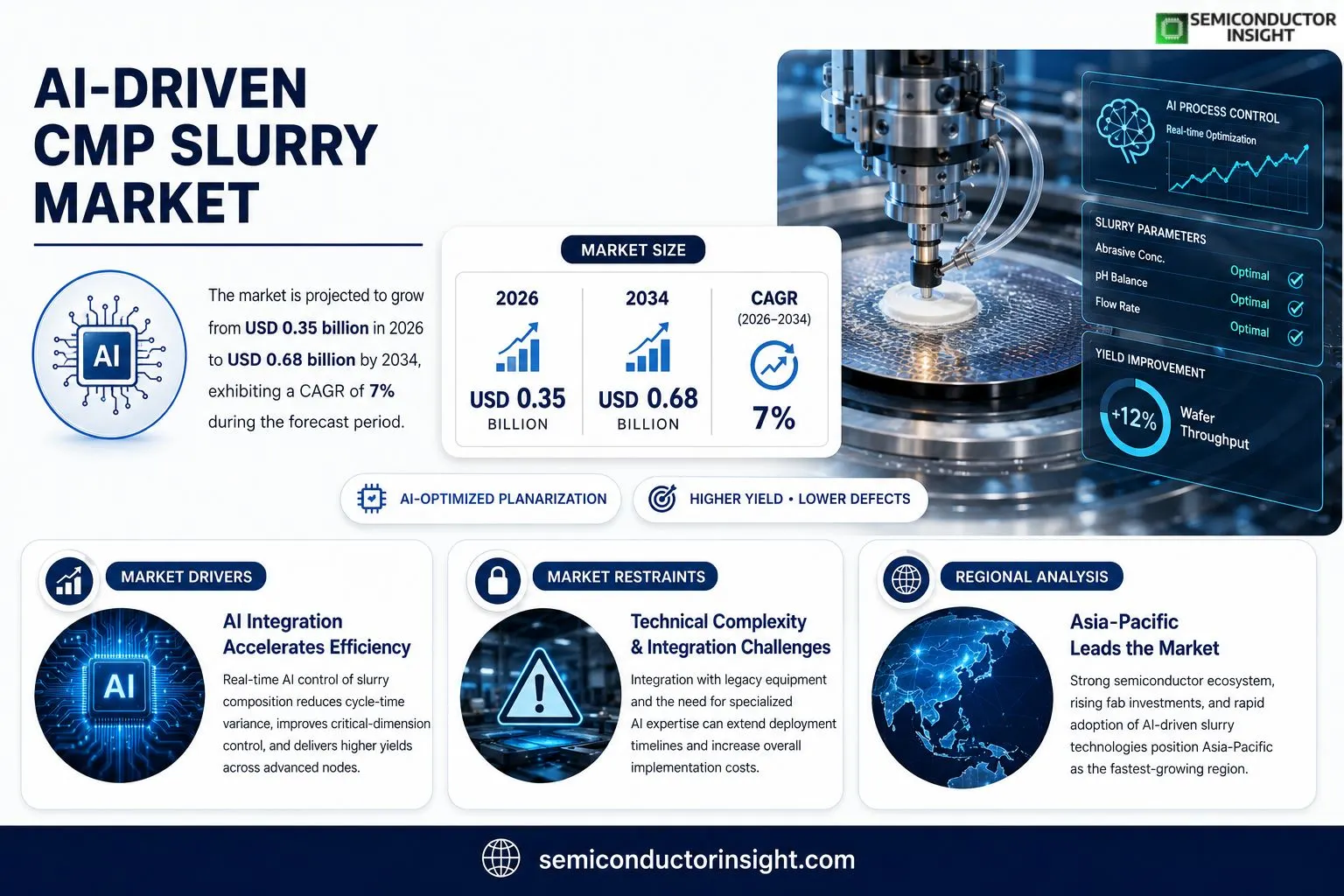
AI-Driven CMP Slurry market size was valued at USD 0.22 billion in 2025. The market will likely increase from USD 0.35 billion in 2026 to USD 0.68 billion by 2034, exhibiting a CAGR of roughly 7 % over the forecast horizon.
AI‑Driven CMP slurry combines traditional chemical‑mechanical planarization fluids with machine‑learning algorithms that continuously adjust abrasive concentration, pH balance and flow rates in real time. This integration enables finer surface planarity, reduced defectivity and shorter cycle times for advanced semiconductor wafers such as sub‑5 nm nodes.The upward trajectory stems from the semiconductor industry’s push toward higher yields and tighter tolerances, because manufacturers are adopting AI‑enabled process control to meet demanding device specifications. Moreover, rising capital expenditures on next‑generation fab equipment and collaborative R&D programs between slurry suppliers and AI firms further reinforce adoption. Companies such as Applied Materials, Ebara Corp., Entegris and Cabot Microelectronics have announced joint initiatives aimed at embedding predictive analytics into their slurry formulations.
MARKET DRIVERS
AI Integration Accelerates Process Efficiency
The infusion of machine‑learning algorithms into chemical‑mechanical planarization (CMP) slurry formulation has reduced cycle‑time variance by 15‑20% across leading fabs. By continuously adjusting slurry composition in real time, manufacturers can achieve tighter critical‑dimension control, which directly translates to higher yield.
Cost Reduction Through Predictive Maintenance
Predictive analytics embedded in AI‑driven CMP slurry dispensers forecast pump wear and nozzle clogging before failure occurs. Early intervention cuts unplanned downtime by nearly 30%, allowing plants to reallocate labor from reactive repairs to process optimization.
➤ Operators who switched to AI‑enabled slurry control reported a 12% improvement in wafer throughput within the first twelve months.
Beyond operational gains, the data lake generated by AI platforms creates a feedback loop for R&D teams. Historical performance metrics are mined to design next‑generation slurries that align with sub‑10 nm patterning requirements, thereby future‑proofing production lines.
MARKET CHALLENGES
Technical Complexity Hinders Adoption
Deploying AI‑driven slurry systems demands integration with existing process control hardware, which often varies from one fab to another. Engineers must reconcile heterogeneous communication protocols, a task that can extend deployment timelines by six to nine months.
Other Challenges
Integration with Legacy Equipment
Older CMP tools lack native API support, forcing vendors to develop custom middleware. The additional software layer introduces latency and raises validation burdens, discouraging smaller players from committing capital.Moreover, the steep learning curve associated with data‑science workflows creates a talent gap. Facilities that cannot attract or train personnel fluent in both semiconductor processing and AI risk underutilizing the technology’s full potential.
MARKET RESTRAINTS
Regulatory and Safety Concerns
The AI‑driven CMP slurry market must navigate stringent environmental regulations governing chemical discharge and worker exposure. Autonomous dosing algorithms, while efficient, must be validated against compliance frameworks, adding a layer of audit that can delay product launches. In regions where chemical‑use permits are tightly controlled, manufacturers often opt for conventional slurry systems to avoid procedural bottlenecks.
MARKET OPPORTUNITIES
Emerging Semiconductor Nodes Drive Demand
As the industry migrates to 3 nm and below, the tolerance window for surface planarity narrows dramatically. AI‑driven CMP slurry solutions, capable of nanometer‑scale adjustments, become indispensable for maintaining defect‑density targets. Companies that can couple AI analytics with proprietary slurry chemistries stand to capture a significant share of the upcoming wave of high‑volume manufacturing.
AI-Driven CMP Slurry Market Trends
AI Integration Elevates CMP Slurry Performance
The infusion of machine‑learning controls into chemical‑mechanical planarization fluids is reshaping wafer fabrication economics. By continuously tuning abrasive load, pH, and flow velocity, the slurry adapts to process drift in real time, delivering tighter planarization tolerance and fewer scratches on sub‑5 nm layers. This operational intelligence reduces re‑work cycles, translates into measurable yield uplift, and shortens overall fab throughput. Manufacturers that have migrated to adaptive slurry chemistries report cycle‑time reductions of up to 15 % while maintaining defect densities below one per million sites.
Other Trends
Collaborative R&D Accelerates Innovation
Major equipment vendors and specialty chemical firms are pooling data science expertise to embed predictive analytics directly into slurry formulations. Joint programs between Applied Materials, Entegris, Cabot Microelectronics and AI specialists have produced trial blends that anticipate surface roughness shifts before they materialize on the wafer. The collaboration model shortens development timelines because algorithmic feedback replaces lengthy empirical testing loops, allowing suppliers to launch new grades within a single product cycle rather than the traditional multi‑year horizon.
Supply Chain Realignment Towards Smart Materials
As fabs prioritize process stability, the upstream logistics for slurry components are being re‑engineered. Suppliers are integrating sensor‑enabled containers that relay temperature and concentration data back to the fab’s control system, enabling just‑in‑time adjustments and reducing inventory buffers. This shift not only cuts holding costs but also mitigates the risk of batch‑to‑batch variability that historically challenged high‑precision nodes. Companies that have embraced these smart containers note a 20 % decrease in material waste and a smoother hand‑off between slurry production and wafer processing teams.
COMPETITIVE LANDSCAPEKey Industry Players
AI‑Driven CMP Slurry Competitive Overview
Applied Materials dominates the AI‑enabled CMP slurry segment largely because it can bundle advanced wafer‑processing equipment with proprietary machine‑learning models that fine‑tune abrasive load and pH on the fly. The firm’s recent partnership with a leading AI start‑up has yielded a cloud‑based analytics dashboard that shortens defect‑inspection cycles and improves yield on sub‑5 nm nodes. Cabot Microelectronics follows closely, leveraging its deep chemistry portfolio to embed predictive algorithms directly into slurry formulations, thereby delivering consistent planarity across high‑volume fabs. Engris complements its material handling expertise with a data‑centric platform that optimizes slurry logistics, reducing waste while maintaining performance metrics demanded by leading chipmakers. BASF’s entry into the space is anchored in its polymer science capabilities; its AI‑driven additive line improves slurry stability, enabling tighter tolerance control without sacrificing throughput. Collectively, these four companies shape a market structure where integration of hardware, chemistry, and software creates a competitive moat that is difficult for newer entrants to breach.Beyond the headline names, a cluster of specialized firms is quietly expanding the technology frontier. Ebara Corp. has focused on high‑precision pump systems that feed AI‑regulated slurry streams, positioning itself as a preferred equipment supplier for niche fabs in Japan and Korea. Hitachi High‑Technologies contributes cutting‑edge metrology tools that feed real‑time feedback into slurry‑adjustment algorithms, fostering a symbiotic relationship with chemistry providers. TOKYO OHKA KOGYO (TKK) and JSR Corporation are developing next‑generation abrasive particles whose surface chemistry is tuned by AI to match each wafer layer’s unique demands. Flint Group’s specialty chemicals unit supplies surfactants that enhance slurry dispersion, while Fujimi’s nano‑particle line offers low‑defectivity options for emerging memory technologies. Daikin, Sagami, and NIPPON GOBIKO round out the ecosystem, each delivering niche additives or processing modules that complement the core AI‑driven slurry stack. Their regional focus and collaborative R&D agreements with larger players allow them to capture market share in localized pockets, driving incremental innovation across the value chain.
List of Key AI‑Driven CMP Slurry Companies Profiled
- Applied Materials
- Cabot Microelectronics
- Entegris
- BASF
- Ebara Corp.
- Hitachi High‑Technologies
- TOKYO OHKA KOGYO (TKK)
- JSR Corporation
- Flint Group
- Fujimi
- Daikin Industries
- Sagami Chemical
- NIPPON GOBIKO
- Nanotech Solutions Ltd.
- Advanced Materials International
Segment Analysis:
| Segment Category | Sub-Segments | Key Insights |
| By Type |
|
Chemical‑Focused AI Slurry
|
| By Application |
|
Advanced Node Planarization
|
| By End User |
|
Foundries
|
| By Technology |
|
Predictive Modeling
|
| By Process Integration |
|
Yield Management
|
Regional Analysis: AI-Driven CMP Slurry Market
Asia-Pacific
Chipmakers across the region are embedding deep‑learning models directly into polishing equipment, enabling closed‑loop control that reacts within milliseconds. This capability reduces material waste and flattens learning curves for new operators, delivering cost efficiencies that are reshaping budgeting priorities.
Logistics providers are synchronizing raw‑material shipments with AI forecasts, ensuring that slurry inventories align with predicted fab schedules. The resulting inventory elasticity mitigates the impact of sudden capacity spikes during new product rollouts.
While environmental standards are tightening, authorities in Japan and Australia have introduced sandbox programmes that let firms trial AI‑enhanced slurry formulations under monitored conditions, expediting market entry.
Advanced logic and memory fabs dominate demand, yet emerging automotive‑grade silicon projects are prompting a diversification of slurry chemistries tailored for high‑temperature stability, a trend amplified by AI‑driven formulation tools.
North America
In North America, the AI‑Driven CMP Slurry Market is shaped by a focus on intellectual‑property protection and high‑value specialty applications such as quantum computing hardware. Leading fabs are investing in bespoke AI platforms that integrate with existing MES systems, emphasizing data security alongside performance gains. Collaborative research initiatives between universities and equipment suppliers are generating proprietary algorithms that adapt slurry parameters to wafer‑level defect signatures, a nuance that differentiates premium service tiers. Although regulatory pathways are more rigorous, the clarity they provide encourages long‑term capital commitments, reinforcing the region’s role as a hub for high‑margin, technology‑intensive projects.
Europe
European stakeholders adopt a cautious yet innovative stance, balancing sustainability mandates with the pursuit of AI‑enhanced process control. The EU’s emphasis on circular‑economy principles drives firms to refine slurry reclamation cycles using predictive analytics, lowering environmental footprints while preserving performance. Cross‑border consortia in Germany, France, and the Netherlands facilitate data sharing among midsize fabs, creating a collective intelligence that accelerates model training without compromising competitive secrecy. The result is a market characterized by incremental adoption, where AI tools complement rather than replace traditional expertise, fostering a resilient ecosystem that can adapt to policy shifts.
South America
South American participation in the AI‑Driven CMP Slurry Market remains embryonic, yet recent government incentives for semiconductor ecosystem development are catalyzing early trials. Pilot projects in Brazil and Chile focus on leveraging cloud‑based AI services to overcome limited on‑site computing resources, enabling smaller fabs to benefit from advanced slurry optimisation without heavy capital outlays. These initiatives are laying the groundwork for a nascent supply chain, where local chemical producers begin to align formulations with AI‑derived specifications, signaling the first steps toward a self‑sustaining market segment.
Middle East & Africa
The Middle East & Africa region is witnessing a strategic push to diversify economies through semiconductor manufacturing hubs, particularly in the United Arab Emirates and Saudi Arabia. Early adopters are integrating AI modules into slurry management to showcase technological sophistication to partners. Partnerships with Asian technology firms provide access to pre‑trained models, allowing regional fabs to bypass the steep learning curve associated with home‑grown AI development. While the market size remains modest, the deliberate alignment of AI capabilities with national industrial agendas suggests a trajectory that could rapidly elevate the region’s relevance in the broader AI‑Driven CMP Slurry landscape.
Report Scope
This market research report provides a comprehensive analysis of the AI-Driven CMP Slurry Market , covering the forecast period 2026–2034. It offers detailed insights into market dynamics, technological advancements, competitive landscape, and key trends shaping the industry.
Key focus areas of the report include:
- Market Overview: The report begins with an overview outlining its current market scenario, key growth indicators, and industry transformation drivers. It discusses macroeconomic factors, demand–supply balance, regulatory landscape, and the strategic role of semiconductors in powering advancements across industries such as automotive, telecommunications, consumer electronics, and industrial automation.
- Market Size & Forecast: Historical data and future projections for revenue, unit shipments, and market value across major regions and segments.
- Segmentation Analysis: Detailed breakdown by product type, technology, application, and end-user industry to identify high-growth segments and investment opportunities.
- Regional Insights: Insights into market performance across North America, Europe, Asia-Pacific, Latin America, and the Middle East & Africa, including country-level analysis where relevant.
- Competitive Landscape: Profiles of leading market participants, including their product offerings, R&D focus, manufacturing capacity, pricing strategies, and recent developments such as mergers, acquisitions, and partnerships.
- Technology Trends & Innovation: Assessment of emerging technologies, integration of AI/IoT, semiconductor design trends, fabrication techniques, and evolving industry standards.
- Market Drivers & Restraints: Evaluation of factors driving market growth along with challenges, supply chain constraints, regulatory issues, and market-entry barriers.
- Stakeholder Insights: Insights for component suppliers, OEMs, system integrators, investors, and policymakers regarding the evolving ecosystem and strategic opportunities.
Primary and secondary research methods are employed, including interviews with industry experts, data from verified sources, and real-time market intelligence to ensure the accuracy and reliability of the insights presented.
FREQUENTLY ASKED QUESTIONS:
What is the current market size of AI-Driven CMP Slurry Market?
-> AI-Driven CMP Slurry Market was valued at USD 0.22 billion in 2025 and is expected to reach USD 0.68 billion by 2034.
Which key companies operate in AI-Driven CMP Slurry Market?
-> Key players include Applied Materials, Ebara Corp., Entegris, and Cabot Microelectronics, among others.
What are the key growth drivers?
-> Key growth drivers include the semiconductor industry’s push for higher yields and tighter tolerances, adoption of AI‑enabled process control, rising capital expenditures on next‑generation fab equipment, and collaborative R&D programs between slurry suppliers and AI firms.
Which region dominates the market?
-> Asia‑Pacific emerges as a leading region due to its concentration of semiconductor fabs, while North America also holds substantial market share.
What are the emerging trends?
-> Emerging trends include integration of predictive analytics into slurry formulations, real‑time AI‑driven process adjustments, and joint initiatives between AI technology providers and traditional slurry manufacturers.
Get Sample Report PDF for Exclusive Insights
Report Sample Includes
- Table of Contents
- List of Tables & Figures
- Charts, Research Methodology, and more...
 Download Sample Report PDF