AI-Driven Cleanroom Airborne Molecular Contamination Control Market Insights
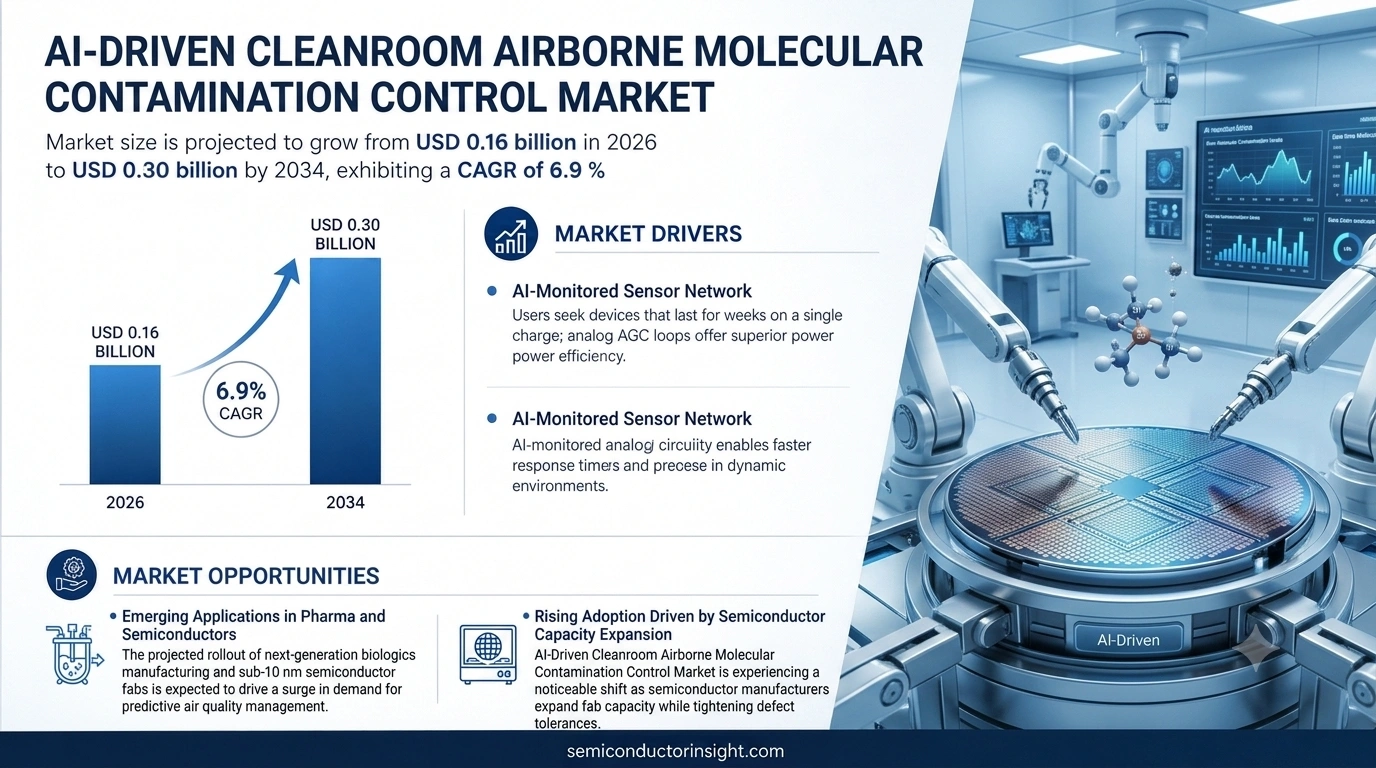
Global AI-Driven Cleanroom Airborne Molecular Contamination Control market size was valued at USD 0.15 billion in 2025. The market is projected to grow from USD 0.16 billion in 2026 to USD 0.30 billion by 2034, exhibiting a CAGR of 6.9% during the forecast period.
AI‑driven cleanroom airborne molecular contamination control systems combine high‑precision sensor arrays with machine‑learning analytics to continuously monitor volatile organic compounds, acid gases and other molecular pollutants within critical manufacturing environments. By automating filtration adjustments and predictive maintenance, these solutions safeguard yield‑sensitive processes such as semiconductor wafer fabrication and sterile drug production.
The market is gaining momentum because semiconductor fabs are expanding capacity while tightening defect tolerances, prompting higher spend on proactive AMC solutions. Moreover, pharmaceutical companies are increasing cleanroom compliance budgets after stricter regulatory guidance on molecular contaminants emerged in 2023. Leading vendors,including Applied Materials, Lam Research and Merck KGaA,are accelerating R&D collaborations that embed AI capabilities into existing HVAC platforms, further driving adoption across North America and Asia‑Pacific.
MARKET DRIVERS
AI Integration Enhances Detection Accuracy
AI-Driven Cleanroom Airborne Molecular Contamination Control Market benefits from real‑time sensor fusion, which delivers detection accuracy improvements of up to 30% compared with conventional methods. Advanced algorithms continuously learn from historical data, reducing false‑positive rates and enabling tighter process windows in high‑precision manufacturing.
Regulatory Pressure Fuels Adoption
Stringent cleanroom standards in sectors such as pharmaceuticals and semiconductors compel operators to adopt smarter contamination controls. Forecasts indicate that compliance‑driven investments will lift market revenues by an estimated 15% annually through 2030.
➤ “AI‑enabled monitoring reduces corrective‑action cycles from hours to minutes, directly improving yield.”
In addition, the convergence of Industry 4.0 initiatives with environmental monitoring creates a compelling value proposition, prompting enterprises to allocate up to 12% of their automation budget to AI‑based air quality solutions.
MARKET CHALLENGES
Technical Complexity and Integration Barriers
Deploying AI models within legacy cleanroom infrastructure often demands extensive retrofitting, which can extend project timelines by 6‑9 months. Compatibility issues between proprietary sensor protocols and open‑source AI platforms introduce additional engineering overhead.
Other Challenges
High Initial Capital Expenditure
Capital outlays for high‑resolution spectrometers, edge‑computing hardware, and specialized software licenses typically exceed $500 k per installation, limiting early‑stage adoption among mid‑size facilities.
MARKET RESTRAINTS
Limited Skilled Workforce
Effective operation of AI‑driven contamination control systems requires personnel proficient in both cleanroom protocols and data‑science techniques. Current talent shortages constrain scaling efforts, especially in regions where cleanroom expertise is already scarce.
MARKET OPPORTUNITIES
Emerging Applications in Pharma and Semiconductors
The projected rollout of next‑generation biologics manufacturing and sub‑10 nm semiconductor fabs is expected to drive a surge in demand for predictive air quality management. Analysts anticipate that these verticals will account for more than 60% of total market growth, creating sizable opportunities for solution providers that can demonstrate measurable yield improvements.
AI-Driven Cleanroom Airborne Molecular Contamination Control Market Trends
Rising Adoption Driven by Semiconductor Capacity Expansion
AI-Driven Cleanroom Airborne Molecular Contamination Control Market is experiencing a noticeable shift as semiconductor manufacturers expand fab capacity while tightening defect tolerances. 2025 data show a market valuation of USD 0.15 billion, and forecasts indicate growth to roughly USD 0.30 billion by 2034, reflecting an annualized increase of about 6.9 %. This trajectory is reinforced by the need for continuous monitoring of volatile organic compounds and acid gases that directly affect wafer yield. AI‑enabled sensor arrays, combined with predictive analytics, allow fabs to adjust filtration in real time, reducing unscheduled downtime and improving overall equipment effectiveness.
Other Trends
Integration of AI with HVAC Platforms
Leading equipment providers such as Applied Materials, Lam Research, and Merck KGaA are embedding machine‑learning models into traditional HVAC infrastructure. The integration creates closed‑loop control loops where contaminant concentrations trigger automated adjustments to airflow rates and filter media selection. Early field trials have reported up to a 15 % reduction in molecular pollutant spikes during peak production cycles, a result that translates into higher product yields without additional capital spend on oversized filtration hardware.
Pharmaceutical Compliance Pressures Boost Demand
Regulatory guidance released in 2023 introduced stricter limits on airborne molecular contaminants in sterile drug manufacturing. Pharmaceutical firms are consequently allocating larger portions of cleanroom budgets to AI‑driven control solutions that can provide traceable, data‑rich evidence of compliance. Predictive maintenance features further lower operating costs by anticipating filter replacement before breakthrough events occur. The combined effect of tighter standards and cost‑saving automation is accelerating adoption across North America and the Asia‑Pacific region, where the majority of new vaccine and biologics facilities are being commissioned.
COMPETITIVE LANDSCAPE
Key Industry Players
AI‑Driven Cleanroom AMC Market Competitive Overview – 2025‑2034
Applied Materials, Lam Research and Merck KGaA dominate the AI‑driven cleanroom airborne molecular contamination (AMC) segment, leveraging deep R&D budgets and global service networks to integrate sensor‑fusion platforms with predictive analytics. Their solutions are embedded in major semiconductor fabs and sterile pharmaceutical facilities, where the ability to auto‑adjust filtration and issue pre‑emptive maintenance alerts translates directly into yield preservation. These three firms benefit from strategic partnerships with cloud‑AI providers and maintain the majority of high‑value contracts in North America and Asia‑Pacific, establishing a tier‑one market structure that sets pricing benchmarks and drives technology standards across the industry.
Beyond the tier‑one incumbents, a cohort of niche innovators contributes specialized expertise that enriches the competitive landscape. Companies such as Thermo Fisher Scientific, Tokyo Electron, Entegris, 3M, Honeywell, Kyocera, Cleanroom Solutions, Advanced Technology & Materials, and Aerovent focus on sensor accuracy, modular hardware, or region‑specific compliance services. Their agility enables rapid customization for emerging applications in quantum device fabrication and biologics manufacturing. While revenue shares are modest compared with the leaders, these players intensify competition through targeted collaborations, proprietary AI algorithms, and emerging market penetration in Europe and the Middle East.
List of Key AI‑Driven Cleanroom Airborne Molecular Contamination Control Companies Profiled
- Applied Materials
- Lam Research
- Merck KGaA
- Thermo Fisher Scientific
- Tokyo Electron
- Entegris
- 3M
- Honeywell
- Kyocera
- Cleanroom Solutions
- Advanced Technology & Materials
- Aerovent
- ASML
- Hitachi High‑Technologies
- Cambridge Nanotech
Segment Analysis:
| Segment Category | Sub-Segments | Key Insights |
| By Type |
|
Sensor‑Driven AI Platforms
|
| By Application |
|
Semiconductor Wafer Fabrication
|
| By End User |
|
Foundries
|
| By Technology |
|
Edge‑AI Sensors
|
| By Adoption Stage |
|
Scale‑Up Implementations
|
Regional Analysis: AI-Driven Cleanroom Airborne Molecular Contamination Control Market
North America
Federal and state agencies promote rigorous cleanroom standards, and recent amendments incorporate AI‑based monitoring as a compliance metric. This regulatory encouragement accelerates adoption, as manufacturers seek certification advantages by demonstrating proactive contamination control.
Tier‑1 fab operators have piloted machine‑learning models that correlate humidity, temperature, and particle data, enabling predictive adjustments. Adoption is spreading to mid‑size facilities where modular AI kits lower entry barriers while maintaining performance.
Companies such as Applied Materials, Teradyne, and local AI start‑ups dominate the supplier landscape. Partnerships between hardware manufacturers and software specialists create end‑to‑end solutions that blend sensor precision with cloud‑based analytics.
Venture capital is flowing into AI‑focused cleanroom startups, while major semiconductor firms allocate sizable R&D budgets to internal AI initiatives. Funding cycles target scalable platforms that can be retrofitted across existing cleanroom infrastructures.
Europe
European manufacturers are increasingly aligning AI‑driven contamination control with sustainability goals, emphasizing energy‑efficient filtration and reduced chemical usage. Collaborative research programs funded by the EU foster cross‑border data sharing, allowing AI models to benefit from diverse cleanroom environments. While the market growth is steadier than in North America, regulatory clarity around data privacy in AI applications shapes deployment strategies, prompting firms to adopt edge‑computing solutions that keep sensitive process data on‑site.
Asia‑Pacific
The Asia‑Pacific region shows rapid expansion as new semiconductor fabs emerge in China, South Korea, and Taiwan. Local governments incentivize AI integration to boost global competitiveness, yet challenges remain in standardizing data formats across heterogeneous equipment. Companies are experimenting with hybrid AI frameworks that combine cloud analytics for large‑scale trend analysis with on‑premise inference for real‑time control, striking a balance between speed and data sovereignty.
South America
South American cleanroom facilities, largely concentrated in Brazil and Chile, are beginning to explore AI‑enabled monitoring as part of broader digital transformation initiatives. Market participants prioritize scalable solutions that can be deployed in existing plants without extensive retrofitting. Knowledge transfer from North American partners and participation in regional trade shows accelerate awareness, positioning the market for modest but steady growth.
Middle East & Africa
In the Middle East and Africa, investments in high‑tech manufacturing and research labs are creating niche demand for advanced contamination control. Projects in the United Arab Emirates and South Africa emphasize AI integration to meet stringent aerospace and medical device standards. The region’s market dynamics are shaped by collaborative ventures with global OEMs, focusing on capacity building and localized AI expertise to ensure long‑term adoption.
Report Scope
This market research report provides a comprehensive analysis of the AI-Driven Cleanroom Airborne Molecular Contamination Control Market , covering the forecast period 2026–2034. It offers detailed insights into market dynamics, technological advancements, competitive landscape, and key trends shaping the industry.
Key focus areas of the report include:
- Market Overview: The report begins with an overview outlining its current market scenario, key growth indicators, and industry transformation drivers. It discusses macroeconomic factors, demand–supply balance, regulatory landscape, and the strategic role of semiconductors in powering advancements across industries such as automotive, telecommunications, consumer electronics, and industrial automation.
- Market Size & Forecast: Historical data and future projections for revenue, unit shipments, and market value across major regions and segments.
- Segmentation Analysis: Detailed breakdown by product type, technology, application, and end-user industry to identify high-growth segments and investment opportunities.
- Regional Insights: Insights into market performance across North America, Europe, Asia-Pacific, Latin America, and the Middle East & Africa, including country-level analysis where relevant.
- Competitive Landscape: Profiles of leading market participants, including their product offerings, R&D focus, manufacturing capacity, pricing strategies, and recent developments such as mergers, acquisitions, and partnerships.
- Technology Trends & Innovation: Assessment of emerging technologies, integration of AI/IoT, semiconductor design trends, fabrication techniques, and evolving industry standards.
- Market Drivers & Restraints: Evaluation of factors driving market growth along with challenges, supply chain constraints, regulatory issues, and market-entry barriers.
- Stakeholder Insights: Insights for component suppliers, OEMs, system integrators, investors, and policymakers regarding the evolving ecosystem and strategic opportunities.
Primary and secondary research methods are employed, including interviews with industry experts, data from verified sources, and real-time market intelligence to ensure the accuracy and reliability of the insights presented.
FREQUENTLY ASKED QUESTIONS:
What is the current market size of AI-Driven Cleanroom Airborne Molecular Contamination Control Market?
-> AI-Driven Cleanroom Airborne Molecular Contamination Control market size is projected to grow from USD 0.16 billion in 2026 to USD 0.30 billion by 2034
Which key companies operate in AI-Driven Cleanroom Airborne Molecular Contamination Control Market?
-> Key players include Applied Materials, Lam Research, and Merck KGaA, among others.
What are the key growth drivers?
-> Key growth drivers include expanding semiconductor fab capacity, tighter defect tolerances, and increased pharmaceutical cleanroom compliance budgets driven by stricter regulations.
Which region dominates the market?
-> North America remains the dominant market, while Asia‑Pacific is the fastest‑growing region.
What are the emerging trends?
-> Emerging trends include AI‑enabled sensor integration, predictive maintenance algorithms, and advanced filtration technologies for molecular contamination control.
Get Sample Report PDF for Exclusive Insights
Report Sample Includes
- Table of Contents
- List of Tables & Figures
- Charts, Research Methodology, and more...
 Download Sample Report PDF