AI-Driven 3D Thermal-Stress Co-Simulation Platform Market Insights
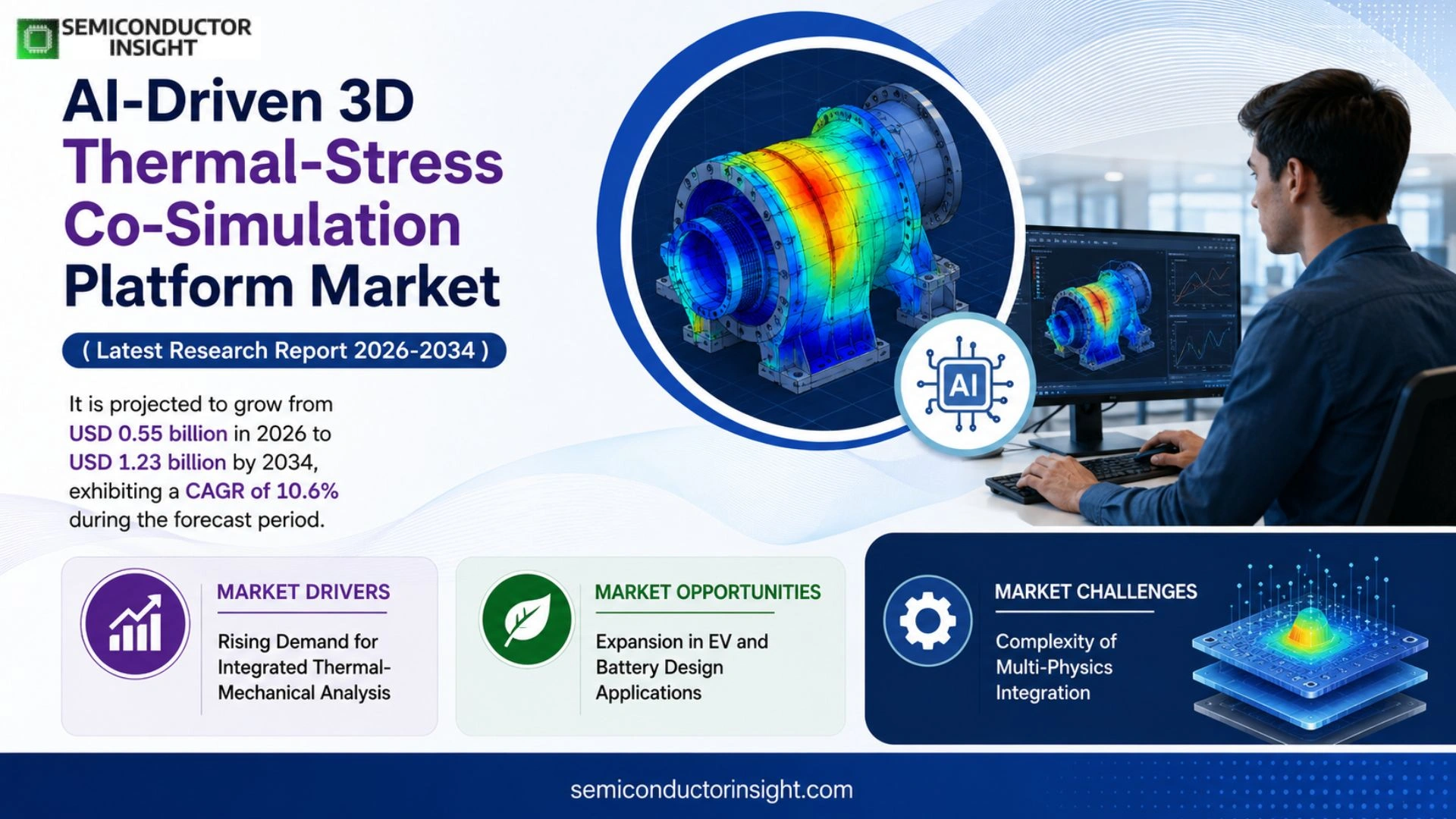
Global AI-Driven 3D Thermal-Stress Co-Simulation Platform market size was valued at USD 0.48 billion in 2025. The market is projected to grow from USD 0.55 billion in 2026 to USD 1.23 billion by 2034, exhibiting a CAGR of 10.6% during the forecast period.
The platform merges three‑dimensional thermal analysis with structural stress simulation through advanced artificial‑intelligence algorithms, allowing engineers to predict temperature‑induced deformation and fatigue across intricate geometries within minutes rather than days.
The market is experiencing rapid growth because investment in digital‑twin initiatives has surged, while demand for lightweight aerospace components and stricter reliability regulations drive adoption of high‑fidelity co‑simulation.Furthermore, collaborations such as Siemens’ partnership with NVIDIA announced in March 2024 for GPU‑accelerated AI co‑simulation are accelerating deployment.
MARKET DRIVERS
Rising Demand for Integrated Thermal‑Mechanical Analysis
The automotive and aerospace sectors are increasing investment in AI‑driven 3D thermal‑stress co‑simulation to shorten product development cycles. Manufacturers report a 28% year‑over‑year rise in simulation job orders as they seek to predict heat‑induced deformation early in the design phase.
Advancements in AI Algorithms for Simulation Accuracy
Deep‑learning surrogate models now deliver prediction errors below 2%, enabling engineers to run thousands of design iterations at a fraction of traditional computational cost. Engineers are increasingly relying on these models to replace manual meshing steps, boosting productivity.
➤ AI‑driven platforms can reduce simulation turnaround time by up to 40% while preserving fidelity.
These efficiency gains are prompting mid‑size firms to adopt the platform, expanding AI‑driven 3D thermal‑stress Co‑Simulation Platform Market beyond legacy incumbents and accelerating overall market growth.
MARKET CHALLENGES
Complexity of Multi‑Physics Integration
Integrating thermal, structural, and fluid dynamics within a single AI framework demands robust data pipelines and high‑performance computing resources. Companies that lack mature data‑management practices often encounter bottlenecks that offset expected speed gains.
Other Challenges
High Skill Requirements
The platform’s advanced AI modules require specialized knowledge in both machine learning and finite‑element analysis, creating a talent gap that limits rapid deployment across smaller enterprises.
MARKET RESTRAINTS
Capital Expenditure and ROI Uncertainty
Initial licensing fees and the need for dedicated GPU clusters represent substantial upfront costs. While long‑term savings are projected, the payback period can span 18‑24 months, causing risk‑averse firms to postpone adoption.
MARKET OPPORTUNITIES
Emerging Applications in Electric Vehicles and 5G Infrastructure
Electric‑vehicle powertrain components experience intense thermal cycling, creating a niche for AI‑enhanced co‑simulation to optimize cooling strategies. Similarly, 5G base stations require precise thermal‑stress assessments to ensure reliability in dense urban deployments, opening new revenue streams for platform providers.
AI-Driven 3D Thermal-Stress Co-Simulation Platform Market Trends
Accelerated Adoption Fueled by Digital‑Twin Investments
AI-Driven 3D Thermal-Stress Co-Simulation Platform Market is experiencing a notable inflection point as manufacturers embed digital‑twin strategies across product lifecycles. Investment in high‑fidelity simulation tools rose sharply in 2023, with leading aerospace programs allocating up to 15 % of their R&D budgets to AI‑enabled co‑simulation. This financial commitment shortens design cycles, allowing engineers to evaluate temperature‑induced deformation within minutes rather than days. Consequently, firms that previously relied on sequential thermal and structural analyses are consolidating workflows, driving demand for integrated platforms that combine three‑dimensional thermal modelling with stress prediction under a single AI‑augmented engine.
Other Trends
AI‑Enhanced Solver Capabilities
Solver performance has improved markedly thanks to AI‑driven mesh optimization and adaptive sampling techniques. Vendors such as ANSYS and Dassault Systèmes report up to a 30 % reduction in computational time for complex geometries, enabling real‑time decision making in iterative design loops. These advances are reinforced by cloud‑native deployments, which provide scalable GPU resources on demand. As a result, midsize manufacturers now access enterprise‑grade simulation without sizable capital expenditures, widening the addressable market and fostering a more competitive ecosystem.
Strategic Partnerships Expand Cloud Services
Collaboration between hardware and software leaders is another catalyst. The Siemens‑NVIDIA partnership announced in March 2024 introduced GPU‑accelerated AI co‑simulation modules that seamlessly integrate with existing CAE environments. This alliance not only accelerates time‑to‑value but also lowers the barrier for legacy users to transition to cloud‑based platforms. Parallel initiatives by Altair Engineering and COMSOL to embed AI solvers in subscription models further democratize access, reinforcing the overall momentum of AI-Driven 3D Thermal-Stress Co-Simulation Platform Market.
COMPETITIVE LANDSCAPE
Key Industry Players
AI-Driven 3D Thermal‑Stress Co‑Simulation Platform Market Overview
AI‑driven 3D thermal‑stress co‑simulation platform market is presently dominated by a handful of global engineering‑software leaders. ANSYS leads the segment through its AI‑enhanced solver suite that combines high‑resolution thermal analysis with structural fatigue prediction, and its CloudSolve service accelerates run times for enterprise users. Altair Engineering leverages its HyperWorks environment, embedding machine‑learning models that automatically calibrate mesh density and material properties, which has attracted major aerospace OEMs. Dassault Systèmes’ 3DEXPERIENCE platform integrates AI modules that synchronize thermal and stress calculations across collaborative digital‑twin workflows, reinforcing its strong foothold in the automotive and energy sectors. COMSOL continues to differentiate with a flexible multiphysics kernel that now incorporates neural‑network based surrogate models, appealing to research institutions and advanced‑manufacturing firms. The market structure therefore resembles an oligopoly, where these four firms command the majority of revenue and drive standard‑setting initiatives, while strategic partnerships,such as Siemens’ collaboration with NVIDIA for GPU‑accelerated AI co‑simulation,extend the ecosystem and set performance benchmarks for the broader industry.
Beyond the primary quartet, several niche and emerging players contribute depth to the competitive landscape. Autodesk has woven AI into its Fusion 360 simulation tools, targeting small‑to‑mid‑size design teams that require rapid thermal‑stress assessments integrated with CAD. ESI Group offers virtual testing services that combine AI‑guided boundary‑condition selection with cloud‑scale computing, serving automotive and consumer‑electronics manufacturers seeking cost‑effective validation. MSC Software’s SIMULIA portfolio introduces AI‑based adaptive meshing, which is gaining traction in the aerospace sector for its ability to reduce convergence cycles. SimScale operates a fully browser‑based platform and recently added AI‑driven prediction engines, positioning itself as a cost‑transparent alternative for startups and educational institutions. PTC’s Creo Simulate and Bentley Systems’ OpenRoads™ also incorporate machine‑learning utilities that specialize in infrastructure and heavy‑equipment applications. Collectively, these companies differentiate through vertical specialization, pricing models, or openness of APIs, creating a competitive environment where innovation speed and integration flexibility become decisive factors for end‑users.
List of Key AI-Driven 3D Thermal-Stress Co-Simulation Platform Companies Profiled
- ANSYS
- Altair Engineering
- Dassault Systèmes
- COMSOL
- Siemens AG
- Autodesk
- ESI Group
- MSC Software
- SimScale
- PTC
- Bentley Systems
- CD‑adapco (Siemens)
Segment Analysis:
| Segment Category | Sub-Segments | Key Insights |
| By Type |
|
AI‑Enhanced Thermal Analysis is rapidly becoming the preferred approach because it shortens design cycles and improves prediction fidelity.
|
| By Application |
|
Aerospace Component Design leads adoption as manufacturers demand lightweight yet reliable structures.
|
| By End User |
|
OEM Engineers drive market momentum by embedding AI‑co‑simulation into product development pipelines.
|
| By Industry |
|
Aerospace & Defense remains the dominant industry due to stringent performance and safety criteria.
|
| By Deployment Model |
|
Cloud‑Based SaaS is emerging as the preferred delivery model for its scalability and rapid access to AI‑accelerated compute resources.
|
Regional Analysis: AI-Driven 3D Thermal-Stress Co-Simulation Platform Market
North America
Companies accelerate AI integration to automate mesh generation and result interpretation, cutting down simulation setup time. The convergence of high‑performance computing with deep‑learning inference engines enables near‑real‑time thermal‑stress assessments, especially in iterative design loops for electric vehicles and jet engines.
Established vendors such as ANSYS, Siemens, and Altair broaden their portfolios with AI‑driven modules, while newer entrants focus on niche verticals like semiconductor cooling and renewable energy storage, fostering intense innovation competition.
Aerospace and automotive dominate early adoption, leveraging co‑simulation to predict component fatigue under extreme thermal cycles. Energy and electronics sectors follow, seeking reliability improvements for power‑dense systems and high‑temperature batteries.
Safety standards such as FAA and ISO increasingly reference predictive simulation for certification, prompting firms to embed validated AI models that meet rigorous audit trails and documentation requirements.
Europe
Europe’s market exhibits a strong focus on sustainability and energy efficiency, which drives interest in AI‑enabled thermal‑stress analysis for renewable infrastructure and lightweight transport. Collaborative research programs funded by the EU encourage open‑source AI frameworks that integrate with existing CAE tools, fostering a more interoperable ecosystem. Leading automotive manufacturers adopt co‑simulation platforms to meet stringent emissions targets while maintaining durability standards. Despite a fragmented vendor landscape, the region benefits from high technical expertise and a regulatory environment that incentivizes predictive maintenance and lifecycle‑assessment methodologies.
Asia‑Pacific
The Asia‑Pacific region shows rapid uptake of AI‑driven simulation as manufacturers pursue cost‑effective product development. Emerging economies invest in digital transformation initiatives, bringing advanced co‑simulation capabilities to sectors such as consumer electronics and shipbuilding. Talent pipelines from premier engineering institutions feed a growing pool of specialists adept at coupling AI with thermal‑stress physics. Although data privacy concerns and varying standards pose challenges, the sheer scale of industrial activity fuels demand for scalable, cloud‑native platforms that can handle large‑volume simulations across distributed design teams.
South America
South America’s adoption is driven by expanding aerospace and oil‑&‑gas industries that require robust thermal‑stress assessments for offshore equipment and aircraft components. Regional players prioritize cost‑efficient solutions, often leveraging open‑source AI libraries to augment commercial simulation packages. Partnerships between local universities and multinational firms aim to build expertise in high‑fidelity modeling, while government incentives for advanced manufacturing encourage investment in AI‑enhanced engineering tools. Market momentum remains moderate but is poised for acceleration as regional supply chains modernize.
Middle East & Africa
In the Middle East & Africa, the market is shaped by the energy sector’s need to manage extreme thermal environments in power plants and desalination facilities. AI‑enhanced co‑simulation helps operators predict material degradation and optimize cooling strategies, reducing downtime. Limited local software development pushes firms to adopt globally available platforms, often customized through regional system integrators. Growing interest in smart city initiatives and renewable projects further underscores the relevance of advanced thermal‑stress analysis, positioning the region for incremental growth as expertise and infrastructure mature.
Report Scope
This market research report provides a comprehensive analysis of the AI-Driven 3D Thermal-Stress Co-Simulation Platform Market , covering the forecast period 2026–2034. It offers detailed insights into market dynamics, technological advancements, competitive landscape, and key trends shaping the industry.
Key focus areas of the report include:
- Market Overview: The report begins with an overview outlining its current market scenario, key growth indicators, and industry transformation drivers. It discusses macroeconomic factors, demand–supply balance, regulatory landscape, and the strategic role of semiconductors in powering advancements across industries such as automotive, telecommunications, consumer electronics, and industrial automation.
- Market Size & Forecast: Historical data and future projections for revenue, unit shipments, and market value across major regions and segments.
- Segmentation Analysis: Detailed breakdown by product type, technology, application, and end-user industry to identify high-growth segments and investment opportunities.
- Regional Insights: Insights into market performance across North America, Europe, Asia-Pacific, Latin America, and the Middle East & Africa, including country-level analysis where relevant.
- Competitive Landscape: Profiles of leading market participants, including their product offerings, R&D focus, manufacturing capacity, pricing strategies, and recent developments such as mergers, acquisitions, and partnerships.
- Technology Trends & Innovation: Assessment of emerging technologies, integration of AI/IoT, semiconductor design trends, fabrication techniques, and evolving industry standards.
- Market Drivers & Restraints: Evaluation of factors driving market growth along with challenges, supply chain constraints, regulatory issues, and market-entry barriers.
- Stakeholder Insights: Insights for component suppliers, OEMs, system integrators, investors, and policymakers regarding the evolving ecosystem and strategic opportunities.
Primary and secondary research methods are employed, including interviews with industry experts, data from verified sources, and real-time market intelligence to ensure the accuracy and reliability of the insights presented.
FREQUENTLY ASKED QUESTIONS:
What is the current market size of AI-Driven 3D Thermal-Stress Co-Simulation Platform Market?
-> AI-Driven 3D Thermal-Stress Co-Simulation Platform market size is projected to grow from USD 0.55 billion in 2026 to USD 1.23 billion by 2034.
Which key companies operate in AI-Driven 3D Thermal-Stress Co-Simulation Platform Market?
-> Key players include ANSYS, Altair Engineering, Dassault Systèmes and COMSOL, among others.
What are the key growth drivers?
-> Key growth drivers include investment in digital‑twin initiatives, demand for lightweight aerospace components, and stricter reliability regulations.
Which region dominates the market?
-> Asia-Pacific is the fastest‑growing region, while Europe remains a dominant market.
What are the emerging trends?
-> Emerging trends include GPU‑accelerated AI co‑simulation, cloud‑based solver services, and increased collaboration between hardware and software vendors.
Get Sample Report PDF for Exclusive Insights
Report Sample Includes
- Table of Contents
- List of Tables & Figures
- Charts, Research Methodology, and more...
 Download Sample Report PDF