AI Digital Pathology Whole Slide Image Scanner Chip Market Insights
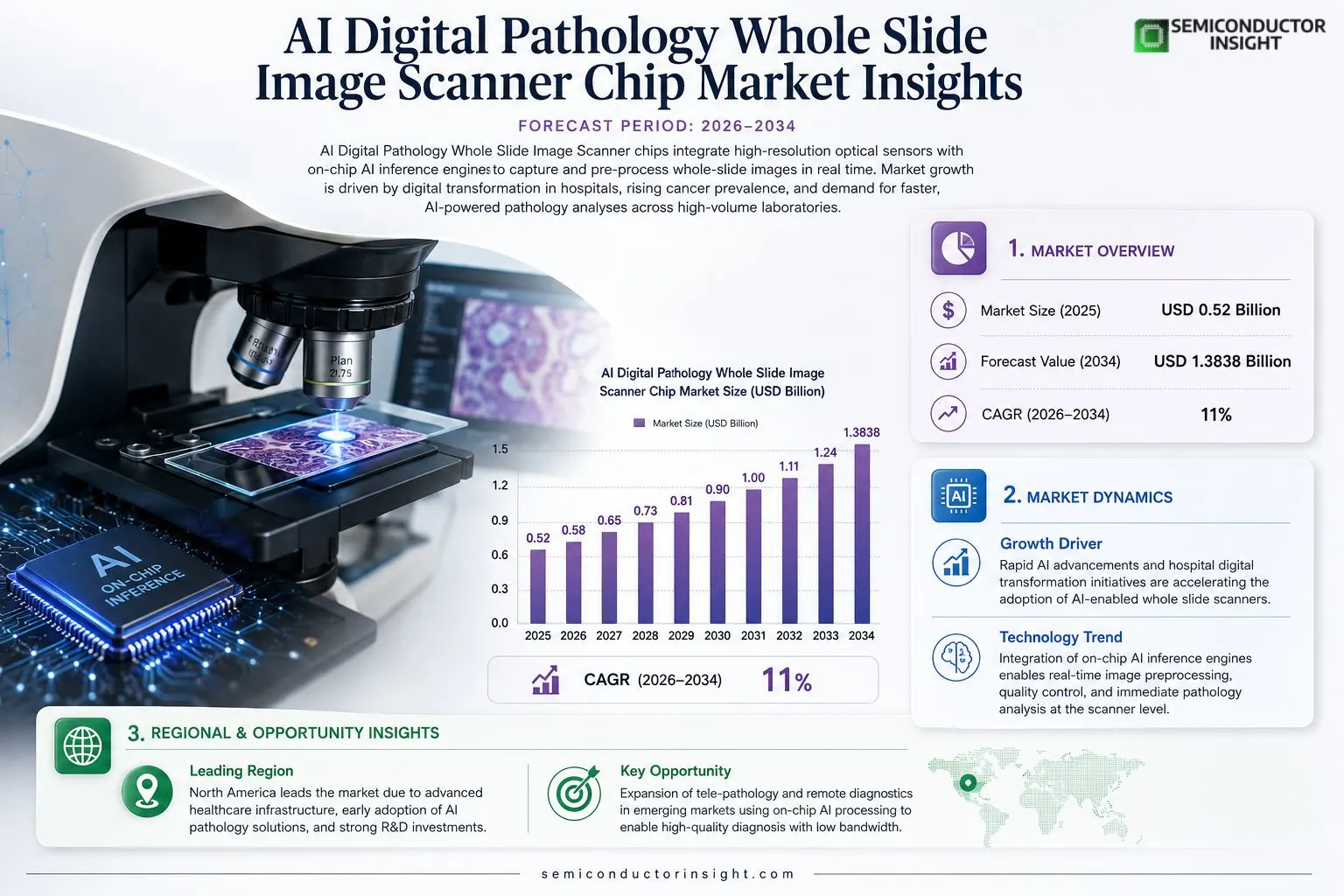
AI Digital Pathology Whole Slide Image Scanner Chip market size was valued at USD 0.52 billion in 2025. The market is projected to grow from USD 0.52 billion in 2025 to USD 1.3838 billion by 2034, exhibiting a CAGR of 11 % during the forecast period.
AI Digital Pathology Whole Slide Image Scanner chips are advanced semiconductor devices that integrate high‑resolution optical sensors with on‑chip AI inference engines to capture and pre‑process whole‑slide images of tissue specimens in real time. These chips enable rapid digitization, automated quality control, and immediate computational pathology analyses directly at the scanner level.The market is experiencing rapid growth because hospitals and diagnostic laboratories are accelerating digital transformation initiatives while pathologists seek faster turnaround times and quantitative insights from AI‑driven image analysis.
Furthermore, rising cancer prevalence worldwide fuels demand for scalable slide‑scanning solutions that can handle large case volumes efficiently.
Key manufacturers such as Philips Healthcare, Leica Biosystems, Hamamatsu Photonics, and Roche Diagnostics are expanding their chip portfolios and forming strategic partnerships to embed AI capabilities into next‑generation scanners.
MARKET DRIVERS
Advancements in AI Integration
AI Digital Pathology Whole Slide Image Scanner Chip Market is being propelled by rapid improvements in machine‑learning algorithms that enable more accurate image segmentation and classification. These technologies enhance diagnostic confidence and support pathologists in detecting subtle morphological patterns, boosting clinical adoption across tertiary care centers.
Increasing Adoption in Clinical Laboratories
Hospitals are investing in integrated scanner‑chip solutions to accelerate workflow efficiency. The ability to process high‑resolution whole‑slide images on‑chip reduces data transfer latency, allowing real‑time AI analysis and shortening turnaround times for biopsy results.
➤ AI‑driven image analysis reduces diagnostic turnaround time by up to 30%
Overall, the confluence of AI capability expansion and the demand for faster, more reliable pathology results is expected to sustain a robust growth trajectory for AI Digital Pathology Whole Slide Image Scanner Chip Market over the coming years.
MARKET CHALLENGES
Regulatory and Validation Hurdles
Obtaining clearance from health authorities requires extensive clinical validation, which can delay market entry. The necessity to demonstrate consistent performance across diverse tissue types adds complexity to the approval process for devices in AI Digital Pathology Whole Slide Image Scanner Chip Market.
Other Challenges
Data Privacy Concerns
Patient imaging data must be protected under stringent privacy regulations, necessitating secure data handling protocols that can increase implementation costs for end users.
MARKET RESTRAINTS
High Capital Expenditure
Acquiring advanced whole‑slide scanners equipped with specialized AI chips involves significant upfront investment, which can deter small and mid‑size pathology labs from adopting the technology, thereby limiting broader market penetration.
MARKET OPPORTUNITIES
Emerging Markets and Remote Diagnostics
Growth potential lies in expanding tele‑pathology services in emerging economies, where on‑chip AI processing can enable remote diagnosis without the need for high‑bandwidth connectivity, opening new revenue streams for vendors in AI Digital Pathology Whole Slide Image Scanner Chip Market.
AI Digital Pathology Whole Slide Image Scanner Chip Market Trends
Integration of AI Inference Engines into Scanning Chips
AI Digital Pathology Whole Slide Image Scanner Chip Market is witnessing a decisive shift as manufacturers embed dedicated AI inference engines directly on the sensor die. This integration enables real‑time image preprocessing, automated focus adjustment, and on‑chip quality control without relying on external compute resources. Hospitals adopting such chips report faster digitization cycles and reduced latency for downstream diagnostic algorithms. By processing raw optical data at the edge, the scanners generate metadata that supports immediate quantitative pathology assessments, helping pathologists meet tighter turnaround expectations while preserving diagnostic accuracy.
Other Trends
Strategic Partnerships and Portfolio Expansion
Key players, including Philips Healthcare, Leica Biosystems, Hamamatsu Photonics, and Roche Diagnostics, are forming alliances with AI software firms and semiconductor specialists to broaden their chip portfolios. These collaborations accelerate the rollout of next‑generation scanners that combine high‑resolution optics with modular AI blocks, allowing customers to upgrade analytical capabilities through firmware updates. The joint development approach reduces time‑to‑market for innovative features such as multi‑modal imaging and cloud‑linked annotation tools, reinforcing the competitive dynamics of AI Digital Pathology Whole Slide Image Scanner Chip Market.
Shift Toward Real‑Time Edge Processing
Emerging clinical workflows prioritize real‑time edge processing to handle the growing volume of whole‑slide images generated by modern pathology labs. By leveraging on‑chip AI, scanners can perform initial tissue classification, artifact detection, and region‑of‑interest segmentation before the image is transmitted to central servers. This edge‑first strategy not only compresses data traffic but also enhances patient privacy by limiting the exposure of raw image files. As regulatory frameworks increasingly emphasize data sovereignty, vendors that embed robust AI capabilities within their scanner chips are positioned to capture a larger share of the market, driving sustained adoption across both large hospital networks and independent diagnostic centers.
COMPETITIVE LANDSCAPE
Key Industry Players
AI Digital Pathology Whole Slide Image Scanner Chip Market Competitive Overview
The market is anchored by a few large OEMs that combine semiconductor expertise with established pathology platforms. Philips Healthcare leads the segment with its integrated AI‑enabled scanner chip that leverages proprietary image‑processing algorithms and benefits from a service network. Leica Biosystems and Hamamatsu Photonics follow closely, each offering high‑resolution sensor arrays paired with on‑chip AI inference engines. These incumbents dominate the high‑volume hospital and reference‑lab space, shaping pricing dynamics and setting technical roadmaps that emphasize throughput, low latency, and regulatory compliance.Beyond the dominant trio, a diverse set of niche innovators contributes specialized capabilities. Roche Diagnostics has entered the arena through strategic acquisitions, focusing on molecular‑imaging integration. Allurion Technologies targets compact, point‑of‑care scanners for community clinics. Emerging pure‑play semiconductor firms such as Synaptics Imaging and Pixalate Labs provide customizable AI cores for OEM partners. Regional players including China’s Shenzhen Anri Technology and Japan’s Shimadzu Corp. are expanding product portfolios to capture growth in domestic markets, while start‑ups like PathAI Chipworks and DeepSlide Systems bring novel deep‑learning ASICs optimized for low‑power operation.
List of Key AI Digital Pathology Whole Slide Image Scanner Chip Market Companies Profiled
- Philips Healthcare
- Leica Biosystems
- Hamamatsu Photonics
- Roche Diagnostics
- Allurion Technologies
- Synaptics Imaging
- Pixalate Labs
- Shenzhen Anri Technology
- Shimadzu Corp.
- PathAI Chipworks
- DeepSlide Systems
- Canon Medical Systems
- GE Healthcare
- Siemens Healthineers
- Boston Scientific (Diagnostics Division)
Segment Analysis:
| Segment Category | Sub-Segments | Key Insights |
| By Type |
|
Hybrid Sensor‑AI Chips are emerging as the preferred architecture because they combine high‑resolution imaging with on‑chip AI processing, enabling immediate analysis at the point of capture.
|
| By Application |
|
Clinical Diagnostics drives the majority of adoption as pathology departments seek faster, reproducible slide digitization.
|
| By End User |
|
Hospital Pathology Departments are leading adopters because they balance patient volume with the need for precision.
|
| By Integration Level |
|
Embedded Systems are gaining traction as manufacturers embed AI chips directly into scanner hardware.
|
| By Workflow Stage |
|
Real‑time Analysis is the most valued stage because it transforms raw slide data into actionable insights instantly.
|
Regional Analysis: AI Digital Pathology Whole Slide Image Scanner Chip Market
North America
The convergence of rising cancer incidence, demand for faster diagnostic turnaround, and increasing reimbursement for AI‑assisted pathology drives procurement of advanced scanner chips. Hospitals prioritize solutions that can handle high slide volumes while delivering accurate, reproducible AI analyses, reinforcing the demand curve in North America.
Emerging opportunities include expansion into community hospitals, integration with electronic health records, and development of custom AI models for niche pathologies. Partnerships between chip manufacturers and software developers enable tailored workflows, unlocking new revenue streams across the region.
The competitive arena features established imaging firms, semiconductor specialists, and AI start‑ups. Collaboration and acquisition activities have intensified, as larger players seek to incorporate cutting‑edge chip architectures while maintaining regulatory compliance and service support.
Recent advancements focus on ultra‑low latency processing, energy‑efficient designs, and on‑chip AI inference capabilities. These innovations reduce hardware footprints and enable real‑time slide analysis, aligning with the strategic goals of North American pathology networks.
Europe
Europe exhibits steady adoption of AI digital pathology, propelled by collaborative research programs and harmonized regulatory pathways under the EU Medical Device Regulation. Leading healthcare systems in Germany, France, and the United Kingdom invest in scanner chips that support multi‑center studies, facilitating cross‑border data sharing. While budget constraints temper rapid rollout, the region benefits from strong academic‑industry partnerships that accelerate validation of AI algorithms, positioning Europe as a key growth market with a focus on quality and interoperability.
Asia‑Pacific
The Asia‑Pacific region is experiencing rapid expansion in digital pathology driven by burgeoning healthcare expenditures and a growing prevalence of chronic diseases. Nations such as China, Japan, and India are prioritizing AI‑enhanced diagnostic tools to address workforce shortages and improve pathology turnaround times. Government initiatives supporting smart hospital infrastructures encourage adoption of whole slide image scanner chips, though challenges remain in standardization and skill development across diverse market segments.
South America
South America shows nascent but promising interest in AI‑enabled pathology solutions, with Brazil and Mexico leading regional initiatives. Academic collaborations and pilot programs in major medical centers highlight the potential for scanner chip integration to improve diagnostic accuracy in oncology. Economic fluctuations and limited reimbursement frameworks temper widespread deployment, yet increasing private‑sector investment signals a gradual shift toward modern pathology workflows.
Middle East & Africa
In the Middle East & Africa, market dynamics are shaped by selective investment in high‑end diagnostic equipment within affluent Gulf Cooperation Council (GCC) states and a few progressive African nations. Strategic government funding for digital health transformation drives early adoption of AI whole slide imaging solutions in Saudi Arabia, United Arab Emirates, and South Africa. While overall market size remains modest, focused initiatives aim to build local expertise and establish regional centers of excellence for digital pathology.
Report Scope
This market research report provides a comprehensive analysis of the AI Digital Pathology Whole Slide Image Scanner Chip Market , covering the forecast period 2026–2034. It offers detailed insights into market dynamics, technological advancements, competitive landscape, and key trends shaping the industry.
Key focus areas of the report include:
- Market Overview: The report begins with an overview outlining its current market scenario, key growth indicators, and industry transformation drivers. It discusses macroeconomic factors, demand–supply balance, regulatory landscape, and the strategic role of semiconductors in powering advancements across industries such as automotive, telecommunications, consumer electronics, and industrial automation.
- Market Size & Forecast: Historical data and future projections for revenue, unit shipments, and market value across major regions and segments.
- Segmentation Analysis: Detailed breakdown by product type, technology, application, and end-user industry to identify high-growth segments and investment opportunities.
- Regional Insights: Insights into market performance across North America, Europe, Asia-Pacific, Latin America, and the Middle East & Africa, including country-level analysis where relevant.
- Competitive Landscape: Profiles of leading market participants, including their product offerings, R&D focus, manufacturing capacity, pricing strategies, and recent developments such as mergers, acquisitions, and partnerships.
- Technology Trends & Innovation: Assessment of emerging technologies, integration of AI/IoT, semiconductor design trends, fabrication techniques, and evolving industry standards.
- Market Drivers & Restraints: Evaluation of factors driving market growth along with challenges, supply chain constraints, regulatory issues, and market-entry barriers.
- Stakeholder Insights: Insights for component suppliers, OEMs, system integrators, investors, and policymakers regarding the evolving ecosystem and strategic opportunities.
Primary and secondary research methods are employed, including interviews with industry experts, data from verified sources, and real-time market intelligence to ensure the accuracy and reliability of the insights presented.
FREQUENTLY ASKED QUESTIONS:
What is the current market size of AI Digital Pathology Whole Slide Image Scanner Chip Market?
-> AI Digital Pathology Whole Slide Image Scanner Chip Market was valued at USD 0.52 billion in 2025 and is expected to reach USD 1.38 billion by 2034, reflecting a CAGR of 11 % during the forecast period.
Which key companies operate in AI Digital Pathology Whole Slide Image Scanner Chip Market?
-> Key players include Philips Healthcare, Leica Biosystems, Hamamatsu Photonics, and Roche Diagnostics, among others.
What are the key growth drivers?
-> Key growth drivers include accelerating digital transformation in hospitals and diagnostic labs, rising cancer prevalence driving demand for high‑throughput slide‑scanning, and the need for rapid, AI‑enabled pathology analyses.
Which region dominates the market?
-> The reference does not specify a single dominant region; however, adoption is strong in North America and Europe, with rapid growth observed in Asia‑Pacific as healthcare infrastructures expand.
What are the emerging trends?
-> Emerging trends include integration of on‑chip AI inference engines for real‑time image processing, strategic partnerships between semiconductor manufacturers and scanner OEMs, and the development of scalable, AI‑driven workflow solutions for high‑volume pathology labs.
Get Sample Report PDF for Exclusive Insights
Report Sample Includes
- Table of Contents
- List of Tables & Figures
- Charts, Research Methodology, and more...