AI Digital Cockpit Domain Controller SoC Market Insights
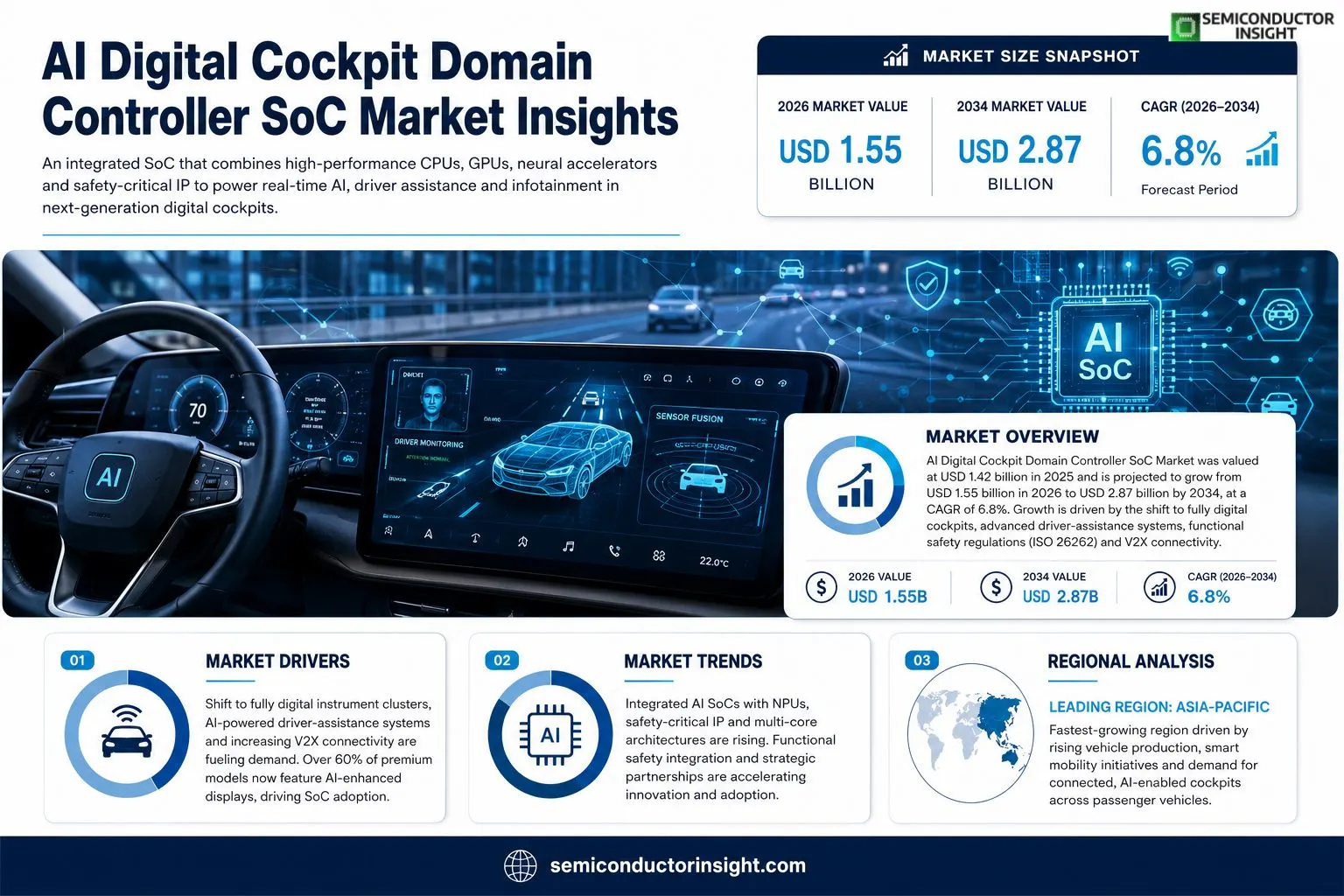
AI digital cockpit domain controller SoC market size was valued at USD 1.42 billion in 2025. The market is projected to grow from USD 1.55 billion in 2026 to USD 2.87 billion by 2034, exhibiting a CAGR of 6.8% during the forecast period.
An AI digital cockpit domain controller System‑on‑Chip integrates high‑performance CPUs, GPUs, neural‑network accelerators and safety‑critical functional‑safety IP onto a single silicon die, enabling real‑time sensor fusion, driver‑assistance algorithms and infotainment services within automotive cockpits.The market is accelerating because automakers are shifting toward fully digital instrument clusters and advanced driver‑assistance systems that demand on‑board AI processing power. Furthermore, regulatory pressure for functional safety (ISO 26262) and the rollout of vehicle‑to‑everything (V2X) connectivity are prompting OEMs to adopt consolidated SoCs rather than discrete components. Leading semiconductor firms such as NXP, Renesas and Qualcomm are expanding their portfolios, while strategic partnerships with Tier‑1 suppliers further fuel adoption.
MARKET DRIVERS
Growing Integration of AI in Automotive Cockpits
AI Digital Cockpit Domain Controller SoC Market is being propelled by automakers’ shift toward fully digital instrument panels that combine voice, gesture and eye‑tracking interfaces. Recent vehicle launches show that more than 60% of premium models now feature AI‑enhanced displays, driving demand for scalable System‑on‑Chip (SoC) solutions.
Demand for High‑Performance SoC Solutions
Customers require SoCs capable of processing 8K video streams, real‑time sensor fusion and on‑board neural network inference with latency under 5 ms. Industry analysts estimate that the need for such compute density will lift SoC shipments by 35% annually through 2028.
➤ “The convergence of AI and automotive cockpit functions is the single largest growth catalyst for semiconductor vendors in the next five years.”
In parallel, regulatory pushes for driver‑monitoring systems and advanced driver‑assistance features are compelling OEMs to adopt AI‑centric domain controllers, further solidifying the market trajectory.
MARKET CHALLENGES
Complexity of Automotive Safety Standards
Achieving functional safety compliance (ISO 26262) while integrating complex AI algorithms adds significant validation overhead. Manufacturers must allocate extensive verification resources, which can delay product launches and increase cost.
Other Challenges
Supply Chain Constraints
The semiconductor shortage that began in 2020 continues to affect the availability of high‑performance GPUs and specialized AI accelerators, creating bottlenecks for cockpit SoC production and impacting delivery timelines.
MARKET RESTRAINTS
High Development Costs
Designing domain controllers that satisfy both AI performance and automotive reliability mandates multi‑year R&D programs, with typical budgets exceeding $150 million per platform. This financial barrier limits entry to a handful of well‑capitalized semiconductor firms.Additionally, the need for proprietary IP blocks and custom verification environments inflates the total cost of ownership, discouraging smaller OEMs from pursuing in‑house solutions.As a result, many vehicle manufacturers continue to rely on legacy MCU architectures, slowing the broader adoption of AI‑driven cockpit technologies.
MARKET OPPORTUNITIES
Emerging 5G‑Enabled Connected Services
The rollout of 5G networks across major markets creates an opportunity for cockpit SoCs to host edge‑AI workloads such as over‑the‑air updates, real‑time traffic analytics and immersive AR navigation. Gartner predicts that 5G‑enabled vehicle services will generate $30 billion in revenue by 2030, a sizable share of which will be captured by AI Digital Cockpit Domain Controller SoC providers.Furthermore, partnerships between automotive OEMs and cloud AI platforms are accelerating the development of hybrid architectures that split inference between on‑board SoCs and edge data centers, opening new revenue streams for semiconductor vendors.Investors should monitor emerging standards for automotive‑grade 5G radio modules, as early adopters will likely secure a competitive edge in the rapidly expanding market.
AI Digital Cockpit Domain Controller SoC Market Trends
Rise of Integrated AI SoCs in Digital Cockpits
AI Digital Cockpit Domain Controller SoC Market is experiencing sustained momentum as automotive manufacturers transition from legacy instrument clusters to fully digital interfaces. Consolidated System‑on‑Chip solutions combine high‑performance CPUs, GPUs, and neural‑network accelerators, enabling real‑time sensor fusion and advanced driver‑assistance functionalities within a single silicon die. This integration reduces board complexity, lowers power consumption, and shortens development cycles, factors that are driving broader adoption across premium and mainstream vehicle segments. The trend is reinforced by growing consumer expectations for personalized infotainment and over‑the‑air updates, which demand robust on‑board AI processing capabilities.
Other Trends
Safety‑Critical Functional Integration
Regulatory emphasis on functional safety, particularly compliance with ISO 26262, is compelling OEMs to embed safety‑critical IP directly into the SoC architecture. By unifying safety monitors, diagnostic controllers, and redundancy mechanisms on the same chip, manufacturers achieve tighter timing guarantees and deterministic behavior essential for active safety systems. This approach also simplifies verification processes, as a single validated silicon block can be reused across multiple vehicle platforms. Tier‑1 suppliers are increasingly offering customizable safety blocks, allowing OEMs to tailor functional‑safety coverage without sacrificing performance for AI workloads.
Strategic Partnerships Accelerate Adoption
Leading semiconductor firms such as NXP, Renesas, and Qualcomm are expanding their AI Cockpit portfolios through strategic collaborations with Tier‑1 automotive suppliers. Joint development programs focus on optimizing neural‑network accelerators for automotive‑grade temperature ranges and integrating V2X communication stacks alongside AI inference engines. These partnerships deliver reference designs that shorten time‑to‑market for OEMs, while shared risk models stimulate investment in next‑generation silicon. As a result, the ecosystem around AI Digital Cockpit Domain Controller SoC Market is becoming more cohesive, providing a reliable pathway for manufacturers to embed sophisticated AI capabilities in future vehicle architectures.
COMPETITIVE LANDSCAPE
Key Industry Players
AI Digital Cockpit Domain Controller SoC Competitive Overview
AI Digital Cockpit Domain Controller SoC Market is presently anchored by a handful of large semiconductor firms that command the majority of revenue and technology leadership. NXP Semiconductors, Renesas Electronics, and Qualcomm dominate the space by offering highly integrated platforms that combine safety‑critical CPUs, GPU cores, and dedicated neural‑network accelerators on a single die. These leaders benefit from long‑standing relationships with automotive OEMs, robust functional‑safety IP portfolios (ISO 26262 compliance), and aggressive road‑map extensions into V2X‑enabled features. Their SoCs are positioned as “best‑in‑class” solutions for fully digital instrument clusters, real‑time sensor fusion, and advanced driver‑assistance systems, driving the bulk of market growth projected through 2034.Beyond the tier‑one incumbents, a vibrant cohort of niche and emerging players is expanding the competitive landscape. Samsung Electronics, Intel, and Texas Instruments contribute high‑performance compute blocks and image‑signal processors that complement core cockpit functions. STMicroelectronics, Infineon Technologies, and MediaTek are leveraging their automotive‑grade portfolios to deliver cost‑effective alternatives for volume models. Tier‑1 suppliers such as Bosch and Continental are also introducing co‑development SoC variants, while NVIDIA and Ambarella bring AI‑centric GPU and video‑processing expertise that enrich the ecosystem. This diversification creates a multi‑layered supply chain where OEMs can select solutions aligned to performance, safety, and price objectives.
List of Key AI Digital Cockpit Domain Controller SoC Companies Profiled
- NXP Semiconductors
- Renesas Electronics
- Qualcomm
- Samsung Electronics
- Intel Corporation
- Texas Instruments
- STMicroelectronics
- Infineon Technologies
Segment Analysis:
| Segment Category | Sub-Segments | Key Insights |
| By Type |
|
Neural‑Network Accelerator SoCs
|
| By Application |
|
Digital Instrument Cluster
|
| By End User |
|
OEMs
|
| By Architecture |
|
Heterogeneous Multi‑Core
|
| By Functional Integration |
|
Safety‑Critical + AI Fusion
|
Regional Analysis: AI Digital Cockpit Domain Controller SoC Market
North America
Federal safety standards increasingly incorporate AI processing requirements, prompting manufacturers to adopt SoCs that meet rigorous functional safety and cybersecurity criteria while supporting OTA updates and data privacy safeguards.
Leading vehicle makers are forging long‑term alliances with silicon vendors to co‑develop customized AI Digital Cockpit Domain Controller SoC solutions that align with brand‑specific user interface philosophies.
High‑resolution displays, voice assistants, and gesture control are becoming standard, driving demand for SoCs that deliver low‑latency inference and multimodal sensor fusion within tight power envelopes.
A well‑established semiconductor supply chain ensures component availability, while strategic stockpiling and near‑shoring initiatives mitigate potential disruptions for AI cockpit deployments.
Europe
Europe’s automotive sector is pivoting toward premium AI‑driven cockpit experiences, leveraging strong heritage in automotive electronics and a regulatory environment that emphasizes sustainability and data protection. OEMs across Germany, France, and the UK are integrating AI Digital Cockpit Domain Controller SoC technologies to differentiate luxury models, often collaborating with EU‑based silicon firms that specialize in energy‑efficient designs. The region’s emphasis on standardized vehicle‑to‑cloud communication protocols fosters a consistent ecosystem for OTA updates, while stringent emissions targets encourage manufacturers to adopt power‑optimized solutions. Market participants also benefit from EU funding programs that support advanced driver‑assistance systems, further stimulating SoC innovation in the cockpit domain.
Asia‑Pacific
The Asia‑Pacific market, anchored by China, Japan, and South Korea, exhibits rapid growth fueled by expanding middle‑class vehicle ownership and aggressive government initiatives promoting smart mobility. Domestic chip manufacturers are scaling production of AI Digital Cockpit Domain Controller SoCs tailored for cost‑sensitive but feature‑rich models. Consumer expectations for seamless connectivity and localized voice assistants drive OEMs to embed sophisticated AI capabilities directly within the cockpit. While regulatory oversight varies, emerging safety standards are prompting a shift toward higher integration levels, reducing system complexity and enabling faster time‑to‑market for next‑generation infotainment platforms.
South America
South America’s automotive landscape is characterized by a mix of legacy vehicle fleets and emerging demand for modern connectivity features. Market entrants are beginning to explore AI Digital Cockpit Domain Controller SoC solutions as a means to revitalize aging models with over‑the‑air enhancement pathways. Economic considerations favor scalable SoC architectures that can be deployed across multiple vehicle segments, balancing cost with incremental AI functionalities such as predictive navigation and adaptive climate control. Regional trade agreements are also facilitating the import of advanced semiconductor components, gradually expanding the ecosystem for AI‑enhanced cockpit deployments.
Middle East & Africa
In the Middle East and Africa, premium vehicle adoption and a growing appetite for advanced infotainment are driving interest in AI Digital Cockpit Domain Controller SoC technologies. Luxury brands are leveraging AI‑enabled cockpit solutions to offer personalized user experiences, while emerging markets focus on robust, temperature‑tolerant SoC designs capable of withstanding harsh climate conditions. Strategic partnerships with silicon providers enable local distributors to deliver turnkey cockpit solutions, accelerating market penetration despite limited domestic chip manufacturing capabilities.
Report Scope
This market research report provides a comprehensive analysis of the AI Digital Cockpit Domain Controller SoC Market , covering the forecast period 2026–2034. It offers detailed insights into market dynamics, technological advancements, competitive landscape, and key trends shaping the industry.
Key focus areas of the report include:
- Market Overview: The report begins with an overview outlining its current market scenario, key growth indicators, and industry transformation drivers. It discusses macroeconomic factors, demand–supply balance, regulatory landscape, and the strategic role of semiconductors in powering advancements across industries such as automotive, telecommunications, consumer electronics, and industrial automation.
- Market Size & Forecast: Historical data and future projections for revenue, unit shipments, and market value across major regions and segments.
- Segmentation Analysis: Detailed breakdown by product type, technology, application, and end-user industry to identify high-growth segments and investment opportunities.
- Regional Insights: Insights into market performance across North America, Europe, Asia-Pacific, Latin America, and the Middle East & Africa, including country-level analysis where relevant.
- Competitive Landscape: Profiles of leading market participants, including their product offerings, R&D focus, manufacturing capacity, pricing strategies, and recent developments such as mergers, acquisitions, and partnerships.
- Technology Trends & Innovation: Assessment of emerging technologies, integration of AI/IoT, semiconductor design trends, fabrication techniques, and evolving industry standards.
- Market Drivers & Restraints: Evaluation of factors driving market growth along with challenges, supply chain constraints, regulatory issues, and market-entry barriers.
- Stakeholder Insights: Insights for component suppliers, OEMs, system integrators, investors, and policymakers regarding the evolving ecosystem and strategic opportunities.
Primary and secondary research methods are employed, including interviews with industry experts, data from verified sources, and real-time market intelligence to ensure the accuracy and reliability of the insights presented.
FREQUENTLY ASKED QUESTIONS:
What is the current market size of AI Digital Cockpit Domain Controller SoC Market?
-> AI Digital Cockpit Domain Controller SoC Market was valued at USD 1.42 billion in 2025 and is expected to reach USD 2.87 billion by 2034.
Which key companies operate in AI Digital Cockpit Domain Controller SoC Market?
-> Key players include NXP, Renesas, Qualcomm, among others.
What are the key growth drivers?
-> Key growth drivers include shift to fully digital instrument clusters, advanced driver‑assistance systems, functional safety regulations (ISO 26262), and V2X connectivity rollout.
Which region dominates the market?
-> Asia-Pacific is the fastest-growing region, while Europe remains a dominant market.
What are the emerging trends?
-> Emerging trends include AI‑enabled sensor fusion, neural‑network accelerators on SoC, and integration of safety‑critical functional‑safety IP.
Get Sample Report PDF for Exclusive Insights
Report Sample Includes
- Table of Contents
- List of Tables & Figures
- Charts, Research Methodology, and more...
 Download Sample Report PDF