AI Data Processing Unit (DPU) Market Insights
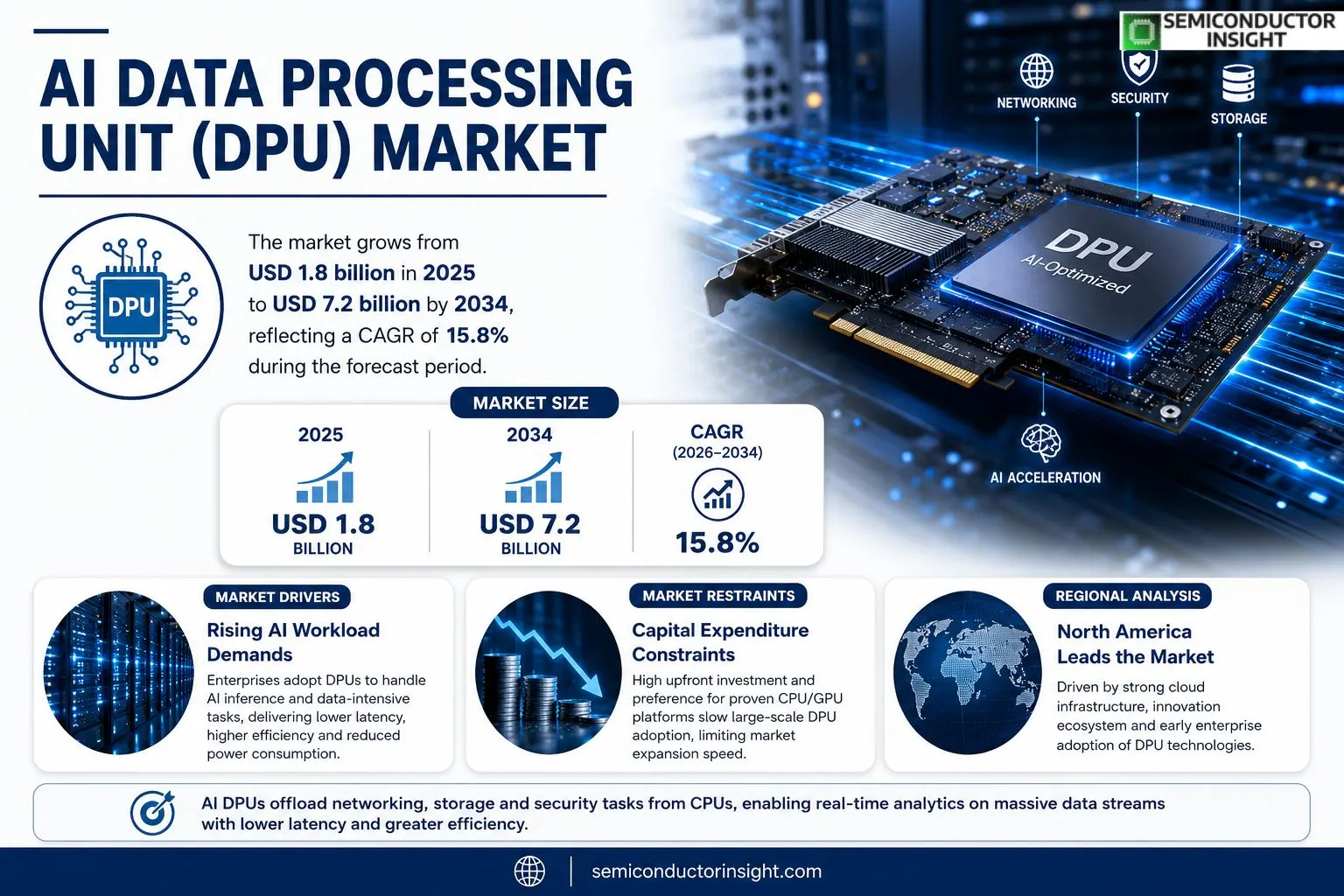
AI Data Processing Unit (DPU) market size was valued at USD 1.8 billion in 2025. The market grows from USD 1.8 billion in 2025 to USD 7.2 billion by 2034, reflecting a CAGR of 15.8% during the forecast period.
AI Data Processing Units are purpose‑built accelerators that shift data‑intensive taskssuch as network packet inspection, storage virtualization, and security enforcementaway from general‑purpose CPUs. By combining programmable packet processors with high‑bandwidth memory interfaces and embedded AI inference engines, DPUs enable real‑time analytics on petabyte‑scale streams while reducing latency.The expansion stems from enterprises scaling cloud and edge infrastructures that require ultra‑low latency data handling, alongside tighter regulatory demands for secure data processing. Recent moves include Nvidia’s integration of Mellanox technologies into its DPU portfolio in early 2023 and Marvell’s launch of the OCTEON Fusion DPU line in mid‑2024 aimed at hyperscale data centers.
MARKET DRIVERS
Rising AI Workload Demands
Enterprises are grappling with AI models that contain billions of parameters, a scale that traditional CPUs and GPUs struggle to process efficiently. Accelerated inference times and lower energy consumption have become decisive criteria, nudging data‑center operators toward purpose‑built AI Data Processing Unit (DPU) solutions. The shift reflects a pragmatic response to escalating latency pressures in real‑time analytics.
Advancements in DPU Architecture
Recent silicon breakthroughs have integrated high‑bandwidth memory interfaces and programmable datapaths, allowing DPUs to offload both networking and AI tasks simultaneously. Zero‑copy data transfers reduce overhead, while modular cores enable vendors to tailor performance to specific workloads. These technical refinements position DPUs as a cost‑effective alternative to over‑provisioned GPU farms.
➤ Analysts note that organizations adopting DPUs report up to a 30% reduction in total cost of ownership compared with legacy architectures.
The convergence of cloud‑native workloads and edge deployments fuels additional demand. As 5G expands, edge nodes require compact, power‑efficient processors capable of handling AI inference locally. DPUs, with their built‑in security accelerators, meet this need while simplifying the software stack, thereby encouraging broader market uptake.
MARKET CHALLENGES
Software Ecosystem Maturity
Despite hardware progress, the surrounding software ecosystem remains fragmented. Developers must navigate disparate SDKs and limited compiler support, which can slow integration timelines. Inconsistent tooling hampers the ability to fully exploit DPU capabilities, deterring risk‑averse enterprises.
Other Challenges
Talent Shortage
A dearth of engineers fluent in both AI model optimization and low‑level hardware programming creates bottlenecks. Companies often resort to external consultants, inflating project costs and extending delivery windows.
MARKET RESTRAINTS
Capital Expenditure Constraints
Large‑scale data‑center upgrades require substantial upfront investment, and many operators prioritize incremental improvements over wholesale DPU adoption. Budget cycles that favor proven CPUs and GPUs limit the speed at which DPUs can achieve critical mass, especially in regions with tighter financial controls.
MARKET OPPORTUNITIES
Edge AI Expansion
The proliferation of AI‑driven IoT devices opens a niche for low‑power DPUs that can process sensor data on‑site. Latency‑sensitive applications such as autonomous robotics, smart cameras, and real‑time anomaly detection stand to benefit from on‑edge processing, presenting a clear growth avenue for vendors that can certify rugged, energy‑efficient units.
Strategic Partnerships
Collaborations between DPU manufacturers and cloud service providers promise bundled offerings that embed acceleration directly into platform services. Such alliances accelerate market penetration by delivering turnkey solutions that abstract hardware complexity, making DPUs accessible even to organizations lacking deep in‑house expertise.
AI Data Processing Unit (DPU) Market Trends
Shift from General‑Purpose CPUs to Dedicated DPUs
AI Data Processing Unit (DPU) Market is being reshaped by enterprises that require near‑zero latency for data‑intensive workloads. Cloud operators and edge providers are moving away from traditional CPU‑centric designs because packet inspection, storage virtualization and security enforcement now consume a disproportionate share of compute cycles. By off‑loading these functions to purpose‑built accelerators, operators achieve measurable reductions in processing delay while freeing CPU capacity for application logic. The migration is further reinforced by stricter compliance regimes that mandate transparent handling of sensitive streams; DPUs embed cryptographic modules that satisfy audit requirements without sacrificing throughput. As a result, organizations that once treated data movement as a background task are now engineering it as a strategic capability, directly influencing service‑level agreements and overall cost structures.
Other Trends
Integration of AI Inference Engines
Recent product announcements illustrate how AI inference is becoming inseparable from DPU architectures. Nvidia’s 2023 acquisition of Mellanox technology introduced programmable packet processors paired with embedded tensor cores, allowing real‑time analytics on petabyte‑scale streams. Meanwhile, Marvell’s 2024 OCTEON Fusion line targets hyperscale data centers with an on‑chip neural engine that executes inference jobs alongside traditional networking functions. These developments reduce the need for separate AI accelerators, compressing hardware footprints and simplifying firmware stacks. Customers benefit from lower power consumption and faster deployment cycles, while vendors capture additional revenue streams by licensing AI‑optimized firmware libraries.
Expansion into Edge and Hyperscale Data Centers
The same forces that drive DPU adoption in cloud cores are spilling over to edge locations where bandwidth constraints and security mandates are even tighter. Edge operators leverage DPUs to process telemetry data locally, avoiding costly backhaul to centralized sites. In hyperscale environments, the sheer volume of intra‑rack traffic makes the traditional CPU‑only model untenable; DPUs act as traffic orchestrators, balancing loads and enforcing policies at line rate. This dual‑segment growth forces original equipment manufacturers to align roadmaps with both latency‑critical edge use cases and massive parallelism demands of hyperscale facilities. Companies that can deliver a unified software development kit across these domains are likely to secure long‑term contracts, while those that remain siloed risk marginalization as the ecosystem coalesces around programmable, AI‑enabled data pipelines.
COMPETITIVE LANDSCAPE
Key Industry Players
AI Data Processing Unit (DPU) Market Competitive Overview
Nvidia dominates the DPU arena thanks to its BlueField‑2 and BlueField‑3 families, which merge Mellanox’s high‑speed interconnect expertise with Nvidia’s AI inference stack. The company’s strategy of bundling programmable packet processors, NVMe‑over‑Fabric support, and Tensor cores has forced hyperscale operators to re‑architect network‑centric workloads around its silicon. This concentration around a single vendor shapes a market where OEMs and cloud providers hinge their roadmap on Nvidia’s release cadence, while also prompting early‑stage entrants to differentiate through open‑source SDKs or ultra‑low‑latency fabric designs.Beyond the headline players, a cluster of specialized firms is carving out niches that could recalibrate the competitive balance. Marvell’s OCTEON Fusion line targets security‑focused data centers, emphasizing programmable flow pipelines for firewalls and DPI. Intel leverages its Data Center Fabric (DCF) portfolio to embed DPU capabilities within its Xeon platform, appealing to enterprises that prefer a single‑vendor silicon stack. Broadcom’s Stingray and Pensando’s Flow Processor (now part of Marvell) address edge‑to‑cloud scaling, while Cisco’s Silicon One and HPE’s GreenLake-ready DPUs reflect a trend toward integrated infrastructure. Emerging contributors such as Qualcomm, Cambricon, Huawei, and Baidu are introducing AI‑centric accelerators that blend DPU functions with proprietary inference engines, positioning themselves for regional cloud markets and AI‑first workloads.
List of Key AI Data Processing Unit Companies Profiled
- Nvidia
- Nvidia
- Marvell Technology
- Marvell
- Intel Corporation
- Intel
- Broadcom Inc.
- Broadcom
- Cisco Systems
- Hewlett Packard Enterprise
- Qualcomm Technologies
- Cambricon Technologies
- Huawei Technologies
- Baidu, Inc.
- Pensando Systems
Segment Analysis:
| Segment Category | Sub-Segments | Key Insights |
| By Type |
|
Programmable Packet Processors
|
| By Application |
|
Real‑time Security Analytics
|
| By End User |
|
Hyperscale Data Centers
|
| By Architecture |
|
Hybrid CPU‑DPU Packages
|
| By Deployment Model |
|
Edge DPU Nodes
|
Regional Analysis: AI Data Processing Unit (DPU) Market
North America
Large corporates are integrating DPUs to segregate networking and storage logic, thereby freeing CPU cycles for AI model inference. This architectural shift yields measurable cost efficiencies and augments the ability to scale workloads without proportional infrastructure expansion.
A dense concentration of systems‑software engineers and hardware architects accelerates DPU firmware development, fostering a virtuous cycle where software innovations quickly translate into silicon refinements.
Emerging data‑privacy statutes compel firms to isolate processing domains, a scenario where DPUs excel by providing hardware‑enforced partitioning, thus turning compliance into a market catalyst.
Proximity to leading foundries and a diversified supplier base safeguards component availability, allowing North American firms to maintain aggressive product‑roadmaps despite logistical volatility.
Europe
European enterprises are gradually aligning with DPU technology as data‑sovereignty regulations compel more localized processing. The region’s emphasis on open‑source hardware frameworks encourages collaborative development, reducing entry barriers for mid‑size firms. While capital intensity lags behind North America, public‑sector procurement programs are showcasing DPUs in smart‑city and industrial‑IoT pilots, hinting at a forthcoming wave of commercial uptake across manufacturing hubs in Germany and France.
Asia‑Pacific
In Asia‑Pacific, rapid digital transformation in China, Japan, and South Korea is creating a fertile environment for DPUs, especially within hyperscale data centers that demand high‑throughput networking. Government incentives for AI chipset research are amplifying domestic design capabilities, yet the market remains fragmented due to divergent standards across the region. Companies that can bridge these gaps stand to capture sizable market share as enterprises chase higher efficiency in cloud‑native workloads.
South America
South American markets exhibit cautious optimism toward AI Data Processing Unit (DPU) Market, driven by a growing appetite for edge‑compute solutions in agriculture and energy sectors. Multinational cloud providers are establishing regional hubs, introducing DPUs to address latency concerns inherent to vast geographies. Local firms are leveraging these deployments to enhance real‑time crop‑monitoring analytics, positioning DPUs as a lever for productivity gains and export competitiveness.
Middle East & Africa
The Middle East & Africa region is in the early adoption phase, with sovereign wealth funds allocating capital toward AI‑centric infrastructure. In the Gulf, sovereign data centers are experimenting with DPUs to meet the dual demands of high security and rapid analytics for finance and oil‑and‑gas operations. African initiatives focus on leveraging DPUs for telemedicine and education platforms, where bandwidth constraints make hardware‑accelerated processing a decisive advantage.
Report Scope
This market research report provides a comprehensive analysis of the AI Data Processing Unit (DPU) Market , covering the forecast period 2026–2034. It offers detailed insights into market dynamics, technological advancements, competitive landscape, and key trends shaping the industry.
Key focus areas of the report include:
- Market Overview: The report begins with an overview outlining its current market scenario, key growth indicators, and industry transformation drivers. It discusses macroeconomic factors, demand–supply balance, regulatory landscape, and the strategic role of semiconductors in powering advancements across industries such as automotive, telecommunications, consumer electronics, and industrial automation.
- Market Size & Forecast: Historical data and future projections for revenue, unit shipments, and market value across major regions and segments.
- Segmentation Analysis: Detailed breakdown by product type, technology, application, and end-user industry to identify high-growth segments and investment opportunities.
- Regional Insights: Insights into market performance across North America, Europe, Asia-Pacific, Latin America, and the Middle East & Africa, including country-level analysis where relevant.
- Competitive Landscape: Profiles of leading market participants, including their product offerings, R&D focus, manufacturing capacity, pricing strategies, and recent developments such as mergers, acquisitions, and partnerships.
- Technology Trends & Innovation: Assessment of emerging technologies, integration of AI/IoT, semiconductor design trends, fabrication techniques, and evolving industry standards.
- Market Drivers & Restraints: Evaluation of factors driving market growth along with challenges, supply chain constraints, regulatory issues, and market-entry barriers.
- Stakeholder Insights: Insights for component suppliers, OEMs, system integrators, investors, and policymakers regarding the evolving ecosystem and strategic opportunities.
Primary and secondary research methods are employed, including interviews with industry experts, data from verified sources, and real-time market intelligence to ensure the accuracy and reliability of the insights presented.
FREQUENTLY ASKED QUESTIONS:
What is the current market size of AI Data Processing Unit (DPU) Market?
-> AI Data Processing Unit (DPU) Market was valued at USD 1.8 billion in 2025 and is expected to reach USD 7.2 billion by 2034.
Which key companies operate in AI Data Processing Unit (DPU) Market?
-> Key players include Nvidia and Marvell, who have announced significant DPU product integrations and launches.
What are the key growth drivers?
-> Key growth drivers include scaling of cloud and edge infrastructures, demand for ultra‑low latency data handling, and heightened regulatory requirements for secure data processing.
Which region dominates the market?
-> The reference does not specify a single dominant region; growth is projected across major markets.
What are the emerging trends?
-> Emerging trends include integration of high‑bandwidth memory, embedded AI inference engines, and programmable packet processors, as demonstrated by Nvidia’s Mellanox integration and Marvell’s OCTEON Fusion DPU line.
Get Sample Report PDF for Exclusive Insights
Report Sample Includes
- Table of Contents
- List of Tables & Figures
- Charts, Research Methodology, and more...
 Download Sample Report PDF