AI CXL Memory Expansion Controller Chip Market Insights
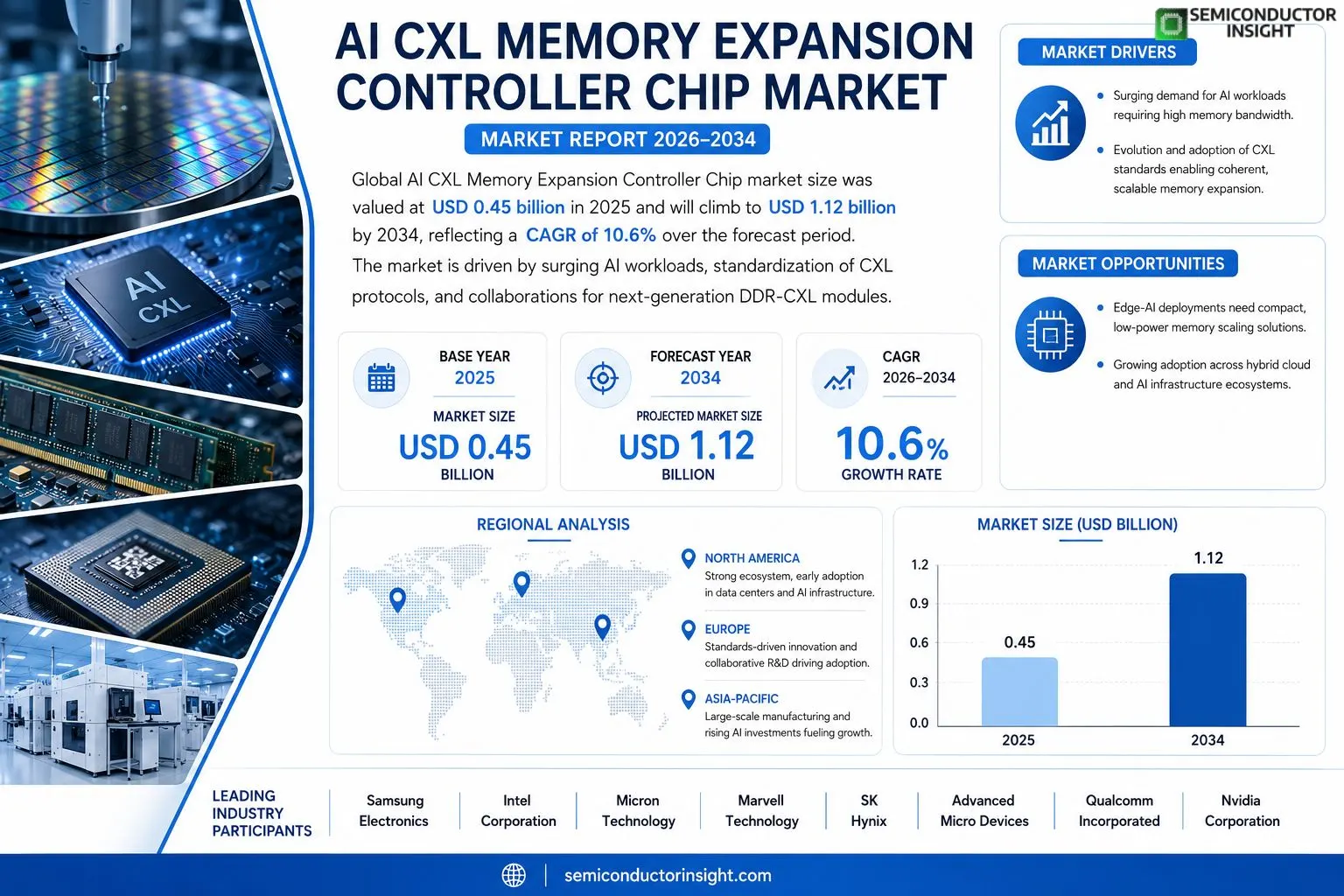
AI CXL Memory Expansion Controller Chip market size was valued at USD 0.45 billion in 2025 and will climb to USD 1.12 billion by 2034, reflecting a CAGR of 10.6% over the forecast period.
AI CXL Memory Expansion Controller Chips are silicon components that orchestrate dynamic allocation of high‑bandwidth memory across heterogeneous compute nodes via the Compute Express Link (Cxl) protocol. They translate host requests into memory‑channel commands, enable coherent sharing between CPUs, GPUs and accelerators, and support tiered memory hierarchies that extend capacity without sacrificing latency.The market gains momentum because data‑center operators seek cost‑effective ways to scale memory for AI workloads while preserving performance envelopes; standards bodies such as the OCP have ratified multiple Cxl versions this year, encouraging broader adoption. Recent collaborationssuch as Intel’s joint development program with Samsung on next‑gen DDR‑Cxl modulessignal confidence among incumbents. Samsung Electronics, Intel Corporation, Micron Technology and Marvell Technology are among the firms actively expanding their controller portfolios.
MARKET DRIVERS
Surging Demand for AI Workloads
Enterprises are scaling AI models that require memory bandwidth far beyond conventional DDR solutions. AI CXL Memory Expansion Controller Chip Market benefits from this pressure, as customers seek a seamless bridge between CPUs and high‑capacity memory pools. Vendors that can demonstrate lower latency and higher throughput gain immediate traction among cloud providers.
Evolution of the CXL Standard
Recent revisions of the Compute Express Link (CXL) specification have introduced tighter coherency guarantees and improved error handling. These technical refinements translate into more predictable system behavior, encouraging OEMs to adopt CXL‑based expansion chips for next‑generation AI accelerators. Companies that embed these chips early position themselves as enablers of the emerging AI infrastructure stack.
➤ “The convergence of AI compute intensity and a mature CXL ecosystem creates a compelling value proposition for memory expansion controllers.”
In parallel, data‑center operators are consolidating workloads to reduce power and floor‑space expenses. By offloading memory functions to dedicated CXL controller chips, they achieve higher utilization of existing servers while postponing costly hardware refresh cycles.
MARKET CHALLENGES
Integration Complexity with Heterogeneous Architectures
Design teams must reconcile differing clock domains, firmware interfaces, and security policies across CPUs, GPUs, and FPGA accelerators. Even modest mismatches can degrade the promised latency advantages of CXL, leading to longer validation cycles and higher engineering costs.
Other Challenges
Supply‑Chain Volatility
Fluctuations in advanced silicon fab capacity and geopolitical tensions have compressed lead times for specialty chips, making it harder for manufacturers to meet the forecasted ramp‑up in AI‑focused deployments.
MARKET RESTRAINTS
Cost Sensitivity of End Users
While the performance uplift is measurable, the incremental bill of materials for a CXL memory expansion controller remains a decisive factor for budget‑constrained hyperscale operators. If price‑performance parity does not improve, adoption may plateau despite technical merit.
MARKET OPPORTUNITIES
Edge‑AI Deployments Requiring Compact Memory Scaling
Edge servers that run inference workloads are limited by physical memory footprints. Introducing a low‑power CXL controller chip enables these devices to tap into external memory modules without enlarging the chassis. Companies that tailor their products for rugged, space‑constrained environments can capture a niche yet growing segment of AI CXL Memory Expansion Controller Chip Market.
AI CXL Memory Expansion Controller Chip Market Trends
Standardization Fuels Early‑Stage Adoption
The Compute Express Link (CXL) protocol has transitioned from a nascent specification to a widely ratified standard this year, prompting data‑center architects to embed AI CXL Memory Expansion Controller Chips into rack designs. By translating host memory requests into coherent channel commands, these chips enable CPUs, GPUs, and custom accelerators to share a common memory pool without incurring the latency penalties traditionally associated with disaggregated storage. Operators are now able to augment memory capacity more incrementally, matching spend to the unpredictable scaling curves of generative‑AI training runs. This alignment of technology capability with cost discipline is reshaping procurement strategies across hyperscale and enterprise clouds.
Other Trends
Strategic Alliances Accelerate Product Roadmaps
Recent joint development programs, notably the collaboration between Intel and Samsung on DDR‑CXL modules, illustrate how incumbent silicon vendors are pooling IP to reduce time‑to‑market. The partnership leverages Samsung’s memory‑fabric expertise and Intel’s controller design heritage, delivering a reference platform that demonstrates sub‑microsecond latencies for multi‑node AI workloads. Such alliances are lowering entry barriers for system integrators, who can now source validated reference designs rather than engineering bespoke solutions from scratch. The ripple effect is a more rapid diffusion of CXL‑enabled memory expansion across mid‑tier cloud providers.
Competitive Landscape Tightens Around Tier‑One Suppliers
While Intel, Samsung, Micron, and Marvell dominate the controller segment, emerging players are seeking niche positions by targeting specific accelerator families or offering firmware that optimizes tiered‑memory hierarchies for inference workloads. This competitive pressure is encouraging incumbent firms to expand their feature sets, such as adding programmable QoS engines and enhanced error‑correction schemes. Buyers are responding by demanding clearer roadmaps and longer‑term support commitments, which in turn drives vendors to bundle firmware updates with proactive service agreements. The evolving supplier dynamics suggest that the market will reward both technological depth and the ability to provide comprehensive lifecycle assurance.
COMPETITIVE LANDSCAPE
Key Industry Players
AI CXL Memory Expansion Controller Chip Market – Competitive Overview
The segment is dominated by a handful of large silicon vendors that have leveraged their existing memory‑controller IP to accelerate CXL adoption. Intel has converted its longstanding Xeon memory‑subsystem expertise into a dedicated CXL expansion controller portfolio, pairing it with Samsung’s DDR‑CXL modules to offer a solution that addresses the latency‑sensitive requirements of AI inference clusters. This partnership signals that incumbent fabs are willing to share development risk, which in turn lowers entry barriers for hyperscale operators. Micron and Marvell complement the field by providing ASIC‑based controllers that emphasize configurable lane counts, enabling cloud providers to tailor bandwidth to specific workload mixes. The tri‑adic focus on performance coherence, cost efficiency, and standards compliance creates a market structure where scale economies are quickly rewarded, while smaller innovators must specialise in niche form factors or vertical‑specific features to stay relevant.Beyond the headline names, a second tier of specialists is shaping the ecosystem. SK Hynix has introduced a memory‑stack controller that targets edge‑AI deployments, where power envelopes are tighter than in data‑center settings. AMD and Qualcomm, traditionally known for CPUs and mobile SoCs, are repurposing their interconnect IP to deliver plug‑and‑play CXL adapters for heterogeneous compute nodes. Nvidia’s acquisition of a low‑power CXL bridge firm has opened a path for GPU‑centric servers to tap into external memory banks without redesigning the PCIe stack. Meanwhile, regional players such as Fujitsu, NXP Semiconductors and Toshiba are building reference designs that integrate CXL controllers with legacy server motherboards, thereby extending the addressable market for enterprises that cannot afford full‑rack upgrades.
List of Key AI CXL Memory Expansion Controller Chip Companies Profiled
- Intel Corporation
- Samsung Electronics
- Micron Technology
- Marvell Technology
- SK Hynix
- Advanced Micro Devices (AMD)
- Qualcomm Incorporated
- Nvidia Corporation
- Google (Alphabet) – TPU Division
- Alibaba Cloud
- Amazon Web Services (AWS)
- Fujitsu Limited
- Toshiba Corp.
- NXP Semiconductors
- Alibaba DAMO Academy
Segment Analysis:
| Segment Category | Sub-Segments | Key Insights |
| By Type |
|
PCIe‑based Controllers
|
| By Application |
|
AI Training Accelerators
|
| By End User |
|
Cloud Service Providers
|
| By Host Architecture |
|
x86 Servers
|
| By Deployment Mode |
|
Hybrid Cloud
|
Regional Analysis: AI CXL Memory Expansion Controller Chip Market
North America
Concentrations of AI‑centric research facilities in Silicon Valley, Boston, and Austin attract both venture capital and talent, allowing rapid iteration of CXL controller prototypes that meet emerging AI memory bandwidth demands.
Multi‑tiered sourcing strategies, backed by domestic fabs and trusted foundry partners, mitigate disruptions and ensure a steady pipeline of advanced process nodes essential for high‑density memory expansion chips.
A clear framework for export controls and data‑privacy compliance gives manufacturers confidence to ship sophisticated AI‑optimized controllers to customers without legal ambiguity.
Early adopterscloud hyperscalers and AI‑focused HPC clustersare piloting CXL‑enabled platforms, providing real‑world feedback that drives iterative refinements and validates market demand.
Europe
European chip designers are leveraging the region’s strong standards‑driven culture to influence CXL specifications, particularly around security extensions and energy‑efficiency metrics. Collaborative initiatives among the EU’s Horizon research programmes and industry groups foster cross‑border testing facilities, enabling small‑to‑mid‑size enterprises to validate controller designs without prohibitive capital outlays. While funding mechanisms are robust, market uptake is tempered by fragmented cloud provider landscapes, prompting vendors to adopt a modular approach that accommodates diverse data‑center architectures across the continent.
Asia-Pacific
The Asia‑Pacific arena is distinguished by its scale of manufacturing capacity and a burgeoning ecosystem of AI start‑ups seeking cost‑effective memory expansion solutions. Nations such as Taiwan and South Korea continue to push process‑node advancements, while China’s policy incentives accelerate domestic development of CXL‑compatible silicon. However, divergent regulatory approaches and intellectual‑property considerations introduce strategic complexity, compelling multinational players to tailor go‑to‑market strategies that respect local compliance while capitalizing on regional production efficiencies.
South America
In South America, market momentum is driven primarily by a handful of telecom operators and governmental research institutes that are experimenting with AI workloads at the edge. Limited domestic fab capability directs most component sourcing to North American and Asian partners, yet the region’s growing demand for low‑latency inference drives interest in modular controller solutions that can be retrofitted into existing infrastructure. Stakeholder collaboration around open‑source firmware is emerging as a cost‑effective pathway to integrate CXL technology without extensive custom engineering.
Middle East & Africa
The Middle East & Africa region exhibits a cautious yet forward‑looking stance, with sovereign wealth funds allocating capital toward AI‑centric semiconductor ventures. Emerging data‑center projects in the United Arab Emirates and South Africa’s fintech sector are exploring CXL‑enabled memory expansion as a means to enhance compute density without massive capital expenditure. Partnerships with OEMs provide access to reference designs, while local talent development programs aim to build the expertise needed for long‑term market participation.
Report Scope
This market research report provides a comprehensive analysis of the AI CXL Memory Expansion Controller Chip Market , covering the forecast period 2026–2034. It offers detailed insights into market dynamics, technological advancements, competitive landscape, and key trends shaping the industry.
Key focus areas of the report include:
- Market Overview: The report begins with an overview outlining its current market scenario, key growth indicators, and industry transformation drivers. It discusses macroeconomic factors, demand–supply balance, regulatory landscape, and the strategic role of semiconductors in powering advancements across industries such as automotive, telecommunications, consumer electronics, and industrial automation.
- Market Size & Forecast: Historical data and future projections for revenue, unit shipments, and market value across major regions and segments.
- Segmentation Analysis: Detailed breakdown by product type, technology, application, and end-user industry to identify high-growth segments and investment opportunities.
- Regional Insights: Insights into market performance across North America, Europe, Asia-Pacific, Latin America, and the Middle East & Africa, including country-level analysis where relevant.
- Competitive Landscape: Profiles of leading market participants, including their product offerings, R&D focus, manufacturing capacity, pricing strategies, and recent developments such as mergers, acquisitions, and partnerships.
- Technology Trends & Innovation: Assessment of emerging technologies, integration of AI/IoT, semiconductor design trends, fabrication techniques, and evolving industry standards.
- Market Drivers & Restraints: Evaluation of factors driving market growth along with challenges, supply chain constraints, regulatory issues, and market-entry barriers.
- Stakeholder Insights: Insights for component suppliers, OEMs, system integrators, investors, and policymakers regarding the evolving ecosystem and strategic opportunities.
Primary and secondary research methods are employed, including interviews with industry experts, data from verified sources, and real-time market intelligence to ensure the accuracy and reliability of the insights presented.
FREQUENTLY ASKED QUESTIONS:
What is the current market size of AI CXL Memory Expansion Controller Chip Market?
-> AI CXL Memory Expansion Controller Chip Market was valued at USD 0.45 billion in 2025 and is expected to reach USD 1.12 billion by 2034, reflecting a CAGR of 10.6% over the forecast period.
Which key companies operate in AI CXL Memory Expansion Controller Chip Market?
-> Key players include Samsung Electronics, Intel Corporation, Micron Technology, and Marvell Technology, among others.
What are the key growth drivers?
-> Key growth drivers include the need for cost‑effective memory scaling in data‑center AI workloads, standardization of CXL protocols by bodies such as OCP, and strategic collaborations enabling next‑generation DDR‑CXL modules.
Which region dominates the market?
-> The reference does not specify a dominant region; market adoption is observed ly with strong interest in North America and Asia‑Pacific.
What are the emerging trends?
-> Emerging trends include increased adoption of CXL‑based memory hierarchies, joint development programs between chip manufacturers and memory suppliers, and the rollout of newer CXL versions that enhance coherence and bandwidth.
Get Sample Report PDF for Exclusive Insights
Report Sample Includes
- Table of Contents
- List of Tables & Figures
- Charts, Research Methodology, and more...
 Download Sample Report PDF