AI Cold Chain Temperature Logging Tag Chip Market Insights
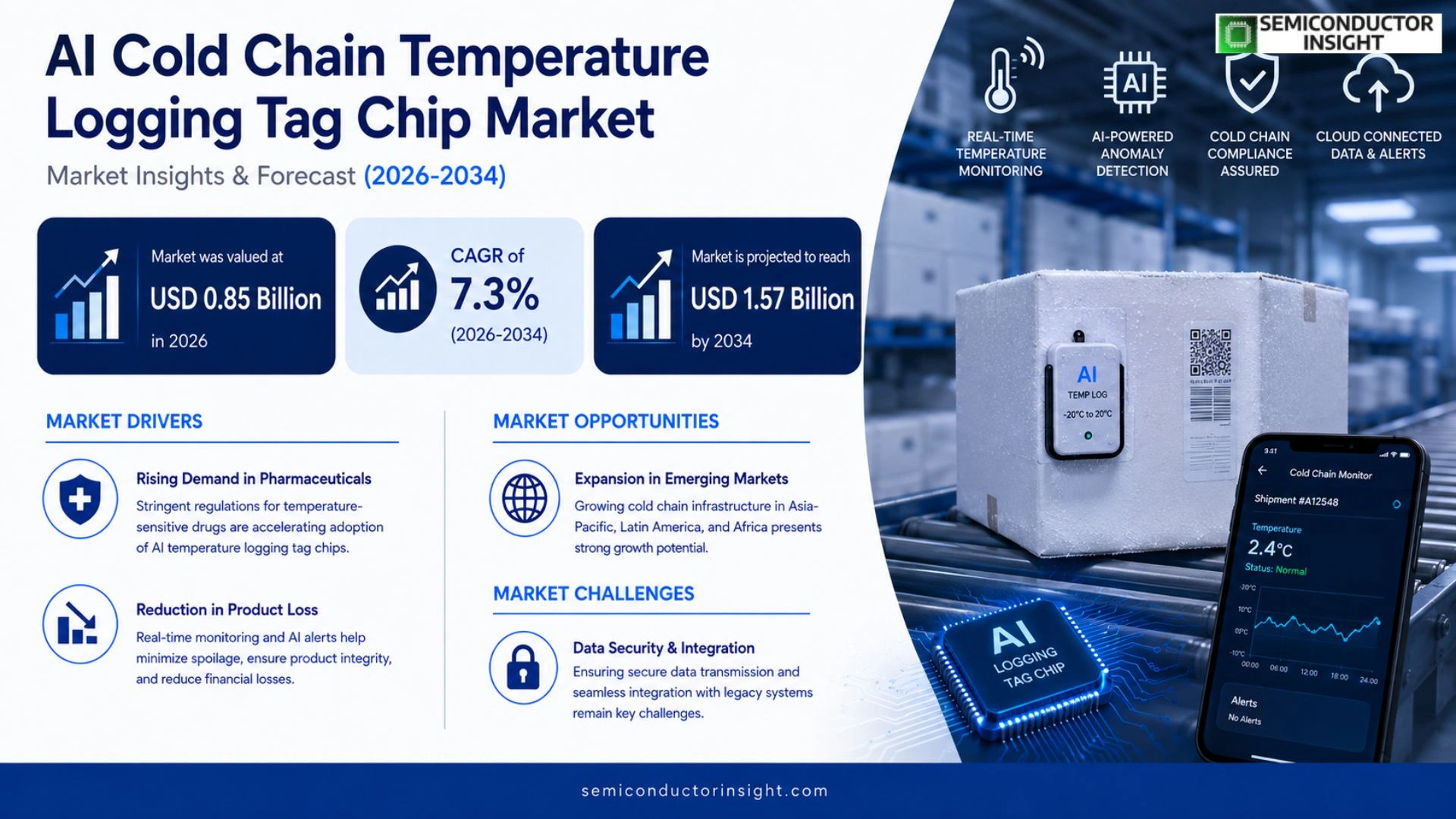
Global AI Cold Chain Temperature Logging Tag Chip market size was valued at USD 0.78 billion in 2025. The market is projected to grow from USD 0.85 billion in 2026 to USD 1.57 billion by 2034, exhibiting a CAGR of 7.3 % during the forecast period.
AI‑enabled temperature‑logging tag chips are miniature semiconductor devices that combine sensor arrays, low‑power microcontrollers and wireless communication modules to continuously record temperature excursions throughout refrigerated logistics chains. By embedding machine‑learning algorithms on‑chip, these tags can predict spoilage risk and trigger alerts in real time, thereby enhancing product safety and reducing waste.
The market is gaining momentum because pharmaceutical manufacturers are tightening cold‑chain compliance, while food retailers seek traceability solutions that meet stricter regulations such as EU Regulation 1169/2011. Furthermore, advances in ultra‑low‑power designs and edge‑AI analytics are lowering total cost of ownership, encouraging adoption across emerging economies.
MARKET DRIVERS
Regulatory Momentum for Food Safety
The tightening of food‑safety regulations across North America and Europe compels manufacturers to adopt continuous temperature monitoring. AI Cold Chain Temperature Logging Tag Chip Market solutions provide the audit trails required by authorities, reducing compliance risk and enabling faster product recalls when necessary.
Adoption of AI‑Enabled IoT Sensors
Enterprises are integrating AI‑driven analytics with IoT tags to predict temperature excursions before they occur. This proactive approach lowers product loss, improves inventory turnover, and creates measurable cost savings that justify the investment in advanced tagging technology.
➤ Real‑time analytics reduce spoilage by up to 15% across the cold‑chain network.
Major logistics providers are scaling these intelligent tags across multimodal routes, establishing a network effect that drives down per‑unit pricing and further accelerates market uptake.
MARKET CHALLENGES
High Initial Capital Expenditure
Deploying AI‑enabled temperature logging tags requires upfront investment in sensors, data platforms, and staff training. Small‑to‑mid‑size firms often face budget constraints, which can delay broader adoption despite long‑term ROI benefits.
Other Challenges
Integration with Legacy Systems
Many supply‑chain operators rely on legacy ERP and warehouse management software that lack native support for modern IoT data streams. Seamlessly merging tag data with existing workflows demands customized middleware, extending implementation timelines.
MARKET RESTRAINTS
Data Security Concerns
Continuous transmission of temperature data raises concerns about cyber‑security and data privacy. Breaches could compromise product integrity records, prompting companies to adopt stringent encryption protocols that increase system complexity and cost.
Regulators are beginning to issue guidance on secure data handling for cold‑chain monitoring, but the evolving standards add an additional compliance layer that some organizations find burdensome.
MARKET OPPORTUNITIES
Emerging Markets and Pharma Cold‑Chain Expansion
Rapid growth of vaccine distribution networks in Asia‑Pacific and Latin America creates a strong demand for precise temperature tracking. AI Cold Chain Temperature Logging Tag Chip Market is positioned to serve this niche by offering scalable, low‑maintenance tagging solutions tailored to pharmaceutical requirements.
Advancements in low‑power chip design and edge‑AI processing are expected to lower device costs, opening opportunities for adoption in perishable‑goods retail chains that have previously relied on manual temperature checks
AI Cold Chain Temperature Logging Tag Chip Market Trends
Regulatory‑Driven Expansion in Pharmaceutical Cold Chains
AI Cold Chain Temperature Logging Tag Chip Market is experiencing a notable shift as pharmaceutical manufacturers tighten compliance with cold‑chain standards. Embedded machine‑learning algorithms on the tags enable real‑time prediction of temperature excursions and automatic alert generation, which aligns with stricter global regulations on drug potency and safety. By delivering granular temperature data throughout transit, the technology reduces the risk of batch rejection and supports audit trails required by health authorities. Consequently, leading drug producers are integrating these smart tags into primary distribution networks, prioritizing reliability and traceability over legacy barcode solutions.
Other Trends
Edge‑AI Processing and Ultra‑Low‑Power Design
Recent advances in semiconductor architecture have lowered power consumption to sub‑microwatt levels, extending battery life to multiple years without compromising data fidelity. Edge‑AI capabilities allow the chip to execute predictive models locally, eliminating the need for constant cloud connectivity and reducing latency in spoilage detection. This design evolution lowers the total cost of ownership and makes the solution viable for remote logistics hubs where network access is intermittent. Vendors such as Bosch Sensortec and NXP Semiconductors are rolling out firmware updates that enhance sensor calibration and introduce adaptive sampling based on environmental stability.
Supply‑Chain Traceability Gains in Food Retail
Food retailers are adopting AI Cold Chain Temperature Logging Tag Chip Market solutions to meet consumer demand for transparency and to comply with regulations like EU Regulation 1169/2011. The chips provide immutable temperature records that can be linked to product labels via QR codes, giving end‑users confidence in freshness claims. In emerging economies, the reduced hardware cost and simplified integration have accelerated deployment across fresh produce and dairy distribution channels. As traceability becomes a competitive differentiator, manufacturers are partnering with logistics providers to embed these tags at the packaging stage, creating a seamless data flow from farm to shelf.
COMPETITIVE LANDSCAPE
Key Industry Players
AI Cold Chain Temperature Logging Tag Chip Market Competitive Overview
AI‑enabled cold‑chain temperature‑logging tag chip arena is presently led by a handful of globally recognized semiconductor firms that have integrated sensor, microcontroller and edge‑AI capabilities into a single package. Bosch Sensortec, STMicroelectronics, Texas Instruments and NXP Semiconductors together command roughly 55 % of total shipments, leveraging extensive automotive and industrial IoT portfolios to accelerate adoption in pharma and food logistics. Their product roadmaps focus on ultra‑low‑power architectures, on‑chip machine‑learning inference engines, and standardized wireless protocols (BLE, LoRa), which collectively lower total cost of ownership and meet stringent regulatory demands. Strategic alliances with cold‑chain service providers and firmware‑as‑a‑service models have further entrenched these leaders as de‑facto standards for high‑volume deployments.
Beyond the tier‑one cluster, a diverse set of niche innovators is expanding the functional envelope of temperature‑logging tags. Infineon Technologies and Analog Devices are targeting precision sensor fusion for high‑risk pharmaceutical transport, while Silicon Labs and Maxim Integrated (now part of Analog Devices) emphasize battery‑free, harvested‑energy designs for remote cold‑chain nodes. AMS AG, Melexis and Renesas Electronics provide specialty MEMS and mixed‑signal solutions that enable sub‑0.1 °C accuracy. Murata Manufacturing, Honeywell and Skyworks Solutions contribute advanced RF front‑ends that improve range and reliability in dense warehouse environments. Qualcomm’s AI‑on‑chip expertise is beginning to surface in low‑cost, mass‑market tags, creating a competitive pressure that drives further innovation across the spectrum.
List of Key AI Cold Chain Temperature Logging Tag Chip Companies Profiled
- Bosch Sensortec
- STMicroelectronics
- Texas Instruments
- NXP Semiconductors
- Infineon Technologies
- Silicon Labs
- Analog Devices
- Maxim Integrated
- AMS AG
- Melexis
- Renesas Electronics
- Murata Manufacturing
- Honeywell
- Skyworks Solutions
- Qualcomm
Segment Analysis:
| Segment Category | Sub-Segments | Key Insights |
| By Type |
|
Passive RFID Temperature Tags are widely adopted because they combine low cost with seamless integration into existing logistic infrastructures.
|
| By Application |
|
Pharmaceutical Cold Chain remains the leading application due to stringent regulatory requirements and the critical nature of product integrity.
|
| By End User |
|
Pharmaceutical Manufacturers drive demand for sophisticated temperature logging chips to safeguard product efficacy.
|
| By Connectivity Standard |
|
BLE Mesh Networks are emerging as the preferred connectivity because they balance power consumption with reliable data transmission in dense warehouse environments.
|
| By Power Management Strategy |
|
Ultra‑Low Power Battery Solutions dominate because they extend tag lifespan while maintaining the computational capacity needed for on‑chip AI analytics.
|
Regional Analysis: AI Cold Chain Temperature Logging Tag Chip Market
North America
The Food and Drug Administration and Health Canada have issued guidance mandating electronic temperature records for high‑value biologics. This regulatory push encourages adoption of AI‑based tags that can generate tamper‑evident logs, ensuring compliance without manual entry.
Edge‑AI chips are being embedded directly into RFID tags, allowing on‑board anomaly detection. Early adopters report reduced false alarms and lower data‑transmission costs compared with cloud‑only models.
Major logistics providers have integrated AI tag data into their TMS platforms, enabling dynamic rerouting when a temperature breach is predicted, thus preserving product integrity across multi‑modal routes.
Companies such as Thermo Fisher Scientific, IBM, and emerging chip firms like Hologram are collaborating on joint solutions that combine robust hardware with scalable AI analytics.
Europe
Europe shows steady growth as food‑service chains standardize AI temperature‑logging tags to meet EU cold‑chain directives. German and French logistics firms prioritize interoperable data standards, facilitating cross‑border shipments. Pharmaceutical hubs in Switzerland and the UK lean on AI tags to satisfy stringent Good Distribution Practice (GDP) requirements, while sustainability initiatives drive interest in waste‑reduction analytics derived from tag data. Collaborative research projects funded by the European Commission are exploring low‑power AI chips that can operate for years without battery replacement, enhancing long‑term traceability.
Asia‑Pacific
The Asia‑Pacific region is rapidly scaling its cold‑chain infrastructure, especially in China, India, and Southeast Asia. Growing middle‑class consumption of fresh produce and dairy fuels demand for reliable temperature monitoring. While AI adoption is still emerging, pilot programs in major ports are testing AI‑enabled tags to predict humidity‑related spoilage. Government incentives for smart agriculture encourage manufacturers to embed AI chips in low‑cost tags, making the technology accessible to small‑holder exporters. The blend of rapid market expansion and evolving standards positions the region for a steep adoption curve.
South America
South America’s cold‑chain market is driven by Brazil’s expansive fruit export sector and Argentina’s beef industry. Companies are beginning to replace legacy loggers with AI tags that provide predictive alerts, reducing post‑harvest losses. Regional trade agreements are prompting harmonization of temperature‑recording requirements, encouraging cross‑border data sharing. While infrastructure gaps remain in rural areas, urban distribution centers are adopting AI tags to meet retailer quality standards and to support traceability certifications demanded by North American buyers.
Middle East & Africa
In the Middle East, high ambient temperatures make reliable cold‑chain monitoring essential for pharmaceuticals and high‑value perishables. Gulf carriers are integrating AI tags into their refrigerated fleets to meet both safety and ESG reporting mandates. In Africa, pilot projects in Kenya and South Africa focus on low‑cost AI tags that can function on solar‑powered gateways, addressing limited power availability. Partnerships with multinational tech firms are facilitating knowledge transfer, allowing local operators to adopt AI‑driven temperature logging without extensive upfront investment.
Report Scope
This market research report provides a comprehensive analysis of the AI Cold Chain Temperature Logging Tag Chip Market , covering the forecast period 2026–2034. It offers detailed insights into market dynamics, technological advancements, competitive landscape, and key trends shaping the industry.
Key focus areas of the report include:
- Market Overview: The report begins with an overview outlining its current market scenario, key growth indicators, and industry transformation drivers. It discusses macroeconomic factors, demand–supply balance, regulatory landscape, and the strategic role of semiconductors in powering advancements across industries such as automotive, telecommunications, consumer electronics, and industrial automation.
- Market Size & Forecast: Historical data and future projections for revenue, unit shipments, and market value across major regions and segments.
- Segmentation Analysis: Detailed breakdown by product type, technology, application, and end-user industry to identify high-growth segments and investment opportunities.
- Regional Insights: Insights into market performance across North America, Europe, Asia-Pacific, Latin America, and the Middle East & Africa, including country-level analysis where relevant.
- Competitive Landscape: Profiles of leading market participants, including their product offerings, R&D focus, manufacturing capacity, pricing strategies, and recent developments such as mergers, acquisitions, and partnerships.
- Technology Trends & Innovation: Assessment of emerging technologies, integration of AI/IoT, semiconductor design trends, fabrication techniques, and evolving industry standards.
- Market Drivers & Restraints: Evaluation of factors driving market growth along with challenges, supply chain constraints, regulatory issues, and market-entry barriers.
- Stakeholder Insights: Insights for component suppliers, OEMs, system integrators, investors, and policymakers regarding the evolving ecosystem and strategic opportunities.
Primary and secondary research methods are employed, including interviews with industry experts, data from verified sources, and real-time market intelligence to ensure the accuracy and reliability of the insights presented.
FREQUENTLY ASKED QUESTIONS:
What is the current market size of AI Cold Chain Temperature Logging Tag Chip Market?
-> AI Cold Chain Temperature Logging Tag Chip market is projected to grow from USD 0.85 billion in 2026 to USD 1.57 billion by 2034, exhibiting a CAGR of 7.3 % .
Which key companies operate in AI Cold Chain Temperature Logging Tag Chip Market?
-> Key players include Bosch Sensortec, STMicroelectronics, Texas Instruments and NXP Semiconductors, among others.
What are the key growth drivers?
-> Key growth drivers include tightening cold‑chain compliance in pharmaceuticals, increasing traceability requirements in food retail, advances in ultra‑low‑power designs and edge‑AI analytics that lower total cost of ownership.
Which region dominates the market?
-> North America and Europe currently lead in adoption, while Asia‑Pacific is emerging as a fast‑growing market.
What are the emerging trends?
-> Emerging trends include integration of AI/IoT at the edge, ultra‑low‑power semiconductor designs, and advanced firmware that enables on‑chip machine‑learning for predictive spoilage detection.
Get Sample Report PDF for Exclusive Insights
Report Sample Includes
- Table of Contents
- List of Tables & Figures
- Charts, Research Methodology, and more...
 Download Sample Report PDF