AI Co-Packaged Optics Silicon Photonics Engine Market Insights
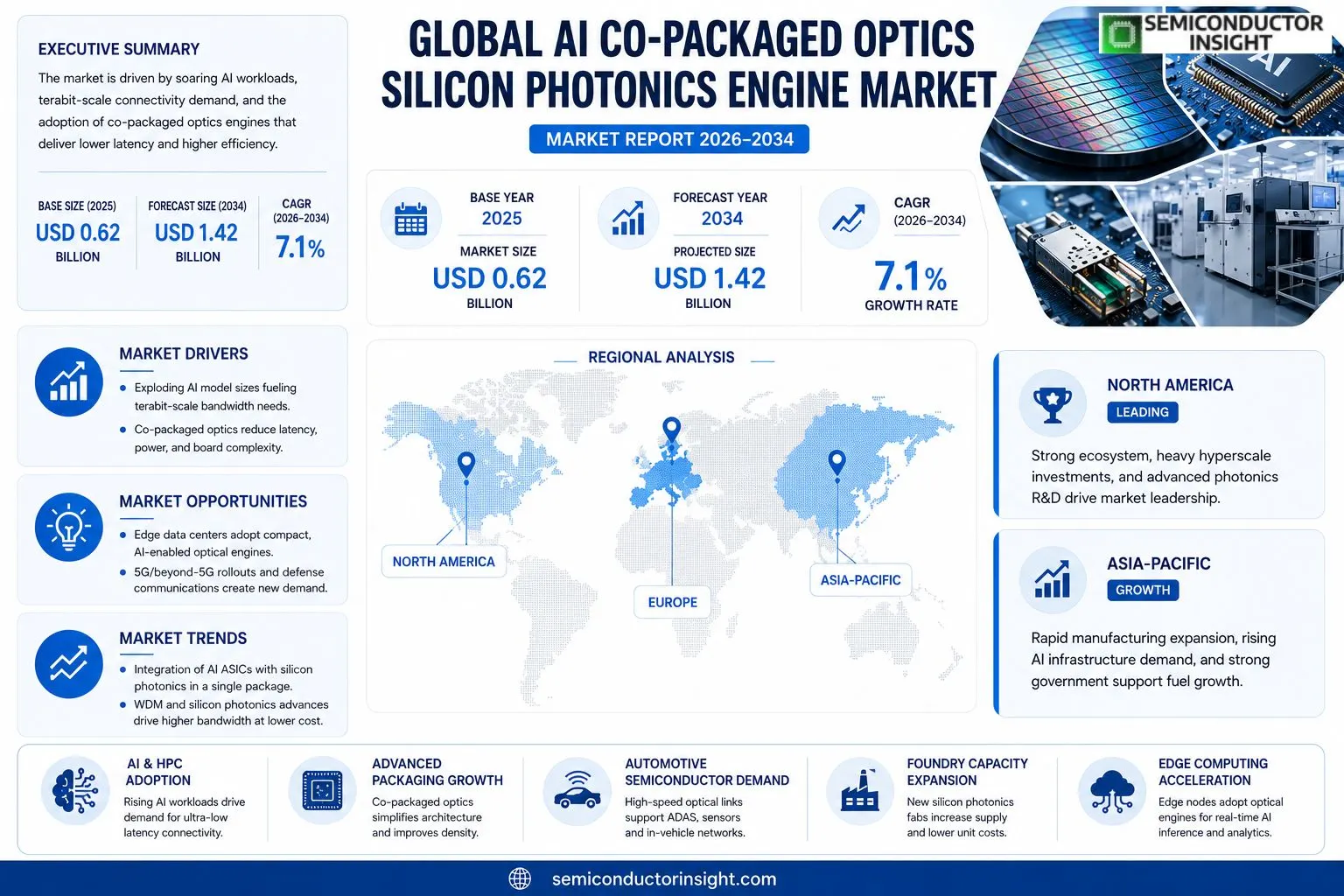
AI Co‑Packaged Optics Silicon Photonics Engine market size was valued at USD 0.62 billion in 2025. Forecasts indicate growth from USD 0.68 billion in 2026 to USD 1.42 billion by 2034, reflecting an implied CAGR of roughly 7.1% during the forecast period.
The engine combines silicon‑based photonic transceivers with artificial‑intelligence ASICs inside a single package, delivering sub‑nanosecond latency and terabit‑per‑second bandwidth while reducing power consumption and board‑level complexity for hyperscale data‑center deployments.The upward trajectory stems from exploding AI model sizes that demand tighter compute‑to‑memory links, alongside carrier‑grade rollouts of wavelength‑division multiplexing that lower total cost of ownership for cloud operators.
In March 2024 Intel announced a joint roadmap with Acacia Communications targeting next‑generation co‑packaged modules, while Microsoft disclosed pilot installations of silicon photonics engines across its Azure hyperscale clustersboth moves underscoring commercial momentum.
MARKET DRIVERS
Escalating Data‑Center Bandwidth Requirements
The surge in hyperscale cloud infrastructure forces operators to replace legacy copper interconnects with photonic solutions that can sustain terabit‑per‑second streams. AI Co‑Packaged Optics Silicon Photonics Engine Market participants that integrate lasers, modulators and detectors on a single silicon die are able to shave latency and power consumption, giving carriers a defensible edge in cost‑per‑bit calculations.
Proliferation of Large‑Scale AI Models
Training cycles for generative AI now routinely involve models with billions of parameters, demanding inter‑node communication that outpaces traditional electrical links. Vendors that embed optical transceivers directly next to AI accelerators can deliver the required throughput while keeping thermal envelopes within rack limits. This technical advantage translates into measurable reductions in total cost of ownership for hyperscale customers.
➤ “Co‑packaged optics are no longer a niche add‑on; they are becoming the default substrate for high‑performance AI clusters.”
Regulatory pressure on data‑center energy efficiency, especially in regions with aggressive carbon‑reduction targets, further incentivizes adoption of integrated silicon photonics. Operators that deploy these engines can claim lower PUE (Power Usage Effectiveness) scores, a factor that increasingly influences procurement decisions.
MARKET CHALLENGES
Manufacturing Yield Variability
Silicon photonic components require sub‑micron patterning and precise epitaxial growth of III‑V materials. Small deviations in fab line performance can cause yield drops that ripple through supply chains, driving up unit costs and deterring risk‑averse buyers.
Other Challenges
Integration Complexity
Combining high‑speed lasers with CMOS driver circuits on a single substrate demands tight co‑design between foundries and design houses. Misalignment in design schedules can delay product launches, eroding market momentum.Supply‑chain exposure to geopolitical tensions adds another layer of uncertainty, as key materials such as indium and gallium are sourced from a limited set of regions.
MARKET RESTRAINTS
High Capital Expenditure for Tooling
Establishing a dedicated silicon‑photonic line entails multi‑million‑dollar investments in lithography, etching and testing equipment. Smaller players often lack the financial bandwidth to make such commitments, limiting the competitive landscape to a handful of well‑capitalized firms.Conversely, the steep learning curve associated with photonic design automation tools extends product development timelines, which can discourage early‑stage startups from entering the space.Customers who operate on thin margins may defer upgrades until the technology matures, thereby slowing the pace at which the AI Co‑Packaged Optics Silicon Photonics Engine Market can achieve broader penetration.
MARKET OPPORTUNITIES
Edge‑Computing Deployments
Edge data centers, which serve latency‑sensitive AI inference workloads, are beginning to adopt compact silicon‑photonic modules to overcome the bottlenecks of traditional Ethernet. The reduced form factor and lower power draw of co‑packaged optics align perfectly with the constraints of micro‑operator sites.Another promising avenue lies in telecom operators transitioning from 5G to beyond‑5G architectures, where fronthaul links require optical solutions that can scale linearly with bandwidth demand. Partnerships between photonics manufacturers and network equipment providers can unlock new revenue streams.Finally, the emergence of standardized design‑for‑manufacturability (DFM) guidelines for silicon photonics is expected to lower entry barriers, enabling a wider ecosystem of software‑defined optical components that can be rapidly customized for specific AI workloads.
AI Co-Packaged Optics Silicon Photonics Engine Market Trends
Integrated Latency Reduction and Bandwidth Expansion
The convergence of silicon‑photonic transceivers with AI‑optimized ASICs inside a single package is reshaping hyperscale data‑center design. By eliminating board‑level interconnects, the engine achieves sub‑nanosecond round‑trip times while sustaining terabit‑per‑second streams. Operators are rewarding this efficiency because it translates directly into lower power draw per bit and simplifies rack layouts. As artificial‑intelligence workloads become more compute‑intensive, the pressure to shorten the distance between processor and memory intensifies, making the co‑packaged approach a pragmatic solution rather than an experimental add‑on.
Other Trends
AI Model Scaling Driving Architecture Shifts
Modern transformer‑based models routinely exceed hundreds of billions of parameters, stretching conventional interconnect fabrics beyond their practical limits. Engineers are responding by re‑architecting the data path: the silicon photonics engine acts as a high‑speed conduit that bridges accelerators and storage clusters without incurring the latency penalties of traditional electrical links. This architectural adjustment is reflected in procurement cycles where cloud service providers prioritize vendors that offer integrated photonic solutions. The shift also influences software stacks, encouraging developers to align algorithmic partitioning with the physical topology afforded by the engine, thereby extracting maximum throughput from the hardware.
Strategic Partnerships Accelerate Adoption
Recent announcements from industry heavyweights illustrate how collaboration is fast‑tracking market penetration. A joint roadmap unveiled by a leading semiconductor manufacturer and a wavelength‑division specialist outlines a roadmap for next‑generation co‑packaged modules, signaling confidence in large‑scale production. Simultaneously, a major cloud platform has reported pilot deployments across multiple hyperscale clusters, providing real‑world validation of performance claims. These moves reduce perceived risk for adopters, encourage downstream ecosystem development, and create a feedback loop that refines the technology based on operational experience. Consequently, the AI Co‑Packaged Optics Silicon Photonics Engine Market is witnessing a measurable acceleration in commercial uptake.
COMPETITIVE LANDSCAPE
Key Industry Players
Competitive Overview of AI Co‑Packaged Optics Silicon Photonics Engine Providers
Intel commands the most visible position in the AI co‑packaged optics arena, chiefly because its silicon photonics foundry dovetails with the company’s AI ASIC portfolio. The March 2024 announcement of a joint development roadmap with Acacia Communications signaled a strategic escalation: Intel supplies the photonic wafer while Acacia contributes high‑speed transceiver IP, creating a package that satisfies hyperscale latency requirements without inflating board‑level bill‑of‑materials. This partnership has anchored a market structure where a handful of vertically integrated firms control the bulk of volume, while a constellation of specialist IP licensors and component assemblers occupy the periphery. Cloud operators such as Microsoft have begun pilot deployments, reinforcing the perception that scale‑up risk has diminished and that the economics of terabit‑per‑second links are now viable for large‑scale data‑center roll‑outs.Beyond the leading duo, a suite of niche innovators enriches the competitive fabric. Lumentum leverages its legacy in modulators to deliver carrier‑grade wavelength‑division multiplexing engines that complement Intel’s silicon platform. Ayar Labs focuses on photonic‑assisted compute‑to‑memory bridges, positioning its technology as a natural extension of co‑packaged optics. Samsung’s foundry services provide a high‑volume silicon photonics process that many emerging startups depend upon, while Ciena integrates the engines into its optical transport portfolio to offer end‑to‑end solutions for service providers. Infinera, NeoPhotonics and Broadcom contribute mature DWDM and ASIC building blocks, allowing system integrators to tailor bandwidth to specific AI workloads. Start‑up entrants such as Rockley Photonics, SiPearl and Terabit are experimenting with novel waveguide geometries and packaging techniques that could reshape cost structures in the next product cycle.
List of Key AI Co-Packaged Optics Silicon Photonics Engine Companies Profiled
- Intel Corporation
- Acacia Communications
- Lumentum Holdings Inc.
- Ayar Labs
- Samsung Electronics
- Ciena Corporation
- Infinera Corporation
- Broadcom Inc.
- NeoPhotonics Corp.
- Rockley Photonics
- SiPearl
- Terabit
- Marvell Technology Group (formerly Inphi)
- Microsoft Azure (pilot deployments)
- AMD (Xilinx) – silicon photonics integration efforts
Segment Analysis:
| Segment Category | Sub-Segments | Key Insights |
| By Type |
|
Integrated Silicon Photonics Engine is emerging as the dominant type because it offers the deepest level of optical‑electrical co‑design, minimizes interconnect parasitics, and aligns with the latency‑critical demands of hyperscale AI workloads.
|
| By Application |
|
Hyperscale Data‑Center Interconnect drives the market because operators seek terabit‑per‑second bandwidth with ultra‑low latency to support ever‑growing AI model sizes.
|
| By End User |
|
Cloud Service Providers are the primary adopters, motivated by the need to sustain AI‑driven services at massive scale.
|
| By Integration Strategy |
|
Package‑on‑Package (PoP) is leading because it enables stacking of photonic and AI ASIC layers without additional interposers, preserving signal integrity.
|
| By Performance Tier |
|
Terabit‑Class Engines dominate the tiered landscape as they satisfy the bandwidth envelope required for next‑generation AI models while preserving latency budgets.
|
Regional Analysis: AI Co-Packaged Optics Silicon Photonics Engine Market
North America
Manufacturers are consolidating silicon photonics foundries with AI chipset fabs to shorten time‑to‑market. This vertical alignment reduces hand‑off friction and enables joint testing of co‑packaged modules, which translates into tighter performance tolerances and lower total cost of ownership for end users.
Fortune‑500 firms are piloting silicon photonic engines within hyperscale clusters, valuing the bandwidth‑density advantage for transformer‑based AI models. Early adopters report measurable latency reductions that justify premium pricing on a case‑by‑case basis.
The region’s universities and research labs produce a steady stream of photonics engineers, allowing firms to staff advanced design teams without resorting to costly overseas recruitment drives.
Recent revisions to export controls have clarified permissible technology transfers, giving U.S. companies confidence to expand collaborative programs with allied partners while protecting core intellectual property.
Europe
European telecom operators are integrating AI‑optimized photonic engines into 5G backhaul, driven by the continent’s push for edge‑centric compute. While the market size lags behind North America, a strong emphasis on standards harmonization and sustainability grants European vendors a unique positioning for green‑focused data centers. Collaborative research consortia, such as the EU Photonics Initiative, channel public funds into prototype demonstrations, accelerating the transition from laboratory concepts to field deployments. Companies that can align with these programs gain early visibility and access to a network of potential OEM customers.
Asia‑Pacific
The Asia‑Pacific region benefits from a juxtaposition of massive manufacturing capacity and escalating AI workloads in China, Japan, and South Korea. Domestic cloud providers are rapidly scaling up AI‑centric infrastructure, prompting local silicon photonics firms to offer co‑packaged solutions that marry cost efficiency with performance. However, fragmented intellectual‑property regimes introduce complexities for multinational players seeking to protect designs while leveraging regional fabs. Strategic joint ventures that blend design expertise with foundry throughput are emerging as a pragmatic response to these market frictions.
South America
In South America, adoption is being catalyzed by a nascent wave of government‑backed digital transformation initiatives aimed at modernizing research institutions and public‑sector data platforms. Though the overall market remains modest, the region’s appetite for energy‑efficient interconnects aligns with the low‑power promise of silicon photonic engines. Early pilots in Brazil’s academic networks hint at a longer‑term trajectory where local telecom carriers might partner with multinational vendors to retrofit existing fiber assets with AI‑ready photonic modules.
Middle East & Africa
The Middle East & Africa are witnessing incremental interest as sovereign wealth funds allocate capital toward AI‑driven smart city projects. These initiatives demand high‑bandwidth, low‑latency links that conventional electrical interconnects struggle to provide. Regional telecom operators are experimenting with pilot deployments in data‑center clusters located in the UAE and South Africa, leveraging partnerships with European and North American OEMs to import proven silicon photonics designs. Success in these pilots could unlock broader regional rollout, especially as policy frameworks begin to emphasize digital infrastructure resilience.
Report Scope
This market research report provides a comprehensive analysis of the AI Co-Packaged Optics Silicon Photonics Engine Market , covering the forecast period 2026–2034. It offers detailed insights into market dynamics, technological advancements, competitive landscape, and key trends shaping the industry.
Key focus areas of the report include:
- Market Overview: The report begins with an overview outlining its current market scenario, key growth indicators, and industry transformation drivers. It discusses macroeconomic factors, demand–supply balance, regulatory landscape, and the strategic role of semiconductors in powering advancements across industries such as automotive, telecommunications, consumer electronics, and industrial automation.
- Market Size & Forecast: Historical data and future projections for revenue, unit shipments, and market value across major regions and segments.
- Segmentation Analysis: Detailed breakdown by product type, technology, application, and end-user industry to identify high-growth segments and investment opportunities.
- Regional Insights: Insights into market performance across North America, Europe, Asia-Pacific, Latin America, and the Middle East & Africa, including country-level analysis where relevant.
- Competitive Landscape: Profiles of leading market participants, including their product offerings, R&D focus, manufacturing capacity, pricing strategies, and recent developments such as mergers, acquisitions, and partnerships.
- Technology Trends & Innovation: Assessment of emerging technologies, integration of AI/IoT, semiconductor design trends, fabrication techniques, and evolving industry standards.
- Market Drivers & Restraints: Evaluation of factors driving market growth along with challenges, supply chain constraints, regulatory issues, and market-entry barriers.
- Stakeholder Insights: Insights for component suppliers, OEMs, system integrators, investors, and policymakers regarding the evolving ecosystem and strategic opportunities.
Primary and secondary research methods are employed, including interviews with industry experts, data from verified sources, and real-time market intelligence to ensure the accuracy and reliability of the insights presented.
FREQUENTLY ASKED QUESTIONS:
What is the current market size of AI Co-Packaged Optics Silicon Photonics Engine Market?
-> AI Co-Packaged Optics Silicon Photonics Engine Market was valued at USD 0.62 billion in 2025 and is expected to reach USD 1.42 billion by 2034.
Which key companies operate in AI Co-Packaged Optics Silicon Photonics Engine Market?
-> Key players include Intel, Acacia Communications, Microsoft, IBM, and Google, among others.
What are the key growth drivers?
-> Key growth drivers include exploding AI model sizes requiring tighter compute‑to‑memory links, adoption of wavelength‑division multiplexing, and demand for low‑latency, high‑bandwidth interconnects in hyperscale data‑centers.
Which region dominates the market?
-> North America leads the market, with strong adoption in the United States, while Asia‑Pacific shows rapid growth.
What are the emerging trends?
-> Emerging trends include integration of AI ASICs with silicon photonics, development of co‑packaged modules for AI accelerators, and deployment of advanced WDM schemes for scaling bandwidth.

Get Sample Report PDF for Exclusive Insights
Report Sample Includes
- Table of Contents
- List of Tables & Figures
- Charts, Research Methodology, and more...
 Download Sample Report PDF