AI Chip Performance Benchmarking and Validation Services Market Insights
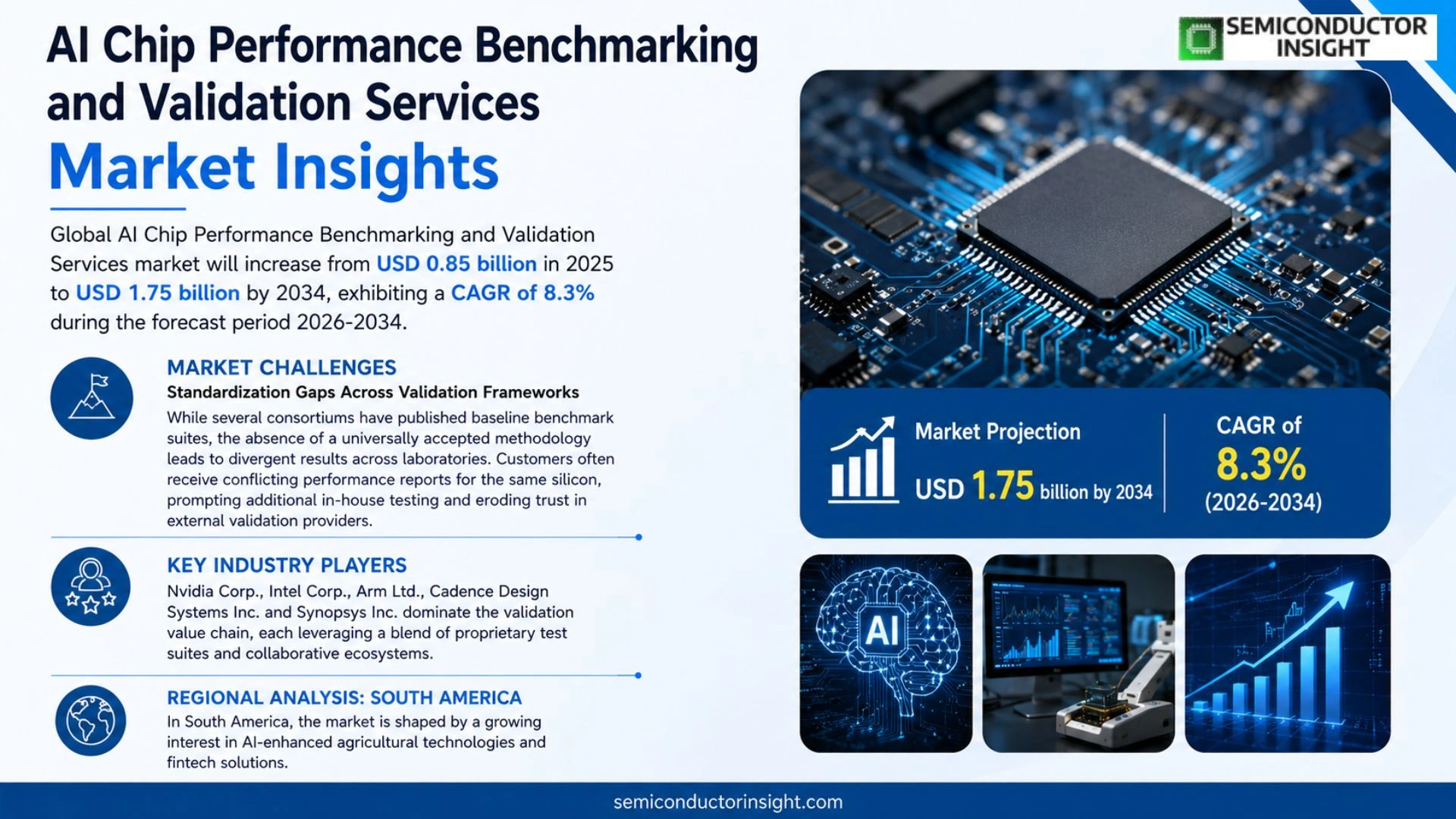
Global AI Chip Performance Benchmarking and Validation Services market size was valued at USD 0.85 billion in 2025. The market will increase from USD 0.85 billion in 2025 to USD 1 75 billion by 2034, exhibiting a CAGR of 8.3 % during the forecast period.
AI chip performance benchmarking and validation services comprise systematic testing, measurement, and certification of semiconductor accelerators built for artificial‑intelligence workloads. They assess throughput, latency, power efficiency and functional correctness against standard AI inference and training suites such as MLPerf™ and SPEC‑AI.
The market is gaining momentum because expanding AI deployments across cloud datacenters, autonomous vehicles and edge devices heighten the need for trustworthy performance metrics and compliance assurance. At the same time, rising capital spending on custom silicon pushes designers toward third‑party validation to curb risk and shorten time‑to‑market
MARKET DRIVERS
Rising Complexity of AI Accelerator Architectures
AI chip manufacturers are integrating ever more heterogeneous compute blocks,tensor cores, sparse matrix units, and dedicated vision processors,into single silicon dies. This architectural sophistication makes it difficult for design teams to infer real‑world throughput from simulation alone, creating a clear impetus for robust performance benchmarking and validation services. Companies that can translate silicon‑level metrics into application‑level outcomes are receiving heightened attention from OEMs seeking to shorten time‑to‑market.
Demand for Transparent Performance Metrics
End‑users, particularly cloud providers and enterprises deploying large language models, now require verifiable performance guarantees before committing to multi‑year hardware contracts. The ability to present an auditable benchmark suite,covering latency, power envelope, and scalability,directly influences purchasing decisions. As a result, service providers that combine industry‑accepted test suites with bespoke validation scripts are gaining strategic relevance.
➤ “A reliable benchmark is the contract language between silicon designers and AI solution architects.”
Consequently, AI Chip Performance Benchmarking and Validation Services Market is seeing a shift from ad‑hoc testing toward integrated service platforms that embed continuous validation into the silicon lifecycle. This evolution not only improves design confidence but also opens recurring revenue streams for firms that can standardize the validation process.
MARKET CHALLENGES
Standardization Gaps Across Validation Frameworks
While several consortiums have published baseline benchmark suites, the absence of a universally accepted methodology leads to divergent results across laboratories. Customers often receive conflicting performance reports for the same silicon, prompting additional in‑house testing and eroding trust in external validation providers.
Other Challenges
Fragmented Tool Ecosystem
Design teams typically employ a mix of proprietary simulators, open‑source profilers, and vendor‑specific diagnostics. Aligning these disparate tools into a coherent validation pipeline demands specialist expertise and can inflate project budgets.
MARKET RESTRAINTS
High Capital Investment for Benchmark Infrastructure
Establishing a state‑of‑the‑art benchmarking lab,complete with high‑speed interconnects, thermal chambers, and AI‑specific power metering,requires multi‑million dollar outlays. Smaller AI chip startups often lack the balance sheet strength to fund such facilities, limiting their ability to engage third‑party validation services.
In addition, the rapid cadence of AI hardware releases means that equipment must be refreshed frequently to remain relevant, further tightening the financial constraints on both service providers and their clients.
MARKET OPPORTUNITIES
Emerging Edge AI Use Cases
The proliferation of AI inference at the edge,industrial IoT, autonomous drones, and AR/VR headsets,creates a niche where power‑efficient, latency‑critical chips must be validated under highly constrained conditions. Services that can simulate real‑world edge workloads while measuring thermal and energy footprints stand to capture a growing slice of the market.
Moreover, as regulatory bodies begin to draft guidelines for AI reliability and safety, compliance‑oriented benchmarking will transition from optional to mandatory. Providers that embed regulatory test criteria into their validation suites will enjoy a first‑mover advantage.
Overall, the convergence of heterogeneous chip designs, heightened performance scrutiny, and nascent edge deployments sets the stage for AI Chip Performance Benchmarking and Validation Services Market to expand its service depth and geographic reach.
AI Chip Performance Benchmarking and Validation Services Market Trends
Escalating Demand for Third‑Party Validation in AI Chip Design
AI Chip Performance Benchmarking and Validation Services Market is being reshaped by the surge in AI workloads across cloud, autonomous‑vehicle and edge environments. As operators scale up compute capacity, the variance in throughput, latency and power efficiency among custom silicon becomes a strategic risk. Companies therefore enlist independent benchmarking firms to certify that their accelerators meet established AI inference and training suites such as MLPerf and SPEC‑AI. This shift reduces design re‑work, shortens time‑to‑market and provides customers with comparable performance data that can be leveraged in procurement negotiations. Forecasts indicate the market will expand from $0.85 billion in 2025 to $1.75 billion by 2034, reflecting sustained investment in validation capabilities. The heightened emphasis on validation also reflects regulatory scrutiny, as jurisdictions introduce mandatory reporting of AI chip energy consumption for sustainability certifications. Vendors that can provide documented benchmark results are better positioned to secure high‑value contracts with hyperscale cloud operators that factor efficiency into service‑level agreements. Moreover, the growing prevalence of heterogeneous compute stacks,combining GPUs, TPUs and emerging neuromorphic chips,necessitates cross‑platform benchmarking to guide system architects in workload allocation. As a result, the market for validation services is evolving from a niche testing function to a strategic advisory component within AI hardware roadmaps.
Other Trends
Standardization of Benchmark Suites
The industry is coalescing around a handful of benchmark suites that offer repeatable, transparent measurements. MLPerf’s latest training v2.1 and inference v3.0 specifications incorporate diverse model mixes, from large language transformers to computer‑vision networks, enabling vendors to demonstrate real‑world efficiency. SPEC‑AI complements this by focusing on power‑per‑watt ratios under constrained thermal envelopes, a metric prized by edge manufacturers. As more customers demand verifiable scores, service providers are embedding these suites into automated test flows, reducing manual configuration time and improving result consistency. This alignment between standards and service delivery creates a predictable evaluation framework that can be referenced across contracts, thereby lowering dispute risk.
Strategic Consolidation Among Service Providers
Recent months have witnessed a series of acquisitions and partnership agreements among the leading validation players. Nvidia’s acquisition of a boutique testing firm and Intel’s joint venture with a cloud‑centric benchmarking startup illustrate a competitive drive to integrate measurement capabilities directly into chip design workflows. These moves broaden service portfolios, allowing providers to offer end‑to‑end solutions that span from silicon validation to post‑silicon performance monitoring. For customers, the consolidation translates into fewer vendor relationships to manage and a clearer roadmap for compliance with emerging AI compute standards. The net effect is a more integrated ecosystem that supports rapid iteration while preserving confidence in reported performance figures.
COMPETITIVE LANDSCAPE
Key Industry Players
AI Chip Benchmarking & Validation: Competitive Overview
Nvidia Corp., Intel Corp., Arm Ltd., Cadence Design Systems Inc. and Synopsys Inc. dominate the validation value chain, each leveraging a blend of proprietary test suites and collaborative ecosystems. Nvidia’s end‑to‑end offering couples its GPU reference boards with MLPerf certification, positioning the firm as a de‑facto standard‑setter for high‑throughput inference evaluation. Intel’s strategy hinges on its oneAPI‑based validation platform, which streamlines cross‑architecture comparisons for both training and inference workloads. Arm, through its recently acquired verification unit, supplies architecture‑agnostic benchmarks that resonate with fabless designers seeking early‑stage assurance. Cadence and Synopsys complement these hardware‑centric players by delivering silicon‑level verification IP and power‑analysis modules that integrate with third‑party test rigs, thereby creating a layered service model that accommodates everything from prototype silicon to volume production.
Beyond the Tier‑1 cohort, a cluster of niche specialists injects differentiation into the market. Qualcomm’s Snapdragon AI Engine team extends validation to edge‑centric accelerators, emphasizing power‑efficiency metrics that matter for mobile and IoT deployments. AMD’s acquisition of Xilinx broadened its portfolio to include FPGA‑based inference validation, catering to customers that require reconfigurable performance guarantees. Graphcore, a UK‑based startup, offers a bespoke benchmark suite aligned with its IPU architecture, appealing to research‑heavy firms prioritizing model fidelity. Huawei’s HiSilicon division and Samsung’s Exynos group both run internal compliance labs, yet they increasingly expose results to external consortia to bolster credibility. MediaTek, IBM and Marvell round out the field, each delivering targeted measurement services for niche verticals such as automotive perception, enterprise AI clouds and networking ASICs. The interplay of these players creates a competitive tapestry where breadth of coverage and depth of specialization determine client preference.
List of Key AI Chip Benchmarking and Validation Services Companies Profiled
- Nvidia Corp.
- Intel Corp.
- Arm Ltd.
- Cadence Design Systems Inc.
- Synopsys Inc.
- Qualcomm Inc.
- Advanced Micro Devices, Inc.
- Xilinx (now part of AMD)
- Graphcore Ltd.
- Huawei Technologies Co., Ltd.
- Samsung Electronics Co., Ltd.
- MediaTek Inc.
- IBM Corporation
- Marvell Technology Group Ltd.
Segment Analysis:
| Segment Category | Sub-Segments | Key Insights |
| By Type |
|
Domain‑specific AI accelerators
|
| By Application |
|
Data‑center inference
|
| By End User |
|
Chip designers
|
| By Validation Phase |
|
Post‑silicon validation
|
| By Industry Vertical |
|
Cloud services
|
Regional Analysis: AI Chip Performance Benchmarking and Validation Services Market
North America
The confluence of research universities and start‑up incubators in Boston and Austin drives a pipeline of novel benchmarking methodologies, prompting service providers to embed machine‑learning‑driven analytics into their validation suites.
A deep talent pool with expertise in both hardware design and software profiling enables firms to offer end‑to‑end performance verification, reducing time‑to‑market for AI‑centric chips.
Major cloud operators and autonomous‑vehicle OEMs, anchored in the region, demand rigorous validation, compelling vendors to tailor services for high‑throughput, low‑latency scenarios.
Emerging standards on AI safety and data integrity influence validation protocols, prompting service firms to incorporate compliance checkpoints within their benchmarking workflows.
Europe
European manufacturers benefit from a coordinated approach to AI chip validation, driven by cross‑border research consortia and substantial public‑sector funding. The region’s emphasis on sustainability translates into benchmarking tools that assess energy efficiency alongside raw performance, influencing design choices for data‑center processors. Moreover, the integration of European Union directives on AI transparency pushes service providers to embed traceability features, ensuring that performance metrics can be audited throughout the supply chain. This regulatory nuance differentiates Europe’s market dynamics, encouraging firms to blend technical rigor with compliance readiness.
Asia‑Pacific
Asia‑Pacific’s rapid expansion of semiconductor fabs and AI accelerator production creates a fertile ground for validation services. Domestic champions in China, South Korea, and Taiwan prioritize in‑house benchmarking to safeguard competitive advantage, while also engaging with international service firms to benchmark against global standards. The region’s heterogeneous demand,spanning consumer electronics, telecom infrastructure, and emerging AI‑driven robotics,requires validation platforms that can scale across diverse workloads. Consequently, providers are adapting modular test environments that can be quickly reconfigured for varying process nodes and architecture styles.
South America
In South America, the market is shaped by a growing interest in AI‑enhanced agricultural technologies and fintech solutions. Local chip designers, often operating within limited R&D budgets, rely on outsourced benchmarking services to validate performance under real‑world conditions such as low‑power field deployments. Partnerships with North American vendors provide access to sophisticated validation suites, while regional trade agreements facilitate technology transfer, gradually raising the sophistication of local validation capabilities.
Middle East & Africa
The Middle East & Africa region is witnessing the early stages of AI chip adoption, primarily driven by government‑led smart‑city initiatives and oil‑field automation projects. Validation services are increasingly viewed as a risk‑mitigation tool, ensuring that new AI processors can handle harsh environmental factors without compromising reliability. Although the market remains nascent, strategic investments in test‑lab infrastructure and collaborations with global benchmarking firms suggest a trajectory toward deeper integration of performance validation within regional AI deployment strategies.
Report Scope
This market research report provides a comprehensive analysis of the AI Chip Performance Benchmarking and Validation Services Market , covering the forecast period 2026–2034. It offers detailed insights into market dynamics, technological advancements, competitive landscape, and key trends shaping the industry.
Key focus areas of the report include:
- Market Overview: The report begins with an overview outlining its current market scenario, key growth indicators, and industry transformation drivers. It discusses macroeconomic factors, demand–supply balance, regulatory landscape, and the strategic role of semiconductors in powering advancements across industries such as automotive, telecommunications, consumer electronics, and industrial automation.
- Market Size & Forecast: Historical data and future projections for revenue, unit shipments, and market value across major regions and segments.
- Segmentation Analysis: Detailed breakdown by product type, technology, application, and end-user industry to identify high‑growth segments and investment opportunities.
- Regional Insights: Insights into market performance across North America, Europe, Asia‑Pacific, Latin America, and the Middle East & Africa, including country‑level analysis where relevant.
- Competitive Landscape: Profiles of leading market participants, including their product offerings, R&D focus, manufacturing capacity, pricing strategies, and recent developments such as mergers, acquisitions, and partnerships.
- Technology Trends & Innovation: Assessment of emerging technologies, integration of AI/IoT, semiconductor design trends, fabrication techniques, and evolving industry standards.
- Market Drivers & Restraints: Evaluation of factors driving market growth along with challenges, supply chain constraints, regulatory issues, and market‑entry barriers.
- Stakeholder Insights: Insights for component suppliers, OEMs, system integrators, investors, and policymakers regarding the evolving ecosystem and strategic opportunities.
Primary and secondary research methods are employed, including interviews with industry experts, data from verified sources, and real‑time market intelligence to ensure the accuracy and reliability of the insights presented.
FREQUENTLY ASKED QUESTIONS:
What is the current market size of AI Chip Performance Benchmarking and Validation Services Market?
-> AI Chip Performance Benchmarking and Validation Services Market was valued at USD 0.85 billion in 2025 and is expected to reach USD 1.75 billion by 2034, reflecting a CAGR of 8.3 % during the forecast period.
Which key companies operate in AI Chip Performance Benchmarking and Validation Services Market?
-> Key players include Nvidia Corp., Intel Corp., Cadence Design Systems Inc., Arm Ltd., and Synopsys Inc.
What are the key growth drivers?
-> Key growth drivers include expanding AI deployments across cloud datacenters, autonomous vehicles and edge devices, rising capital spending on custom silicon, and the increasing need for trustworthy performance metrics and compliance assurance.
Which region dominates the market?
-> The reference does not specify a single dominant region; market growth is driven globally across major regions.
What are the emerging trends?
-> Emerging trends include greater reliance on third‑party validation to mitigate risk and accelerate time‑to‑market, as well as strategic alliances and acquisitions among leading providers to broaden validation portfolios.

Get Sample Report PDF for Exclusive Insights
Report Sample Includes
- Table of Contents
- List of Tables & Figures
- Charts, Research Methodology, and more...
 Download Sample Report PDF