AI Chip EDA Software Market Insights
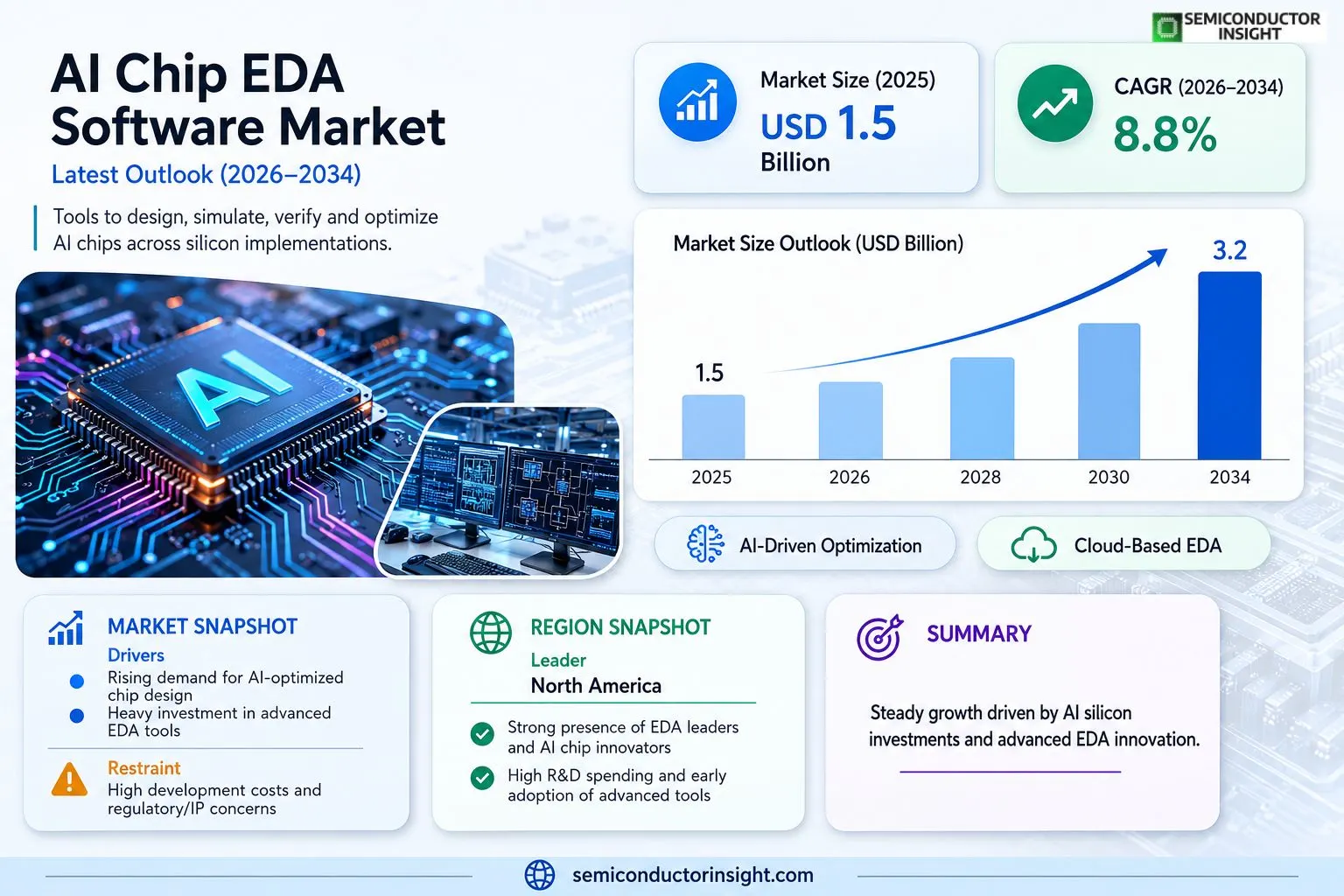
Global AI Chip EDA Software market size was valued at USD 1.5 billion in 2025. The market is projected to grow from USD 1.6 billion in 2026 to USD 3.2 billion by 2034, exhibiting a CAGR of 8.8% during the forecast period.
AI Chip Electronic Design Automation (EDA) software are specialized platforms that enable designers to model, simulate, verify, and optimize artificial‑intelligence accelerator architectures across silicon‑level implementations. These tools integrate circuit synthesis, floorplanning, power analysis, and machine‑learning‑driven optimization to accelerate time‑to‑market for AI chips.
The market is accelerating because semiconductor firms are pouring capital into AI‑centric silicon, while rising demand for edge inference drives the need for efficient design cycles. Furthermore, collaborations such as Nvidia’s partnership with Cadence in 2023 to co‑develop custom AI flow suites have spurred adoption. Leading vendors,including Synopsys, Cadence Design Systems, Siemens Mentor Graphics, and Ansys,continue expanding their portfolios through acquisitions and cloud‑based offerings.
MARKET DRIVERS
Growing Demand for AI-Optimized Chip Design
AI Chip EDA Software Market is being propelled by the rapid adoption of AI workloads across cloud, automotive, and consumer electronics. Companies are seeking design tools that can accelerate neural‑network inference while minimizing power consumption, leading to a projected compound annual growth rate of around 12% over the next five years.
Investment in Advanced Design Tools
Major semiconductor firms are allocating up to 15% of their R&D budgets to next‑generation EDA platforms that support heterogeneous integration and system‑level simulation. This influx of capital boosts software licensing revenues and fuels innovation in algorithmic optimization.
➤ “The convergence of AI algorithms and chip architecture creates a virtuous cycle where better tools drive faster silicon, and faster silicon unlocks new AI capabilities.”
Furthermore, collaborations between EDA vendors and AI research institutions are shortening time‑to‑market for custom AI accelerators, reinforcing the market’s upward trajectory.
MARKET CHALLENGES
High Development Costs
Developing sophisticated AI‑focused EDA suites requires substantial investment in both software engineering and hardware validation. Smaller players often struggle to match the pricing power of established incumbents, limiting market penetration.
Other Challenges
Talent Shortage
The scarcity of engineers proficient in both AI algorithms and semiconductor design tools creates a talent bottleneck, delaying product deployments and increasing payroll expenses.
MARKET RESTRAINTS
Regulatory and IP Concerns
Stringent export controls on high‑performance computing technologies restrict Global distribution of certain AI chip design solutions, especially in regions with geopolitical sensitivities. This regulatory landscape can curtail revenue opportunities for vendors.Intellectual property disputes over proprietary layout optimizations and algorithmic kernels also pose legal risks, compelling companies to invest heavily in IP protection strategies.
MARKET OPPORTUNITIES
Emerging Edge‑AI Applications
Edge devices such as autonomous drones, smart cameras, and IIoT sensors are demanding low‑latency, power‑efficient AI accelerators. This creates a niche for EDA tools that can co‑design hardware and AI models simultaneously, opening new licensing and consultancy revenue streams.Additionally, the rise of open‑source AI hardware frameworks offers a collaborative ecosystem where EDA vendors can integrate their verification modules, expanding market reach and fostering innovation.
AI Chip EDA Software Market Trends
Accelerating Adoption of AI‑Centric Design Flows
AI Chip EDA Software Market is witnessing a rapid shift as semiconductor manufacturers prioritize AI‑focused silicon. 2025 valuations reached approximately USD 1.5 billion, and the pipeline for 2026‑2034 shows a steady climb toward USD 3.2 billion. This growth is driven by the need to compress design cycles for edge‑inference processors, where traditional design tools struggle with the computational intensity of modern deep‑learning workloads. Advanced simulation, power‑analysis, and machine‑learning‑enhanced floorplanning are now standard features in leading EDA suites, allowing designers to iterate more quickly and reduce time‑to‑market. The market’s trajectory reflects both the expanding AI silicon ecosystem and the strategic investments of major foundries in specialized design automation.
Other Trends
Strategic Partnerships and Acquisitions
Collaboration between hardware leaders and EDA vendors has become a hallmark of AI Chip EDA Software Market. Notably, the 2023 alliance between Nvidia and Cadence to co‑develop customized AI flow suites has accelerated the integration of hardware‑aware optimization modules. Similarly, Synopsys has broadened its portfolio through targeted acquisitions of startup firms specializing in neural‑network‑driven synthesis, while Mentor Graphics (Siemens) has deepened its cloud‑EDA capabilities via strategic investments. These moves collectively enhance tool interoperability and expand the range of pre‑validated IP blocks, which in turn supports faster design closure for AI accelerators.
Shift Toward Cloud‑Based EDA Platforms
Another prominent trend is the migration of AI Chip design environments to cloud infrastructures. Cloud‑hosted EDA solutions provide scalable compute resources that match the intensive simulation demands of AI architectures, while also offering subscription models that lower upfront capital expenditures. Vendors are now delivering end‑to‑end design flows that integrate data‑centric verification, performance profiling, and post‑silicon validation through a unified web portal. This transition not only improves collaboration across geographically dispersed design teams but also aligns with broader industry moves toward flexible, as‑a‑service technology stacks.
COMPETITIVE LANDSCAPEKey Industry Players
Synopsys, Cadence Design Systems, and Siemens EDA Maintain Dominant Positions in Global AI Chip EDA Software Market
Global AI Chip EDA Software market is characterized by a consolidated competitive structure, with a handful of established technology incumbents commanding significant market share. Synopsys and Cadence Design Systems collectively lead the landscape, offering end-to-end electronic design automation platforms that integrate machine-learning-driven optimization, circuit synthesis, power analysis, and silicon-level verification tailored specifically for AI accelerator architectures. Cadence’s collaboration with Nvidia in 2023 to co-develop custom AI design flow suites underscores the strategic depth these top-tier players are investing in to maintain competitive differentiation. Siemens EDA, operating under the Mentor Graphics heritage, reinforces the top-three dynamic with its robust suite of simulation and verification tools adapted for complex AI chip design workflows. Ansys further strengthens the upper tier with its physics-based simulation capabilities, which complement traditional EDA workflows in thermal and signal integrity analysis critical to high-performance AI silicon development. These leaders continue to expand their competitive moats through strategic acquisitions, cloud-native platform migrations, and deep integrations with foundry process design kits, enabling faster time-to-market for next-generation AI chips across data center, automotive, and edge inference applications.Beyond the dominant vendors, several specialized and emerging players are carving meaningful niches within AI Chip EDA Software Market. Zuken and Altium address segment-specific design requirements, while companies such as Silvaco offer TCAD and circuit simulation tools used in the early-stage AI semiconductor development pipeline. Keysight Technologies contributes high-frequency and RF simulation capabilities increasingly relevant to AI chip testing and validation. Berkeley Design Automation and Real Intent focus on formal verification and analog simulation, addressing precision-critical design stages for AI accelerators. Additionally, Empyrean Technology has emerged as a notable regional competitor, particularly within Asia-Pacific, offering full-custom and mixed-signal EDA solutions gaining traction among domestic AI chip fabless firms. The competitive environment is further intensified by cloud EDA disruptors and AI-native startups developing autonomous design tools, pushing established players to accelerate their own AI-augmented feature roadmaps. As the market is projected to grow from USD 1.6 billion in 2026 to USD 3.2 billion by 2034 at a CAGR of 8.8%, competitive intensity across both established vendors and emerging challengers is expected to escalate considerably throughout the forecast period.
List of Key AI Chip EDA Software Companies Profiled
- Synopsys Inc.
- Cadence Design Systems
- Siemens EDA (Mentor Graphics)
- Ansys Inc.
- Keysight Technologies
- Zuken Inc.
- Altium Limited
- Silvaco Inc.
- Real Intent Inc.
- Berkeley Design Automation
- Empyrean Technology
- Springsoft (Synopsys Subsidiary)
- Aldec Inc.
- JEDA Technologies
- Agnisys Inc.
Segment Analysis:
| Segment Category | Sub-Segments | Key Insights |
| By Type |
|
Simulation Tools
|
| By Application |
|
Edge Inference
|
| By End User |
|
Semiconductor Designers
|
| By Design‑Flow Stage |
|
Power Optimization
|
| By Deployment Model |
|
Cloud‑Based Platforms
|
Regional Analysis: North America
United States
The US market is heavily invested in EDA tools that support the design of complex, heterogeneous AI chip architectures, including those incorporating specialized accelerators for machine learning workloads.
There’s a growing trend towards cloud-based EDA solutions in the US, enabling greater collaboration, scalability, and access to advanced computing resources.
The US market is witnessing increasing adoption of AI and machine learning techniques within EDA software itself to automate design tasks and optimize chip performance.
Government initiatives and funding programs in the US play a significant role in fostering innovation and supporting the growth of AI Chip EDA Software Market.
Europe
The European market for AI Chip EDA Software is experiencing robust growth, driven by increasing investments in AI research and the development of advanced semiconductor technologies. Several European countries, including Germany, France, and the UK, are establishing themselves as key players in the AI chip design landscape. The focus in Europe is on developing EDA tools that cater to the specific needs of European semiconductor manufacturers and research institutions. Compliance with data privacy regulations, such as GDPR, is also a significant consideration in the European market. The emphasis is on sustainable chip design and energy-efficient AI solutions, aligning with European Union’s environmental goals. The EDA software adoption rate is steadily increasing across various industries, including automotive, industrial automation, and healthcare.
Asia-Pacific
Asia-Pacific represents a dynamic and rapidly expanding market for AI Chip EDA Software. Driven by the massive growth of the AI industry in countries like China, Japan, and South Korea, the demand for advanced EDA tools is soaring. China, in particular, is investing heavily in its domestic semiconductor industry and is actively seeking to reduce its reliance on foreign technologies. The Asia-Pacific market is characterized by fierce competition among EDA vendors and a strong focus on cost-effectiveness. Local EDA software providers are also emerging to cater to the specific requirements of the regional market. The growth of AI Chip EDA Software Market in Asia-Pacific is expected to continue at a rapid pace in the coming years.
South America
The South American market for AI Chip EDA Software is relatively nascent but poised for growth. The increasing adoption of AI technologies in industries such as finance, e-commerce, and telecommunications is driving demand for sophisticated chip designs. Countries like Brazil and Chile are emerging as key markets in the region. However, the market is currently limited by factors such as limited investment in R&D and a shortage of skilled engineers. The adoption of cloud-based EDA solutions is expected to be a key factor in driving growth in the South American market. Government initiatives aimed at promoting technological development are also expected to play a role in fostering market growth.
Middle East & Africa
The Middle East & Africa region presents a long-term growth opportunity for AI Chip EDA Software Market. Several countries in the region are investing in AI initiatives as part of their broader economic diversification strategies. The increasing adoption of AI in sectors such as healthcare, energy, and transportation is driving demand for advanced chip designs. However, the market is currently characterized by limited awareness of EDA software and a shortage of skilled personnel. The adoption of cloud-based solutions and the development of local talent will be crucial for unlocking the market potential in this region. Government support and investment in education and training programs will also be essential.
Report Scope
This market research report provides a comprehensive analysis of the AI Chip EDA Software Market , covering the forecast period 2026–2034. It offers detailed insights into market dynamics, technological advancements, competitive landscape, and key trends shaping the industry.
Key focus areas of the report include:
- Market Overview: The report begins with an overview outlining its current market scenario, key growth indicators, and industry transformation drivers. It discusses macroeconomic factors, demand–supply balance, regulatory landscape, and the strategic role of semiconductors in powering advancements across industries such as automotive, telecommunications, consumer electronics, and industrial automation.
- Market Size & Forecast: Historical data and future projections for revenue, unit shipments, and market value across major regions and segments.
- Segmentation Analysis: Detailed breakdown by product type, technology, application, and end-user industry to identify high‑growth segments and investment opportunities.
- Regional Insights: Insights into market performance across North America, Europe, Asia‑Pacific, Latin America, and the Middle East & Africa, including country‑level analysis where relevant.
- Competitive Landscape: Profiles of leading market participants, including their product offerings, R&D focus, manufacturing capacity, pricing strategies, and recent developments such as mergers, acquisitions, and partnerships.
- Technology Trends & Innovation: Assessment of emerging technologies, integration of AI/IoT, semiconductor design trends, fabrication techniques, and evolving industry standards.
- Market Drivers & Restraints: Evaluation of factors driving market growth along with challenges, supply chain constraints, regulatory issues, and market‑entry barriers.
- Stakeholder Insights: Insights for component suppliers, OEMs, system integrators, investors, and policymakers regarding the evolving ecosystem and strategic opportunities.
Primary and secondary research methods are employed, including interviews with industry experts, data from verified sources, and real‑time market intelligence to ensure the accuracy and reliability of the insights presented.
FREQUENTLY ASKED QUESTIONS:
What is the current market size of AI Chip EDA Software Market?
-> AI Chip EDA Software Market was valued at USD 1.5 billion in 2025 and is expected to reach USD 3.2 billion by 2034 with a CAGR of 8.8% during the forecast period.
Which key companies operate in AI Chip EDA Software Market?
-> Key players include Synopsys, Cadence Design Systems, Siemens Mentor Graphics, and Ansys, among others.
What are the key growth drivers?
-> Key growth drivers include increased capital investment in AI‑centric silicon, rising demand for edge inference, and strategic collaborations such as Nvidia’s partnership with Cadence.
Which region dominates the market?
-> North America is a leading region, while Asia‑Pacific shows rapid growth due to strong semiconductor manufacturing ecosystems.
What are the emerging trends?
-> Emerging trends include cloud‑based EDA platforms, AI‑driven design optimization, and ongoing acquisitions to expand tool portfolios.

Get Sample Report PDF for Exclusive Insights
Report Sample Includes
- Table of Contents
- List of Tables & Figures
- Charts, Research Methodology, and more...
 Download Sample Report PDF