Market Insights
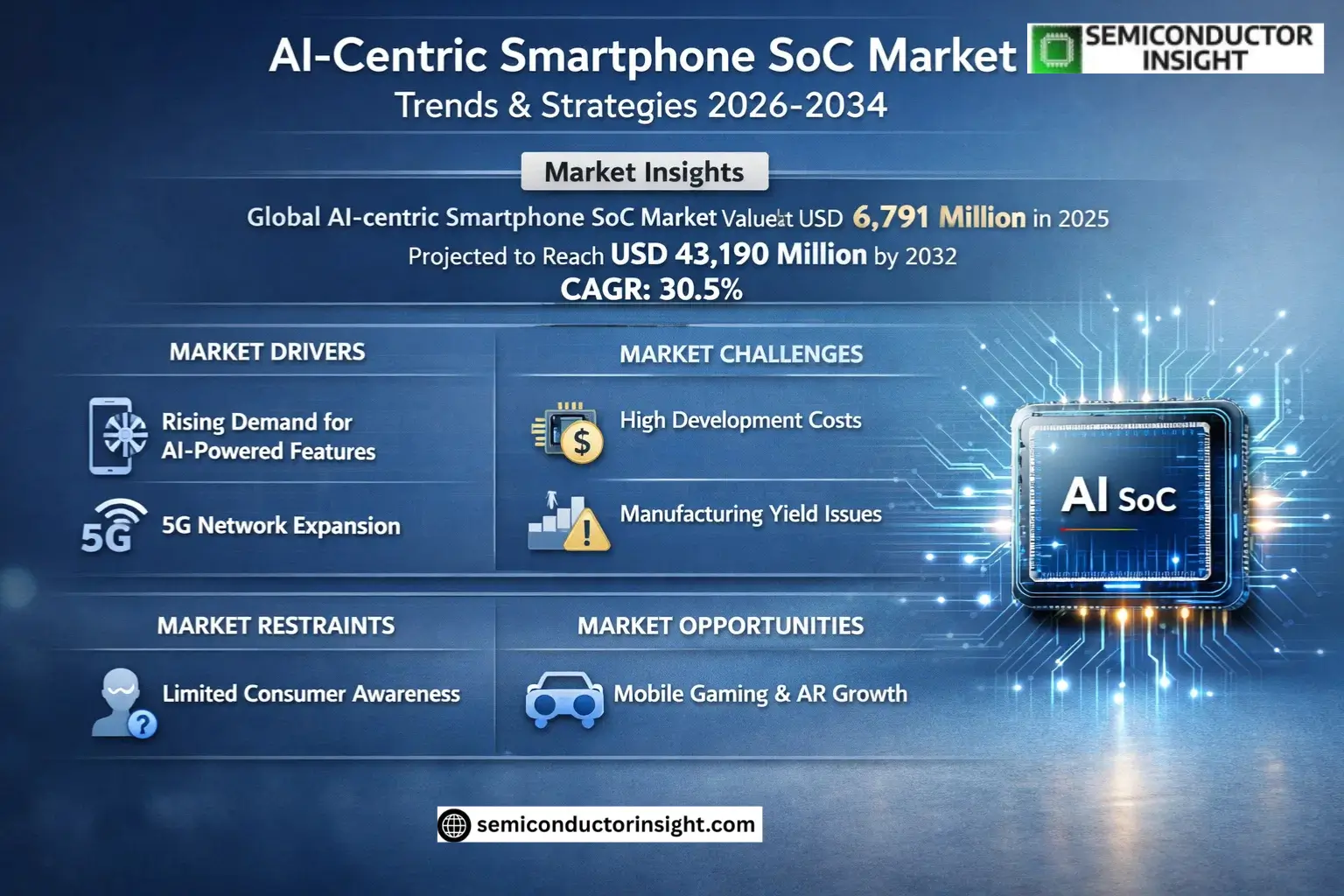
Global AI-centric Smartphone SoC Market was valued at USD 6,791 million in 2025 and is projected to reach USD 43,190 million by 2032, exhibiting a CAGR of 30.5% during the forecast period.
AI-centric Smartphone SoCs are system-on-chip processors designed with artificial intelligence as a core architectural priority, integrating high-performance NPUs, CPUs, GPUs, and memory controllers to support on-device and hybrid generative AI workloads. These SoCs enable real-time inference, multimodal processing, and system-level AI functions in smartphones, forming the hardware foundation of GenAI-powered devices.
The market is experiencing rapid growth due to increasing demand for AI-driven smartphone features such as advanced photography, voice assistants, and real-time language translation. Additionally, rising investments in semiconductor manufacturing and advancements in neural processing units (NPUs) are accelerating adoption. Key players like Qualcomm, MediaTek, Apple, and Samsung are driving innovation through next-generation chip designs optimized for generative AI applications.
MARKET DRIVERS
Rising Demand for AI-Powered Smartphone Features
Global AI-centric Smartphone SoC Market is experiencing rapid growth due to increasing consumer demand for AI-enhanced functionalities. Advanced features like real-time language translation, computational photography, and voice assistants rely heavily on dedicated AI processing cores in smartphone SoCs. Manufacturers are prioritizing on-device AI processing to improve speed and privacy, driving innovation in this segment.
5G Network Expansion Accelerating Adoption
The rollout of 5G networks worldwide is creating synergistic growth opportunities for AI-centric Smartphone SoCs. These chipsets combine 5G modems with dedicated neural processors, enabling low-latency AI applications that weren’t feasible with previous generations. Market data shows a 78% year-over-year increase in 5G smartphones featuring specialized AI processing units.
This rapid hardware evolution is creating a virtuous cycle where improved AI capabilities drive consumer upgrades, further fueling market expansion.
MARKET CHALLENGES
High Development Costs and Design Complexity
Creating AI-centric Smartphone SoCs presents significant technical hurdles, particularly in power efficiency and thermal management. Integrating multiple neural processing units alongside traditional CPU/GPU cores requires substantial R&D investment, with leading manufacturers spending over USD 2 billion annually on chip development.
Other Challenges
Manufacturing Yield Issues
The complex architectures of AI-centric SoCs result in lower production yields compared to traditional designs, with some manufacturers reporting initial yields below 60% for their most advanced chips.
MARKET RESTRAINTS
Limited Consumer Awareness of AI Capabilities
Despite significant technological advancements, many consumers don’t fully understand the benefits of AI-centric Smartphone SoCs. Market surveys indicate that only 38% of smartphone buyers can correctly identify AI-specific features when making purchasing decisions, potentially limiting market growth among mainstream consumers.
MARKET OPPORTUNITIES
Emerging Applications in Mobile Gaming and AR
The gaming segment presents significant growth potential for AI-centric Smartphone SoCs, with the mobile gaming market expected to reach USD 160 billion by 2025. Advanced AI processing enables real-time physics simulation and adaptive gameplay features that were previously limited to high-end gaming PCs.
AI-centric Smartphone SoC Market Trends
Accelerated Adoption of On-Device AI Processing
AI-centric Smartphone SoC Market is witnessing a rapid shift toward on-device AI processing capabilities. Leading manufacturers now integrate dedicated neural processing units (NPUs) capable of 40 TOPS or higher, enabling real-time generative AI applications without cloud dependency. This trend reflects growing consumer demand for privacy-preserving AI features and latency-sensitive applications like live translation and computational photography.
Other Trends
Process Node Advancements
Leading chipmakers are aggressively adopting 3nm and below semiconductor manufacturing technologies to enhance AI performance per watt. Current-generation AI-centric SoCs demonstrate 35% better energy efficiency compared to previous nodes, enabling sustained AI workloads without excessive thermal throttling in smartphones.
Multimodal AI Integration
Modern AI-centric SoCs now incorporate specialized accelerators for simultaneous text, image, and speech processing. This architectural evolution supports emerging multimodal GenAI applications, with flagship SoCs handling 8+ concurrent AI model inferences. OEMs are leveraging this capability to differentiate through advanced camera features, contextual assistants, and adaptive UI elements.
Hybrid AI Architectures Gain Traction
While on-device processing dominates premium segments, mid-range devices are adopting hybrid architectures that intelligently partition workloads between local NPUs and cloud resources. This approach balances cost with capability, with hybrid SoCs capturing 42% of non-flagship AI smartphone shipments.
Regional Market Developments
Asia-Pacific leads in AI-centric SoC adoption, accounting for 68% of global demand. Chinese manufacturers are particularly aggressive in implementing homegrown AI architectures, while North American markets show stronger preference for cloud-assisted solutions due to robust 5G infrastructure. European adoption is growing steadily, focusing on privacy-oriented on-device implementations.
COMPETITIVE LANDSCAPE
Key Industry Players
AI-centric Smartphone SoC Market Dominated by Semiconductor Giants and Vertical Integrators
AI-centric Smartphone SoC Market exhibits an oligopolistic structure with Qualcomm, MediaTek, and Apple collectively commanding over 65% market share in 2025. Qualcomm maintains its leadership position through its Snapdragon 8 Gen series featuring dedicated Hexagon NPUs, while MediaTek’s Dimensity 9000/8000 family demonstrates rapid adoption in premium-mid segment smartphones. Apple’s vertically integrated A-series and M-series chips with Neural Engine accelerators achieve industry-leading AI performance benchmarks, though limited to iOS ecosystem.
Specialist semiconductor firms like Unisoc and Samsung System LSI are gaining traction with cost-optimized AI SoC designs, particularly in emerging markets. Samsung’s Exynos series integrates AMD RDNA graphics with proprietary AI accelerators, while Huawei’s HiSilicon continues to supply Kirin SoCs despite geopolitical constraints. Emerging players such as Google’s Tensor chips (developed with Samsung) and Amazon’s in-house silicon for Alexa devices demonstrate vertical integration trends among cloud-AI leaders entering the hardware space.
List of Key AI-centric Smartphone SoC Companies Profiled
- Qualcomm Technologies
- MediaTek Inc.
- Apple Inc. (A-series/M-series)
- Samsung Electronics (System LSI Division)
- Huawei HiSilicon
- Unisoc (Shanghai)
- Google LLC (Tensor SoC)
- Intel Corporation (Emerging Mobile XPU)
- NVIDIA (Tegra legacy designs)
- AMD (RDNA IP licensing)
- Xiaomi (Pinecone in-house SoC)
- Amazon (Alexa AI processors)
- Rockchip Electronics
- Allwinner Technology
- Actions Semiconductor
Segment Analysis:
| Segment Category | Sub-Segments | Key Insights |
| By Type |
|
Hybrid AI-centric SoC is gaining traction due to:
|
| By Application |
|
Android Devices represent the primary market due to:
|
| By End User |
|
Premium Smartphones dominate adoption because:
|
| By AI Compute Capability |
|
High AI Compute SoC shows strongest market potential because:
|
| By Processor Integration |
|
Heterogeneous Processing Units are emerging as preferred solutions due to:
|
Regional Analysis: AI-centric Smartphone SoC Market
Chinese brands lead in implementing dedicated NPUs in smartphones, focusing on camera enhancements and real-time translation. Local manufacturers prioritize vertical integration, developing both chipsets and end-user devices.
South Korea hosts advanced semiconductor fabs producing the most sophisticated AI-centric SoCs. Samsung’s Exynos chips incorporate cutting-edge AI processors optimized for flagship mobile experiences.
Taiwan’s semiconductor foundries provide crucial manufacturing capacity for global smartphone chip designers. TSMC’s leading-edge nodes enable high-performance, energy-efficient AI accelerators in compact smartphone SoCs.
India and Southeast Asia show rapid adoption of AI-capable smartphones, driving demand for cost-effective SoCs with basic AI functionalities like voice assistants and battery optimization.
North America
North America maintains strong influence in AI-centric smartphone SoC design, home to Qualcomm and Apple’s chip development teams. The region focuses on premium AI processing capabilities for computational photography and augmented reality applications. US companies lead in developing heterogeneous compute architectures that balance CPU, GPU, and NPU performance. Ecosystem partnerships between chipmakers and AI software developers create specialized neural network optimizations for mobile platforms.
Europe
European smartphone brands leverage third-party AI-centric SoCs while investing in specialized AI IP blocks. The region shows strong demand for privacy-focused on-device AI processing in smartphones. Automotive partnerships are driving developments in mobile AI chips capable of vehicle-smartphone integration. European research institutions contribute to energy-efficient neural network architectures suitable for mobile implementations.
Middle East & Africa
The MEA region shows growing appetite for AI-enhanced smartphones, particularly in Gulf countries. Localized AI features like Arabic language processing gain importance. Market growth is constrained by premium pricing of advanced AI SoCs, creating opportunities for mid-range chip solutions. Smartphone manufacturers are customizing AI capabilities for regional photography preferences and mobile payment security needs.
South America
South America’s AI-centric SoC adoption follows global smartphone upgrade cycles. Brazilian and Mexican markets show preference for AI-enhanced camera capabilities in mid-range devices. Economic factors slow adoption of flagship AI chips, favoring optimized solutions from Chinese suppliers. Regional mobile network conditions influence AI SoC requirements for connectivity and battery efficiency.
Report Scope
This market research report provides a comprehensive analysis of the AI-centric Smartphone SoC Market, covering the forecast period 2025–2032. It offers detailed insights into market dynamics, technological advancements, competitive landscape, and key trends shaping the industry.
Key focus areas of the report include:
- Market Overview: The report begins with an overview outlining its current market scenario, key growth indicators, and industry transformation drivers. It discusses macroeconomic factors, demand–supply balance, regulatory landscape, and the strategic role of semiconductors in powering advancements across industries such as automotive, telecommunications, consumer electronics, and industrial automation.
- Market Size & Forecast: Historical data and future projections for revenue, unit shipments, and market value across major regions and segments.
- Segmentation Analysis: Detailed breakdown by product type, technology, application, and end-user industry to identify high-growth segments and investment opportunities.
- Regional Insights: Insights into market performance across North America, Europe, Asia-Pacific, Latin America, and the Middle East & Africa, including country-level analysis where relevant.
- Competitive Landscape: Profiles of leading market participants, including their product offerings, R&D focus, manufacturing capacity, pricing strategies, and recent developments such as mergers, acquisitions, and partnerships.
- Technology Trends & Innovation: Assessment of emerging technologies, integration of AI/IoT, semiconductor design trends, fabrication techniques, and evolving industry standards.
- Market Drivers & Restraints: Evaluation of factors driving market growth along with challenges, supply chain constraints, regulatory issues, and market-entry barriers.
- Stakeholder Insights: Insights for component suppliers, OEMs, system integrators, investors, and policymakers regarding the evolving ecosystem and strategic opportunities.
Primary and secondary research methods are employed, including interviews with industry experts, data from verified sources, and real-time market intelligence to ensure the accuracy and reliability of the insights presented.
FREQUENTLY ASKED QUESTIONS:
What is the current market size of AI-centric Smartphone SoC Market?
-> AI-centric Smartphone SoC Market was valued at USD 6,791 million in 2025 and is projected to reach USD 43,190 million by 2032, exhibiting a CAGR of 30.5% during the forecast period.
Which key companies operate in AI-centric Smartphone SoC Market?
-> Key players include MediaTek, Qualcomm, Apple, Spreadtrum, Samsung, and Huawei, among others.
What are the key growth drivers?
-> Key growth drivers include rising demand for on-device AI capabilities, increasing smartphone penetration with AI features, and advancements in generative AI workloads.
Which region dominates the market?
-> Asia is the dominant market, driven by China, Japan, and South Korea, with North America and Europe also showing significant growth.
What are the emerging trends?
-> Emerging trends include GenAI-optimized SoCs, multimodal-centric processing, and hybrid AI deployment models.
Get Sample Report PDF for Exclusive Insights
Report Sample Includes
- Table of Contents
- List of Tables & Figures
- Charts, Research Methodology, and more...
 Download Sample Report PDF