AI-Centric Semiconductor IP Ecosystem Platform Market Insights
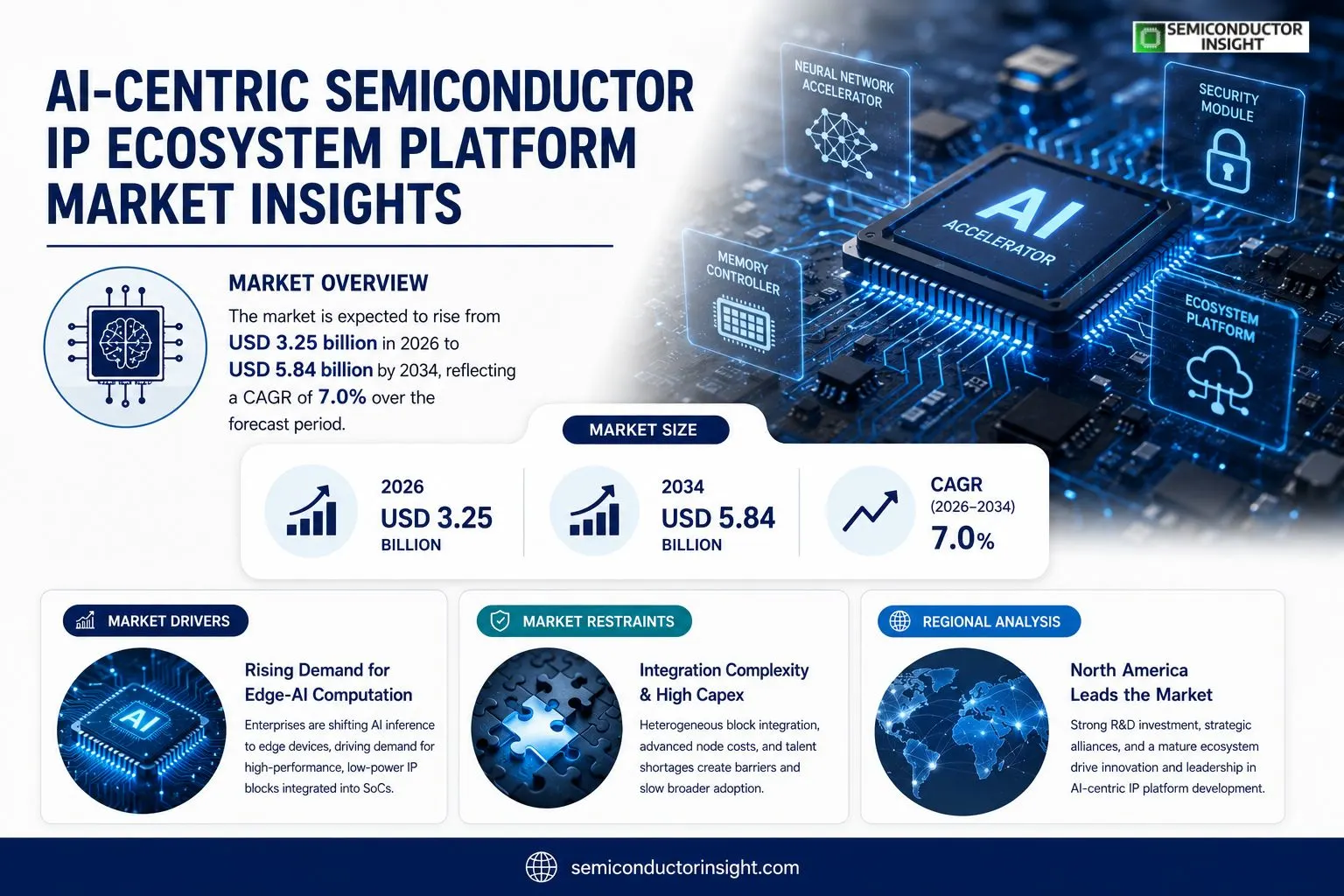
AI‑Centric Semiconductor IP Ecosystem Platform market size was valued at USD 3.12 billion in 2025. The market is expected to rise from USD 3.25 billion in 2026 to USD 5.84 billion by 2034, reflecting a CAGR of approximately 7.0 % over the forecast period.
An AI‑Centric Semiconductor IP Ecosystem Platform comprises reusable intellectual‑property blockssuch as neural‑network accelerators, memory controllers and security modulesintegrated through standardized interfaces that enable chip designers to embed advanced artificial‑intelligence capabilities quickly and cost‑effectively.The sector is gaining momentum because enterprises are scaling AI inference workloads across data‑center, edge and automotive domains while silicon vendors seek faster time‑to‑market solutions. Recent collaborations illustrate this trend; for example, in March 2024 Arm announced a joint development agreement with Nvidia to co‑create next‑generation AI cores, and Synopsys introduced a cloud‑based verification suite tailored for AI IP blocks earlier this year.
MARKET DRIVERS
Rising Demand for Edge‑AI Computation
Enterprises are migrating AI inference workloads from data centers to endpoint devices to reduce latency and bandwidth costs. This shift fuels demand for semiconductor IP that can deliver high‑performance, low‑power kernels within a single die. Vendors that embed AI‑centric accelerators directly into system‑on‑chip (SoC) portfolios are seeing significant order acceleration as OEMs strive to differentiate smart products.
Consolidation of IP Licensing Models
Customers increasingly prefer turnkey licensing arrangements that bundle core compute blocks, memory controllers, and verification suites. This trend reduces legal overhead and shortens design cycles, encouraging chip designers to adopt comprehensive platforms rather than piecemeal blocks. AI‑Centric Semiconductor IP Ecosystem Platform Market benefits from this preference because integrated offerings streamline verification and integration.
➤ “A unified IP stack cuts time‑to‑market by up to 30 % and lowers NRE spend, making the business case for AI‑centric designs compelling.”
Combined, these forces push design teams toward ecosystem platforms that promise scalability across multiple AI workloads, from vision to speech, reinforcing the market’s forward momentum.
MARKET CHALLENGES
Integration Complexity Across Heterogeneous Blocks
Designers must stitch together cores, DSPs, and specialized AI accelerators that often originate from different vendors. Alignment of clock domains, power‑management schemes, and security primitives creates a steep learning curve. Even with robust verification frameworks, integration risk remains a primary source of schedule overruns.
Other Challenges
Regulatory Uncertainty
Data‑privacy legislation in several regions now dictates on‑device processing thresholds. Companies that cannot guarantee compliance through secure IP partitions may face market access restrictions, prompting them to reevaluate roadmap timelines.
MARKET RESTRAINTS
High Capital Expenditure for Advanced Nodes
Access to sub‑10 nm process technologies, essential for maximizing AI‑centric IP efficiency, requires multi‑billion‑dollar investments from fab operators. Chipmakers with limited capital may defer adoption, constraining overall market volume.
Scarcity of Specialized Design Talent
The convergence of AI algorithms and hardware design demands engineers fluent in both domains. Talent shortages drive up labor costs and lengthen development cycles, acting as a brake on rapid adoption.
Fragmented Standards Landscape
Multiple competing AI inference standards (e.g., ONNX, TensorFlow Lite, proprietary formats) impede the creation of truly interchangeable IP. Without a dominant open standard, licensees hesitate to commit to a single ecosystem, limiting scale.
MARKET OPPORTUNITIES
Adoption of Heterogeneous Multi‑Core Architectures
Emerging SoCs that combine general‑purpose cores, GPU‑like shaders, and dedicated AI accelerators enable workload‑specific optimization. IP vendors that provide modular, plug‑and‑play AI blocks can capture design wins across automotive, robotics, and consumer electronics.
Geographic Expansion in Emerging Economies
Manufacturing hubs in Southeast Asia and Eastern Europe are upgrading to advanced nodes, creating fresh demand for cost‑effective AI‑centric IP solutions. Companies that localize support and pricing structures stand to grow market share as regional players scale up production.
Strategic Alliances Between Foundries and IP Providers
Co‑development programs that embed IP directly into process design kits (PDKs) shorten validation time and guarantee silicon compatibility. Such collaborations open new revenue streams for both parties and accelerate ecosystem adoption across AI‑Centric Semiconductor IP Ecosystem Platform Market.
AI-Centric Semiconductor IP Ecosystem Platform Market Trends
Accelerated AI Inference Adoption Across Edge and Data‑Center
The surge in AI inference demand is reshaping how silicon vendors assemble core blocks. Enterprises that run deep‑learning models on premises or at the edge require chips that can deliver high throughput while keeping power budgets modest. By standardising reusable IPneural‑network accelerators, memory controllers, and dedicated security modulesdesign houses can shorten integration cycles and defer costly custom development. This shift is evident in the increasing share of AI‑centric silicon in data‑center upgrades and in automotive platforms that blend vision and sensor fusion. AI‑Centric Semiconductor IP Ecosystem Platform Market is responding to the tension between performance pressure and the need to manage bill‑of‑materials, prompting a migration toward ecosystem platforms that promise plug‑and‑play capability.
Other Trends
Collaborative IP Development Initiatives
Arm’s March 2024 joint development agreement with Nvidia exemplifies the collaborative spirit that is redefining IP sourcing. The partnership targets a next‑generation AI core that merges Arm’s efficiency‑focused microarchitectures with Nvidia’s tensor‑engine expertise, creating a block that can be licensed across a broad customer base. Around the same time, Synopsys released a cloud‑based verification suite tuned for AI IP, allowing designers to validate performance and timing without maintaining on‑premise test rigs. These moves lower entry barriers for midsize fabs and system‑integrators, encouraging a more fragmented but highly interoperable supplier landscape. As more players converge around shared standards, the ecosystem platform becomes a conduit for rapid innovation cycles and risk sharing, which in turn accelerates time‑to‑revenue for AI‑enabled products.
Emerging Security & Compliance Requirements
Regulatory scrutiny over data privacy and model integrity is prompting chip makers to embed security primitives directly into the IP stack. Features such as hardware‑rooted attestation, secure key storage, and runtime encryption are moving from optional add‑ons to baseline requirements, especially in automotive and industrial IoT deployments. The implication for AI‑Centric Semiconductor IP Ecosystem Platform Market is a parallel demand stream for compliant IP that satisfies emerging standards without sacrificing inference efficiency. Vendors that can demonstrate a proven security‑by‑design methodology are likely to capture premium contracts, while customers will increasingly evaluate suppliers on the robustness of these safeguards. Consequently, the convergence of performance, integration speed, and compliance shapes the competitive equation for the ecosystem platform market.
COMPETITIVE LANDSCAPE
Key Industry Players
Competitive dynamics of AI‑Centric Semiconductor IP Ecosystem Platforms
Arm continues to dominate the platform space, leveraging its extensive library of AI‑accelerator IP blocks and a broad ecosystem of licensees. The recent partnership with Nvidia amplifies its reach into high‑performance data‑center segments, while the integration of security modules positions the offering as a one‑stop solution for edge and automotive customers. Synopsys, with its cloud‑enabled verification suite, has cemented a reputation for reducing design cycle risk, allowing silicon firms to validate AI IP more rapidly than ever before. Together, these leaders shape a market architecture where reusable blocks are stitched together through common standards, creating a consolidated supply chain that favours firms capable of delivering end‑to‑end design enablement.Beyond the headline names, a cohort of specialised vendors is carving out valuable niches. Cadence’s IP portfolio emphasizes high‑density neural network fabrics, while Qualcomm contributes AI‑centric DSP cores that serve mobile and automotive use cases. Imagination Technologies focuses on power‑efficient graphics‑AI hybrids, and CEVA supplies modular vision‑processing IP for edge devices. GreenWaves Technologies and Horizon Robotics bring ultra‑low‑power AI engines tailored for IoT sensors and autonomous‑driving platforms respectively. AMD (through Xilinx) offers programmable logic‑integrated AI blocks, and Samsung’s System‑LSI unit supplies vertically integrated AI‑ready silicon for consumer electronics. Marvell and Broadcom round out the ecosystem with networking‑focused AI accelerators that address data‑center throughput demands.
List of Key Semiconductor IP Companies Profiled
- Arm Ltd.
- Nvidia Corp.
- Synopsys Inc.
- Cadence Design Systems
- Qualcomm Incorporated
- Imagination Technologies
- CEVA Inc.
- GreenWaves Technologies
- Horizon Robotics
- AMD (Xilinx)
- Samsung Electronics
- Marvell Technology Group
- Broadcom Inc.
Segment Analysis:
| Segment Category | Sub-Segments | Key Insights |
| By Type |
|
Neural‑Network Accelerators are driving platform adoption because they enable rapid integration of sophisticated AI models; they reduce design complexity for silicon vendors; they are favored in workloads that demand high throughput and low latency. |
| By Application |
|
Data‑Center AI Inference remains the leading application as platform providers target massive parallelism; the need for scalable verification accelerates ecosystem collaborations; designers value the plug‑and‑play nature of IP blocks to meet aggressive rollout schedules. |
| By End User |
|
Chip Designers prioritize reusable IP to accelerate time‑to‑market; they value the standardized interfaces that simplify cross‑vendor integration; collaborative verification environments enhance confidence in AI‑centric designs. |
| By Integration Model |
|
Pre‑verified Blocks are favored because they eliminate iterative debugging; they enable rapid system integration across heterogeneous silicon; ecosystem partners emphasize co‑development to ensure compatibility with emerging AI standards. |
| By Collaboration |
|
Joint Development Agreements catalyze cross‑industry innovation; they align roadmaps of major silicon vendors and AI leaders; the collaborative model nurtures shared verification frameworks and accelerates adoption of next‑generation AI IP. |
Regional Analysis: AI-Centric Semiconductor IP Ecosystem Platform Market
North America
Leading foundries and IP firms are forging joint development agreements that lower integration risk for AI‑centric designs, enabling faster validation cycles and shared risk mitigation.
Flexible, usage‑based licensing structures replace traditional royalty models, giving OEMs the agility to scale AI functionality as product demand evolves.
Universities and research labs in the region supply a pipeline of AI hardware specialists, reinforcing the ecosystem’s capacity to iterate on cutting‑edge IP blocks.
Export‑control policies incentivize domestic sourcing of critical AI IP, prompting firms to expand local design capabilities and reduce reliance on foreign technology.
European manufacturers are leveraging strong standards‑driven frameworks to embed AI capabilities within existing semiconductor IP portfolios. The region’s emphasis on interoperability drives IP owners to produce modular blocks that align with EU‑wide safety and sustainability certifications, creating a differentiated value proposition for industrial and automotive customers.
In the Asia‑Pacific, rapid adoption of AI-enabled devices fuels demand for cost‑effective, high‑performance IP. Vendors respond with aggressive price‑to‑value strategies and extensive design‑win support, capitalising on the region’s large manufacturing base and fast product turnover cycles.
South American markets are beginning to explore AI‑centric semiconductor solutions, primarily through collaborations with multinational firms. The focus lies on tailoring IP to local telecommunications and emerging automotive applications, where cost sensitivity and regulatory compliance dominate decision‑making.
Growth in the Middle East & Africa is anchored by government‑backed initiatives targeting smart infrastructure and defense. IP providers are adapting their roadmaps to meet stringent security standards, positioning AI‑centric platforms as enablers of next‑generation surveillance and edge‑compute solutions.
Europe
European players benefit from a regulatory landscape that rewards energy efficiency and safety, prompting IP developers to embed power‑management features directly into AI blocks. This approach resonates with automotive OEMs seeking to meet stringent EU emissions targets while still delivering on‑chip AI inference. The resulting ecosystem favors collaborative standard‑setting bodies, which accelerate the diffusion of interoperable solutions across fragmented markets.
Asia‑Pacific
The region’s manufacturing scale creates pressure for IP vendors to deliver compact, high‑throughput designs that can be mass‑produced at low cost. Companies are increasingly establishing local design centres to shorten feedback loops with fabless partners, ensuring AI‑centric IP can be rapidly adjusted to the nuances of each sub‑market, from smartphones to autonomous drones.
South America
Investment in 5G rollout and smart‑city projects is driving nascent interest in AI‑enabled semiconductor IP. Local chip designers are partnering with IP firms to acquire ready‑made AI kernels, allowing them to focus on regional customization rather than developing core technology from scratch.
Middle East & Africa
Strategic initiatives in defense and critical infrastructure create a niche for secure, low‑latency AI IP. Vendors are tailoring cryptographic features and tamper‑resistant architectures to satisfy government procurement criteria, positioning themselves as preferred suppliers for high‑security environments.
North America
The region’s concentration of cloud service providers and edge‑compute operators fuels a demand for AI IP that can be seamlessly integrated across heterogeneous hardware stacks. This environment encourages a move toward reusable IP libraries that support both high‑performance data‑center GPUs and power‑constrained edge ASICs, reinforcing North America’s leadership in shaping the market’s technical direction.
Report Scope
This market research report provides a comprehensive analysis of the AI-Centric Semiconductor IP Ecosystem Platform Market , covering the forecast period 2026–2034. It offers detailed insights into market dynamics, technological advancements, competitive landscape, and key trends shaping the industry.
Key focus areas of the report include:
- Market Overview: The report begins with an overview outlining its current market scenario, key growth indicators, and industry transformation drivers. It discusses macroeconomic factors, demand–supply balance, regulatory landscape, and the strategic role of semiconductors in powering advancements across industries such as automotive, telecommunications, consumer electronics, and industrial automation.
- Market Size & Forecast: Historical data and future projections for revenue, unit shipments, and market value across major regions and segments.
- Segmentation Analysis: Detailed breakdown by product type, technology, application, and end-user industry to identify high-growth segments and investment opportunities.
- Regional Insights: Insights into market performance across North America, Europe, Asia-Pacific, Latin America, and the Middle East & Africa, including country-level analysis where relevant.
- Competitive Landscape: Profiles of leading market participants, including their product offerings, R&D focus, manufacturing capacity, pricing strategies, and recent developments such as mergers, acquisitions, and partnerships.
- Technology Trends & Innovation: Assessment of emerging technologies, integration of AI/IoT, semiconductor design trends, fabrication techniques, and evolving industry standards.
- Market Drivers & Restraints: Evaluation of factors driving market growth along with challenges, supply chain constraints, regulatory issues, and market-entry barriers.
- Stakeholder Insights: Insights for component suppliers, OEMs, system integrators, investors, and policymakers regarding the evolving ecosystem and strategic opportunities.
Primary and secondary research methods are employed, including interviews with industry experts, data from verified sources, and real-time market intelligence to ensure the accuracy and reliability of the insights presented.
FREQUENTLY ASKED QUESTIONS:
What is the current market size of AI-Centric Semiconductor IP Ecosystem Platform Market?
-> AI‑Centric Semiconductor IP Ecosystem Platform Market was valued at USD 3.12 billion in 2025 and is expected to reach USD 5.84 billion by 2034.
Which key companies operate in AI-Centric Semiconductor IP Ecosystem Platform Market?
-> Key players include Arm Ltd., Nvidia Corp., and Synopsys Inc.
What are the key growth drivers?
-> Key growth drivers include scaling AI inference workloads across data‑center, edge and automotive domains and the need for faster time‑to‑market semiconductor solutions.
Which region dominates the market?
-> The market is ly distributed, with significant activity in North America and Asia‑Pacific regions.
What are the emerging trends?
-> Emerging trends include increasing collaborations such as the Arm‑Nvidia joint AI core development and cloud‑based verification suites from Synopsys, which accelerate AI‑centric IP integration.

Get Sample Report PDF for Exclusive Insights
Report Sample Includes
- Table of Contents
- List of Tables & Figures
- Charts, Research Methodology, and more...
 Download Sample Report PDF