AI-Capable HBM Controller IP Market Insights
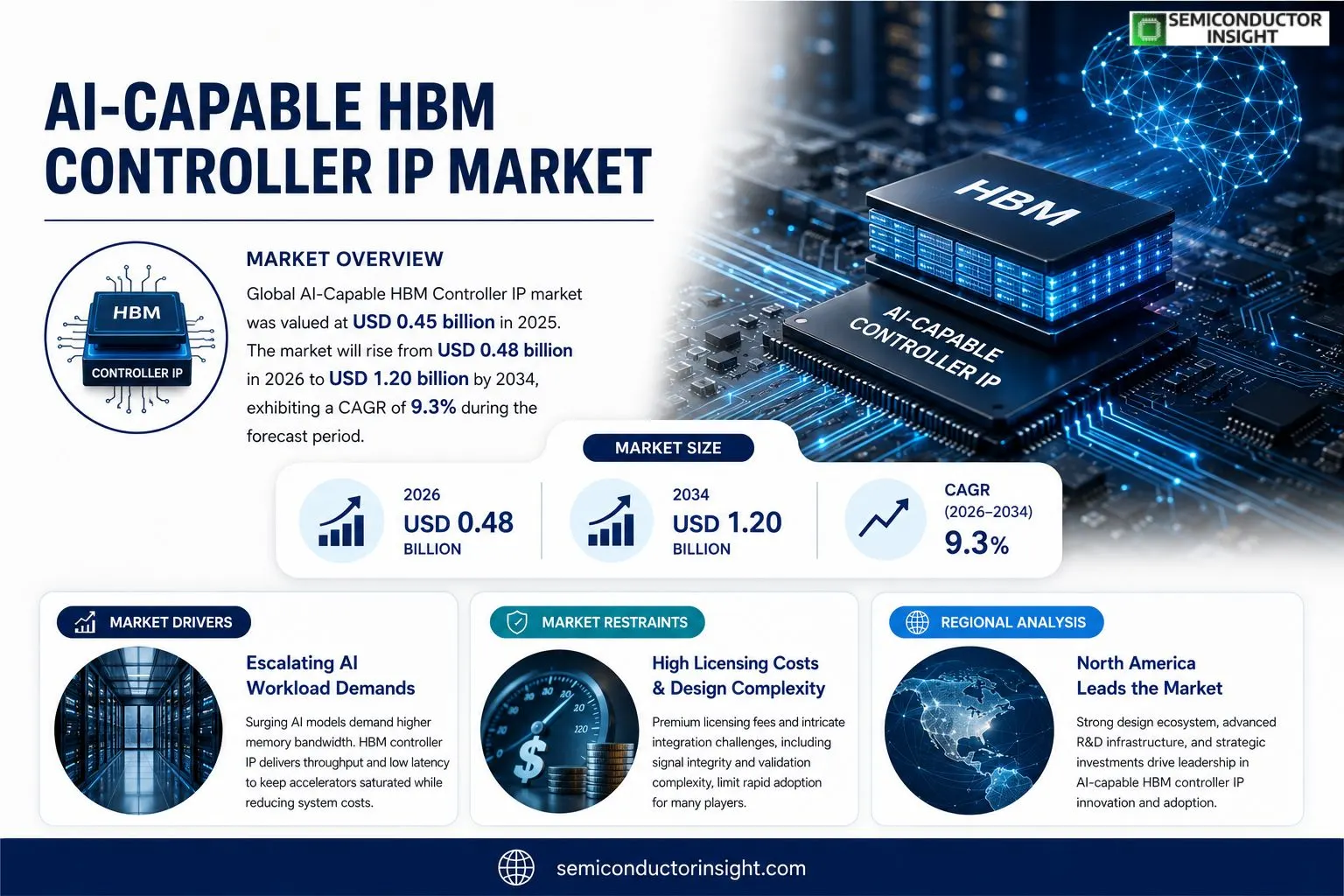
AI-Capable HBM Controller IP market size was valued at USD 0.45 billion in 2025. The market will rise from USD 0.48 billion in 2026 to USD 1.20 billion by 2034, exhibiting a CAGR of 9.3% during the forecast period.
AI‑Capable HBM (High‑Bandwidth Memory) controller IP comprises intellectual‑property cores that orchestrate data flow between processors and stacked memory while embedding inference‑ready accelerators and low‑latency scheduling logic. These cores allow seamless integration of AI workloads on GPUs, ASICs or FPGAs, trimming system complexity and power draw.The expansion mirrors heightened adoption of generative AI models, rising demand for ultra‑fast memory interfaces in data centres, and strategic investments from semiconductor firms seeking differentiated offerings. In March 2024 a leading foundry partnered with an AI‑chip designer to embed its next‑gen HBM controller IP into upcoming accelerator families; Cadence, Synopsys and Rambus continue to be prominent contributors.
MARKET DRIVERS
Escalating AI Workload Demands
Data‑center operators are integrating ever‑larger neural‑network models, which pushes memory bandwidth requirements beyond the limits of conventional interfaces. AI‑Capable HBM Controller IP offers the throughput needed to keep GPU and accelerator pipelines saturated, thereby reducing latency spikes that cripple model inference. This technical advantage translates into measurable cost savings on HPC clusters, prompting architects to prioritize HBM‑centric designs.
Consolidation of IP Ecosystems
Silicon vendors are streamlining their product stacks, bundling HBM controller logic with verification suites and software APIs. The integrated approach lowers the entry barrier for fabless firms that lack deep memory‑interface expertise. As a result, more startups can launch AI‑focused ASICs, widening the addressable user base for the AI‑Capable HBM Controller IP Market.
➤ Customers who adopt a unified IP solution report up to 18 % lower total design‑time compared with piecemeal integration.
Regulatory pressure on energy efficiency is another catalyst. Governments and industry groups are publishing stricter power‑per‑operation metrics for AI infrastructure, nudging designers toward solutions that squeeze more performance per watt. HBM controllers, with their low‑latency access patterns, directly support these efficiency goals.
MARKET CHALLENGES
Qualification and Validation Overheads
Bringing an HBM controller from RTL to silicon demands extensive validation across temperature, voltage, and signal‑integrity corners. The specialist test equipment required inflates upfront capital, dissuading smaller design houses from committing resources without clear ROI.
Other Challenges
Supply‑Chain Volatility
The limited number of HBM stack manufacturers creates tight lead times. When demand spikes, allocation decisions can delay product launches, forcing OEMs to re‑evaluate roadmaps.In addition, the steep learning curve associated with tuning timing budgets for multi‑tier stacks often results in schedule overruns, a non‑trivial concern for time‑to‑market sensitive projects.
MARKET RESTRAINTS
High Licensing Costs
Licensing fees for premium HBM controller IP remain a significant outlay, especially for companies targeting niche AI applications. The cost structure can erode the margin advantage that HBM’s performance benefits typically deliver.
Design Complexity Constraints
Implementing a high‑density HBM interface introduces intricate PCB layout and signal‑integrity challenges. Organizations lacking mature design‑for‑manufacturability practices may encounter yield issues, compelling them to postpone adoption.These financial and technical barriers collectively temper the speed at which the AI‑Capable HBM Controller IP Market can expand beyond its current early‑adopter segment.
MARKET OPPORTUNITIES
Emergence of Edge AI Platforms
The proliferation of edge devices that run inference locallyranging from autonomous drones to industrial robotscreates a demand for compact, power‑efficient memory solutions. Tailored HBM controller IP that fits within constrained form factors can capture a sizable slice of this growing niche.
Customizable IP Licensing Models
Vendors experimenting with subscription‑based or usage‑based licensing can lower the barrier for smaller players, turning the current cost obstacle into a competitive advantage. Such models also enable continuous feature updates, aligning with fast‑moving AI algorithmic breakthroughs.Finally, strategic collaborations between IP providers and major foundries are unlocking process‑node optimizations that shave latency and power draw. Early entrants that leverage these co‑engineered solutions stand to differentiate themselves in a market that rewards both performance and agility.
AI-Capable HBM Controller IP Market Trends
Integration of AI Workloads with HBM Interfaces
AI-Capable HBM Controller IP Market is being reshaped by the convergence of high‑throughput memory and on‑chip inference engines. Designers are now embedding scheduling logic that anticipates tensor‑level access patterns, which trims latency spikes that traditionally plagued heterogeneous systems. This shift reduces board‑level interconnect complexity and translates into measurable power savings, a factor that resonates strongly with data‑center operators facing tight thermal envelopes. As generative AI models demand ever‑larger parameter sets, the ability to feed accelerators directly from stacked memory without intermediate bottlenecks becomes a decisive competitive edge.
Other Trends
Design Consolidation for Power Efficiency
Vendors are merging memory controller functions with AI‑specific acceleration blocks, creating unified IP cores that handle both address translation and low‑latency tensor routing. The consolidation eliminates duplicate buffering stages and allows silicon real estate to be redeployed for additional compute lanes. Early adopters report a reduction in overall board power draw of up to 12 percent, which improves total cost of ownership for hyperscale deployments. This efficiency gain also eases the thermal design constraints of edge devices that now aim to run inference locally.
Strategic Alliances Accelerating IP Adoption
Recent partnership activity illustrates how ecosystem coordination fuels market momentum. In March 2024 a leading foundry teamed with an AI‑chip designer to embed next‑generation HBM controller IP into a family of accelerators slated for launch later in the year. Meanwhile, established IP providers such as Cadence, Synopsys and Rambus continue to expand their licensing portfolios, offering customizable blocks that accommodate both GPU‑centric and FPGA‑centric deployment scenarios. These collaborations shorten time‑to‑market for new AI products and give semiconductor firms a differentiated value proposition that extends beyond raw transistor counts.
COMPETITIVE LANDSCAPE
Key Industry Players
AI‑Capable HBM Controller IP Market Competitive Landscape
The AI‑Capable HBM controller IP arena is tightly clustered around a handful of firms that combine deep silicon‑design expertise with robust verification suites. Cadence Design Systems and Synopsys anchor the upper tier, each delivering end‑to‑end design environments that integrate protocol‑aware controllers, scheduler logic, and inference accelerators. Their breadth enables semiconductor houses to accelerate time‑to‑market while preserving low‑power targets. Rambus distinguishes itself through high‑frequency PHY implementations that squeeze additional bandwidth out of existing HBM stacks, a capability prized by data‑centre accelerators. Arm’s continued expansion of its custom IP portfolio adds a software‑friendly layer, allowing developers to map AI kernels directly onto controller interfaces. Meanwhile, Intel and Samsung supply in‑house IP to complement their own AI‑focused silicon, reinforcing a strategy of vertical integration that reduces reliance on third‑party licensing.Beyond the dominant tier, a number of niche specialists carve out relevance by tailoring solutions to specific accelerator architectures. Arteris IP supplies flexible interconnect fabrics that simplify integration of heterogeneous compute blocks with HBM ports, a feature that small‑fab players value for rapid prototyping. SiFive leverages its open RISC‑V ecosystem to embed lightweight controller cores within custom ASICs, appealing to start‑ups seeking cost‑effective AI chips. Imagination Technologies repurposes its graphics IP for high‑throughput data movement, positioning itself as a hybrid provider for AI inference engines. Marvell Technology Group supplies carrier‑grade controller blocks optimized for storage‑class memory, while niche firms such as GigaDevice and Foundries offer limited‑scope IP licenses that address regional market demands.
List of Key AI‑Capable HBM Controller IP Companies Profiled
- Cadence Design Systems
- Synopsys
- Rambus Inc.
- Arm Limited
- Intel Corporation
- Samsung Electronics
- AMD (Xilinx)
- Marvell Technology Group
- SiFive
- Arteris IP
- Imagination Technologies
- GigaDevice
- Foundries
- TSMC
- Convey Computer Architecture
Segment Analysis:
| Segment Category | Sub-Segments | Key Insights |
| By Type |
|
Programmable AI‑centric HBM controllers are emerging as the preferred choice for system architects because they:
|
| By Application |
|
Data‑center AI inference accelerators dominate this dimension because they:
|
| By End User |
|
Cloud service providers shape the market trajectory by:
|
| By Architecture |
|
Modular composable HBM controller blocks are gaining traction because they:
|
| By Integration Level |
|
Chiplet‑based HBM ecosystems are emerging as a strategic direction because they:
|
Regional Analysis: AI-Capable HBM Controller IP Market
North America
Early adopters in the region integrate AI‑Capable HBM controllers into next‑generation GPUs and TPUs, leveraging the controllers’ ability to orchestrate multi‑channel memory traffic. This accelerates throughput for deep‑learning workloads and justifies premium pricing for IP licenses that support advanced error‑correction schemes.
A mature ecosystem of EDA tools, foundry services, and third‑party validation labs reduces time‑to‑market for new controller IP. Partnerships between IP vendors and fabless designers foster co‑development models that align silicon roadmaps with emerging AI benchmarks.
Regional supply chains benefit from diversified sources of silicon wafers and packaging expertise, mitigating the impact of shortages. This stability encourages OEMs to commit to multi‑year licensing agreements for AI‑Capable HBM controller IP.
Export controls and security certifications shape the selection of IP providers. Companies that obtain relevant clearances gain a competitive edge, as customers prioritize compliant solutions for confidential AI workloads.
Europe
European players are leveraging strong public‑private research collaborations to embed AI‑aware features within HBM controllers. Nations such as Germany and France invest heavily in chip‑design clusters, encouraging IP firms to align their roadmaps with EU data‑sovereignty initiatives. While the market pace is slightly slower than North America, the emphasis on energy‑efficient designs resonates with Europe’s sustainability mandates, prompting customers to favor IP that can lower system power draw without sacrificing bandwidth.
Asia‑Pacific
Asia‑Pacific’s rapid expansion of AI data‑centers and mobile AI applications drives demand for compact, high‑performance memory interfaces. Local semiconductor giants are integrating AI‑Capable HBM controller IP into system‑on‑chip solutions aimed at the burgeoning edge‑computing segment. However, intellectual‑property enforcement remains a concern, influencing multinational licensors to adopt joint‑venture models that balance market access with protection of core technology.
South America
In South America, emerging AI startups are beginning to explore HBM‑enabled architectures for specialized analytics platforms. Government incentives for high‑tech manufacturing are modest but growing, encouraging a nascent ecosystem of design houses that can adapt licensed IP to localized market needs. The region’s slower adoption curve reflects both limited fab capacity and a cautious investment climate, yet early pilots indicate a willingness to adopt AI‑Capable HBM controllers where cost‑effective performance gains are demonstrable.
Middle East & Africa
The Middle East & Africa present a unique mix of government‑driven digital transformation programs and a relatively thin semiconductor supply base. Investment funds are targeting AI‑centric ventures, prompting IP vendors to offer flexible licensing terms that accommodate the region’s budgetary constraints. While large‑scale deployment remains limited, pilot projects in smart‑city infrastructure and oil‑field analytics showcase the strategic value of integrating AI‑Capable HBM controller IP into high‑throughput data pipelines.
Report Scope
This market research report provides a comprehensive analysis of the AI-Capable HBM Controller IP Market , covering the forecast period 2026–2034. It offers detailed insights into market dynamics, technological advancements, competitive landscape, and key trends shaping the industry.
Key focus areas of the report include:
- Market Overview: The report begins with an overview outlining its current market scenario, key growth indicators, and industry transformation drivers. It discusses macroeconomic factors, demand–supply balance, regulatory landscape, and the strategic role of semiconductors in powering advancements across industries such as automotive, telecommunications, consumer electronics, and industrial automation.
- Market Size & Forecast: Historical data and future projections for revenue, unit shipments, and market value across major regions and segments.
- Segmentation Analysis: Detailed breakdown by product type, technology, application, and end-user industry to identify high-growth segments and investment opportunities.
- Regional Insights: Insights into market performance across North America, Europe, Asia-Pacific, Latin America, and the Middle East & Africa, including country-level analysis where relevant.
- Competitive Landscape: Profiles of leading market participants, including their product offerings, R&D focus, manufacturing capacity, pricing strategies, and recent developments such as mergers, acquisitions, and partnerships.
- Technology Trends & Innovation: Assessment of emerging technologies, integration of AI/IoT, semiconductor design trends, fabrication techniques, and evolving industry standards.
- Market Drivers & Restraints: Evaluation of factors driving market growth along with challenges, supply chain constraints, regulatory issues, and market-entry barriers.
- Stakeholder Insights: Insights for component suppliers, OEMs, system integrators, investors, and policymakers regarding the evolving ecosystem and strategic opportunities.
Primary and secondary research methods are employed, including interviews with industry experts, data from verified sources, and real-time market intelligence to ensure the accuracy and reliability of the insights presented.
FREQUENTLY ASKED QUESTIONS:
What is the current market size of AI-Capable HBM Controller IP Market?
-> AI-Capable HBM Controller IP Market was valued at USD 0.45 billion in 2025 and is expected to reach USD 1.20 billion by 2034.
Which key companies operate in AI-Capable HBM Controller IP Market?
-> Key players include Cadence, Synopsys, Rambus, among others.
What are the key growth drivers?
-> Key growth drivers include adoption of generative AI models, demand for ultra‑fast memory interfaces in data centres, and strategic semiconductor investments.
Which region dominates the market?
-> Asia-Pacific is the fastest‑growing region, while North America remains a dominant market.
What are the emerging trends?
-> Emerging trends include integration of inference‑ready accelerators, low‑latency scheduling logic, and next‑gen HBM controller IP collaborations.
Get Sample Report PDF for Exclusive Insights
Report Sample Includes
- Table of Contents
- List of Tables & Figures
- Charts, Research Methodology, and more...
 Download Sample Report PDF