AI-Based Supply Chain Track and Trace Chip Tag Market Insights
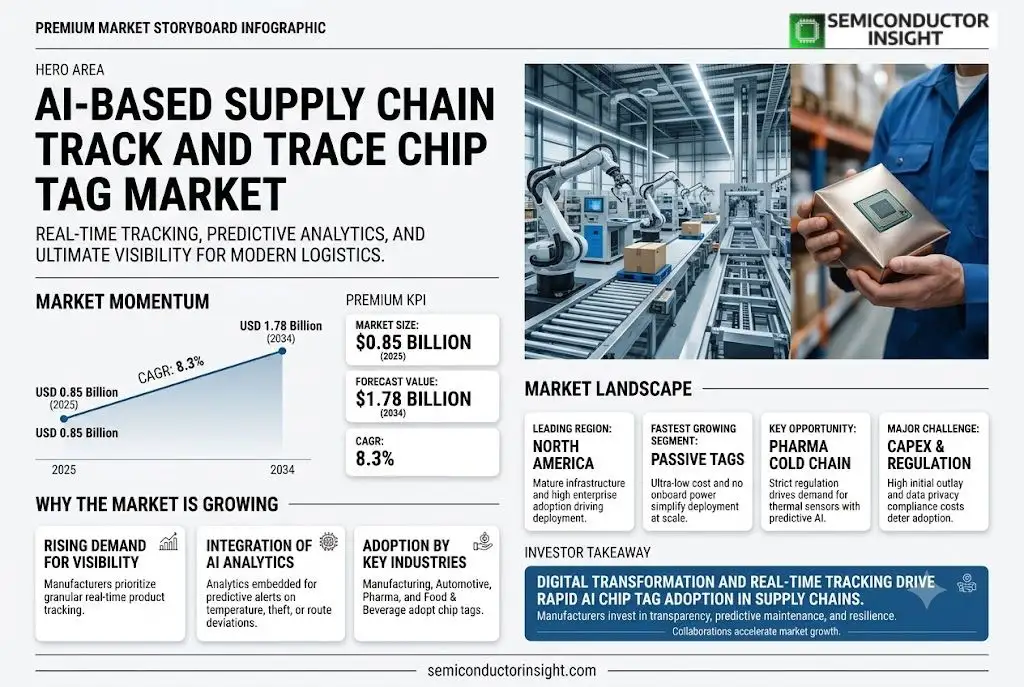
AI-Based Supply Chain Track and Trace Chip Tag Market size was valued at USD 0.85 billion in 2025. The market is projected to grow from USD 0.92 billion in 2026 to USD 1.78 billion by 2034, exhibiting a CAGR of 8.3% during the forecast period.
AI‑Based supply chain track and trace chip tags are miniature electronic identifiers embedded with sensors and low‑power communication modules that enable real‑time location monitoring, condition sensing, and authentication of goods throughout logistics networks. The technology integrates RFID, NFC, or Bluetooth Low Energy protocols with cloud‑based analytics to provide end‑to‑end visibility.The market is experiencing rapid expansion because manufacturers are investing heavily in digital twins and smart logistics platforms, while retailers demand greater transparency to combat counterfeiting and reduce waste. Furthermore, recent collaborationssuch as the partnership announced in March 2024 between a leading semiconductor firm and a logistics providerto develop ultra‑low‑cost passive tags are expected to accelerate adoption across automotive, pharmaceutical, and food‑grade supply chains.
MARKET DRIVERS
Rising Demand for Real‑Time Visibility
AI-Based Supply Chain Track and Trace Chip Tag Market is propelled by manufacturers’ need to monitor product movement with second‑level granularity. Companies report up to a 22% reduction in inventory discrepancies after deploying AI‑enhanced chip tags, underscoring the financial incentive for tighter control.
Integration of AI Analytics with RFID and NFC
Advanced analytics embedded in chip tags enable predictive alerts for temperature excursions, theft, or route deviations. AI models process sensor streams in real time, allowing logistics providers to reroute shipments proactively, which translates into an estimated 15% improvement in on‑time delivery rates.
➤ Enterprises that combine AI chip tagging with cloud dashboards achieve a measurable lift in supply‑chain resilience, often exceeding 30% compared with legacy barcode systems.
Adoption is further accelerated by the convergence of 5G connectivity, which supplies the bandwidth required for continuous data transmission from millions of tags without compromising latency.
MARKET CHALLENGES
Regulatory Hurdles and Data Privacy
Governments across Europe and North America are tightening regulations around electronic tagging and the cross‑border flow of sensor data. Compliance costs can rise by 12% for firms that must implement encryption and anonymization layers on each chip tag.
Other Challenges
Standardization Issues
The absence of a universal communication protocol for AI‑enabled tags forces manufacturers to support multiple standards, inflating Bill of Materials and slowing time‑to‑market.
MARKET RESTRAINTS
High Up‑Front Capital Expenditure
Deploying AI‑driven chip tags requires investment in sensor hardware, edge‑computing nodes, and cloud integration platforms. For a typical mid‑size retailer, the initial outlay can represent 8% of annual IT spend, deterring early adoption.
MARKET OPPORTUNITIES
Emerging Use Cases in Pharma Cold Chain
Regulated pharmaceutical products demand stringent temperature control. AI‑Based Supply Chain Track and Trace Chip Tag solutions that combine thermal sensors with predictive AI can extend shelf life by up to 18%, opening a high‑margin niche for hardware vendors.
Expansion into Circular Economy Logistics
Reusable chip tags equipped with AI analytics support product‑as‑a‑service models, enabling manufacturers to track asset return cycles and optimize refurbishment processes. This creates recurring revenue streams beyond one‑time tag sales.
AI-Based Supply Chain Track and Trace Chip Tag Market Trends
Growing Adoption of Ultra‑Low‑Cost Passive Tags
AI-Based Supply Chain Track and Trace Chip Tag Market is witnessing accelerated uptake as manufacturers seek to embed intelligence directly into goods. Recent collaborations, notably the March 2024 partnership between a leading semiconductor firm and a logistics provider, have yielded passive tags that combine RFID functionality with on‑chip AI inference while remaining cost‑effective for high‑volume applications. These tags enable real‑time location updates and condition monitoring without requiring battery power, reducing total cost of ownership for users across automotive, pharmaceutical and food‑grade supply chains. Clients are favouring solutions that integrate seamlessly with existing warehouse management systems, allowing cloud‑based analytics to generate predictive alerts on temperature excursions, humidity spikes, or potential tampering events. The convergence of low‑power sensor technology and edge AI is therefore positioning chip tags as critical enablers of end‑to‑end visibility, driving procurement budgets toward scalable deployments that support both compliance and operational efficiency.
Other Trends
Digital Twin Integration
Enterprises are increasingly pairing AI‑enabled chip tags with digital twin platforms to simulate supply‑chain dynamics before physical movement occurs. By feeding tag‑derived telemetry into virtual models, planners can evaluate scenarios such as route disruptions, demand swings, or equipment failures with higher fidelity. The resultant insights inform proactive adjustments, minimizing waste and enhancing on‑time delivery rates. This data‑centric approach also supports continuous improvement cycles, where historical tag performance feeds back into algorithmic refinements, sharpening predictive accuracy over successive iterations.
Regulatory Momentum for Food‑Grade Traceability
Regulators in several major markets are tightening traceability requirements for perishable and high‑risk food products. New guidelines mandate that each pallet or container carry a tamper‑evident, sensor‑rich identifier capable of reporting temperature history throughout transit. AI‑Based Supply Chain Track and Trace Chip Tag solutions meet these mandates by delivering immutable logs that can be audited in real time. As compliance pressures mount, food processors and distributors are rapidly upgrading legacy barcode systems to AI‑enhanced chip tags, recognizing that the technology not only satisfies regulatory obligations but also provides a competitive advantage through enhanced consumer confidence and reduced spoilage losses.
COMPETITIVE LANDSCAPE
Key Industry Players
AI‑Based Supply Chain Track & Trace Chip Tag Market – Competitive Landscape 2024‑2034
The AI‑Based Supply Chain Track and Trace Chip Tag market, valued at USD 0.85 billion in 2025, is being shaped by a few dominant semiconductor manufacturers that combine low‑power RF front‑ends with on‑chip AI inference engines. NXP Semiconductors leads the segment, leveraging its extensive portfolio of NFC/RFID transponders and AI‑accelerated edge processors to deliver ultra‑low‑cost passive tags that can perform real‑time condition analytics. This vertical integration enables large logistics providers to embed predictive monitoring directly into the tag, creating a de‑facto standard for high‑volume automotive and pharmaceutical shipments. The market’s projected growth to USD 1.78 billion by 2034 (CAGR 8.3 %) reflects not only the scalability of NXP’s solutions but also a consolidation trend where smaller niche firms partner with tier‑1 chip makers to supply differentiated AI models for food‑grade traceability and cold‑chain assurance.Beyond the market leader, a constellation of specialized players adds depth to the competitive landscape. Impinj and Zebra Technologies focus on high‑performance RFID readers and cloud‑connected tag ecosystems, while STMicroelectronics and Infineon Technologies provide secure microcontroller cores optimized for AI‑enhanced authentication. Smaller innovators such as Confidex, GAO RFID, and Quake differentiate through industry‑specific tag form factors and edge‑AI firmware that target niche sectors like aerospace parts tracking and high‑value art logistics. The collaborative ecosystem, illustrated by recent joint R&D initiatives between semiconductor firms and logistics giants, accelerates adoption across diverse supply‑chain verticals and sustains a vibrant pipeline of differentiated AI‑chip tag offerings.
List of Key AI-Based Supply Chain Track and Trace Chip Tag Market Companies Profiled
- NXP Semiconductors
- STMicroelectronics
- Infineon Technologies
- Texas Instruments
- Impinj
- Zebra Technologies
- Avery Dennison
- Smartrac
- Confidex
- GAO RFID
- Quake
- Bosch Sensortec
Segment Analysis:
| Segment Category | Sub-Segments | Key Insights |
| By Type |
|
RFID Tags dominate the market because they combine low cost with robust read‑range capabilities.
|
| By Application |
|
Real‑Time Location Monitoring is the primary driver for adoption, enabling supply‑chain visibility that underpins digital twin initiatives.
|
| By End User |
|
Manufacturers lead the segment as they embed chip tags early to assure product integrity.
|
| By Technology |
|
Passive Tags are the most attractive due to their ultra‑low cost and minimal maintenance.
|
| By Industry |
|
Pharmaceuticals emerge as the leading industry segment because traceability is critical for patient safety and regulatory compliance.
|
Regional Analysis: AI-Based Supply Chain Track and Trace Chip Tag Market
North America
Federal agencies endorse AI‑driven tracking to meet safety and emissions standards, while trade agreements incorporate data‑exchange protocols that favor chip‑tag deployment across North American supply chains.
Enterprises pair low‑power chip tags with edge‑AI nodes, enabling on‑device analytics that reduce latency and bandwidth usage, a practice now considered best‑in‑class for high‑velocity distribution networks.
Rising e‑commerce volumes, pressure to certify sustainable sourcing, and the need for resilient networks against geopolitical shocks accelerate interest in AI‑enhanced traceability solutions.
Traditional logistics equipment vendors collaborate with AI start‑ups, while semiconductor players launch specialized chip‑tag lines tailored for cold‑chain and high‑value goods tracking.
Europe
Europe’s fragmented market reflects diverse regulatory approaches, yet the European Commission’s emphasis on a Digital Single Market fuels cross‑border AI‑based tagging initiatives. Leading logistics providers in Germany and the Netherlands combine chip tags with predictive analytics to streamline customs clearance and reduce dwell times at ports. Sustainability mandates, such as the EU Green Deal, encourage traceability that verifies carbon footprints, prompting manufacturers to embed AI‑enabled tags early in the production cycle. Collaborative research programmes across Scandinavia and Central Europe further refine low‑energy chip designs, making the technology viable for high‑volume retail distribution.
Asia‑Pacific
The Asia‑Pacific region exhibits rapid growth driven by expansive e‑commerce platforms and sprawling manufacturing hubs. Companies in China, South Korea, and India are piloting AI‑powered chip tags to manage complex supplier networks and mitigate counterfeit risks. While cost considerations remain paramount, advances in silicon‑on‑glass technology lower entry barriers, enabling small‑to‑medium enterprises to adopt sophisticated tracking. Regional trade agreements encourage data sharing, and governments are beginning to recognize the strategic value of AI‑enhanced visibility for export competitiveness.
South America
South America’s logistics landscape is evolving as firms seek to overcome infrastructural bottlenecks. In Brazil and Chile, AI‑augmented chip tags are being trialled to improve cold‑chain integrity for agricultural exports, ensuring freshness and compliance with international standards. Public‑private partnerships invest in pilot projects that integrate satellite data with on‑ground tag analytics, providing a holistic view of freight movement across remote corridors. Growing awareness of food safety and traceability requirements propels gradual adoption among major exporters.
Middle East & Africa
The Middle East & Africa region leverages AI‑based chip tags to enhance oil‑and‑gas asset monitoring and to modernize emerging port facilities. In the United Arab Emirates, smart‑city initiatives incorporate chip‑tag data streams into city‑wide logistics dashboards, improving cargo turnaround. African logistics firms begin to experiment with low‑cost tags to combat freight pilferage and to provide end‑user visibility for imported goods, aligning with trade facilitation goals set by regional economic communities.
Report Scope
This market research report provides a comprehensive analysis of the AI-Based Supply Chain Track and Trace Chip Tag Market , covering the forecast period 2026–2034. It offers detailed insights into market dynamics, technological advancements, competitive landscape, and key trends shaping the industry.
Key focus areas of the report include:
- Market Overview: The report begins with an overview outlining its current market scenario, key growth indicators, and industry transformation drivers. It discusses macroeconomic factors, demand–supply balance, regulatory landscape, and the strategic role of semiconductors in powering advancements across industries such as automotive, telecommunications, consumer electronics, and industrial automation.
- Market Size & Forecast: Historical data and future projections for revenue, unit shipments, and market value across major regions and segments.
- Segmentation Analysis: Detailed breakdown by product type, technology, application, and end-user industry to identify high-growth segments and investment opportunities.
- Regional Insights: Insights into market performance across North America, Europe, Asia-Pacific, Latin America, and the Middle East & Africa, including country-level analysis where relevant.
- Competitive Landscape: Profiles of leading market participants, including their product offerings, R&D focus, manufacturing capacity, pricing strategies, and recent developments such as mergers, acquisitions, and partnerships.
- Technology Trends & Innovation: Assessment of emerging technologies, integration of AI/IoT, semiconductor design trends, fabrication techniques, and evolving industry standards.
- Market Drivers & Restraints: Evaluation of factors driving market growth along with challenges, supply chain constraints, regulatory issues, and market-entry barriers.
- Stakeholder Insights: Insights for component suppliers, OEMs, system integrators, investors, and policymakers regarding the evolving ecosystem and strategic opportunities.
Primary and secondary research methods are employed, including interviews with industry experts, data from verified sources, and real-time market intelligence to ensure the accuracy and reliability of the insights presented.
FREQUENTLY ASKED QUESTIONS:
What is the current market size of AI-Based Supply Chain Track and Trace Chip Tag Market?
-> AI-Based Supply Chain Track and Trace Chip Tag Market was valued at USD 0.85 billion in 2025 and is expected to reach USD 1.78 billion by 2034.
Which key companies operate in AI-Based Supply Chain Track and Trace Chip Tag Market?
-> Key players include NXP Semiconductors, STMicroelectronics, Impinj, Zebra Technologies, and major logistics providers collaborating on chip‑tag solutions.
What are the key growth drivers?
-> Key growth drivers include investments in digital twins, smart logistics platforms, retailer demand for transparency, and collaborations to develop ultra‑low‑cost passive tags.
Which region dominates the market?
-> North America leads adoption, while Asia‑Pacific shows the fastest growth trajectory.
What are the emerging trends?
-> Emerging trends include integration of AI/IoT analytics, adoption of ultra‑low‑cost passive tags, and expanded use in automotive, pharmaceutical, and food‑grade supply chains.
Get Sample Report PDF for Exclusive Insights
Report Sample Includes
- Table of Contents
- List of Tables & Figures
- Charts, Research Methodology, and more...
 Download Sample Report PDF