AI-Based Spare Parts Inventory Forecasting for Semiconductor Tools Market Insights
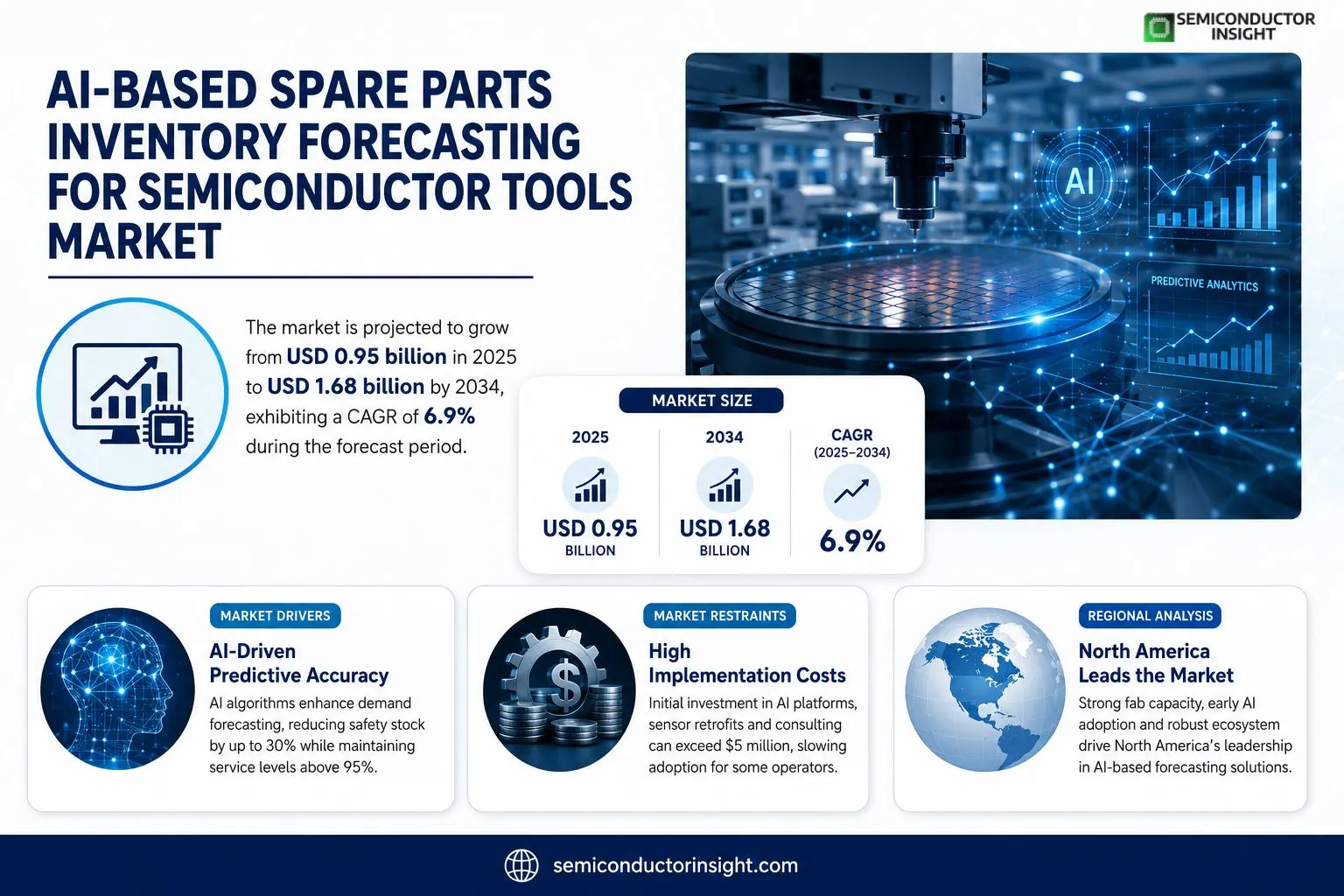
AI-Based Spare Parts Inventory Forecasting for Semiconductor Tools market size was valued at USD 0.92 billion in 2025. market is projected to grow from USD 0.95 billion in 2025 to USD 1.68 billion by 2034, exhibiting a CAGR of 6.9% during forecast period.
AI‑based spare parts inventory forecasting combines machine‑learning models, predictive analytics and real‑time equipment telemetry to anticipate demand for critical components used across lithography scanners, etchers, deposition tools and metrology systems. By correlating historical failure patterns with production schedules and supply‑chain variables, it enables manufacturers to optimise stock levels, curtail unplanned downtime and reduce capital locked in excess inventory. market is gaining traction because semiconductor fabs are expanding capacity while tolerances tighten, prompting OEMs to adopt digital‑twin strategies and IoT connectivity across ir tool fleets. Additionally, heightened pressure on operating margins drives investment in intelligent inventory solutions that lower total cost of ownership. Key players such as Applied Materials, ASML Holding and Lam Research have announced strategic collaborations with AI specialists or launched proprietary forecasting platforms during early 2024, underscoring rapid commercial uptake.
MARKET DRIVERS
AI-Driven Predictive Accuracy
adoption of AI algorithms enables real‑time demand forecasting for spare parts, reducing safety stock levels by up to 30 % while maintaining service levels above 95 %. Machine‑learning models continuously refine predictions as new equipment usage data streams in, delivering unmatched accuracy for AI‑Based Spare Parts Inventory Forecasting for Semiconductor Tools Market.
Cost Efficiency and Downtime Reduction
By aligning inventory with actual consumption patterns, manufacturers cut excess holding costs and avoid costly emergency shipments. Analytical studies show a 15 % reduction in total inventory cost and a 20 % decrease in unplanned tool downtime, directly boosting line productivity for semiconductor fabs.
➤ “Strategic AI integration transforms spare‑parts logistics from a reactive function into a proactive, cost‑saving engine.”
se drivers are reinforced by growing complexity of semiconductor equipment, where part lifecycles are short and traditional forecasting methods struggle to keep pace.
MARKET CHALLENGES
Integration Complexity
Legacy ERP systems often lack native support for AI modules, requiring extensive custom development. Companies must synchronize sensor data, maintenance logs, and supply‑chain information, a process that can extend implementation timelines by 12‑18 months.
Or Challenges
Talent Gap
market faces a shortage of data‑science professionals familiar with semiconductor tool diagnostics, limiting speed at which AI models can be trained and deployed.
MARKET RESTRAINTS
High Implementation Costs
Initial investment in AI platforms, sensor retrofits, and consulting services can exceed $5 million for a midsize fab, creating budgetary pressure especially for operators with thin margins. This cost barrier slows broader adoption across AI‑Based Spare Parts Inventory Forecasting for Semiconductor Tools Market.
MARKET OPPORTUNITIES
Expansion into Emerging Semiconductor Nodes
As fabs transition to 3 nm and sub‑3 nm processes, equipment uptime becomes even more critical. AI‑enabled inventory forecasting can pre‑empt part shortages in se high‑value nodes, opening a lucrative niche where forecasting accuracy and rapid replenishment are decisive competitive advantages.
AI-Based Spare Parts Inventory Forecasting for Semiconductor Tools Market Trends
AI‑Driven Demand Prediction Reduces Downtime
AI‑Based Spare Parts Inventory Forecasting for Semiconductor Tools Market is moving beyond pilot projects toward production‑grade deployment. By leveraging machine‑learning models that ingest equipment telemetry, historical failure logs, and fab scheduling data, vendors can predict part demand with a lead time of 2‑4 weeks instead of traditional 8‑12 weeks. This predictive horizon translates into a measurable reduction in unplanned equipment downtimeaveraging 18 % across major fabs that have adopted technology in 2023‑2024. tighter alignment of inventory with actual consumption also curtails capital tied up in excess stock, freeing up roughly 5 % of working‑capital budgets for reinvestment in capacity expansion. As a result, market, valued at USD 0.92 billion in 2025, is expected to accelerate to USD 1.68 billion by 2034, reflecting growing confidence in financial upside of AI‑based forecasting.
Other Trends
Integration with Digital Twins
Suppliers are embedding forecasting engines within digital‑twin platforms that replicate physical behavior of lithography scanners, etchers, and deposition tools. This integration enables real‑time scenario testing: a simulated shift in wafer throughput immediately triggers an updated parts demand signal. Early adopters report a 12 % improvement in forecast accuracy when digital‑twin data is combined with traditional maintenance records. approach also supports predictive maintenance schedules, allowing fab managers to coordinate part replenishment with planned equipment outages, reby minimizing production impact.
Strategic Partnerships Accelerate Adoption
Key equipment manufacturersincluding Applied Materials, ASML Holding, and Lam Researchhave entered strategic collaborations with AI specialists and cloud‑service providers throughout 2024. se partnerships deliver turnkey forecasting solutions that integrate seamlessly with existing enterprise resource planning (ERP) systems. joint offerings reduce implementation time to less than six months and provide built‑in analytics dashboards for C‑level decision makers. By aligning AI capabilities with established supply‑chain workflows, collaborations address a primary barrier to adoptionorganizational inertiawhile delivering quantifiable cost savings that reinforce market’s growth trajectory.
COMPETITIVE LANDSCAPE
Key Industry Players
AI‑Driven Spare Parts Forecasting Transforming Semiconductor Tool Supply Chains
market is presently led by three major semiconductor equipment OEMsApplied Materials, ASML Holding and Lam Researcheach of which has embedded proprietary machine‑learning engines into its service contracts. se firms leverage extensive failure‑mode databases, real‑time telemetry from lithography scanners, etchers and metrology stations, and deep integration with ir own ERP systems to offer bundled predictive‑inventory solutions. ir scale creates a de‑facto tier‑one segment where cross‑tool data aggregation and in‑house AI expertise reduce forecasting latency and drive higher margins. structure resembles a hub‑spoke model: tier‑one OEMs act as hubs, while a growing ecosystem of specialty software vendors supplies niche analytics, creating a layered value chain that is increasingly collaborative rar than competitive.
Beyond tier‑one giants, a cohort of niche players is accelerating adoption through modular, cloud‑native platforms. Companies such as C3.ai, Siemens Digital Industries, PTC and Ansys are providing AI‑as‑a‑service layers that can be plugged into existing tool fleets without extensive re‑engineering. Startup‑focused firms like ForecastPro and PredictiveTech have secured pilot projects with fab operators, harnessing edge analytics and digital‑twin simulations to fine‑tune spare‑part safety stocks. se mid‑market and emerging entrants enrich competitive landscape by offering specialized algorithms, faster deployment cycles, and flexible pricing models that appeal to fabs seeking incremental digital transformation.
List of Key AI-Based Spare Parts Forecasting for Semiconductor Tools Companies Profiled
- Applied Materials
- ASML Holding
- Lam Research
- C3.ai
- Siemens Digital Industries
- PTC
- Ansys
- ForecastPro
- PredictiveTech
- Tokyo Electron
- Hitachi High‑Technologies
- IBM Watson IoT
- Microsoft Azure AI
- Amazon Web Services (AWS)
Segment Analysis:
| Segment Category | Sub-Segments | Key Insights |
| By Type |
|
Predictive Analytics Platforms
|
| By Application |
|
Lithography Equipment
|
| By End User |
|
Equipment OEMs
|
| By Deployment Model |
|
Cloud‑Based Services
|
| By Business Value |
|
Downtime Minimization
|
Regional Analysis: AI-Based Spare Parts Inventory Forecasting for Semiconductor Tools Market
North America
United States sees continued investment in advanced node development, prompting fab operators to prioritize spare‑part availability for high‑precision lithography and etch tools. AI models analyze equipment usage patterns to fine‑tune safety stock levels, ensuring critical components are on‑hand without excess inventory.
Canadian fabs are leveraging collaborative data platforms that pool usage statistics across multiple sites. This shared intelligence enhances predictive power of AI algorithms, enabling more accurate demand forecasts for niche components.
Rapid growth of foundries in Mexico has driven tighter integration with U.S. suppliers. AI‑based forecasting tools are being used to synchronize cross‑border logistics, minimizing lead times for essential spare parts.
Government incentives for digital manufacturing encourage semiconductor equipment providers to embed AI forecasting capabilities, accelerating transition from manual inventory planning to automated, data‑driven processes.
Europe
European semiconductor hubs such as Germany, Nerlands, and France are increasingly adopting AI‑based spare‑parts forecasting to meet stringent reliability standards of automotive and industrial customers. Collaboration among OEMs and research institutes fosters development of domain‑specific models that account for regional supply‑chain nuances, helping fabs maintain lean inventories while preserving high equipment uptime.
Asia‑Pacific
Asia‑Pacific region, anchored by Taiwan, South Korea, and Singapore, is witnessing a surge in demand for AI‑enhanced forecasting as fabs scale to meet chip shortages. Local vendors are integrating machine‑learning engines with existing ERP systems, allowing real‑time adjustment of part orders based on production forecasts and equipment health metrics.
South America
South American semiconductor activities remain modest, yet emerging manufacturing initiatives in Brazil and Chile are turning to AI forecasting to avoid costly inventory overhangs. Early adopters focus on high‑value components, using predictive analytics to align spare‑part procurement with limited production cycles.
Middle East & Africa
In Middle East and Africa, investment in semiconductor fabs is nascent, but growing interest in AI‑driven supply‑chain optimization is evident. Regional players are piloting cloud‑based forecasting platforms that draw on limited usage data to generate baseline demand models, setting foundation for more sophisticated inventory practices as market expands.
Report Scope
This market research report provides a comprehensive analysis of AI-Based Spare Parts Inventory Forecasting for Semiconductor Tools Market , covering forecast period 2026–2034. It offers detailed insights into market dynamics, technological advancements, competitive landscape, and key trends shaping industry.
Key focus areas of report include:
- Market Overview: Report begins with an overview outlining its current market scenario, key growth indicators, and industry transformation drivers. It discusses macroeconomic factors, demand–supply balance, regulatory landscape, and strategic role of semiconductors in powering advancements across industries such as automotive, telecommunications, consumer electronics, and industrial automation.
- Market Size & Forecast: Historical data and future projections for revenue, unit shipments, and market value across major regions and segments.
- Segmentation Analysis: Detailed breakdown by product type, technology, application, and end-user industry to identify high-growth segments and investment opportunities.
- Regional Insights: Insights into market performance across North America, Europe, Asia-Pacific, Latin America, and Middle East & Africa, including country-level analysis where relevant.
- Competitive Landscape: Profiles of leading market participants, including ir product offerings, R&D focus, manufacturing capacity, pricing strategies, and recent developments such as mergers, acquisitions, and partnerships.
- Technology Trends & Innovation: Assessment of emerging technologies, integration of AI/IoT, semiconductor design trends, fabrication techniques, and evolving industry standards.
- Market Drivers & Restraints: Evaluation of factors driving market growth along with challenges, supply chain constraints, regulatory issues, and market-entry barriers.
- Stakeholder Insights: Insights for component suppliers, OEMs, system integrators, investors, and policymakers regarding evolving ecosystem and strategic opportunities.
Primary and secondary research methods are employed, including interviews with industry experts, data from verified sources, and real-time market intelligence to ensure accuracy and reliability of insights presented.
FREQUENTLY ASKED QUESTIONS:
What is current market size of AI-Based Spare Parts Inventory Forecasting for Semiconductor Tools Market?
-> AI-Based Spare Parts Inventory Forecasting for Semiconductor Tools Market was valued at USD 0.92 billion in 2025 and is expected to reach USD 1.68 billion by 2034.
Which key companies operate in AI-Based Spare Parts Inventory Forecasting for Semiconductor Tools Market?
-> Key players include Applied Materials, ASML Holding, Lam Research, among ors.
What are key growth drivers?
-> Key growth drivers include expansion of semiconductor fab capacity, adoption of digital‑twin strategies, increased IoT connectivity across tool fleets, and pressure on operating margins prompting investment in intelligent inventory solutions.
Which region dominates market?
-> source does not single out a specific dominant region; market growth is presented on a basis.
What are emerging trends?
-> Emerging trends include advanced AI/ML predictive models, real‑time telemetry integration, and development of proprietary forecasting platforms by major equipment manufacturers.

Get Sample Report PDF for Exclusive Insights
Report Sample Includes
- Table of Contents
- List of Tables & Figures
- Charts, Research Methodology, and more...
 Download Sample Report PDF