AI-Based Solder Ball Coplanarity Inspection Market Insights
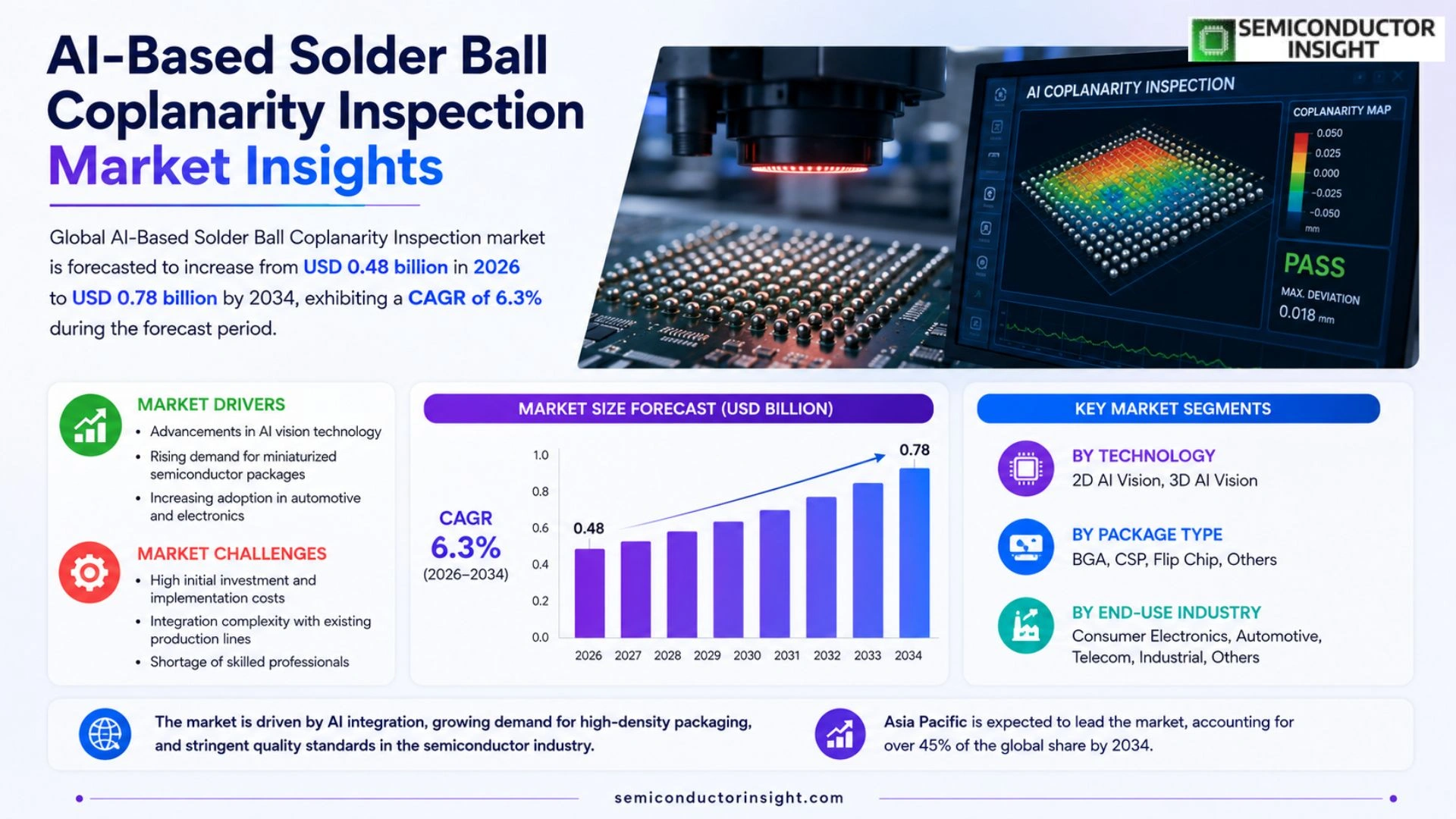
Global AI-Based Solder Ball Coplanarity Inspection market size was valued at USD 0.45 billion in 2025. The market is forecasted to increase from USD 0.48 billion in 2026 to USD 0.78 billion by 2034, exhibiting a CAGR of 6.3% during the forecast period.
This segment comprises systems that combine high‑resolution machine‑vision sensors with deep‑learning models to evaluate the planar alignment of solder balls on BGA and CSP packages. By analysing pixel‑level variations, the solution can flag out‑of‑tolerance coplanarity instantly, support real‑time process control and help manufacturers meet IPC J‑STD‑001 standards without manual intervention.
The shift toward finer pitch interconnects and heterogeneous integration is prompting fabs to adopt these tools because they reduce defect leakage and shorten cycle time. Cost pressures encourage suppliers such as KLA Corp., Applied Materials and CyberOptics to embed predictive analytics that anticipate drift before it impacts yield, while Asian‑Pacific producers lead adoption owing to dense electronics assembly clusters.
MARKET DRIVERS
Advancements in AI Vision Technology
AI-Based Solder Ball Coplanarity Inspection Market is being reshaped by breakthroughs in deep‑learning vision algorithms. Modern convolutional networks can distinguish sub‑micron deviations that traditional optics miss, delivering substantially higher detection confidence. This technical edge allows manufacturers to tighten process windows without sacrificing line throughput, a combination that directly fuels demand for automated inspection solutions.
Rising Quality Standards in Electronics Manufacturing
Global customers,from consumer gadgets to mission‑critical aerospace systems,are imposing tighter coplanarity tolerances to avoid signal‑integrity failures. As board densities climb, even minimal ball misalignment can trigger costly field failures. Consequently, quality assurance budgets are being reallocated toward AI‑driven inspection tools that promise consistent compliance across high‑volume production runs.
➤ “Early adopters report up to a 20% reduction in rework cycles after deploying AI‑based coplanarity inspection.”
The confluence of smarter sensors and stricter specifications creates a feedback loop: manufacturers invest in AI systems to meet standards, and the improved data quality from those systems further tightens the standards. This dynamic positions AI-Based Solder Ball Coplanarity Inspection Market for accelerated uptake across multiple segments.
MARKET CHALLENGES
Integration Complexity with Existing Production Lines
Legacy test equipment often operates on proprietary protocols, making it difficult to embed AI inspection modules without extensive retrofitting. Plant engineers must reconcile timing constraints, data exchange formats, and mechanical footprints, which can extend implementation timelines and erode the perceived cost advantage of new technology.
Other Challenges
Skill Gap
The algorithms that power AI‑based inspection require expertise in data labeling, model training, and performance tuning. Many mid‑size OEMs lack in‑house talent, forcing them to rely on external consultants and thereby inflating total ownership costs.
Data Management Overheads
High‑resolution image streams generate terabytes of data per shift. Without robust storage and analytics pipelines, manufacturers risk information bottlenecks that diminish the real‑time value of inspection insights.
MARKET RESTRAINTS
High Capital Expenditure for AI Equipment
The upfront purchase price of AI‑enabled cameras, edge processors, and supporting software suites remains a barrier for facilities operating on thin margins. Even with financing options, the payback horizon can exceed the typical budgeting cycle for small‑ to medium‑sized producers.
In addition, many suppliers bundle inspection software with proprietary hardware, limiting the ability of buyers to stage incremental upgrades. This lock‑step approach discourages firms that prefer a modular roadmap aligned with production expansion plans.
Finally, the lack of universally accepted benchmarking standards for coplanarity assessment means that companies must conduct independent validation studies, adding another layer of expense and uncertainty before committing to large‑scale deployments.
MARKET OPPORTUNITIES
Emerging Edge‑AI Platforms
New generations of low‑power edge processors enable AI inference directly on the inspection camera, eliminating the need for centralized compute farms. This shift reduces latency, lowers bandwidth costs, and opens the door for real‑time corrective actions on the production floor.
Manufacturers that pair edge‑AI hardware with cloud‑based analytics dashboards can offer subscription‑style services, creating a recurring revenue model while providing continuous algorithm improvements without physical upgrades.
Additionally, the growing demand for high‑reliability electronics in automotive and aerospace sectors creates a niche where premium AI inspection solutions can command higher margins, given the heightened emphasis on safety and regulatory compliance.
AI-Based Solder Ball Coplanarity Inspection Market Trends
Shift Toward Fine‑Pitch Interconnect Inspection
The emergence of ultra‑dense BGA and CSP packages has forced manufacturers to rethink planar quality controls. Traditional optical gauges struggle to resolve sub‑micron deviations, prompting fabs to integrate AI‑Based Solder Ball Coplanarity Inspection Market solutions that pair high‑resolution sensors with deep‑learning classifiers. By interpreting pixel‑level anomalies, these systems pinpoint out‑of‑tolerance balls in real time, reducing the window between defect detection and corrective action. The practical benefit is a tighter feedback loop on placement equipment, which translates into higher first‑pass yields and fewer scrapped trays. Moreover, the ability to automate compliance with IPC J‑STD‑001 standards eliminates manual verification steps, freeing skilled technicians for higher‑value tasks. Collectively, these operational efficiencies are reshaping quality assurance workflows across the semiconductor assembly chain.
Other Trends
Predictive Analytics Integration
Vendors such as KLA Corp., Applied Materials, and CyberOptics have begun embedding predictive models directly into inspection rigs. The algorithms learn from historical coplanarity data, flagging drift patterns before they breach tolerance limits. This pre‑emptive capability helps production planners adjust solder paste deposition or stencil design proactively, rather than reacting after yield loss is observed. The resulting reduction in defect leakage not only safeguards downstream testing but also shortens overall cycle time, a critical metric for high‑mix, low‑volume fabs that cannot afford prolonged rework loops.
Geographic Adoption Patterns
Supply‑chain concentrations in the Asia‑Pacific region have accelerated the rollout of AI‑Based Solder Ball Coplanarity Inspection Market technology. Dense electronics clusters and aggressive cost targets create an environment where incremental yield improvements are monetarily compelling. Leading foundries in Taiwan, South Korea, and China are leveraging these inspection platforms to sustain throughput while maintaining tight quality envelopes. In contrast, North American and European facilities are adopting a more measured approach, focusing on retrofitting legacy lines where the return on investment can be clearly quantified. The divergent pacing underscores a broader industry movement: the technology is becoming a competitive differentiator for manufacturers that must balance price pressure with stringent reliability expectations.
COMPETITIVE LANDSCAPE
Key Industry Players
AI‑Based Solder Ball Coplanarity Inspection Market: Competitive Overview
KLA Corp. dominates the segment with a portfolio that couples high‑resolution vision modules and proprietary deep‑learning inference engines. Its systems are favored by major foundries that seek to align inspection throughput with sub‑micron pitch requirements, and the company’s push toward predictive analytics has created a de‑facto standard for real‑time process control. Applied Materials follows closely, leveraging its wafer‑scale metrology heritage to embed coplanarity assessment within broader fab automation suites. This integration reduces hand‑off time and allows customers to consolidate tool spending. CyberOptics, a specialist in 3‑D vision, differentiates through a modular architecture that supports rapid algorithm swaps, giving end‑users flexibility to address emerging package formats such as fan‑in CSPs. The three firms together command a sizable share of the $0.45 billion market recorded in 2025, and their pricing power shapes the investment horizon for mid‑size players seeking niche adoption in high‑mix, low‑volume production lines.
Beyond the top tier, several regional and technology‑focused vendors are carving out defensible positions. Nikon’s inspection platform, long respected in semiconductor lithography, now incorporates AI‑driven coplanarity modules that appeal to Japanese OEMs looking for domestic supply chains. Taiwan‑based AdvantEdge and Taiwan Semiconductor Industry Association (TSIA) members such as ASE Technology and Unimicron provide cost‑effective alternatives tailored to the dense electronics clusters of the Asia‑Pacific. European contender PI (Precision Instruments) offers a hybrid sensor suite that blends line‑scan cameras with point‑cloud analysis, attracting customers in automotive electronics where reliability thresholds are stringent. Smaller innovators like Camtek, Inspecta, and Zhenhua Technology supply plug‑and‑play units for contract manufacturers, emphasizing rapid deployment and lower capital outlay. Collectively, these firms enrich the competitive texture, prompting larger players to accelerate feature roll‑outs and maintain ecosystem partnerships.
List of Key AI‑Based Solder Ball Coplanarity Inspection Companies Profiled
- KLA Corp.
- Applied Materials
- CyberOptics Corporation
- Nikon Corporation
- AdvantEdge Technology Co., Ltd.
- ASE Technology Holding
- Unimicron Technology Corp.
- PI (Precision Instruments) Ltd.
- Camtek Ltd.
- Inspecta AG
- Zhenhua Technology Co., Ltd.
- Teradyne Inc.
- Panasonic Industrial Devices
- Mentor, a Siemens Business
Segment Analysis:
| Segment Category | Sub-Segments | Key Insights |
| By Type |
|
AI‑Driven Vision Systems
|
| By Application |
|
Advanced Package Validation
|
| By End User |
|
Leading End‑User: Fab Operators
|
| By Deployment Mode |
|
Preferred Mode: Hybrid Edge‑Cloud
|
| By Process Phase |
|
Critical Phase: In‑Line Production Monitoring
|
Regional Analysis: AI-Based Solder Ball Coplanarity Inspection Market
OEMs integrate AI‑driven defect detection into existing production lines to reduce re‑work cycles. By leveraging transfer learning, manufacturers accelerate model deployment, shortening the time required to achieve stable inspection performance.
Collaborative platforms link component suppliers with inspection vendors, enabling real‑time calibration of coplanarity thresholds. This synergy minimizes lead‑time variations and aligns quality targets across the value chain.
Federal standards for electronic reliability increasingly reference AI‑verified measurements, compelling manufacturers to certify their inspection software against evolving compliance criteria.
End‑users prioritize predictive analytics that forecast coplanarity drift, allowing proactive process adjustment before yield loss materializes.
Europe
European manufacturers are capitalising on the continent’s strong emphasis on sustainability and circular design. Investment in AI‑based inspection aligns with directives that require demonstrable reduction of material waste, prompting firms to adopt systems that automatically flag out‑of‑tolerance solder balls. Additionally, cross‑border research consortia accelerate algorithmic breakthroughs, feeding a marketplace that values both precision and environmental stewardship.
Asia‑Pacific
The Asia‑Pacific arena combines rapid capacity expansion with a burgeoning electronics export market. Local producers, eager to meet the exacting standards of global OEMs, embed AI inspection modules into high‑volume assembly lines. While cost pressures dominate decision‑making, the region also benefits from a dense network of semiconductor hubs that foster knowledge transfer and rapid prototyping of inspection solutions.
South America
In South America, emerging aerospace programmes and increasing adoption of advanced automotive electronics are nudging manufacturers toward more sophisticated inspection tools. Partnerships with North American technology providers introduce AI capabilities, while regional incentives for high‑tech manufacturing encourage investments that elevate local quality assurance practices.
Middle East & Africa
Growth in the Middle East & Africa is driven by diversification strategies that prioritize advanced electronics manufacturing. Government‑backed innovation funds are channelled into pilot projects that showcase AI‑enabled coplanarity assessment. Although the market remains nascent, early adopters are establishing proof‑points that could accelerate broader regional uptake.
Report Scope
This market research report provides a comprehensive analysis of the AI-Based Solder Ball Coplanarity Inspection Market , covering the forecast period 2026–2034. It offers detailed insights into market dynamics, technological advancements, competitive landscape, and key trends shaping the industry.
Key focus areas of the report include:
- Market Overview: The report begins with an overview outlining its current market scenario, key growth indicators, and industry transformation drivers. It discusses macroeconomic factors, demand–supply balance, regulatory landscape, and the strategic role of semiconductors in powering advancements across industries such as automotive, telecommunications, consumer electronics, and industrial automation.
- Market Size & Forecast: Historical data and future projections for revenue, unit shipments, and market value across major regions and segments.
- Segmentation Analysis: Detailed breakdown by product type, technology, application, and end-user industry to identify high-growth segments and investment opportunities.
- Regional Insights: Insights into market performance across North America, Europe, Asia-Pacific, Latin America, and the Middle East & Africa, including country-level analysis where relevant.
- Competitive Landscape: Profiles of leading market participants, including their product offerings, R&D focus, manufacturing capacity, pricing strategies, and recent developments such as mergers, acquisitions, and partnerships.
- Technology Trends & Innovation: Assessment of emerging technologies, integration of AI/IoT, semiconductor design trends, fabrication techniques, and evolving industry standards.
- Market Drivers & Restraints: Evaluation of factors driving market growth along with challenges, supply chain constraints, regulatory issues, and market-entry barriers.
- Stakeholder Insights: Insights for component suppliers, OEMs, system integrators, investors, and policymakers regarding the evolving ecosystem and strategic opportunities.
Primary and secondary research methods are employed, including interviews with industry experts, data from verified sources, and real-time market intelligence to ensure the accuracy and reliability of the insights presented.
FREQUENTLY ASKED QUESTIONS:
What is the current market size of AI-Based Solder Ball Coplanarity Inspection Market?
-> AI-Based Solder Ball Coplanarity Inspection market is forecasted to increase from USD 0.48 billion in 2026 to USD 0.78 billion by 2034, exhibiting a CAGR of 6.3%
Which key companies operate in AI-Based Solder Ball Coplanarity Inspection Market?
-> Key players include KLA Corp., Applied Materials, CyberOptics, among others.
What are the key growth drivers?
-> Key growth drivers include the shift toward finer‑pitch interconnects, heterogeneous integration, the need to reduce defect leakage and shorten cycle time, and cost pressures prompting AI‑driven predictive analytics.
Which region dominates the market?
-> Asia‑Pacific leads adoption due to dense electronics assembly clusters, while other regions follow its momentum.
What are the emerging trends?
-> Emerging trends include integration of deep‑learning models for real‑time process control, predictive analytics that anticipate drift before yield impact, and enhanced machine‑vision sensor technologies.

Get Sample Report PDF for Exclusive Insights
Report Sample Includes
- Table of Contents
- List of Tables & Figures
- Charts, Research Methodology, and more...
 Download Sample Report PDF