
AI-Based Quantum Control Chip Market Insights
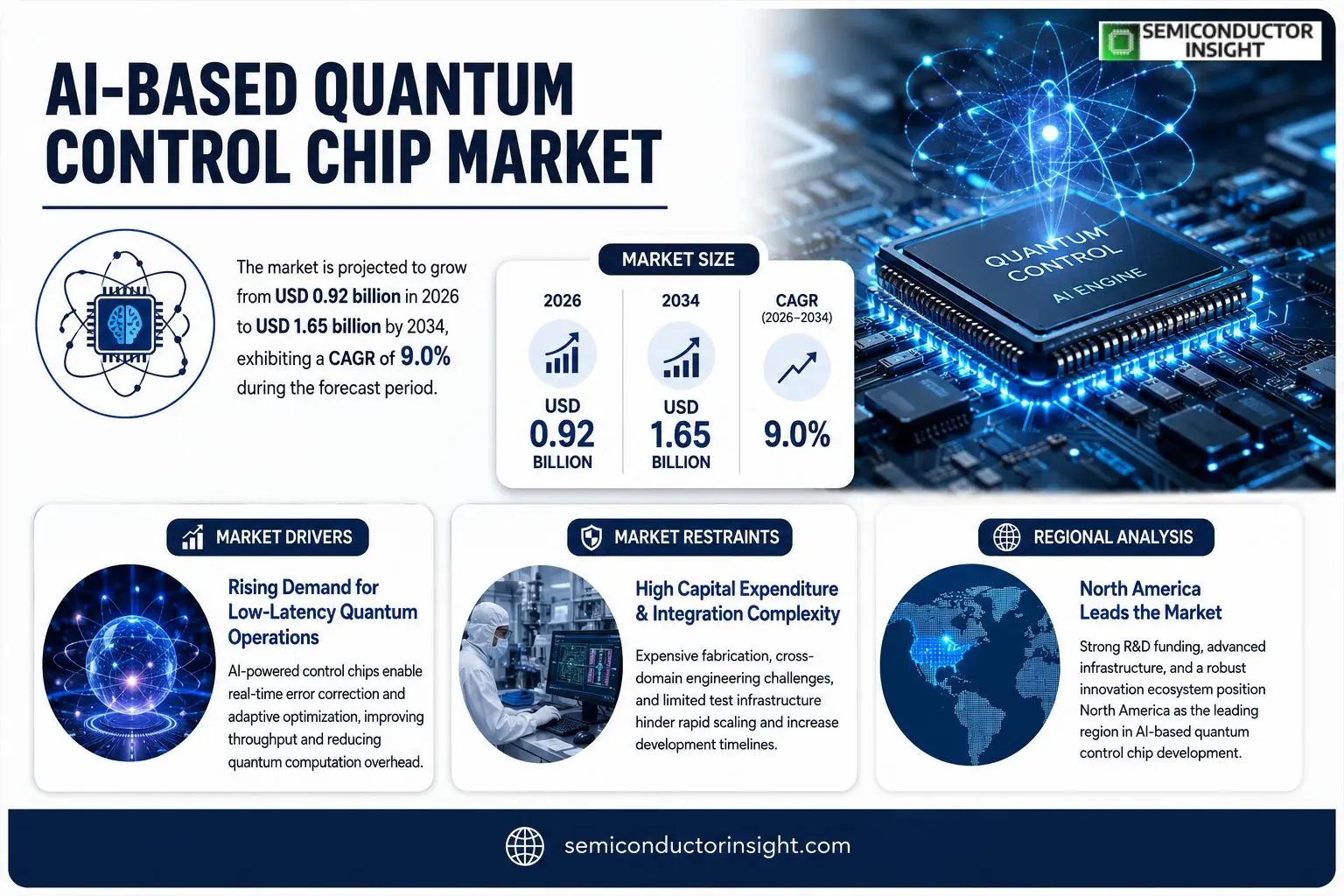
AI-Based Quantum Control Chip market size was valued at USD 0.85 billion in 2025. The market is set to increase from USD 0.92 billion in 2026 to USD 1.65 billion by 2034, reflecting a compound annual growth rate of approximately 9 % over the forecast horizon.
AI‑Based Quantum Control Chips integrate machine‑learning algorithms with quantum hardware to manage qubit states, suppress decoherence, and optimize gate operations in real time. By leveraging predictive models, these chips translate classical control signals into precise quantum actions, thereby enhancing fidelity and scaling potential of quantum processors.The expansion of this segment stems from rising investment in quantum computing platforms, heightened interest in AI‑enhanced error correction, and growing government programmes that fund next‑generation hardware research. For example, in March 2024 IBM announced a partnership with NVIDIA to embed deep‑learning inference engines directly into its latest control ASICs, while Google disclosed a prototype chip that reduces latency by 30 % through adaptive AI tuning. Companies such as Intel, Rigetti and IonQ are also expanding their portfolios with specialized control solutions.
MARKET DRIVERS
Rising Demand for Low‑Latency Quantum Operations
AI-Based Quantum Control Chip Market is gaining traction as cloud‑based quantum services require tighter integration between AI algorithms and hardware control loops. Enterprises are investing in chips that can execute adaptive error‑correction routines in real time, a capability that directly reduces computation overhead and improves throughput.
Advancements in Neuromorphic AI Architectures
Recent breakthroughs in spiking neural networks are being embedded into quantum control firmware, enabling the chip to anticipate decoherence events before they manifest. This proactive approach is shifting procurement decisions toward platforms that combine AI inference with quantum gate scheduling.
➤ Clients are willing to pay a premium for chips that blend predictive AI with quantum error mitigation, because the resulting cost‑per‑operation drops dramatically.
Manufacturers that can certify low‑power consumption while delivering sub‑nanosecond response times are securing a competitive edge, as data centers prioritize energy efficiency alongside performance.
MARKET CHALLENGES
Complexity of Cross‑Domain Integration
Bridging AI software stacks with quantum control electronics introduces a layer of engineering difficulty that many traditional semiconductor firms lack. The need for co‑design across algorithm, firmware, and hardware domains inflates development cycles and escalates talent acquisition costs.
Other Challenges
Regulatory uncertainty around quantum‑grade encryption can deter early adopters who fear future compliance burdens. Moreover, the scarcity of qualified quantum‑grade test facilities hampers rapid prototype validation.
Supply Chain Bottlenecks
Component shortages for specialized cryogenic interconnects and high‑precision DACs force manufacturers to prioritize a limited set of flagship customers, limiting broader market diffusion.
MARKET RESTRAINTS
High Capital Expenditure for Production Facilities
Establishing fabs capable of delivering the sub‑micron geometries required for quantum‑grade AI control chips demands multi‑year capital outlays. This financial barrier curtails entry of new players and keeps pricing elevated for existing solutions.
MARKET OPPORTUNITIES
Strategic Partnerships with Cloud Quantum Providers
Collaborations between chip designers and leading quantum‑as‑a‑service platforms can accelerate adoption curves. By embedding AI‑enhanced control chips directly into provider infrastructure, vendors gain access to recurring revenue streams and valuable usage data for iterative refinements.
AI-Based Quantum Control Chip Market Trends
Integration of AI with Quantum Control Hardware
AI-Based Quantum Control Chip Market is witnessing a decisive shift as manufacturers embed machine‑learning inference directly into control ASICs. IBM’s March 2024 collaboration with NVIDIA exemplifies this movement: deep‑learning engines are now co‑located with quantum control logic, enabling real‑time adjustment of drive pulses. By converting classical command streams into adaptive quantum actions, the chips reduce error accumulation and improve gate fidelity, which directly addresses the scalability bottleneck that has long constrained quantum processors.
Other Trends
AI‑Enhanced Error‑Correction Strategies
Investors are allocating capital toward error‑correction frameworks that rely on predictive analytics. Google’s prototype chip, disclosed in early 2024, demonstrates a roughly 30 % latency reduction by continuously tuning qubit control parameters through an AI feedback loop. This approach shifts error mitigation from post‑processing to the control layer, shortening the correction cycle and lowering overhead for logical qubit construction. The ripple effect is evident as firms such as Intel, Rigetti and IonQ broaden their control‑chip portfolios to include AI‑driven calibration modules, signaling a broader industry consensus that software‑defined control will become a competitive differentiator.
Government‑Backed R&D Accelerates Adoption
National programmes aimed at quantum supremacy are increasingly stipulating AI integration as a prerequisite for funding. Recent grant announcements in Europe and Asia reserve a portion of their budgets for projects that combine quantum hardware with advanced control algorithms. This policy direction creates a dual incentive: it lowers the entry barrier for startups developing niche AI‑control solutions while encouraging incumbent chip vendors to upgrade their design pipelines. The combined effect is a more collaborative ecosystem in which software, silicon and algorithmic expertise converge, promising faster time‑to‑market for next‑generation quantum systems.
COMPETITIVE LANDSCAPE
Key Industry Players
AI‑Based Quantum Control Chip Market Competitive Overview
The frontier of quantum control is now defined by a handful of hardware giants that have merged deep learning expertise with quantum ASIC design. IBM’s collaboration with NVIDIA, announced in early 2024, illustrates a strategic move to embed inferencing engines directly into control pathways, shortening the feedback loop between measurement and correction. Google’s prototype demonstrates a 30 % latency reduction through adaptive AI tuning, signalling that large‑scale cloud providers are willing to allocate substantial R&D budgets to secure a foothold in this niche. Intel has accelerated its quantum portfolio by launching a family of AI‑augmented control chips that target both superconducting and spin‑qubit platforms, leveraging its existing silicon‑manufacturing scale. Rigetti, positioning itself as a full‑stack player, integrates its own software stack with bespoke AI control ASICs, creating a vertically‑aligned offering that appeals to enterprises looking for turnkey solutions. These companies dominate the revenue stream, command the majority of patent activity, and shape the ecosystem through strategic alliances and joint ventures.Beyond the headline makers, a vibrant set of specialized firms is carving out differentiated value propositions. IonQ focuses on trapped‑ion architectures, embedding lightweight neural networks to mitigate decoherence in real time, while Quantum Motion (via partnership with Honeywell) applies reinforcement‑learning models to fine‑tune gate timings. European consortia such as QuTech and Atos are delivering open‑source AI control libraries that lower entry barriers for academic and industrial users alike. Start‑ups like Pasqal and Xanadu provide photonic‑based control solutions, emphasizing flexibility and lower hardware overhead. Alibaba’s quantum cloud unit has introduced AI‑driven error‑correction services for its silicon‑based processors, targeting the Asian market. Meanwhile, D‑Wave continues to enhance its annealing control circuitry with predictive algorithms that improve solution quality for optimization problems. Collectively, these players enrich the market with niche expertise, foster competitive pressure, and create partnership opportunities for the larger incumbents.
List of Key AI‑Based Quantum Control Chip Companies Profiled
- IBM
- NVIDIA
- Intel
- Rigetti
- IonQ
- Microsoft
- Honeywell
- Quantinuum
- D‑Wave
- Alibaba Quantum
- Xanadu
- Pasqal
- QuTech
- Atos
Segment Analysis:
| Segment Category | Sub-Segments | Key Insights |
| By Type |
|
Superconducting Qubit Control Chips
|
| By Application |
|
Quantum Computing Platforms
|
| By End User |
|
Research Institutions
|
| By Technology Stack |
|
Hybrid AI‑Quantum Firmware
|
| By Integration Model |
|
Embedded ASICs within Processors
|
Regional Analysis: AI-Based Quantum Control Chip Market
North America
Federal agencies allocate multi‑year grants that target error‑correction algorithms embedded in quantum control chips. Private labs amplify this effort by co‑funding university labs, accelerating the transition from proof‑of‑concept to silicon‑ready designs.
Export‑control frameworks for quantum‑enabled hardware encourage domestic sourcing of key materials, prompting firms to establish secure supply lines within the continent.
Graduate programs in quantum information science attract a steady stream of engineers, while cross‑disciplinary bootcamps blend AI expertise with chip‑design fundamentals, expanding the skilled labor pool.
Strategic partnerships between fabs and AI software firms reduce lead times, ensuring that novel control architectures can be fabricated without bottleneck delays.
Europe
European research consortia, anchored by the EU Quantum Flagship, are emphasizing interoperability between AI control layers and heterogeneous qubit platforms. Manufacturing clusters in Germany and the Netherlands are piloting wafer‑scale integration, which could lower unit costs for niche applications in finance and pharmaceuticals. Policy incentives that reward collaborative patents foster a climate where academic breakthroughs quickly inform commercial chip roadmaps, nudging the regional market toward a more cohesive growth trajectory.
Asia‑Pacific
In Asia‑Pacific, governments in China, Singapore, and Japan are embedding AI‑driven quantum control objectives within national semiconductor strategies. The region benefits from a high‑volume foundry base, yet faces talent scarcity in the AI‑hardware intersection. Companies are responding by launching internal up‑skilling programs and forming joint labs with overseas universities, a move that gradually bridges the expertise gap and positions the market for broader adoption across telecommunications and cloud services.
South America
South American activity centers on collaborative research between Brazil’s federal labs and private start‑ups focused on low‑temperature control chips for satellite communications. While the ecosystem remains nascent, emerging public‑private partnerships are attracting early‑stage venture capital, signalling a willingness to nurture niche use‑cases that could later feed into larger supply chains.
Middle East & Africa
The Middle East & Africa region is leveraging sovereign wealth funds to seed quantum‑control ventures, primarily in the United Arab Emirates and South Africa. Emphasis is placed on education, with scholarships targeting AI‑quantum curricula, and on creating test‑beds for defense‑related applications. Though market size is modest, the strategic focus on capability building lays groundwork for future participation in the AI‑Based Quantum Control Chip Market.
Report Scope
This market research report provides a comprehensive analysis of the AI-Based Quantum Control Chip Market , covering the forecast period 2026–2034. It offers detailed insights into market dynamics, technological advancements, competitive landscape, and key trends shaping the industry.
Key focus areas of the report include:
- Market Overview: The report begins with an overview outlining its current market scenario, key growth indicators, and industry transformation drivers. It discusses macroeconomic factors, demand–supply balance, regulatory landscape, and the strategic role of semiconductors in powering advancements across industries such as automotive, telecommunications, consumer electronics, and industrial automation.
- Market Size & Forecast: Historical data and future projections for revenue, unit shipments, and market value across major regions and segments.
- Segmentation Analysis: Detailed breakdown by product type, technology, application, and end-user industry to identify high-growth segments and investment opportunities.
- Regional Insights: Insights into market performance across North America, Europe, Asia-Pacific, Latin America, and the Middle East & Africa, including country-level analysis where relevant.
- Competitive Landscape: Profiles of leading market participants, including their product offerings, R&D focus, manufacturing capacity, pricing strategies, and recent developments such as mergers, acquisitions, and partnerships.
- Technology Trends & Innovation: Assessment of emerging technologies, integration of AI/IoT, semiconductor design trends, fabrication techniques, and evolving industry standards.
- Market Drivers & Restraints: Evaluation of factors driving market growth along with challenges, supply chain constraints, regulatory issues, and market-entry barriers.
- Stakeholder Insights: Insights for component suppliers, OEMs, system integrators, investors, and policymakers regarding the evolving ecosystem and strategic opportunities.
Primary and secondary research methods are employed, including interviews with industry experts, data from verified sources, and real-time market intelligence to ensure the accuracy and reliability of the insights presented.
FREQUENTLY ASKED QUESTIONS:
What is the current market size of AI-Based Quantum Control Chip Market?
-> AI-Based Quantum Control Chip Market was valued at USD 0.85 billion in 2025 and is expected to reach USD 1.65 billion by 2034.
Which key companies operate in AI-Based Quantum Control Chip Market?
-> Key players include IBM, NVIDIA, Google, Intel, Rigetti, IonQ, among others.
What are the key growth drivers?
-> Key growth drivers include increasing investment in quantum computing platforms, AI‑enhanced error correction research, and government funding programs for next‑generation hardware.
Which region dominates the market?
-> North America currently leads the market, while Asia‑Pacific shows rapid growth potential.
What are the emerging trends?
-> Emerging trends include AI‑driven adaptive control, integration of deep‑learning inference engines into ASICs, and latency‑reduction prototypes.
Get Sample Report PDF for Exclusive Insights
Report Sample Includes
- Table of Contents
- List of Tables & Figures
- Charts, Research Methodology, and more...
 Download Sample Report PDF


