AI Automotive Zonal Controller Gateway Processor Market Insights
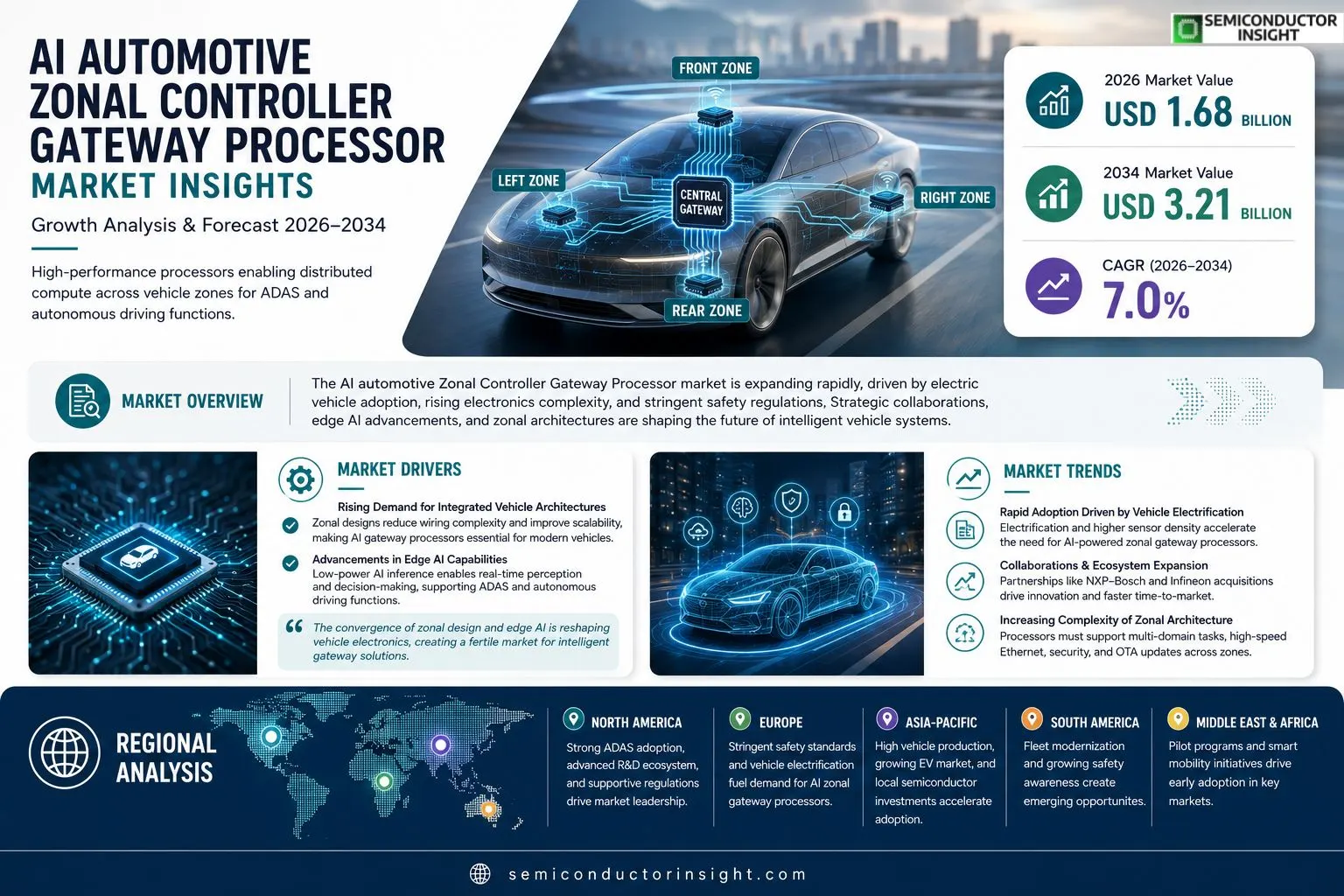
AI automotive Zonal Controller Gateway Processor market size was valued at USD 1.52 billion in 2025. The market is projected to grow from USD 1.68 billion in 2026 to USD 3.21 billion by 2034, exhibiting a CAGR of 7.0% during the forecast period.
AI automotive Zonal Controller Gateway Processors are high‑performance semiconductor solutions that enable distributed computing across vehicle zones, integrating sensor fusion, control algorithms, and communication interfaces for advanced driver‑assistance systems (ADAS) and autonomous driving functions.The market is experiencing rapid growth due to rising adoption of electric vehicles, increasing complexity of vehicle electronics, and regulatory pressure for safety standards. Furthermore, collaborations such as NXP’s partnership with Bosch on next‑gen gateway architectures and Infineon’s acquisition of a leading automotive processor firm are accelerating innovation. Key players including NXP Semiconductors, Renesas Electronics, Texas Instruments, and STMicroelectronics are expanding their portfolios to meet demand.
MARKET DRIVERS
Rising Demand for Integrated Vehicle Architectures
Automakers are accelerating the shift toward zonal architectures to reduce wiring complexity and improve scalability. AI‑enabled gateway processors play a pivotal role by consolidating compute, storage, and networking functions within each vehicle zone, thereby lowering weight and cost. This structural shift is a primary catalyst for growth in AI Automotive Zonal Controller Gateway Processor Market.
Advancements in Edge AI Capabilities
Recent breakthroughs in low‑power AI inference engines enable real‑time perception and decision‑making at the vehicle edge. These capabilities support advanced driver‑assistance systems (ADAS) and emerging autonomous functions, driving OEMs to adopt sophisticated gateway processors that can host AI models locally.
➤ “The convergence of zonal design and edge AI is reshaping vehicle electronics, creating a fertile market for intelligent gateway solutions.”
Regulatory pressures for higher safety standards and emissions efficiency further compel manufacturers to integrate smarter, more reliable processors, reinforcing the upward trajectory of AI Automotive Zonal Controller Gateway Processor Market.
MARKET CHALLENGES
Complexity of Software Integration
Implementing AI models across multiple zones requires harmonized software stacks and robust validation processes. The intricacy of aligning firmware, middleware, and application layers raises development costs and extends time‑to‑market for new vehicle platforms.
Other Challenges
Supply Chain Constraints
Semiconductor shortages and the reliance on specialized automotive‑grade components can delay production schedules, limiting the pace at which manufacturers can deploy next‑generation gateway processors.
MARKET RESTRAINTS
High Initial Capital Expenditure
Developing and qualifying AI‑driven zonal controllers demand substantial upfront investment in R&D, testing infrastructure, and safety certification, which can deter smaller suppliers and emerging market entrants.
Stringent Automotive Safety Standards
Compliance with functional safety standards such as ISO 26262 adds layers of verification and documentation, extending development cycles and increasing overall project costs.
MARKET OPPORTUNITIES
Growth in Electrified and Autonomous Vehicle Segments
The rapid expansion of electric and Level‑3/4 autonomous vehicles creates a demand for high‑performance, low‑latency processing nodes. AI Automotive Zonal Controller Gateway Processor Market participants can capture market share by offering solutions optimized for power‑efficient AI workloads in these emerging vehicle classes.
Expansion into After‑market Upgrades
After‑market retrofits that add advanced driver assistance features present a lucrative growth avenue. Modular gateway processors designed for easy integration enable OEMs and Tier‑1 suppliers to tap into this segment without redesigning entire vehicle platforms.
AI Automotive Zonal Controller Gateway Processor Market Trends
Rapid Adoption Driven by Vehicle Electrification
AI Automotive Zonal Controller Gateway Processor Market is witnessing accelerated adoption as vehicle manufacturers transition to electric powertrains. Distributed processing across vehicle zones reduces wiring complexity and supports the higher sensor density required for advanced driver‑assistance systems. This architectural shift enables more efficient power management, which aligns with stricter emissions regulations and consumer demand for longer range. As a result, OEMs are integrating gateway processors early in the design stage, creating a ripple effect that pushes semiconductor suppliers to prioritize low‑latency, high‑reliability solutions tailored for electric platforms.
Other Trends
Collaborations and Ecosystem Expansion
Strategic partnerships are reshaping the competitive landscape. Notable collaborations such as the alliance between NXP and Bosch focus on next‑generation gateway architectures that combine sensor fusion with secure communication protocols. In parallel, Infineon’s recent acquisition of a specialized automotive processor firm expands its portfolio and accelerates time‑to‑market for integrated solutions. These joint efforts provide developers with reference designs and software stacks, lowering entry barriers for new entrants while reinforcing the market’s overall innovation velocity.
Increasing Complexity of Zonal Architecture
Vehicle electronics are becoming increasingly fragmented as manufacturers adopt zone‑based designs to meet safety and performance targets. This fragmentation demands processors that can handle multiple real‑time tasks, support high‑speed automotive Ethernet, and ensure deterministic behavior across isolated domains. Consequently, suppliers are embedding enhanced security features and over‑the‑air update capabilities directly into the gateway processor silicon. The trend toward higher integration reduces bill‑of‑materials costs and simplifies validation processes, positioning AI Automotive Zonal Controller Gateway Processor Market as a critical enabler for future autonomous driving functionalities.
COMPETITIVE LANDSCAPE
Key Industry Players
AI Automotive Zonal Controller Gateway Processor Market Overview
AI Automotive Zonal Controller Gateway Processor Market is anchored by a few dominant semiconductor manufacturers that leverage deep expertise in automotive safety, sensor fusion, and high‑speed communication. NXP Semiconductors leads the segment with its Zonar™ gateway portfolio, reinforced by a strategic partnership with Bosch that accelerates next‑generation zonal architectures. Texas Instruments and STMicroelectronics follow closely, extending their analog‑mixed‑signal and microcontroller families to address the growing demand for distributed processing in electric vehicles. These firms benefit from sizable R&D budgets, automotive customer bases, and the ability to meet stringent functional safety standards, positioning them as the primary drivers of market growth.Beyond the market leaders, a diverse set of niche players contributes critical innovation and competitive pressure. Renesas Electronics focuses on low‑power automotive MCUs that integrate AI inference engines for zone‑level control. Infineon Technologies, after acquiring a leading automotive processor specialist, expands its power‑efficient gateway solutions. Qualcomm and MediaTek bring mobile‑grade AI accelerators to the automotive space, while NVIDIA and Intel (Mobileye) emphasize high‑performance compute for advanced ADAS functions. Additional contributors such as Samsung Electronics, AMD, ON Semiconductor, Microchip Technology, Bosch, and Continental diversify the ecosystem with specialized sensor‑fusion IP, automotive‑grade safety IP, and system‑level integration services.
List of Key AI Automotive Zonal Controller Gateway Processor Companies Profiled
- NXP Semiconductors
- Renesas Electronics
- Texas Instruments
- STMicroelectronics
- Infineon Technologies
- Qualcomm
- MediaTek
- Samsung Electronics
- AMD
- NVIDIA
- Intel (Mobileye)
- ON Semiconductor
- Microchip Technology
- Bosch
- Continental
Segment Analysis:
| Segment Category | Sub-Segments | Key Insights |
| By Type |
|
Microcontroller‑based solutions are favored for their integration ease and proven reliability.
|
| By Application |
|
Advanced Driver‑Assistance Systems (ADAS) drive the most intensive processing requirements.
|
| By End User |
|
Original Equipment Manufacturers (OEMs) shape the market direction through platform decisions.
|
| By Architecture |
|
Zonal (distributed) architecture is emerging as the preferred model for next‑generation vehicles.
|
| By Functional Tier |
|
Safety‑critical tier commands the highest assurance requirements.
|
Regional Analysis: AI Automotive Zonal Controller Gateway Processor Market
North America
The convergence of AI algorithms with zonal controller designs fuels demand for powerful gateway processors. OEMs seek to consolidate functions, reduce weight, and meet stringent safety standards, all of which drive adoption across passenger and commercial vehicles.
U.S. safety regulations encourage higher levels of vehicle automation, prompting manufacturers to embed AI‑capable processors that can meet real‑time decision requirements while complying with cybersecurity mandates.
Edge‑AI inference and low‑power design techniques are rapidly maturing, allowing gateway processors to handle sensor fusion, predictive maintenance, and OTA updates without compromising vehicle efficiency.
Tier‑1 suppliers and leading semiconductor firms are forging strategic alliances, creating a diversified portfolio of AI‑enabled gateway solutions that cater to both luxury and mass‑market segments.
Europe
European automakers are leveraging stringent emissions standards and a strong emphasis on vehicle electrification to push AI zonal controllers into mainstream production. The region’s focus on functional safety, guided by ISO 26262, encourages the integration of fault‑tolerant gateway processors that can support advanced driver‑assist functions. Collaborative initiatives such as the European Automotive Powertrain Partnership foster joint development of AI‑centric silicon, ensuring that European supply chains remain competitive. Although the market is fragmented, the presence of innovative startups specializing in AI inference accelerates the adoption of zonal architectures across both premium and mid‑range brands.
Asia‑Pacific
Asia‑Pacific exhibits rapid growth due to large-scale vehicle manufacturing and aggressive government incentives for autonomous driving research. Countries like China, Japan, and South Korea are investing heavily in AI chip design, enabling domestic OEMs to embed sophisticated gateway processors without relying on external sources. The region’s cost‑driven market dynamics push suppliers to balance performance with affordability, leading to a proliferation of scalable AI solutions. Additionally, emerging markets within Southeast Asia are beginning to adopt advanced vehicle platforms, further expanding the addressable market for AI automotive zonal controller technologies.
South America
In South America, market expansion is closely tied to the gradual modernization of vehicle fleets and increasing consumer demand for safety features. While overall penetration of AI zonal controllers remains modest, regional automotive clusters in Brazil and Argentina are establishing partnerships with semiconductor firms to pilot AI‑enabled gateway processors. Regulatory developments are beginning to address cybersecurity and functional safety, creating a more conducive environment for advanced controller adoption in the near term.
Middle East & Africa
The Middle East & Africa region is characterized by a nascent but promising outlook for AI automotive technologies. Wealthier markets such as the United Arab Emirates are positioning themselves as testbeds for autonomous vehicle pilots, prompting early interest in zonal controller gateway processors. In Africa, growing urbanization and rising vehicle ownership rates drive demand for cost‑effective safety solutions, encouraging local distributors to explore AI‑enhanced processors that can be retrofitted into existing platforms. Collaborative initiatives with European and Asian OEMs are expected to accelerate technology transfer and market readiness.
Report Scope
This market research report provides a comprehensive analysis of the AI Automotive Zonal Controller Gateway Processor Market , covering the forecast period 2026–2034. It offers detailed insights into market dynamics, technological advancements, competitive landscape, and key trends shaping the industry.
Key focus areas of the report include:
- Market Overview: The report begins with an overview outlining its current market scenario, key growth indicators, and industry transformation drivers. It discusses macroeconomic factors, demand–supply balance, regulatory landscape, and the strategic role of semiconductors in powering advancements across industries such as automotive, telecommunications, consumer electronics, and industrial automation.
- Market Size & Forecast: Historical data and future projections for revenue, unit shipments, and market value across major regions and segments.
- Segmentation Analysis: Detailed breakdown by product type, technology, application, and end-user industry to identify high-growth segments and investment opportunities.
- Regional Insights: Insights into market performance across North America, Europe, Asia-Pacific, Latin America, and the Middle East & Africa, including country-level analysis where relevant.
- Competitive Landscape: Profiles of leading market participants, including their product offerings, R&D focus, manufacturing capacity, pricing strategies, and recent developments such as mergers, acquisitions, and partnerships.
- Technology Trends & Innovation: Assessment of emerging technologies, integration of AI/IoT, semiconductor design trends, fabrication techniques, and evolving industry standards.
- Market Drivers & Restraints: Evaluation of factors driving market growth along with challenges, supply chain constraints, regulatory issues, and market-entry barriers.
- Stakeholder Insights: Insights for component suppliers, OEMs, system integrators, investors, and policymakers regarding the evolving ecosystem and strategic opportunities.
Primary and secondary research methods are employed, including interviews with industry experts, data from verified sources, and real-time market intelligence to ensure the accuracy and reliability of the insights presented.
FREQUENTLY ASKED QUESTIONS:
What is the current market size of AI Automotive Zonal Controller Gateway Processor Market?
-> AI Automotive Zonal Controller Gateway Processor Market was valued at USD 1.52 billion in 2025 and is expected to reach USD 3.21 billion by 2034.
Which key companies operate in AI Automotive Zonal Controller Gateway Processor Market?
-> Key players include NXP Semiconductors, Renesas Electronics, Texas Instruments, and STMicroelectronics, among others.
What are the key growth drivers?
-> Key growth drivers include rising adoption of electric vehicles, increasing complexity of vehicle electronics, regulatory pressure for safety standards, and strategic collaborations such as NXP’s partnership with Bosch and Infineon’s recent acquisition.
Which region dominates the market?
-> The reference material does not specify a single dominant region for this market.
What are the emerging trends?
-> Emerging trends include next‑generation gateway architectures, integration of AI‑driven sensor fusion for ADAS and autonomous driving, and intensified collaboration between semiconductor firms and automotive OEMs.

Get Sample Report PDF for Exclusive Insights
Report Sample Includes
- Table of Contents
- List of Tables & Figures
- Charts, Research Methodology, and more...
 Download Sample Report PDF