AI-Assisted RTL Synthesis Market Insights
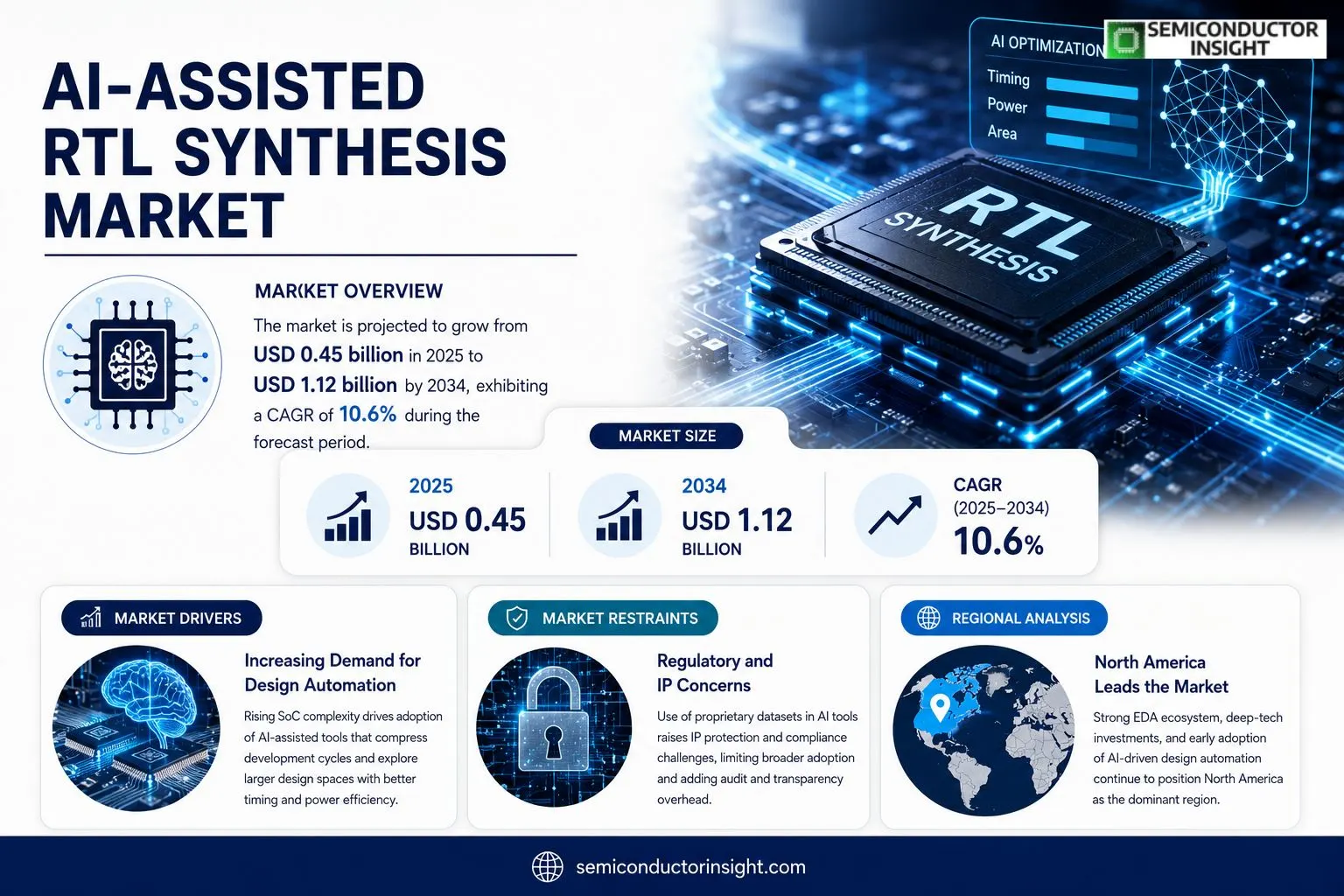
AI-Assisted RTL Synthesis market size was valued at USD 0.45 billion in 2025. The market is projected to grow from USD 0.45 billion in 2025 to USD 1.12 billion by 2034, exhibiting a CAGR of 10.6% during the forecast period.
AI‑assisted RTL synthesis employs advanced machine‑learning models to translate high‑level hardware description languages into register‑transfer level representations that are already optimized for timing, power and area constraints, thereby shortening verification loops and reducing manual engineering effort.The expansion reflects heightened pressure on semiconductor companies to shorten time‑to‑market while managing escalating design complexity.
Adoption accelerates because leading EDA vendors such as Synopsys, Cadence and Siemens Mentor are embedding generative‑AI modules into their toolchains, and several silicon startups have reported up to a 30 % reduction in cycle time when using these assistants.Furthermore, increased capital allocation toward AI‑enabled design automation across North America and Europe fuels investment in proprietary datasets and cloud‑based inference services.A notable collaboration emerged in March 2024 when a major foundry partnered with an AI startup to co‑develop a predictive placement engine integrated directly into the RTL synthesis flow.
MARKET DRIVERS
Increasing Demand for Design Automation
The rising intricacy of system‑on‑chip architectures pushes design teams toward tools that can compress development cycles. AI‑Assisted RTL Synthesis offers the ability to explore larger design spaces while preserving timing closure, a capability that traditional rule‑based flows struggle to provide. This efficiency gain directly translates into shorter time‑to‑market for semiconductor manufacturers.
Maturation of Machine Learning Algorithms
Advances in deep‑learning techniques, particularly transformer‑based models, have reached a level of maturity that makes them reliable for interpreting RTL patterns. As these algorithms become more data‑efficient, vendors can integrate them into synthesis engines without prohibitive training costs, thereby unlocking higher quality of results across a broader range of designs.
➤ “The shift toward AI‑driven synthesis is reshaping how designers balance performance and power, creating a competitive edge for early adopters.”
When combined, the pressure to accelerate design turnover and the availability of robust AI models form a compelling incentive for semiconductor firms to invest in the AI‑Assisted RTL Synthesis Marke Companies that embed these capabilities now position themselves to capture a larger share of upcoming high‑performance product launches.
MARKET CHALLENGES
Technical Integration Barriers
Embedding AI modules into existing synthesis toolchains often requires extensive code refactoring. Legacy environments, which rely on deterministic heuristics, clash with probabilistic AI outputs, forcing verification teams to redesign test benches and validation scripts.
Other Challenges
Skill Gap
Design engineers accustomed to manual RTL optimization must acquire competencies in AI model interpretation. The learning curve slows adoption rates, especially in organizations where training budgets are constrained.
MARKET RESTRAINTS
Regulatory and IP Concerns
AI‑driven synthesis tools often rely on large datasets that contain proprietary design snippets. Companies are cautious about exposing such intellectual property to cloud‑based AI services, which can impede broader deployment.Compliance with emerging standards for AI transparency adds another layer of procedural overhead. Firms must document model decisions to satisfy audit requirements, a step that extends development timelines.Furthermore, the lack of unified guidelines for AI validation in hardware design creates uncertainty around liability, prompting some customers to delay full‑scale adoption.
MARKET OPPORTUNITIES
Emerging Edge Computing Applications
The expansion of edge devices demands ultra‑low‑power ASICs that can be realized quickly. AI‑Assisted RTL synthesis shortens the path from concept to silicon, making it an attractive solution for startups targeting niche edge markets.Strategic partnerships between AI startup innovators and established EDA vendors are opening new revenue streams. Joint offerings that bundle AI capabilities with proven synthesis suites provide customers with a turnkey experience.Finally, the growing interest in custom AI accelerators within data‑center and automotive sectors presents a fertile ground for specialized synthesis engines. Tailoring AI models to specific accelerator architectures could unlock differentiated performance that rivals traditional design methods.
AI-Assisted RTL Synthesis Market Trends
Accelerated Design Closure in AI-Assisted RTL Synthesis Market
Leading semiconductor firms are feeling mounting pressure to compress design cycles as transistor counts climb and product road‑maps tighten. The infusion of generative‑AI modules into RTL synthesis tools is reshaping how engineers address timing, power and area constraints. By automating portions of the translation from high‑level hardware description languages to register‑transfer level representations, design teams are trimming verification loops and shifting labour from repetitive coding to higher‑value architectural decisions. Early adopters have reported up to a 30 % reduction in overall cycle time, a gain that translates directly into earlier silicon tape‑out and a more competitive positioning in fast‑moving markets.
Other Trends
AI‑Enhanced Placement and Timing Optimization
Beyond the synthesis front‑end, AI techniques are being layered onto placement engines to predict congestion hotspots before routing begins. This pre‑emptive insight allows the synthesis flow to adjust register allocations proactively, mitigating downstream timing violations. Cloud‑based inference services supplied by major EDA vendors are now offering on‑demand models that incorporate proprietary foundry data, enabling designers to exploit site‑specific nuances without extensive manual tuning. The result is a more deterministic path from RTL to physical implementation, which reduces costly redesign iterations.
Strategic Partnerships Fueling Toolchain Integration
Collaboration between foundries and AI startups has accelerated the embedding of predictive placement engines directly within RTL synthesis suites. A notable partnership announced in March 2024 linked a leading foundry with an emerging AI company to co‑develop a placement module that feeds real‑time feedback to the synthesis optimizer. This joint effort exemplifies a broader shift: capital is flowing toward AI‑enabled design automation across North America and Europe, prompting the creation of shared datasets and joint‑venture cloud platforms. For customers, the convergence of synthesis and placement under a unified AI‑driven workflow promises not only speed but also consistency across design stages, reshaping budgeting and staffing models for future projects.
COMPETITIVE LANDSCAPEKey Industry Players
AI‑Assisted RTL Synthesis: Competitive Overview
Synopsys continues to dominate the AI‑enhanced synthesis arena, largely because its flagship Design Compiler now embeds a generative‑AI module that automates timing closure while preserving area efficiency. This capability has turned the product into a de‑facto platform for large‑scale ASIC projects, prompting many design houses to standardize on Synopsys’ flow. Cadence and Siemens EDA (formerly Mentor) follow closely, each leveraging their extensive EDA portfolios to layer machine‑learning inference on top of traditional synthesis kernels. Their market share reflects a consolidation around vendors that can deliver end‑to‑end automation, from front‑end RTL creation through back‑end place‑and‑route, while preserving the trust of established semiconductor OEMs. The presence of these three powerhouses creates a tiered competitive structure in which incumbents protect their ecosystems through strategic licensing, while also courting AI‑focused startups for niche enhancements.Beyond the three giants, a cohort of specialized firms is shaping the periphery of the market. Start‑ups such as DeepSilicon and AIChip have introduced proprietary datasets that train synthesis models on industry‑specific design patterns, delivering measurable cycle‑time reductions for niche applications like automotive SoCs. Ansys has entered the space by integrating physics‑aware AI modules that predict power hotspots early in the RTL stage, a feature that appeals to high‑performance computing designers. Meanwhile, cloud providers including Amazon Web Services and Google Cloud are offering on‑demand inference engines that enable smaller design teams to tap into AI‑accelerated synthesis without hefty upfront capital. This mosaic of participants intensifies pressure on incumbents to innovate rapidly and suggests a future where collaborative ecosystems, rather than outright dominance, define success.
List of Key AI‑Assisted RTL Synthesis Companies Profiled
- Synopsys
- Cadence Design Systems
- Siemens EDA (Mentor)
- Ansys
- Keysight Technologies
- DeepSilicon
- AIChip
- Astera Labs
- Zhaoxin
- Alibaba Cloud
- Amazon Web Services
- Google Cloud
- IBM
- Intel
- Qualcomm
Segment Analysis:
| Segment Category | Sub-Segments | Key Insights |
| By Type |
|
Neural‑Optimized RTL Synthesis is emerging as the dominant approach because it leverages deep‑learning models trained on extensive silicon datasets; it delivers synthesis flows that anticipate timing bottlenecks early. Key observations include: • Designers experience a smoother transition from high‑level description to RTL with fewer manual tweaks. • The AI engine continuously refines constraints, enabling faster convergence on optimal power‑area trade‑offs. |
| By Application |
|
High‑Performance Computing drives adoption as organizations seek to compress design cycles for data‑center accelerators. Notable insights: • AI‑assisted synthesis aligns micro‑architectural intent with low‑latency constraints, reducing iterative re‑synthesis. • The technology facilitates rapid exploration of alternative pipeline structures, which is critical in competitive HPC markets. |
| By End User |
|
Semiconductor Design Houses are the primary beneficiaries, leveraging AI assistance to streamline complex chip projects. Key points: • Design teams report markedly fewer manual edits, freeing talent for higher‑level architectural work. • The collaborative AI layer integrates with existing EDA suites, allowing seamless insertion into established workflows. |
| By Design Phase |
|
Mid‑Flow Optimization emerges as the most influential segment because it bridges high‑level intent and physical implementation. Observations include: • AI models suggest micro‑architectural refinements that pre‑empt timing violations. • The approach reduces back‑and‑forth between synthesis and place‑and‑route tools, accelerating overall project timelines. |
| By Integration Mode |
|
Cloud‑Based AI Services are gaining traction as they offer scalable compute resources without requiring heavy on‑site infrastructure. Key insights: • Designers can tap into continuously updated AI models, ensuring access to the latest optimization techniques. • Subscription‑driven models lower entry barriers for smaller firms, expanding the overall ecosystem. |
Regional Analysis: AI-Assisted RTL Synthesis Market
North America
The integration of transformer‑based models for netlist optimisation has become a hallmark of recent product releases. Companies are experimenting with hybrid architectures that combine rule‑based heuristics with learned patterns, delivering faster convergence on timing targets. This blend reduces the reliance on manual tuning, allowing design teams to allocate more effort to architectural exploration.
Universities in the United States and Canada now offer specialised curricula that marry VLSI design with machine‑learning engineering. Graduates emerge with fluency in both HDL coding and model training, feeding a pipeline of engineers who can bridge the cultural divide between traditional EDA and AI startups.
Emerging guidelines from the Semiconductor Industry Association stress encryption of design‑level data used to train AI engines. Vendors that embed secure model‑training workflows are positioning themselves as trusted partners, mitigating concerns over inadvertent leakage of proprietary netlist information.
Leading chip makers report that AI‑enabled synthesis tools have shortened their time‑to‑tape‑out by several weeks, translating into earlier market entry. This performance uplift is prompting a shift from perpetual licensing to subscription models tied to realized design savings.
Europe
European design houses are leveraging the continent’s strong emphasis on standards compliance to embed AI modules that respect timing and power budgets defined by the International Electronics Standards. Collaboration between EDA vendors and research institutes in Germany and the UK yields bespoke AI solutions that cater to automotive and aerospace safety‑critical designs. The market here is characterised by a cautious adoption curve; firms first pilot AI‑assisted RTL synthesis on non‑mission‑critical blocks before scaling across full chip projects. This measured rollout helps organisations balance innovation with the stringent certification regimes that dominate the European semiconductor landscape.
Asia-Pacific
In the Asia‑Pacific corridor, rapid expansion of fab capacity fuels a demand for tools that can keep pace with aggressive design cycles. Companies are gravitating toward AI‑enabled synthesis platforms that promise higher utilisation of silicon area, a priority for manufacturers targeting cost‑sensitive consumer electronics. Local EDA firms are forging joint ventures with AI specialists, creating hybrid solutions that reflect regional design practices while borrowing advanced model architectures. The competitive pressure drives a shift toward outcome‑oriented pricing, where design houses evaluate suppliers based on the tangible reduction in iteration loops rather than feature checklists.
South America
South American semiconductor activities remain anchored by niche markets such as IoT devices for agritech. Here, AI‑assisted RTL synthesis is viewed as a lever to offset limited access to high‑end design talent. Early adopters are integrating cloud‑based AI inference services that allow smaller teams to tap into sophisticated optimisation without heavy on‑premise infrastructure. The strategic implication is a democratisation of advanced design capabilities, enabling regional players to compete on functional differentiation rather than sheer scale.
Middle East & Africa
The Middle East & Africa region is witnessing nascent interest in AI‑driven design automation, spurred by government‑backed initiatives to diversify economies into high‑tech manufacturing. Pilot programs in United Arab Emirates tech parks have introduced AI‑enhanced synthesis tools to accelerate the development of smart‑city hardware. While the ecosystem is still emerging, the focus on knowledge transfer and local talent development signals a long‑term commitment to building a self‑sustaining design capability that could eventually feed into supply chains.
Report Scope
This market research report provides a comprehensive analysis of the AI-Assisted RTL Synthesis Market , covering the forecast period 2026–2034. It offers detailed insights into market dynamics, technological advancements, competitive landscape, and key trends shaping the industry.
Key focus areas of the report include:
- Market Overview: The report begins with an overview outlining its current market scenario, key growth indicators, and industry transformation drivers. It discusses macroeconomic factors, demand–supply balance, regulatory landscape, and the strategic role of semiconductors in powering advancements across industries such as automotive, telecommunications, consumer electronics, and industrial automation.
- Market Size & Forecast: Historical data and future projections for revenue, unit shipments, and market value across major regions and segments.
- Segmentation Analysis: Detailed breakdown by product type, technology, application, and end-user industry to identify high-growth segments and investment opportunities.
- Regional Insights: Insights into market performance across North America, Europe, Asia-Pacific, Latin America, and the Middle East & Africa, including country-level analysis where relevant.
- Competitive Landscape: Profiles of leading market participants, including their product offerings, R&D focus, manufacturing capacity, pricing strategies, and recent developments such as mergers, acquisitions, and partnerships.
- Technology Trends & Innovation: Assessment of emerging technologies, integration of AI/IoT, semiconductor design trends, fabrication techniques, and evolving industry standards.
- Market Drivers & Restraints: Evaluation of factors driving market growth along with challenges, supply chain constraints, regulatory issues, and market-entry barriers.
- Stakeholder Insights: Insights for component suppliers, OEMs, system integrators, investors, and policymakers regarding the evolving ecosystem and strategic opportunities.
Primary and secondary research methods are employed, including interviews with industry experts, data from verified sources, and real-time market intelligence to ensure the accuracy and reliability of the insights presented.
FREQUENTLY ASKED QUESTIONS:
What is the current market size of AI-Assisted RTL Synthesis Market?
-> AI-Assisted RTL Synthesis Market was valued at USD 0.45 billion in 2025 and is expected to reach USD 1.12 billion by 2034, exhibiting a CAGR of 10.6%.
Which key companies operate in AI-Assisted RTL Synthesis Market?
-> Key players include Synopsys, Cadence Design Systems, Siemens Mentor (Siemens EDA), and emerging AI‑focused silicon startups, among others.
What are the key growth drivers?
-> Key growth drivers include the need to shorten time‑to‑market, increasing semiconductor design complexity, rising capital allocation toward AI‑enabled automation, and the integration of generative‑AI modules by major EDA vendors.
Which region dominates the market?
-> North America leads the market, while Europe remains a significant contributor.
What are the emerging trends?
-> Emerging trends include generative‑AI assisted RTL synthesis, AI‑driven placement engines, cloud‑based inference services, and AI‑enhanced verification loops.
Get Sample Report PDF for Exclusive Insights
Report Sample Includes
- Table of Contents
- List of Tables & Figures
- Charts, Research Methodology, and more...
 Download Sample Report PDF