AI-Assisted Chiplet Ecosystem Compliance Verification Market Insights
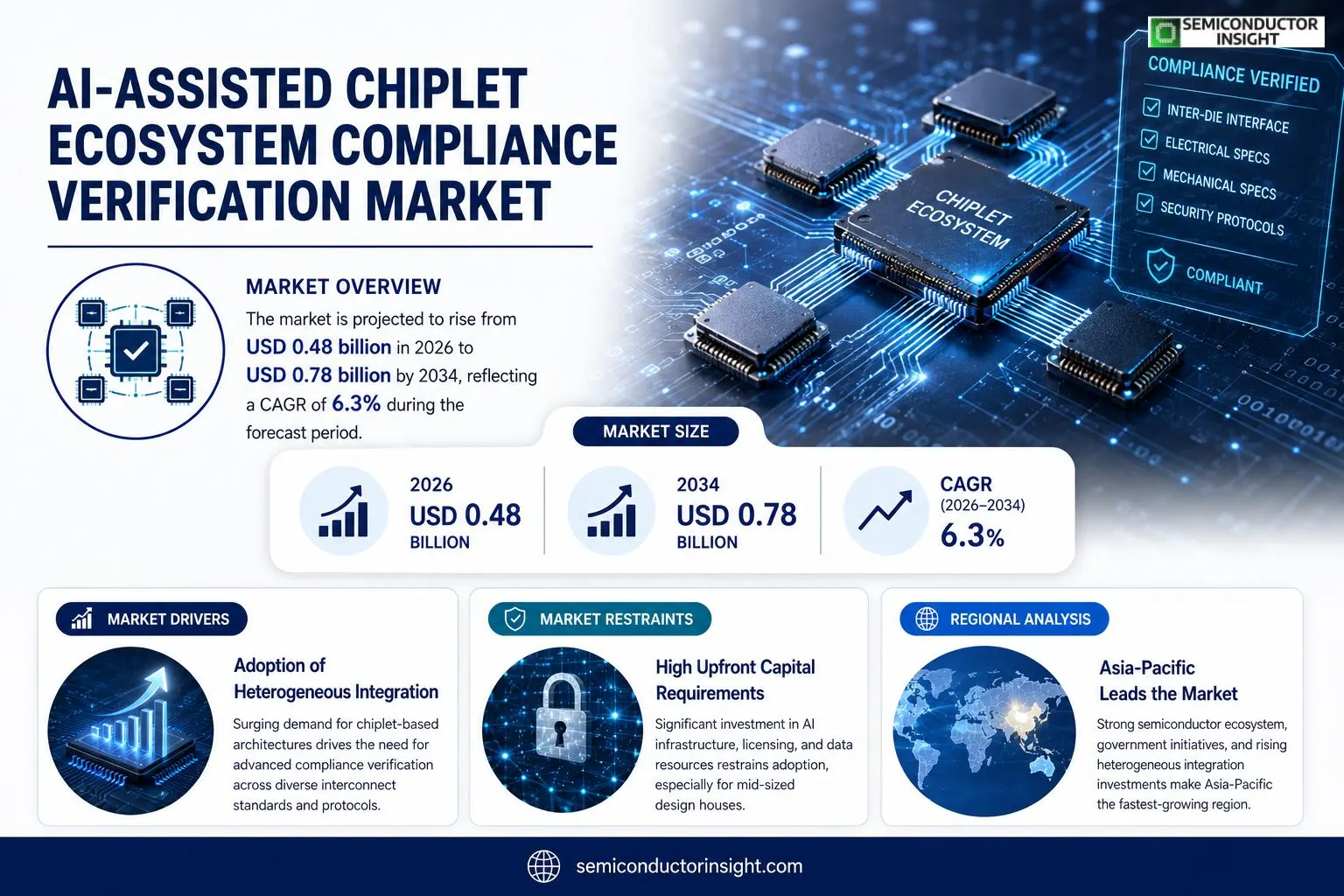
AI-Assisted Chiplet Ecosystem Compliance Verification market size was valued at USD 0.45 billion in 2025. The market will rise from USD 0.48 billion in 2026 to USD 0.78 billion by 2034, reflecting a compound annual growth rate of 6.3% during the forecast period.
AI‑assisted chiplet ecosystem compliance verification comprises automated validation of inter‑die interfaces, electrical‑mechanical specifications, and security protocols across heterogeneous building blocks assembled into advanced system‑in‑package solutions. By leveraging machine‑learning models trained on design rule databases, these tools accelerate detection of mismatches between vendor‑specific IP and industry standards such as OIF OpenFX and IEEE P802.The expansion stems from heightened investment in heterogeneous integration, stricter safety certifications for automotive and aerospace applications, and the emergence of AI‑enhanced EDA suites from major vendors like Cadence and Synopsys that streamline conformance checks across multiple process nodes. Moreover, collaborative initiatives among semiconductor consortia are establishing unified test methodologies, which encourage adop
MARKET DRIVERS
Adoption of Heterogeneous Integration
Manufacturers are shifting toward heterogeneous integration to overcome the physical limits of monolithic die scaling. By combining multiple specialized chiplets on a common substrate, they achieve higher performance density while controlling power budgets. This structural move creates a pressing need for verification tools that can assure compliance across disparate interconnect standards.
AI‑Enabled Verification Workflow
Artificial‑intelligence algorithms now process design rule checks at speeds unattainable by traditional scripts, extracting pattern anomalies from large datasets of prior silicon failures. The reduction in validation cycle timeoften by 30‑40 %allows firms to launch products ahead of rival roadmaps, a strategic advantage that fuels investment in AI‑driven compliance platforms.
➤ Design teams that integrate AI‑based verification report up to 25 % fewer post‑tapeout fixes, translating into measurable cost avoidance.
Consequently, AI-Assisted Chiplet Ecosystem Compliance Verification Market experiences heightened acquisition interest from both silicon foundries and EDA vendors, as the ecosystem matures and the financial upside becomes evident.
MARKET CHALLENGES
Fragmented Standards Landscape
Despite concerted efforts by industry consortia, the chiplet domain still contends with divergent interface definitions (e.g., OIF, CXL, and proprietary protocols). Verification solutions must map each variant, inflating tool complexity and raising the barrier to entry for smaller design houses.
Other Challenges
Talent Shortage
The convergence of AI expertise and deep semiconductor knowledge is scarce. Companies struggle to recruit engineers capable of fine‑tuning machine‑learning models for compliance checks, which slows product rollout and escalates development costs.
MARKET RESTRAINTS
High Upfront Capital Requirements
Deploying AI‑centric verification platforms demands substantial investment in GPU clusters, data‑labeling infrastructure, and licensing fees. For mid‑size chip designers, the initial outlay can outweigh projected efficiency gains, prompting a cautious adoption pace.
Regulatory Ambiguity
Emerging data‑privacy regulations affect how design telemetry can be harvested for model training. Unclear guidance creates legal risk, compelling firms to limit the scope of AI data ingestion and thereby restraining the market’s expansion.These financial and compliance pressures temper the velocity at which AI-Assisted Chiplet Ecosystem Compliance Verification Market can achieve broader penetration.
MARKET OPPORTUNITIES
Cloud‑Based Verification Services
Offering AI verification as a subscription on cloud platforms democratizes access for startups and regional design houses. The pay‑as‑you‑go model mitigates capital constraints, while centralized data pools improve model robustness across diverse chiplet architectures.
Integration with Security Assurance
Combining compliance checks with hardware‑security validation opens a new revenue stream. As supply‑chain attacks become more sophisticated, customers seek integrated suites that certify both functional correctness and tamper‑resistance, positioning AI‑assisted tools as a strategic differentiator.By capitalizing on these service‑oriented and security‑focused avenues, players can capture a larger share of the evolving AI-Assisted Chiplet Ecosystem Compliance Verification Market, translating technical advantage into sustainable growth.
AI-Assisted Chiplet Ecosystem Compliance Verification Market Trends
Accelerating Automated Interface Validation
The surge in heterogeneous integration projects is compelling design teams to adopt more rigorous validation workflows. By embedding machine‑learning models that reference established design‑rule repositories, verification tools now pinpoint mismatches between vendor‑specific IP blocks and industry specifications such as OIF OpenFX or IEEE P802 within minutes rather than weeks. This speed gain translates directly into shorter tape‑out cycles, which is especially valuable for automotive and aerospace suppliers facing intense certification timelines. Within AI-Assisted Chiplet Ecosystem Compliance Verification Market, the shift toward fully automated interface checks reflects a broader industry move to treat validation as a continuous, data‑driven process rather than a downstream checkpoint.
Other Trends
AI‑Driven Security Protocol Audits
Security considerations have migrated from peripheral concerns to core design criteria as chiplet‑based modules proliferate in edge‑compute devices. Modern compliance suites now incorporate deep‑learning classifiers that scan communication stacks for deviations from encrypted handshake standards and undisclosed back‑door vectors. Early adopters report that these audits reduce the probability of field‑level failures by identifying subtle timing‑side‑channel vulnerabilities that traditional static analysis overlooks. Consequently, system‑level architects are integrating security verification earlier in the design flow, aligning risk mitigation with performance optimization.
Standardization via Consortia Initiatives
Collaborative bodies across the semiconductor ecosystem are drafting unified test methodologies that simplify cross‑vendor compliance. By converging on a common set of metric definitions and benchmark suites, these initiatives lower the friction associated with mixing IP from multiple sources. The resulting interoperability framework not only eases supplier negotiations but also encourages smaller design houses to enter markets that previously required extensive in‑house validation infrastructure. Major EDA providers are responding by embedding the consensus standards directly into their toolchains, ensuring that design teams can run a single, standards‑compliant verification pass regardless of the underlying process node.
COMPETITIVE LANDSCAPE
Key Industry Players
AI‑Assisted Chiplet Compliance Verification: Competitive Overview
Cadence Design Systems and Synopsys Inc. dominate the verification segment by embedding machine‑learning engines directly into their flagship EDA platforms. Cadence’s “Chiplet Compliance Suite” leverages historic rule sets from OIF OpenFX and IEEE P802 to auto‑generate error reports, reducing manual sign‑off time for automotive‑grade designs. Synopsys counters with a tightly integrated AI layer in its “Verification Composer,” which cross‑references vendor IP libraries against emerging security specifications. Both firms benefit from deep relationships with silicon foundries and large system‑integrator customers, allowing them to lock in recurring revenue through subscription‑based licensing. Their financial strength also funds continuous model training, keeping the tools ahead of evolving standards.Beyond the duopoly, a cluster of niche innovators is reshaping the ecosystem. Arm Ltd. and SiFive provide IP‑centric compliance modules that speak the same language as heterogeneous integration stacks, positioning themselves as preferred partners for fabless startups. Imec and IBM Research contribute open‑source verification kernels that accelerate early‑stage testing in academic and government projects. Qualcomm Technologies, Intel Corporation, and Foundries have launched specialized validation services targeting high‑performance compute and automotive safety domains. Meanwhile, Efabless, ANSYS, Inc., and Altium Limited supply cloud‑hosted verification environments that lower entry barriers for small‑scale designers. This diversified field injects competitive pressure, encouraging the market leaders to broaden their AI capabilities and improve pricing elasticity.
List of Key Chiplet Verification Companies Profiled
- Cadence Design Systems
- Synopsys Inc.
- Mentor, a Siemens Business
- Arm Ltd.
- SiFive Inc.
- Imec
- IBM Research
- Qualcomm Technologies
- Intel Corporation
- Foundries
- Efabless Inc.
- ANSYS, Inc.
- Altium Limited
- TSMC
- AMD (Xilinx)
Segment Analysis:
| Segment Category | Sub-Segments | Key Insights |
| By Type |
|
IP‑Level Verification
|
| By Application |
|
Automotive Safety Systems
|
| By End User |
|
Semiconductor Foundries
|
| By Verification Technique |
|
Machine Learning Models
|
| By Compliance Standard |
|
OpenFX Interface Standards
|
Regional Analysis: AI-Assisted Chiplet Ecosystem Compliance Verification Market
North America
The U.S. Federal Trade Commission and the Semiconductor Industry Association have jointly issued guidance that clarifies liability for non‑compliant chiplet assemblies, prompting vendors to embed verification logic early in design cycles. This regulatory clarity reduces uncertainty for multinational projects and accelerates cross‑border collaborations.
Enterprises are shifting from manual rule‑sets toward adaptive AI frameworks that learn from each silicon iteration. The trend is especially evident in high‑performance computing firms that need to validate heterogeneous integration without sacrificing design agility.
Universities in the Midwest and West Coast now offer interdisciplinary programs that blend chip architecture with data‑science, feeding the market with engineers capable of designing both hardware and its verification algorithms.
Major foundries have begun to expose compliance‑ready APIs to design houses, allowing AI‑driven checks to be performed as part of the wafer‑fabrication handoff, which streamlines the end‑to‑end delivery timeline.
Europe
European chip consortia are leveraging public‑private partnerships to fund sandbox environments where AI‑based verification tools can be trialed against emerging chiplet standards. The emphasis on sustainability forces manufacturers to demonstrate not only functional compliance but also energy‑efficiency metrics, prompting a broader definition of verification. German automation firms are partnering with French AI start‑ups to embed predictive compliance checks into the early stages of system‑on‑chip design, a move that could reshape supplier contracts across the continent. The cumulative effect is a gradual migration from legacy validation suites toward intelligent platforms that can respond to the continent’s stringent data‑privacy regulations while maintaining design velocity.
Asia‑Pacific
In the Asia‑Pacific corridor, rapid industrialization and government incentives for advanced packaging have created a fertile breeding ground for chiplet verification services. Chinese semiconductor parks are establishing dedicated AI labs that focus on anomaly detection within heterogeneous integration workflows. Meanwhile, Japanese firms are prioritizing precision in compliance reporting, aligning AI outputs with their tradition of meticulous quality control. The region’s diversityranging from mature markets in Japan and South Korea to fast‑growing ecosystems in India and Southeast Asiagenerates a spectrum of adoption rates, yet the common thread is a strategic push to embed verification intelligence early to avoid costly re‑spins in a highly competitive export environment.
South America
South American manufacturers are still consolidating their chiplet capabilities, but a nascent cohort of AI‑focused tech hubs in Brazil and Chile is beginning to address compliance challenges specific to low‑cost, high‑volume applications. Local telecom operators, seeking to upgrade network infrastructure, are pressuring suppliers to certify interoperability across heterogeneous modules, an area where AI‑assisted verification can deliver measurable risk mitigation. The region’s regulatory approach focuses on harmonizing standards with North American and European frameworks, encouraging cross‑regional collaborations that introduce sophisticated compliance tools without overwhelming domestic firms.
Middle East & Africa
The Middle East & Africa market is characterized by targeted investments in semiconductor research centers, particularly in the United Arab Emirates and South Africa. These centers are experimenting with AI models that can simulate compliance scenarios before physical prototyping, a practice that aligns with the region’s broader agenda of reducing capital outlays. Partnerships with European verification vendors are facilitating knowledge transfer, enabling local engineers to adopt AI‑driven compliance workflows adapted to the region’s specific standards for aerospace and defense applications. Although adoption remains in early phases, the strategic emphasis on building a self‑sufficient chip ecosystem suggests a steady rise in AI‑assisted verification activities over the next decade.
Report Scope
This market research report provides a comprehensive analysis of the AI-Assisted Chiplet Ecosystem Compliance Verification Market , covering the forecast period 2026–2034. It offers detailed insights into market dynamics, technological advancements, competitive landscape, and key trends shaping the industry.
Key focus areas of the report include:
- Market Overview: The report begins with an overview outlining its current market scenario, key growth indicators, and industry transformation drivers. It discusses macroeconomic factors, demand–supply balance, regulatory landscape, and the strategic role of semiconductors in powering advancements across industries such as automotive, telecommunications, consumer electronics, and industrial automation.
- Market Size & Forecast: Historical data and future projections for revenue, unit shipments, and market value across major regions and segments.
- Segmentation Analysis: Detailed breakdown by product type, technology, application, and end-user industry to identify high-growth segments and investment opportunities.
- Regional Insights: Insights into market performance across North America, Europe, Asia-Pacific, Latin America, and the Middle East & Africa, including country-level analysis where relevant.
- Competitive Landscape: Profiles of leading market participants, including their product offerings, R&D focus, manufacturing capacity, pricing strategies, and recent developments such as mergers, acquisitions, and partnerships.
- Technology Trends & Innovation: Assessment of emerging technologies, integration of AI/IoT, semiconductor design trends, fabrication techniques, and evolving industry standards.
- Market Drivers & Restraints: Evaluation of factors driving market growth along with challenges, supply chain constraints, regulatory issues, and market-entry barriers.
- Stakeholder Insights: Insights for component suppliers, OEMs, system integrators, investors, and policymakers regarding the evolving ecosystem and strategic opportunities.
Primary and secondary research methods are employed, including interviews with industry experts, data from verified sources, and real-time market intelligence to ensure the accuracy and reliability of the insights presented.
FREQUENTLY ASKED QUESTIONS:
What is the current market size of AI-Assisted Chiplet Ecosystem Compliance Verification Market?
-> AI-Assisted Chiplet Ecosystem Compliance Verification Market was valued at USD 0.45 billion in 2025 and is expected to reach USD 0.78 billion by 2034.
Which key companies operate in AI-Assisted Chiplet Ecosystem Compliance Verification Market?
-> Key players include Cadence Design Systems, Synopsys, Siemens EDA (formerly Mentor), ANSYS, and Intel, among others.
What are the key growth drivers?
-> Key growth drivers include increased investment in heterogeneous integration, tighter safety certifications for automotive and aerospace, and the rise of AI‑enhanced EDA suites that accelerate compliance checks.
Which region dominates the market?
-> Asia-Pacific is the fastest‑growing region, while Europe remains a strong and dominant market.
What are the emerging trends?
-> Emerging trends include AI‑augmented verification workflows, unified test methodologies driven by semiconductor consortia, and expanding standards such as OIF OpenFX and IEEE P802.

Get Sample Report PDF for Exclusive Insights
Report Sample Includes
- Table of Contents
- List of Tables & Figures
- Charts, Research Methodology, and more...
 Download Sample Report PDF