AI AIB (Advanced Interface Bus) Chiplet PHY Market Insights
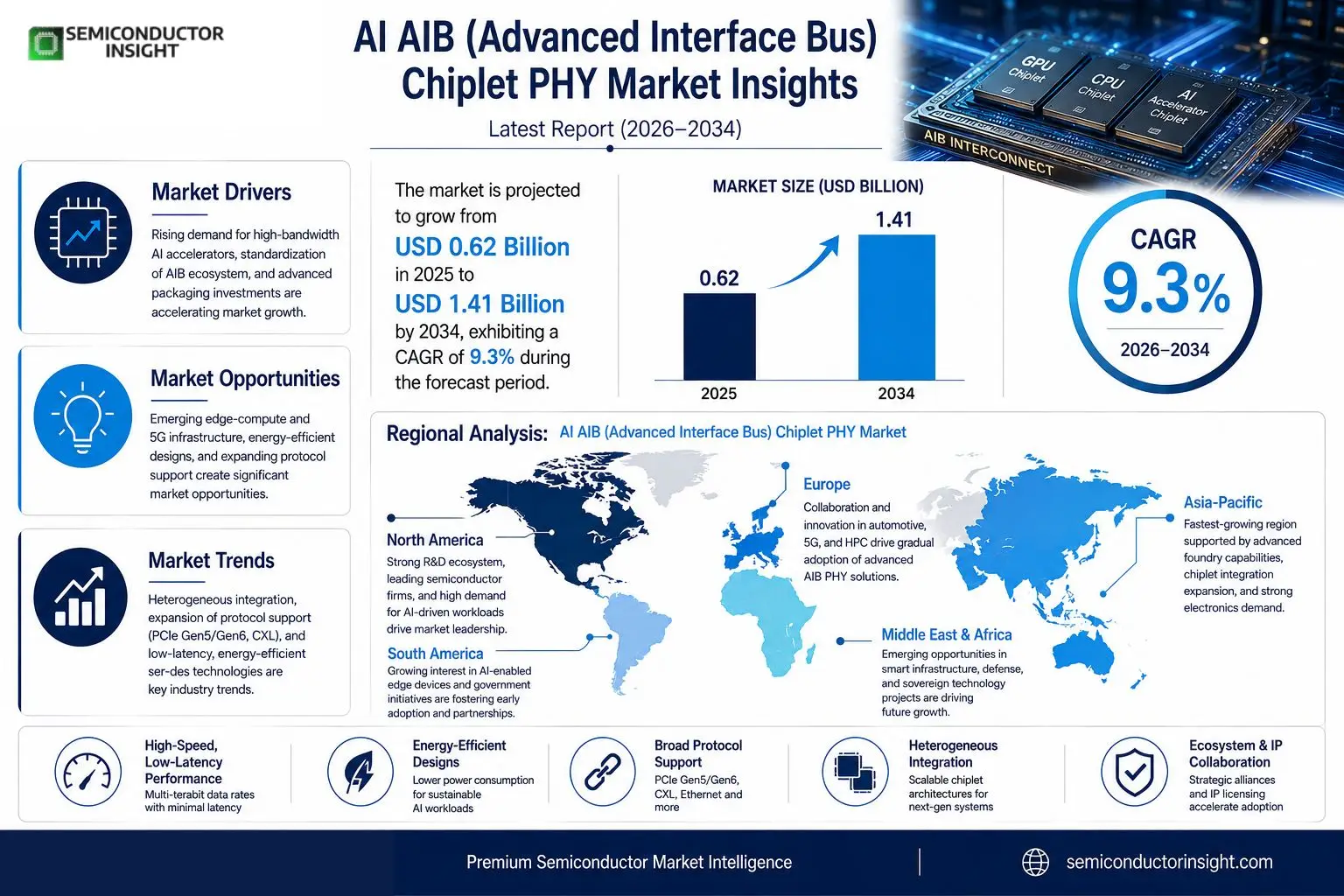
AI AIB (Advanced Interface Bus) Chiplet PHY market size was valued at USD 0.62 billion in 2025. The market is projected to grow from USD 0.68 billion in 2026 to USD 1.41 billion by 2034, exhibiting a CAGR of 9.3% during the forecast period.
AI AIB Chiplet PHYs are high‑speed physical interface modules that enable seamless communication between heterogeneous chiplets within a package or across interposer substrates. They support protocols such as PCIe Gen5/Gen6, CXL, and Ethernet while providing low‑latency ser‑des conversion, clock‑data recovery, and adaptive equalization required for next‑generation compute accelerators.The market is experiencing rapid growth because semiconductor manufacturers are accelerating heterogeneous integration strategies to meet escalating demand for AI inference and HPC workloads. Furthermore, rising investments in advanced packaging foundries and the push for energy‑efficient data‑center architectures are driving adoption of AI AIB solutions. Key players such as Intel, AMD, Samsung Electronics, TSMC and Broadcom are expanding their product portfolios through strategic alliances and IP licensing agreements, which further fuels market expansion.
MARKET DRIVERS
Rising Demand for High‑Bandwidth AI Accelerators
AI AIB (Advanced Interface Bus) Chiplet PHY Market is being propelled by an unprecedented surge in AI‑driven workloads that require multi‑terabit‑per‑second interconnects. Data‑center operators are scaling out heterogeneous compute nodes, and the need for a low‑latency, energy‑efficient interface bus has become a decisive factor in system architecture decisions.
Standardization and Ecosystem Maturity
Recent consensus on AIB specifications has reduced design risk, enabling silicon vendors to adopt a common PHY layer across diverse chiplet portfolios. This harmonization shortens time‑to‑market and encourages broader IP reuse, which in turn stimulates demand for compliant PHY solutions.
➤ “The convergence of AI workload growth and a unified AIB standard creates a virtuous cycle that accelerates market adoption.”
In addition, leading foundries are expanding capacity for advanced nodes optimized for chiplet integration, providing the manufacturing scalability that supports the projected double‑digit CAGR of the AI AIB Chiplet PHY segment.
MARKET CHALLENGES
Integration Complexity and Validation
Designing a seamless interface between heterogeneous chiplets demands rigorous signal‑integrity analysis and extensive co‑simulation. The lack of mature CAD plugins for AIB‑specific timing closure can extend development cycles, particularly for first‑time‑up designers.
Other Challenges
Design Validation Overheads
Ensuring compliance with the AIB protocol across multiple process corners often requires redundant test structures, inflating silicon cost and verification time.
MARKET RESTRAINTS
Cost Sensitivity in Emerging Chiplet Deployments
While performance advantages are clear, many OEMs remain cautious about the incremental bill‑of‑materials associated with high‑speed PHY IP. Price‑elastic segments, such as consumer electronics, may delay adoption until the cost curve of AIB PHYs aligns with volume‑driven pricing expectations.
MARKET OPPORTUNITIES
Emerging Edge‑Compute and 5G Infrastructure
The rollout of edge‑centric AI inference and the densification of 5G antenna arrays present a fertile landscape for AI AIB (Advanced Interface Bus) Chiplet PHY Market. These applications demand compact, power‑efficient interconnects that can scale bandwidth without imposing prohibitive thermal budgets, positioning AIB PHYs as a strategic enabler for next‑generation edge platforms.
AI AIB (Advanced Interface Bus) Chiplet PHY Market Trends
Heterogeneous Integration Accelerates Demand
AI AIB (Advanced Interface Bus) Chiplet PHY Market is being reshaped by a surge in heterogeneous integration strategies adopted by leading semiconductor manufacturers. Designers are increasingly combining CPU, GPU, accelerator, and memory chiplets within a single package to meet the bandwidth and latency requirements of AI inference and high‑performance computing workloads. This shift reduces die size, shortens time‑to‑market, and enables modular upgrades, creating a strong incentive for adopting advanced interface bus solutions that can sustain multi‑terabit per second data rates while preserving power efficiency.
Other Trends
Energy‑Efficient Data‑Center Architectures
Data‑center operators are prioritizing energy‑conscious designs to curb operational expenditures. AI AIB (Advanced Interface Bus) Chiplet PHYs provide low‑latency ser‑des conversion and adaptive equalization, which together lower the power envelope of inter‑chip communication. By integrating these PHY modules, vendors can achieve higher compute density per watt, a critical metric as AI workloads dominate server utilization. The trend is reinforced by investment in advanced packaging foundries that support fine‑pitch interposers and wafer‑level chiplet assembly.
Broadening Protocol Support Strengthens Ecosystem
Another decisive trend is the expansion of supported protocols. Early AI AIB implementations focused on PCIe Gen5, but recent releases now accommodate PCIe Gen6, Compute Express Link (CXL), and high‑speed Ethernet interfaces. This broader compatibility enables seamless interoperability across diverse accelerator families and simplifies system‑level validation for OEMs. The convergence of protocol support also encourages collaborative licensing models among key players such as Intel, AMD, Samsung Electronics, TSMC, and Broadcom, accelerating the diffusion of standardized AI AIB (Advanced Interface Bus) Chiplet PHY solutions across the supply chain.
COMPETITIVE LANDSCAPE
Key Industry Players
AI AIB Chiplet PHY Market Competitive Landscape
AI AIB (Advanced Interface Bus) Chiplet PHY Market is anchored by a handful of vertically integrated semiconductor giants that control both design IP and high‑volume manufacturing. Intel leads the segment with its Xe‑on processor‑centric chiplet ecosystems, leveraging in‑house silicon photonics and proprietary CXL/IP licensing to offer end‑to‑end AIB solutions for hyperscale data centers. AMD complements Intel’s position through its acquisition of Xilinx, expanding the portfolio of PCIe Gen5/Gen6 and CXL compliant PHY blocks that target heterogeneous compute modules. Samsung Electronics and TSMC dominate the foundry side, providing advanced packaging nodes (2 nm class) and interposer technologies that enable the ultra‑low latency ser‑des required for AI inference accelerators. Broadcom’s extensive portfolio of high‑speed transceivers further solidifies the oligopolistic structure, creating substantial entry barriers for new entrants while setting a clear roadmap for standards compliance and performance scaling.Beyond the tier‑one group, a vibrant set of niche players is shaping specialized market segments. Marvell Technology contributes cost‑effective PHY IP for edge AI and 5G infrastructure, while NXP Semiconductors focuses on automotive‑grade AIB modules that meet stringent reliability criteria. Qualcomm and Renesas are developing customized PHY blocks for mobile AI accelerators and industrial IoT applications respectively. Foundries and ASE Group provide advanced assembly and testing services that support low‑volume, high‑mix productions for startups and research institutions. In addition, emerging firms such as Inphi (now part of Marvell) and MediaTek are expanding their high‑speed interface portfolios, creating competitive pressure on pricing and innovation cycles across the ecosystem.
List of Key AI AIB Chiplet PHY Companies Profiled
- Intel Corporation
- Advanced Micro Devices (AMD)
- Samsung Electronics
- Taiwan Semiconductor Manufacturing Company (TSMC)
- Broadcom Inc.
- Marvell Technology Group
- ASE Group
- MediaTek Inc.
Segment Analysis:
| Segment Category | Sub-Segments | Key Insights |
| By Type |
|
Ser‑des PHY drives the core value proposition of AI AIB chiplet PHYs.
|
| By Application |
|
AI inference accelerators emerge as the leading application segment.
|
| By End User |
|
Semiconductor fabless companies dominate end‑user adoption.
|
| By Integration Strategy |
|
In‑package chiplet integration stands out as the primary growth driver.
|
| By Performance Tier |
|
Ultra‑high‑speed premium PHYs command the spotlight for cutting‑edge workloads.
|
Regional Analysis: AI AIB (Advanced Interface Bus) Chiplet PHY Market
North America
R&D pipelines in the United States emphasize heterogeneous integration, leveraging AI‑optimized AIB protocols to shrink latency and boost throughput. Collaborative consortia accelerate standard‑setting, enabling rapid prototype cycles and cross‑vendor compatibility.
Near‑shoring of wafer fabrication and diversified fab partnerships reduce lead‑time volatility, ensuring a steady flow of advanced chiplet PHY components to OEMs and system integrators.
Federal agencies maintain clear guidelines for high‑speed interface compliance, allowing designers to focus on performance enhancements without extensive legal overhead.
Data‑center providers and automotive Tier‑1s prioritize AI‑ready PHYs, rewarding vendors that can deliver scalable bandwidth while meeting power‑efficiency targets.
Europe
European manufacturers are capitalising on strong academic‑industry collaborations to embed AI AIB (Advanced Interface Bus) Chiplet PHY technology into emerging 5G and automotive platforms. While regulatory environments are thorough, they provide clarity that encourages long‑term investment. Regional alliances, particularly in Germany and the Nordic countries, focus on energy‑efficient designs, aligning with sustainability goals and creating a niche for low‑power PHY solutions. Market participants note a gradual shift from legacy interconnects toward AI‑enabled interfaces as system‑level designers seek higher data rates for edge computing workloads.
Asia‑Pacific
The Asia‑Pacific region exhibits rapid uptake driven by expansive mobile and consumer electronics markets. Countries such as South Korea, Japan, and Taiwan host leading foundries that are beginning to offer AI AIB (Advanced Interface Bus) Chiplet PHY services to customers. Competitive pricing and high‑volume production capacity attract OEMs seeking cost‑effective pathways to integrate AI‑centric interconnects. However, fragmented standards adoption and varying intellectual‑property approaches introduce complexity, prompting regional players to form consortiums that harmonise specifications and accelerate market acceptance.
South America
In South America, market growth is anchored by increasing demand for AI‑enabled edge devices in sectors like agriculture and mining. Local integrators are exploring AI AIB (Advanced Interface Bus) Chiplet PHY solutions to improve sensor data aggregation and real‑time analytics. While investment levels remain modest compared to mature markets, government incentives for high‑tech manufacturing and partnerships with North American firms are fostering a nascent ecosystem that could mature as regional supply chains become more robust.
Middle East & Africa
The Middle East & Africa region is at an early stage of adoption, with interest primarily centered on intelligent infrastructure and defense applications. Strategic initiatives in the United Arab Emirates and Saudi Arabia aim to build local design capabilities for AI AIB (Advanced Interface Bus) Chiplet PHYs, leveraging partnerships with established vendors. Although the market size is limited, the focus on sovereign technology development and emerging smart‑city projects provides a foothold for future expansion as expertise and funding increase.
Report Scope
This market research report provides a comprehensive analysis of the AI AIB (Advanced Interface Bus) Chiplet PHY Market , covering the forecast period 2026–2034. It offers detailed insights into market dynamics, technological advancements, competitive landscape, and key trends shaping the industry.
Key focus areas of the report include:
- Market Overview: The report begins with an overview outlining its current market scenario, key growth indicators, and industry transformation drivers. It discusses macroeconomic factors, demand–supply balance, regulatory landscape, and the strategic role of semiconductors in powering advancements across industries such as automotive, telecommunications, consumer electronics, and industrial automation.
- Market Size & Forecast: Historical data and future projections for revenue, unit shipments, and market value across major regions and segments.
- Segmentation Analysis: Detailed breakdown by product type, technology, application, and end-user industry to identify high-growth segments and investment opportunities.
- Regional Insights: Insights into market performance across North America, Europe, Asia-Pacific, Latin America, and the Middle East & Africa, including country-level analysis where relevant.
- Competitive Landscape: Profiles of leading market participants, including their product offerings, R&D focus, manufacturing capacity, pricing strategies, and recent developments such as mergers, acquisitions, and partnerships.
- Technology Trends & Innovation: Assessment of emerging technologies, integration of AI/IoT, semiconductor design trends, fabrication techniques, and evolving industry standards.
- Market Drivers & Restraints: Evaluation of factors driving market growth along with challenges, supply chain constraints, regulatory issues, and market-entry barriers.
- Stakeholder Insights: Insights for component suppliers, OEMs, system integrators, investors, and policymakers regarding the evolving ecosystem and strategic opportunities.
Primary and secondary research methods are employed, including interviews with industry experts, data from verified sources, and real-time market intelligence to ensure the accuracy and reliability of the insights presented.
FREQUENTLY ASKED QUESTIONS:
What is the current market size of AI AIB (Advanced Interface Bus) Chiplet PHY Market?
-> AI AIB (Advanced Interface Bus) Chiplet PHY Market was valued at USD 0.62 billion in 2025 and is expected to reach USD 1.41 billion by 2034, exhibiting a CAGR of 9.3% during the forecast period.
Which key companies operate in AI AIB (Advanced Interface Bus) Chiplet PHY Market?
-> Key players include Intel, AMD, Samsung Electronics, TSMC, and Broadcom, among others.
What are the key growth drivers?
-> Key growth drivers include accelerated heterogeneous integration strategies, rising investments in advanced packaging foundries, and demand for energy‑efficient data‑center architectures driven by AI inference and HPC workloads.
Which region dominates the market?
-> Asia-Pacific is expected to be the fastest‑growing region, while North America remains a dominant market due to the presence of leading semiconductor firms.
What are the emerging trends?
-> Emerging trends include adoption of AI‑optimized interface protocols (PCIe Gen5/Gen6, CXL), increased IP licensing collaborations, and development of low‑latency, energy‑efficient ser‑des technologies.
Get Sample Report PDF for Exclusive Insights
Report Sample Includes
- Table of Contents
- List of Tables & Figures
- Charts, Research Methodology, and more...
 Download Sample Report PDF