Agentic AI Market Insights
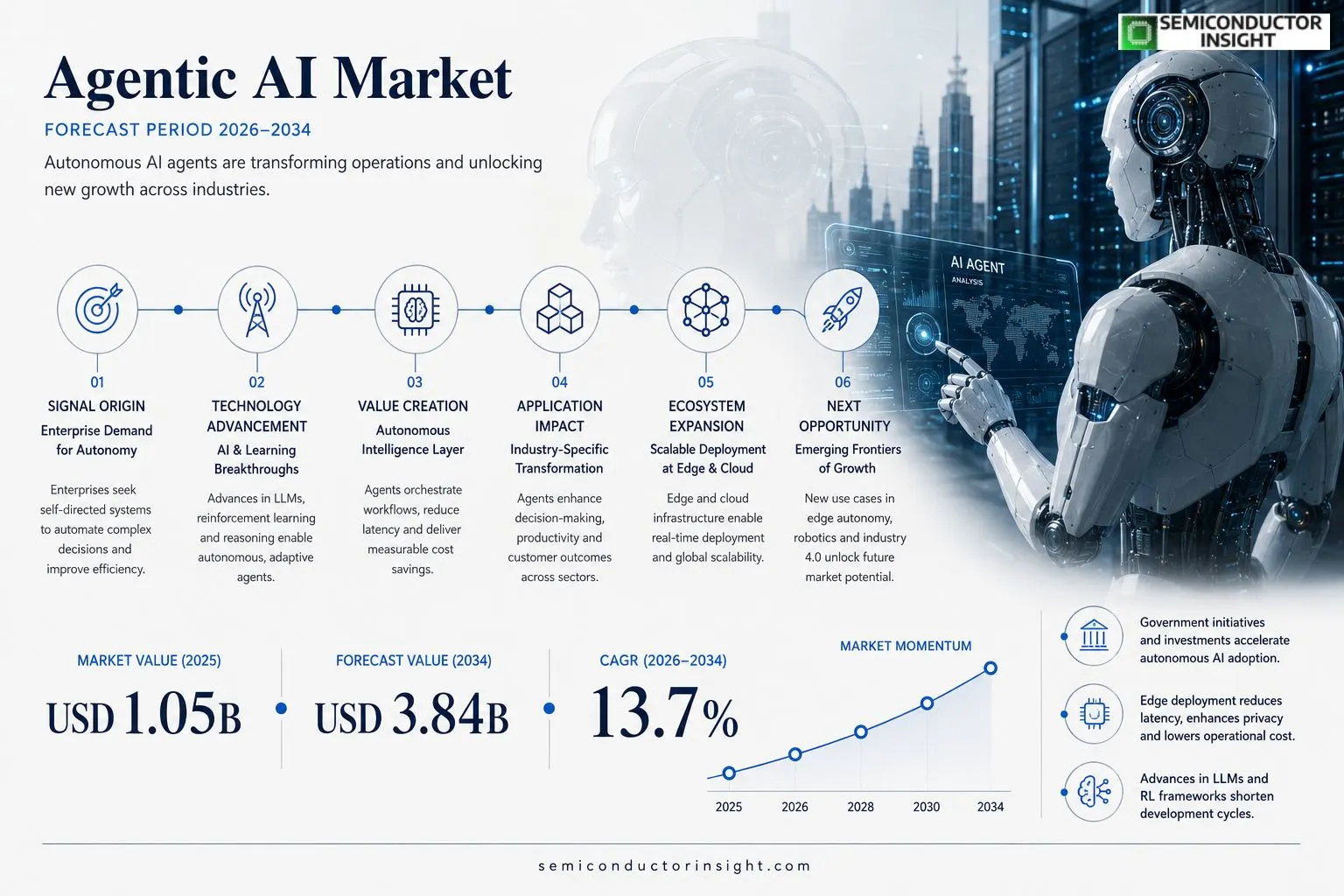
Agentic AI Market size was valued at USD 1.05 billion in 2025. The market is projected to grow from USD 1.12 billion in 2026 to USD 3.84 billion by 2034, exhibiting a CAGR of 13.7% during the forecast period.
Agentic AI refers to autonomous artificial‑intelligence systems capable of self‑directed decision‑making and goal‑oriented actions without continuous human oversight. These agents combine advanced machine‑learning models, reinforcement learning, natural‑language processing and contextual reasoning to execute complex tasks across finance, healthcare, logistics and customer‑service domains.The market is experiencing rapid growth due to several factors, including heightened investment in autonomous technologies, rising demand for scalable digital assistants and the proliferation of edge‑computing infrastructure that enables real‑time agent deployment. Furthermore, breakthroughs in large language models and reinforcement‑learning frameworks are accelerating adoption. Initiatives by key players such as OpenAI’s partnership with Microsoft for integrated agent platforms, Google DeepMind’s release of autonomous research agents and IBM’s launch of Watson Orchestrate are expected to further fuel market expansion.
MARKET DRIVERS
Technological Advancements in Autonomy
Agentic AI Market is propelled by rapid improvements in machine learning algorithms that enable systems to make independent decisions with minimal human intervention. These advancements reduce operational latency and improve real‑time responsiveness across industries such as logistics, finance, and healthcare.
Enterprise Adoption of Self‑Managing Solutions
Large enterprises are increasingly integrating agentic platforms to automate routine processes, resulting in measurable cost savings and higher workforce productivity. The shift toward self‑managing AI agents aligns with broader digital transformation initiatives and supports scalable deployment models.
➤ “Deploying autonomous agents has shortened decision cycles by up to 30 % in pilot projects, underscoring the competitive edge of early adopters.”
Regulatory frameworks are evolving to accommodate accountable AI, providing clearer pathways for commercialization and encouraging investment in Agentic AI Market. This supportive environment further accelerates market momentum.
MARKET CHALLENGES
Complexity of Integration with Legacy Systems
Implementing agentic solutions often requires extensive integration with existing IT infrastructure, which can be resource‑intensive and prone to compatibility issues. Organizations must allocate skilled personnel and adapt processes to fully leverage autonomous capabilities.
Other Challenges
Data Quality and Governance
Effective autonomous decision‑making depends on high‑quality, well‑governed data. Inconsistent data pipelines and fragmented data ownership can degrade performance and raise compliance concerns.
MARKET RESTRAINTS
Ethical and Trust Concerns
Stakeholders remain wary of delegating critical decisions to autonomous agents without transparent explainability mechanisms. Perceived risks around bias, accountability, and loss of control can slow adoption rates across regulated sectors.
MARKET OPPORTUNITIES
Emerging Use Cases in Edge Computing
Deploying agentic AI at the edge opens new avenues for real‑time analytics in manufacturing, smart cities, and autonomous vehicles. The convergence of low‑latency connectivity and on‑device intelligence creates a fertile landscape for innovative solutions that can capture untapped demand.
Agentic AI Market Trends
Growing Adoption of Autonomous Agents
Agentic AI Market is witnessing a rapid shift as enterprises seek self‑directed systems that can operate without continuous human input. Recent advancements in large language models, reinforcement learning, and contextual reasoning have enabled agents to perform complex decision‑making across finance, healthcare, logistics, and customer‑service domains. Companies are investing heavily in these capabilities to reduce operational latency and to scale digital assistance beyond rule‑based bots. The convergence of improved model accuracy and the availability of high‑performance compute resources is driving organizations to replace legacy automation with true autonomous agents that can learn, adapt, and execute goal‑oriented tasks in real time.
Other Trends
Edge Computing Enablement
Deploying agentic solutions at the edge is emerging as a critical factor for market growth. Edge infrastructure reduces the round‑trip time to centralized data centers, allowing agents to process sensor data and user inputs locally, which is essential for time‑sensitive applications such as autonomous vehicles and industrial IoT. Recent hardware releases provide on‑device GPUs and specialized AI accelerators that support inference for large models, making it feasible to run sophisticated reasoning engines at the network periphery. This architectural shift not only improves responsiveness but also enhances data privacy by keeping sensitive information on‑premise, a consideration that is increasingly influencing procurement decisions across regulated sectors.
Strategic Partnerships Accelerating Innovation
Collaboration between leading AI developers and cloud providers is accelerating the commercial rollout of agentic technologies. Notable examples include integrated agent platforms that combine advanced language models with scalable cloud services, enabling seamless deployment and management of autonomous agents for enterprises. These alliances are also fostering the creation of standardized APIs and toolkits, lowering the barrier to entry for organizations that lack in‑house expertise. By uniting cutting‑edge research with robust infrastructure, strategic partnerships are shortening development cycles and expanding the range of use cases, thereby reinforcing the overall momentum of Agentic AI Market.
COMPETITIVE LANDSCAPEKey Industry Players
Agentic AI Market – Competitive Landscape Overview
Agentic AI Market, valued at USD 1.05 billion in 2025, is being shaped by a few dominant innovators that command the majority of research funding and platform integration. OpenAI, in partnership with Microsoft, delivers large‑scale autonomous agents through Azure, leveraging GPT‑4‑based decision frameworks that are quickly becoming reference implementations for enterprise automation. Google DeepMind’s autonomous research agents and reinforcement‑learning pipelines provide open‑source benchmarks that accelerate industry adoption, while IBM’s Watson Orchestrate positions itself as an enterprise‑grade orchestration layer for multi‑agent workflows. These leaders benefit from substantial cloud infrastructure, extensive developer ecosystems, and strategic alliances that create high entry barriers for newcomers, establishing a tiered market structure where tier‑1 platforms dominate cross‑industry deployments and niche specialists compete on vertical customization.Beyond the tier‑1 cohort, a diversified set of players contributes specialized capabilities that broaden the Agentic AI ecosystem. Amazon Web Services offers Sage‑Maker agents for scalable deployment, while Meta AI focuses on socially aware agents for customer‑service contexts. NVIDIA supplies the GPU‑accelerated inference stack that underpins real‑time agent execution. Asian tech giants such as Baidu, Alibaba DAMO Academy, Huawei Cloud AI, and Tencent AI Lab are scaling autonomous agents for language‑rich markets and edge‑computing scenarios. Additional contributors include Salesforce Einstein for CRM‑centric agents, Intel AI for edge‑optimized models, Samsung Research for embedded agents, and Accenture AI for consulting‑driven integration services. Collectively, these firms enrich the market with domain‑specific solutions, driving competitive pressure that fuels innovation and expands addressable use cases across finance, healthcare, logistics, and beyond.
List of Key Agentic AI Companies Profiled
- OpenAI
- Microsoft
- Google DeepMind
- IBM Watson
- Amazon Web Services
- Meta AI
- NVIDIA
- Baidu
- Alibaba DAMO Academy
- Salesforce Einstein
- Intel AI
- Huawei Cloud AI
- Samsung Research
- Tencent AI Lab
- Accenture AI
Segment Analysis:
| Segment Category | Sub-Segments | Key Insights |
| By Type |
|
Goal‑Driven Agents
|
| By Application |
|
Customer Service Assistants
|
| By End User |
|
Enterprises
|
| By Deployment Environment |
|
Edge
|
| By Industry |
|
Technology
|
Regional Analysis: North America
United States
The financial services sector is rapidly adopting Agentic AI for tasks like fraud detection, risk management, and personalized customer interactions, contributing significantly to market growth.
Agentic AI is transforming healthcare through applications like virtual assistants for patient care, automated medical record analysis, and drug discovery, driving efficiency and improving patient outcomes.
Retail and e-commerce businesses leverage Agentic AI for personalized shopping experiences, inventory management, and automated customer support, fostering customer loyalty and operational optimization.
Manufacturing companies are utilizing Agentic AI for predictive maintenance, quality control, and supply chain optimization, enhancing productivity and reducing operational costs.
Europe
Europe presents a strong and steadily growing market for Agentic AI, with a focus on ethical AI development and data privacy compliance. Key drivers include government initiatives supporting AI innovation, a skilled talent pool, and increasing adoption across sectors like automotive, logistics, and public services. The European focus on explainable AI (XAI) and responsible AI is influencing the development and deployment of Agentic AI solutions. While the pace of adoption may be slightly slower than in the US, the long-term growth potential remains significant.
Asia-Pacific
The Asia-Pacific region, particularly China and Japan, is emerging as a high-growth market for Agentic AI. Strong government support for technological advancement, a large digital consumer base, and increasing industrial automation are propelling market expansion. The focus is on leveraging Agentic AI for smart cities, industrial IoT, and enhancing manufacturing capabilities. The region’s unique regulatory environment and cultural nuances present both opportunities and challenges for Agentic AI vendors.
South America
South America is witnessing a nascent but promising growth in Agentic AI Market. Key industries driving adoption include financial services, retail, and agriculture. The increasing availability of affordable computing power and the growing demand for automation are creating favorable conditions for Agentic AI solutions. However, challenges related to infrastructure development, data availability, and regulatory uncertainty need to be addressed for sustained market growth.
Middle East & Africa
The Middle East and Africa represent a developing market for Agentic AI, with significant potential for growth in sectors like oil & gas, healthcare, and government services. Increasing investments in digital transformation and smart infrastructure are driving demand for Agentic AI solutions. The region’s unique energy landscape and focus on technological diversification are creating opportunities for specialized Agentic AI applications.
Report Scope
This market research report provides a comprehensive analysis of the Agentic AI Market , covering the forecast period 2026–2034. It offers detailed insights into market dynamics, technological advancements, competitive landscape, and key trends shaping the industry.
Key focus areas of the report include:
- Market Overview: The report begins with an overview outlining its current market scenario, key growth indicators, and industry transformation drivers. It discusses macroeconomic factors, demand–supply balance, regulatory landscape, and the strategic role of semiconductors in powering advancements across industries such as automotive, telecommunications, consumer electronics, and industrial automation.
- Market Size & Forecast: Historical data and future projections for revenue, unit shipments, and market value across major regions and segments.
- Segmentation Analysis: Detailed breakdown by product type, technology, application, and end-user industry to identify high-growth segments and investment opportunities.
- Regional Insights: Insights into market performance across North America, Europe, Asia-Pacific, Latin America, and the Middle East & Africa, including country-level analysis where relevant.
- Competitive Landscape: Profiles of leading market participants, including their product offerings, R&D focus, manufacturing capacity, pricing strategies, and recent developments such as mergers, acquisitions, and partnerships.
- Technology Trends & Innovation: Assessment of emerging technologies, integration of AI/IoT, semiconductor design trends, fabrication techniques, and evolving industry standards.
- Market Drivers & Restraints: Evaluation of factors driving market growth along with challenges, supply chain constraints, regulatory issues, and market-entry barriers.
- Stakeholder Insights: Insights for component suppliers, OEMs, system integrators, investors, and policymakers regarding the evolving ecosystem and strategic opportunities.
Primary and secondary research methods are employed, including interviews with industry experts, data from verified sources, and real-time market intelligence to ensure the accuracy and reliability of the insights presented.
FREQUENTLY ASKED QUESTIONS:
What is the current market size of Agentic AI Market?
-> Agentic AI Market was valued at USD 1.05 billion in 2025 and is expected to reach USD 3.84 billion by 2034.
Which key companies operate in Agentic AI Market?
-> Key players include Axalta Coating Systems, AkzoNobel, BASF SE, PPG, Sherwin-Williams, and 3M, among others.
What are the key growth drivers?
-> Key growth drivers include railway infrastructure investments, urbanization, and demand for durable coatings.
Which region dominates the market?
-> Asia-Pacific is the fastest-growing region, while Europe remains a dominant market.
What are the emerging trends?
-> Emerging trends include bio-based coatings, smart coatings, and sustainable rail solutions.

Get Sample Report PDF for Exclusive Insights
Report Sample Includes
- Table of Contents
- List of Tables & Figures
- Charts, Research Methodology, and more...