
Aerial Common Sensor Market Insights
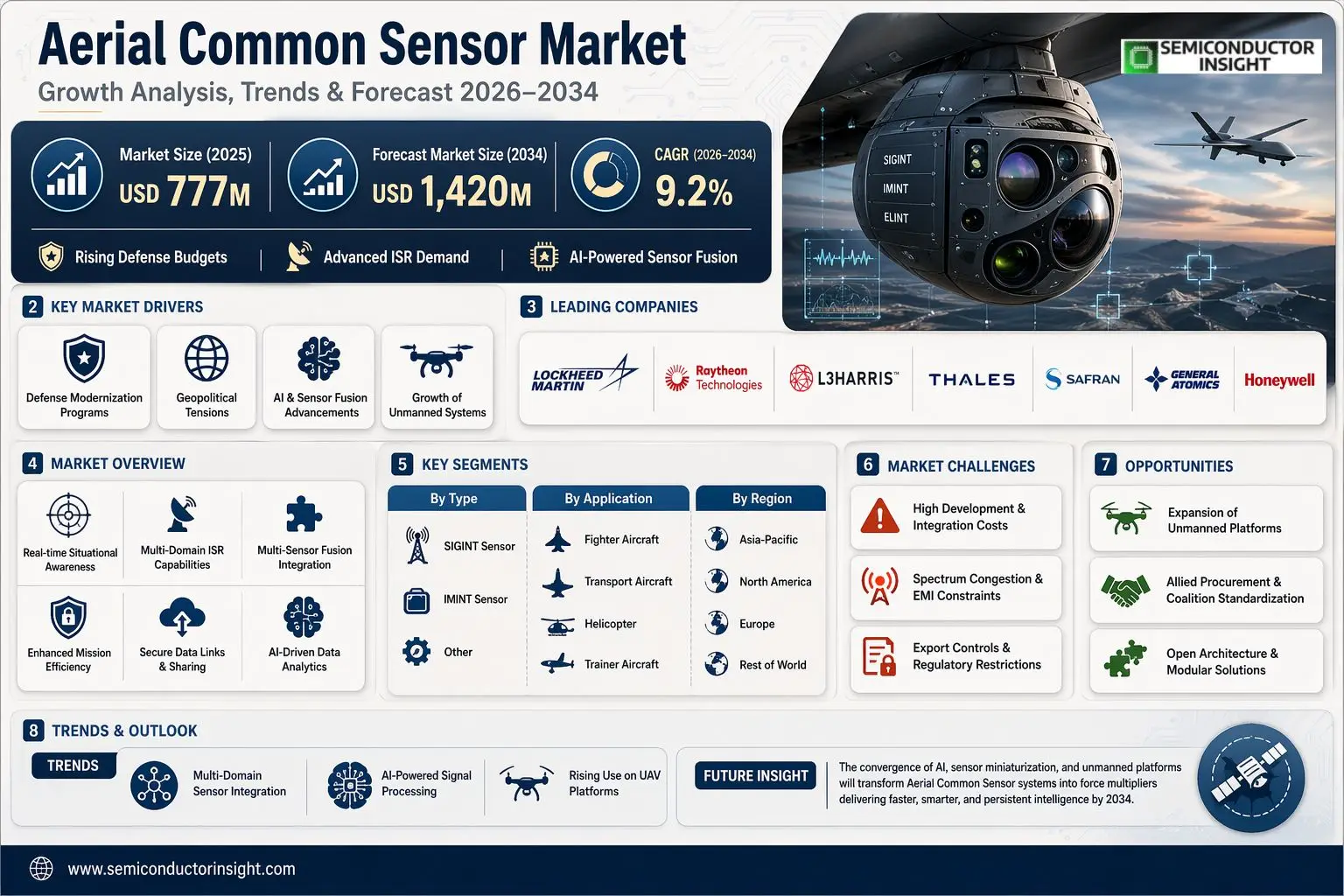
Global Aerial Common Sensor market size was valued at USD 777 million in 2025. The market is projected to grow from USD 848.5 million in 2026 to USD 1,420 million by 2034, exhibiting a CAGR of 9.2% during the forecast period.
The Aerial Common Sensor (ACS) is an advanced airborne intelligence, surveillance, and reconnaissance (ISR) system designed to provide real-time situational awareness and intelligence collection capabilities. It integrates various sensors and technologies to detect, track, and monitor targets across a wide range of environments, including land, sea, and air. The ACS platform is used by military forces and other organizations for surveillance, reconnaissance, and targeting purposes, typically mounted on aircraft, drones, or other airborne platforms. Key sensor types in the market include SIGINT (Signals Intelligence) sensors, IMINT (Imagery Intelligence) sensors, and other multi-domain sensing solutions.
The market is witnessing robust growth driven by escalating defense budgets globally, growing demand for advanced ISR capabilities, and the rapid integration of artificial intelligence and data fusion technologies into airborne sensor systems. Furthermore, increasing geopolitical tensions and the modernization of military fleets across North America, Europe, and Asia-Pacific are accelerating procurement activities. Key players driving innovation and market competition include Lockheed Martin, Raytheon Technologies, Honeywell International, Thales Group, Safran SA, General Atomics, L3 Harris Technologies Inc., and others, each maintaining broad and technologically advanced product portfolios in the Aerial Common Sensor space.
MARKET DRIVERS
Rising Defense Modernization Programs Fueling Demand for Aerial Common Sensor Systems
Aerial Common Sensor (ACS) Market is being significantly propelled by accelerating defense modernization initiatives across NATO member states and allied nations. Governments are prioritizing the integration of advanced multi-intelligence (multi-INT) airborne surveillance platforms that consolidate signals intelligence (SIGINT), imagery intelligence (IMINT), and electronic intelligence (ELINT) capabilities into unified sensor architectures. This consolidation reduces operational redundancy while enhancing situational awareness in complex threat environments, making the Aerial Common Sensor platform a strategically critical asset for modern armed forces.
Growing Geopolitical Tensions Accelerating Investment in Airborne Intelligence, Surveillance, and Reconnaissance
Escalating geopolitical tensions across multiple global theaters have compelled defense ministries to substantially increase budgetary allocations toward Intelligence, Surveillance, Target Acquisition, and Reconnaissance (ISTAR) capabilities. Aerial Common Sensor Market directly benefits from this trend, as military planners seek persistent, wide-area aerial surveillance solutions capable of operating in contested and denied airspace. The increasing frequency of asymmetric warfare scenarios and hybrid conflict situations has further underscored the operational necessity of versatile airborne sensor platforms that can rapidly adapt mission profiles without requiring significant hardware reconfiguration.
➤ Defense agencies across North America and Europe have been progressively reallocating procurement budgets toward next-generation airborne ISR platforms, with multi-sensor fusion architectures representing a central pillar of long-term capability development roadmaps through the coming decade.
Technological advancements in sensor miniaturization, onboard data processing, and secure communications have further strengthened the market drivers for Aerial Common Sensor systems. The integration of artificial intelligence and machine learning algorithms into airborne sensor platforms enables real-time data exploitation and automated target recognition, substantially reducing the analytical burden on ground-based intelligence teams. These capabilities position Aerial Common Sensor Market for sustained growth as defense forces prioritize faster decision cycles and improved battlefield awareness in multi-domain operational environments.
MARKET CHALLENGES
High Development and Procurement Costs Posing Significant Barriers Across Aerial Common Sensor Market
One of the most pressing challenges confronting Aerial Common Sensor Market is the substantial financial investment required across the full program lifecycle, from research and development through platform integration, operational deployment, and sustained maintenance. The complexity of integrating multiple sensor modalities , including radar, electro-optical/infrared systems, and electronic warfare payloads , into a cohesive, interoperable architecture drives significant engineering costs. Smaller allied nations and emerging defense markets often face considerable procurement challenges, limiting broader adoption of Aerial Common Sensor platforms despite recognized operational requirements.
Other Challenges
Interoperability and Standardization Constraints
Achieving seamless interoperability between Aerial Common Sensor platforms and the diverse command, control, communications, computers, and intelligence (C4I) architectures operated by different allied nations presents a persistent technical and institutional challenge. Variations in communication protocols, data link standards, and national security classification frameworks complicate multinational deployment scenarios and joint operational planning, requiring extensive coordination and customization efforts that can extend program timelines and inflate overall program costs.
Regulatory and Export Control Restrictions
Aerial Common Sensor Market operates within a stringent regulatory environment governed by international arms control frameworks, including the International Traffic in Arms Regulations (ITAR) and the Wassenaar Arrangement. These export control mechanisms, while essential for national security, can restrict market access, limit technology transfer agreements between allied nations, and create procurement delays. Navigating these regulatory complexities requires dedicated compliance infrastructure and ongoing engagement with governmental licensing authorities, adding operational overhead for both prime contractors and platform operators.
MARKET RESTRAINTS
Budget Constraints and Shifting Defense Procurement Priorities Limiting Market Expansion
Despite robust long-term demand fundamentals, Aerial Common Sensor Market faces meaningful restraints stemming from cyclical defense budget pressures and competing procurement priorities within national defense establishments. In periods of fiscal consolidation, airborne ISR programs , including Aerial Common Sensor platform acquisitions , are frequently subject to schedule delays, scope reductions, or outright program restructuring. The long development timelines characteristic of complex multi-intelligence sensor programs make them particularly vulnerable to shifting political priorities and evolving threat assessments that may redirect funding toward more immediately deployable capabilities.
Technological Obsolescence Risk and Rapid Evolution of Counter-ISR Capabilities
The rapid pace of technological advancement in adversarial electronic warfare and counter-ISR systems presents a structural restraint on Aerial Common Sensor Market. Platform designs with extended development and fielding timelines risk incorporating sensor architectures that may be partially obsolete upon operational deployment, as adversary nations invest heavily in electronic attack capabilities, low-probability-of-intercept systems, and advanced electronic countermeasures specifically designed to degrade airborne intelligence collection effectiveness. This dynamic compels program managers and defense contractors to incorporate costly technology refresh cycles and open-systems architecture designs to maintain platform relevance, adding financial and schedule pressure across program lifecycles.
MARKET OPPORTUNITIES
Expansion of Multi-Domain Operations Frameworks Creating New Growth Avenues for Aerial Common Sensor Platforms
Global transition toward Multi-Domain Operations (MDO) doctrine across leading defense forces presents a compelling growth opportunity for Aerial Common Sensor Market. As military organizations seek to achieve decision superiority by integrating intelligence streams across land, sea, air, space, and cyberspace domains, airborne multi-intelligence platforms capable of simultaneous multi-sensor collection and real-time data fusion become operationally indispensable. The Aerial Common Sensor’s inherent capability to consolidate previously separate collection disciplines into a single, persistent airborne platform aligns directly with MDO operational requirements, positioning it as a high-priority acquisition for defense establishments pursuing next-generation warfighting concepts.
Integration of Artificial Intelligence and Advanced Data Analytics Unlocking Platform Capability Enhancements
The accelerating integration of artificial intelligence, machine learning, and advanced data analytics technologies into airborne intelligence systems represents a transformative opportunity for Aerial Common Sensor market participants. AI-enabled onboard processing capabilities allow sensor platforms to perform real-time automated target recognition, anomaly detection, and pattern-of-life analysis with significantly reduced latency compared to traditional ground-based exploitation workflows. Defense contractors and platform integrators that successfully embed these advanced analytical capabilities into Aerial Common Sensor architectures stand to capture substantial competitive advantage, as military customers increasingly prioritize platforms that deliver actionable intelligence directly at the point of collection rather than dependent on extended ground-exploitation timelines.
Allied Nation Cooperative Programs and Foreign Military Sales Expanding the Addressable Market
Growing interest among allied and partner nations in acquiring interoperable airborne ISR capabilities compatible with existing coalition operational frameworks represents a significant market expansion opportunity for the Aerial Common Sensor sector. Foreign Military Sales programs administered through established bilateral defense cooperation agreements provide a structured pathway for extending platform availability beyond primary development nations, broadening the addressable customer base for prime contractors and subsystem suppliers. As regional security environments across the Indo-Pacific, Middle East, and Eastern Europe continue to evolve, demand for proven multi-intelligence airborne sensor platforms with demonstrated interoperability credentials is expected to strengthen, supporting sustained market growth through the coming years.
Aerial Common Sensor Market Trends
Rising Demand for Airborne Intelligence, Surveillance, and Reconnaissance Drives Aerial Common Sensor Market Growth
Aerial Common Sensor Market is witnessing significant momentum driven by the escalating need for advanced airborne intelligence, surveillance, and reconnaissance (ISR) capabilities across military and defense sectors worldwide. As geopolitical tensions persist across multiple regions, defense establishments are prioritizing real-time situational awareness solutions, positioning the Aerial Common Sensor as a critical component of modern airborne operations. The integration of multi-sensor platforms on aircraft, helicopters, and unmanned aerial vehicles has become a strategic imperative, as militaries seek unified systems capable of simultaneous detection, tracking, and monitoring across land, sea, and air domains. North America continues to lead adoption trends, with the United States representing the largest national market for Aerial Common Sensor systems, supported by sustained defense modernization budgets and an established ecosystem of leading manufacturers including Lockheed Martin, Raytheon Technologies, and L3 Harris Technologies Inc.
Other Trends
Expanding Role of SIGINT and IMINT Sensor Technologies
Within Aerial Common Sensor Market, the SIGINT (Signals Intelligence) and IMINT (Imagery Intelligence) sensor segments are gaining considerable traction as defense agencies seek layered intelligence-gathering capabilities. SIGINT sensors are increasingly deployed to intercept and analyze electronic emissions, providing critical battlefield intelligence, while IMINT sensors deliver high-resolution imagery for target identification and reconnaissance missions. The convergence of these two sensor types within a single airborne platform reflects a broader industry trend toward multi-domain sensor fusion, enabling operators to derive richer, more actionable intelligence from a single sortie. Leading players such as Thales Group, Safran SA, and Honeywell International are actively advancing sensor miniaturization and signal processing technologies to enhance operational efficiency across fighter aircraft, transport aircraft, and helicopter platforms.
Integration with Unmanned Aerial Platforms and Autonomous Systems
A defining trend shaping Aerial Common Sensor Market is the accelerating integration of ACS systems with unmanned aerial vehicles (UAVs) and autonomous airborne platforms. Defense forces are increasingly deploying sensor-equipped drones for persistent surveillance missions in contested environments where manned aircraft operations carry elevated risk. Companies such as AgEagle Aerial Systems and General Atomics are at the forefront of adapting Aerial Common Sensor payloads for unmanned platforms, enabling extended-endurance ISR missions with reduced operational costs. This shift is also influencing procurement strategies, with governments in Asia-Pacific regions, particularly China, Japan, South Korea, and India, ramping up investments in indigenous UAV-based surveillance programs that incorporate advanced common sensor architectures.
Technological Advancements and Competitive Landscape Reshaping Market Dynamics
Aerial Common Sensor Market’s competitive landscape is being reshaped by continuous technological advancements in sensor miniaturization, artificial intelligence-driven data processing, and real-time data link capabilities. Key manufacturers including Curtiss-Wright Corporation, Ametek Inc., and Meggitt PLC are investing in next-generation sensor architectures designed to improve target discrimination and reduce sensor-to-shooter timelines. The trend toward open-architecture sensor platforms is also gaining ground, allowing defense customers to upgrade individual sensor modules without complete system overhauls, thereby extending the operational lifecycle of existing airborne ISR assets. Across regions including the Middle East, Europe, and South America, procurement activity for Aerial Common Sensor-equipped platforms is expected to remain robust as nations modernize their air force inventories and align with NATO interoperability standards, sustaining long-term demand across the market’s diverse application segments.
COMPETITIVE LANDSCAPE
Key Industry Players
Global Aerial Common Sensor Market: Competitive Dynamics, Strategic Positioning, and Leading Manufacturer Profiles
Aerial Common Sensor (ACS) Market is characterized by the strong dominance of a handful of large-scale defense and aerospace conglomerates, with Lockheed Martin and Raytheon Technologies commanding significant revenue shares among the top five players, who collectively accounted for a substantial portion of global market revenue in 2025. Valued at approximately USD 777 million in 2025 and projected to reach USD 1,420 million by 2034 at a CAGR of 9.2%, the market reflects robust demand driven by rising military modernization programs, growing investments in airborne ISR (Intelligence, Surveillance, and Reconnaissance) platforms, and the increasing integration of SIGINT and IMINT sensor technologies across fighter aircraft, helicopters, transport aircraft, and unmanned aerial platforms. North America, led by the United States, remains the largest regional market, with these prime contractors benefiting from long-standing defense procurement relationships and deep integration across military supply chains. Companies such as Honeywell International, Thales Group, and Safran SA further reinforce the competitive intensity through continuous R&D investment, advanced sensor fusion capabilities, and strategic partnerships with military agencies worldwide.
Beyond the market leaders, several niche yet significant players are shaping the ACS competitive landscape through specialization and technological differentiation. General Atomics has established a strong foothold through its expertise in unmanned aerial systems, making it a key platform provider for sensor integration. L3 Harris Technologies Inc. brings advanced signals intelligence and electronic warfare capabilities that closely align with the SIGINT sensor segment’s growth trajectory. Curtiss-Wright Corporation and Ametek Inc. contribute ruggedized electronics and embedded computing solutions critical to mission-grade airborne sensor systems, while Meggitt PLC delivers sensing and monitoring technologies suited for demanding aerospace environments. AgEagle Aerial Systems represents the growing role of smaller, commercially oriented UAV-focused companies entering the ISR space. Together, these players compete across product innovation, platform compatibility, cost-efficiency, and responsiveness to evolving defense procurement requirements across North America, Europe, Asia-Pacific, and the Middle East and Africa regions.
List of Key Aerial Common Sensor Companies Profiled
- Lockheed Martin
- Raytheon Technologies
- L3 Harris Technologies Inc.
- Thales Group
- Honeywell International
- Safran SA
- General Atomics
- Curtiss-Wright Corporation
- Ametek Inc.
- Meggitt PLC
- AgEagle Aerial Systems
Segment Analysis:
| Segment Category | Sub-Segments | Key Insights |
| By Type |
|
SIGINT Sensor holds a leading position within Aerial Common Sensor Market by type, driven by the increasing strategic importance of electronic intelligence gathering in modern defense operations.
|
| By Application |
|
Fighter Aircraft represents the dominant application segment in Aerial Common Sensor Market, owing to the critical need for real-time intelligence, surveillance, and reconnaissance capabilities integrated directly into combat platforms.
|
| By End User |
|
Defense & Military constitutes the predominant end-user segment for Aerial Common Sensor systems, reflecting the platform’s foundational design purpose of supporting armed forces with superior situational awareness in contested environments.
|
| By Platform |
|
Unmanned Aerial Vehicles (UAVs) are establishing themselves as the fastest-growing platform segment within Aerial Common Sensor Market, fundamentally transforming how ISR missions are conceived, planned, and executed by defense and security organizations globally.
|
| By Technology |
|
Multi-Sensor Fusion Systems represent the most strategically important technology segment in Aerial Common Sensor Market, reflecting a broader industry shift away from single-modality sensors toward integrated, data-fused ISR architectures capable of providing comprehensive battlefield awareness.
|
Regional Analysis: Aerial Common Sensor Market
North America’s Aerial Common Sensor market benefits immensely from one of the world’s largest defense budgets. Consistent government allocations toward airborne intelligence and surveillance modernization ensure sustained demand. Multi-year procurement contracts between defense agencies and industry leaders provide market stability and encourage long-term investment in next-generation aerial sensor architectures, keeping the region at the forefront of global capability development.
The region hosts a dense ecosystem of aerospace primes, specialized sensor manufacturers, and defense-focused research institutions. This interconnected network accelerates the pace of innovation in Aerial Common Sensor Market, enabling rapid prototyping, testing, and deployment of advanced multi-spectral and signals intelligence sensor payloads integrated onto both manned and unmanned aerial platforms across various operational environments.
North America leads globally in the development and deployment of unmanned aerial systems configured with common sensor suites. The growing preference for persistent, low-risk ISR missions is driving the integration of Aerial Common Sensor technologies onto medium and high-altitude long-endurance UAV platforms. This trend reflects a broader operational shift toward remotely piloted intelligence gathering across contested and denied airspace environments.
Strong bilateral and multilateral defense relationships enable North American Aerial Common Sensor market participants to expand their reach through foreign military sales and cooperative development agreements. NATO interoperability standards and Five Eyes intelligence-sharing frameworks create additional demand for compatible aerial sensor solutions, expanding the addressable market well beyond domestic borders and reinforcing the region’s strategic influence in global defense technology ecosystems.
Europe
Europe represents a strategically significant and rapidly evolving segment of Aerial Common Sensor Market. The region’s market dynamics are shaped by collective NATO commitments, national defense modernization programs, and a growing emphasis on European strategic autonomy in defense capabilities. Countries such as the United Kingdom, France, Germany, and Italy are key contributors, investing in indigenous aerial surveillance technologies while also participating in collaborative multinational programs. The resurgence of geopolitical tensions on the European continent has accelerated procurement timelines and broadened the scope of airborne reconnaissance requirements. European defense agencies are increasingly prioritizing sensor fusion, interoperability, and open-architecture platforms that can adapt to evolving threat environments. The presence of established aerospace conglomerates and a strong industrial base ensures that Europe remains a competitive and innovative force within Global Aerial Common Sensor market through the forecast period.
Asia-Pacific
The Asia-Pacific region is emerging as one of the most dynamic growth frontiers in Aerial Common Sensor Market, underpinned by rising defense expenditures, territorial disputes, and rapid modernization of air force capabilities across multiple nations. Countries including China, India, Japan, South Korea, and Australia are making substantial investments in airborne intelligence and surveillance platforms to address complex regional security challenges. India’s push for defense indigenization and Japan’s evolving security posture are particularly noteworthy drivers. The region’s diverse threat landscape, spanning maritime domain awareness to counter-insurgency operations, creates multifaceted demand for versatile aerial sensor solutions. Growing domestic defense industrial bases in several Asia-Pacific nations are also reducing reliance on imports, fostering local capability development in Aerial Common Sensor Market and positioning the region as a long-term structural growth driver globally.
South America
South America occupies a developing but increasingly relevant position within Global Aerial Common Sensor market. Regional demand is primarily driven by border surveillance requirements, counter-narcotics operations, and the need to monitor vast and geographically challenging territories. Brazil, as the region’s largest defense spender, plays a central role in shaping procurement trends, with ongoing investments in airborne surveillance and reconnaissance platforms. Other nations including Colombia and Peru are also expanding their aerial ISR capabilities to address internal security challenges. Budget constraints and competing national priorities can moderate growth, yet growing concerns over border security and the proliferation of non-state actor threats are gradually expanding the addressable market. International defense partnerships and foreign military assistance programs also introduce advanced Aerial Common Sensor technologies into the South American operational environment.
Middle East & Africa
The Middle East and Africa region presents a compelling mix of near-term demand intensity and long-term market potential for Aerial Common Sensor Market. The Middle East, driven by nations such as Saudi Arabia, the United Arab Emirates, and Israel, maintains some of the highest per-capita defense spending globally, with significant allocations directed toward airborne ISR and electronic warfare capabilities. Israel, in particular, stands out as both a major consumer and a sophisticated exporter of aerial sensor technologies. Ongoing regional conflicts and the persistent threat of asymmetric warfare sustain demand for advanced reconnaissance and surveillance systems. In Sub-Saharan Africa, Aerial Common Sensor Market is at a nascent stage, with growth linked to peacekeeping missions, counter-terrorism operations, and increasing external defense assistance programs that are gradually introducing modern aerial surveillance platforms to the continent.
Report Scope
This market research report provides a comprehensive analysis of Aerial Common Sensor Market, covering the forecast period 2026–2034. It offers detailed insights into market dynamics, technological advancements, competitive landscape, and key trends shaping the industry.
Key focus areas of the report include:
- Market Overview: The report begins with an overview outlining its current market scenario, key growth indicators, and industry transformation drivers. It discusses macroeconomic factors, demand–supply balance, regulatory landscape, and the strategic role of airborne intelligence, surveillance, and reconnaissance (ISR) systems in powering advancements across industries such as defense, military operations, homeland security, and unmanned aerial systems.
- Market Size & Forecast: Historical data and future projections for revenue, unit shipments, and market value across major regions and segments.
- Segmentation Analysis: Detailed breakdown by product type, technology, application, and end-user industry to identify high-growth segments and investment opportunities.
- Regional Insights: Insights into market performance across North America, Europe, Asia-Pacific, Latin America, and the Middle East & Africa, including country-level analysis where relevant.
- Competitive Landscape: Profiles of leading market participants, including their product offerings, R&D focus, manufacturing capacity, pricing strategies, and recent developments such as mergers, acquisitions, and partnerships.
- Technology Trends & Innovation: Assessment of emerging technologies, integration of AI/IoT, sensor fusion design trends, fabrication techniques, and evolving industry standards.
- Market Drivers & Restraints: Evaluation of factors driving market growth along with challenges, supply chain constraints, regulatory issues, and market-entry barriers.
- Stakeholder Insights: Insights for component suppliers, OEMs, system integrators, investors, and policymakers regarding the evolving ecosystem and strategic opportunities.
Primary and secondary research methods are employed, including interviews with industry experts, data from verified sources, and real-time market intelligence to ensure the accuracy and reliability of the insights presented.
FREQUENTLY ASKED QUESTIONS:
What is the current market size of Aerial Common Sensor Market?
-> Global Aerial Common Sensor Market was valued at USD 777 million in 2025 and is expected to reach USD 1,420 million by 2034, growing at a CAGR of 9.2% during the forecast period.
Which key companies operate in Aerial Common Sensor Market?
-> Key players include Lockheed Martin, Raytheon Technologies, AgEagle Aerial Systems, Curtiss-Wright Corporation, Ametek Inc., Honeywell International, Safran SA, General Atomics, Meggitt PLC, Thales Group, and L3 Harris Technologies Inc., among others.
What are the key growth drivers?
-> Key growth drivers include rising defense budgets, increasing demand for real-time situational awareness, growing adoption of ISR systems on aircraft and drones, and expanding military surveillance and reconnaissance operations across land, sea, and air environments.
Which region dominates the market?
-> North America, led by the United States, is a dominant market for Aerial Common Sensor, driven by significant defense spending and advanced military programs, while Asia is emerging as a fast-growing region with expanding defense modernization initiatives.
What are the emerging trends?
-> Emerging trends include integration of SIGINT and IMINT sensor technologies, deployment on unmanned aerial platforms and drones, advancements in multi-domain ISR capabilities, and increased adoption across fighter aircraft, transport aircraft, helicopters, and trainer aircraft.

Get Sample Report PDF for Exclusive Insights
Report Sample Includes
- Table of Contents
- List of Tables & Figures
- Charts, Research Methodology, and more...
 Download Sample Report PDF





