Addressable Liquid Leak Detection System Market Insights
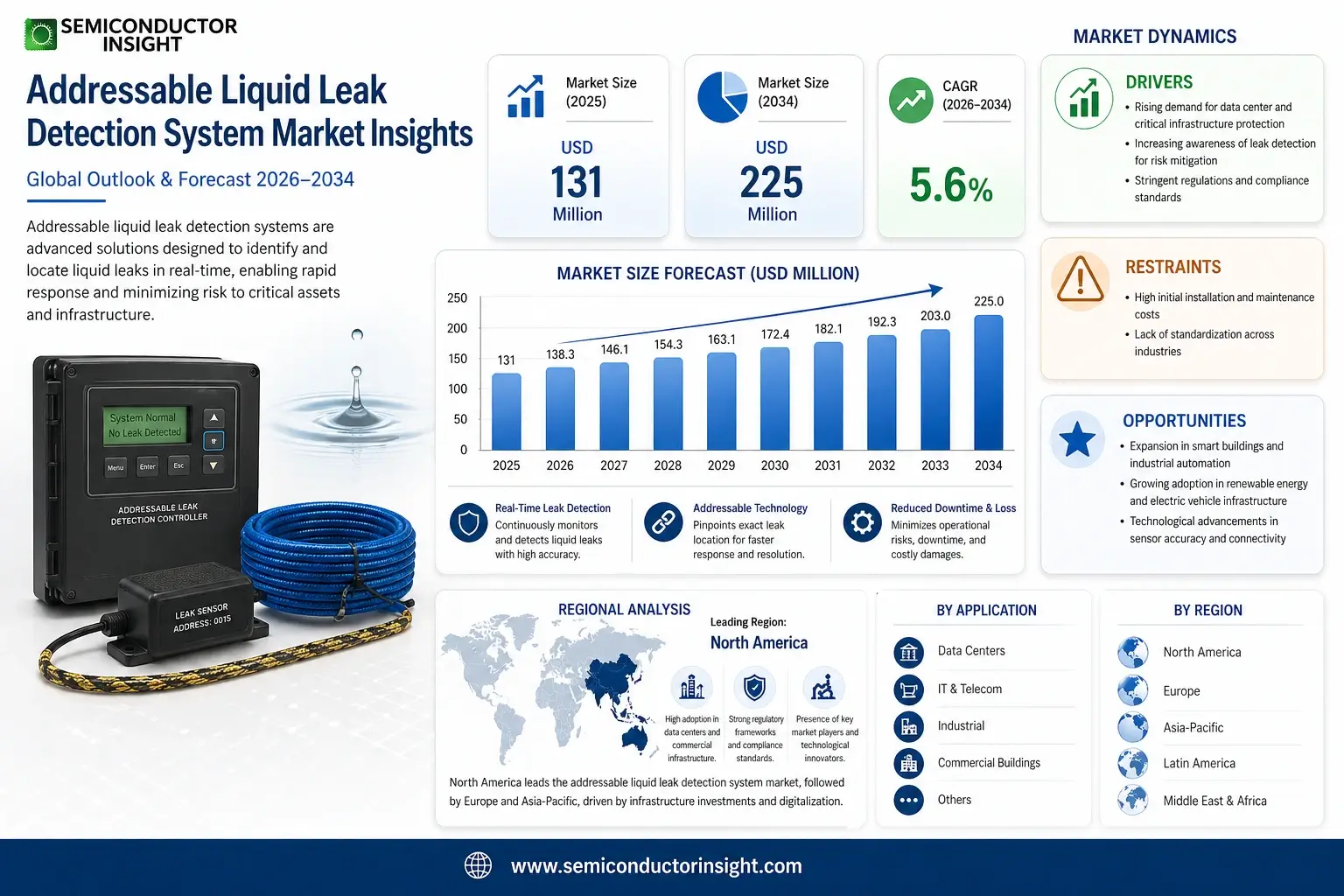
Global Addressable Liquid Leak Detection System Market size was valued at USD 131 million in 2025. The market is projected to grow from USD 138.3 million in 2026 to USD 225 million by 2034, exhibiting a CAGR of 5.6% during the forecast period.
An Addressable Liquid Leak Detection System is an intelligent monitoring system specifically designed to identify and pinpoint the exact location of liquid leaks. It utilizes a network of sensors strategically distributed around critical areas or equipment, enabling real-time surveillance. When a leak is detected, the system can accurately transmit the precise location data to an operator or central monitoring station, facilitating immediate intervention to prevent environmental contamination, equipment damage, and costly operational downtime.
The market growth is primarily driven by stringent regulatory requirements for environmental protection and workplace safety across industries such as data centers, semiconductor manufacturing, and chemical processing. Furthermore, the rising value of critical infrastructure and sensitive electronic equipment has made proactive leak prevention a significant operational priority. Technological advancements are also contributing; for instance, leading players are integrating these systems with broader Building Management Systems (BMS) and Industrial IoT platforms for enhanced predictive maintenance capabilities. Key manufacturers operating in this competitive landscape include Siemens AG, RLE Technologies, Raychem (a brand of nVent), and TTK Leak Detection, among others.
MARKET DRIVERS
Stringent Regulatory Mandates and Risk Mitigation
Increasingly strict environmental and safety regulations across data centers, industrial facilities, and healthcare are compelling investment in advanced monitoring. These mandates are a primary driver for Addressable Liquid Leak Detection System Market, as organizations seek to avoid costly fines, operational downtime, and environmental damage. The ability to quickly pinpoint the exact location of a leak is critical for compliance and rapid response.
Digital Transformation in Critical Infrastructure
The expansion of cloud computing and data center infrastructure globally necessitates robust physical security for IT assets. Water and coolant leaks pose a severe threat to server uptime. Modern addressable systems integrate directly with Building Management Systems (BMS) and IT Service Management platforms, enabling proactive facility management and driving adoption in this high-growth sector.
➤ The trend towards predictive maintenance, powered by IoT connectivity, is transforming Addressable Liquid Leak Detection System Market from a simple alert tool into a core component of smart facility analytics.
Additionally, the rising value density of equipment in manufacturing and laboratories makes even small leaks economically catastrophic. This financial risk calculation is accelerating the replacement of traditional, non-addressable leak detection with precise, addressable liquid leak detection system solutions that minimize asset damage and business interruption.
MARKET CHALLENGES
Integration Complexities and Perceived High Initial Cost
Despite their advantages, addressable systems face challenges in retrofitting existing facilities, where installation can be disruptive and costly. The integration of sensor cables, control panels, and software with legacy infrastructure requires specialized expertise, creating a barrier for some end-users who perceive the initial investment as high compared to conventional point-sensors.
Other Challenges
Competition from Conventional Alternatives
Non-addressable spot detectors and basic alarm systems continue to serve price-sensitive segments, particularly in smaller operations where the granular data of an addressable system is not seen as essential, creating competitive pressure.
Technical Limitations and False Alarms
Sensor performance can be affected by environmental factors like extreme temperatures or chemical exposure, potentially leading to false positives or sensor degradation. Ensuring reliability across diverse and harsh operational environments remains an ongoing engineering challenge for the market.
MARKET RESTRAINTS
Capital Expenditure Prioritization in Economic Downturns
A significant restraint for Addressable Liquid Leak Detection System Market is its susceptibility to reductions in non-essential capital expenditure during economic slowdowns. While these systems offer long-term savings, they can be deferred in favor of more immediate operational spending, particularly in price-sensitive industries and regions. The sales cycle often lengthens as financial justification processes become more stringent.
Limited Awareness in Emerging Markets
In many developing economies, awareness of advanced liquid leak detection technologies is still low. The market growth is restrained by a prevailing reliance on manual inspections or basic alarm systems, coupled with a less mature regulatory landscape that does not yet mandate such precise monitoring solutions, slowing adoption rates.
MARKET OPPORTUNITIES
Artificial Intelligence and Predictive Analytics Integration
The convergence of AI with Addressable Liquid Leak Detection System Market solutions presents a major opportunity. Advanced analytics can use historical and real-time sensor data to predict potential failure points in piping or infrastructure, shifting the paradigm from leak detection to leak prevention. This creates higher-value, software-as-a-service revenue models for providers.
Expansion into New Application Verticals
Beyond traditional data centers and telecom, significant growth opportunities exist in renewable energy (e.g., battery storage facilities), electric vehicle manufacturing, and pharmaceutical logistics. Each of these sectors handles sensitive processes or materials where precise leak location is paramount, representing untapped markets for advanced addressable liquid leak detection system deployments.
Wireless and Hybrid System Development
The development of reliable, long-range wireless sensors and hybrid wired/wireless architectures presents a key opportunity to overcome installation challenges. These systems can reduce deployment complexity and cost, opening the market to a broader range of facilities, including those with difficult physical layouts or heritage buildings where running cables is problematic.
Addressable Liquid Leak Detection System Market Trends
Convergence with Smart Building Infrastructure
A primary trend shaping Addressable Liquid Leak Detection System Market is its rapid integration into broader smart building and industrial IoT frameworks. Modern systems are moving beyond standalone alarms to become connected nodes within intelligent facility management platforms. This enables not only precise leak location but also automated responses such as valve shutoff, equipment shutdown, and integration with building management systems for centralized monitoring. The demand for this connectivity is particularly strong in mission-critical environments like data centers and semiconductor manufacturing, where real-time data and automated controls are essential for operational continuity and asset protection.
Other Trends
Shift Towards Predictive and Preventive Maintenance
The industry is witnessing a significant shift from purely reactive leak detection to predictive analytics. Advanced Addressable Liquid Leak Detection Systems now incorporate data analytics to monitor sensor health, establish baseline performance, and identify anomalies that may precede a failure. This capability allows facility managers to schedule maintenance proactively, reducing the risk of unexpected downtime and the high costs associated with catastrophic leaks. This trend aligns with the broader industrial shift towards condition-based monitoring.
Diversification of Sensing Technologies and Applications
While acoustic and pressure-test types remain core technologies, there is notable diversification in sensing solutions tailored to specific fluids and environments. This is driving adoption across new application segments, including pharmaceutical labs, chemical processing plants, and renewable energy facilities. The need to detect various conductive and non-conductive liquids is pushing manufacturers to innovate, leading to more versatile and specialized systems. This expansion is a key factor in the market’s growth beyond its traditional strongholds, opening new revenue streams for established players and encouraging competitive innovation.
COMPETITIVE LANDSCAPE
Key Industry Players
A Market Consolidating Around Technology Leaders and Niche Specialists
Global Addressable Liquid Leak Detection System Market features a competitive landscape with a mix of established industrial conglomerates and specialized technology providers. Siemens, Raychem (a brand of nVent), and TTK Leak Detection represent leading global players, leveraging extensive R&D, diverse product portfolios, and strong multinational distribution channels. These companies command significant market share, particularly in high-stakes sectors like data centers and industrial facilities, by offering integrated monitoring solutions. The market structure is characterized by moderate concentration, with the top five players accounting for a notable portion of global revenue. Competition is intensifying around technological innovation, particularly in improving sensor accuracy, system integration with Building Management Systems (BMS), and the development of advanced detection types such as acoustic and pressure test technologies.
Beyond the major players, the landscape includes numerous specialized and regional competitors that address specific niches. Companies like RLE Technologies and Permalert have strong footholds in the North American data center and telecommunications markets, while Envirotech Alarms and Dorlen Products are recognized for robust solutions in chemical and industrial applications. Firms such as Aqualeak Detection and OmniLeak focus on customizable, addressable point sensing solutions for complex facilities. The Asia-Pacific region, a high-growth market, sees active participation from players like TATSUTA and OMARA, catering to the burgeoning semiconductor and electronics manufacturing sectors. This diverse ecosystem drives continuous product development and competitive pricing, benefiting end-users across critical infrastructure verticals.
List of Key Addressable Liquid Leak Detection System Companies Profiled
- Siemens
- Raychem (nVent)
- TTK Leak Detection
- RLE Technologies
- Permalert
- Envirotech Alarms
- Dorlen Products
- Aqualeak Detection
- OmniLeak
- TATSUTA
- OMARA
- Waxman Consumer Products Group
Segment Analysis:
| Segment Category | Sub-Segments | Key Insights |
| By Type |
|
Acoustic Detection Type represents the leading innovation segment. It is highly valued for its non-invasive diagnostic capabilities and its ability to detect micro-leaks with pinpoint accuracy through advanced sound wave analysis, making it superior for pre-emptive maintenance in critical continuous operations. This segment’s growth is propelled by its compatibility with complex pipe networks and its role in minimizing operational downtime, offering a clear advantage in environments where system integrity cannot be compromised for physical inspection. |
| By Application |
|
Data Centers are the paramount application segment, driven by the extreme criticality of their cooling infrastructure and the catastrophic operational and financial risks posed by water intrusion. The addressable nature of these systems is essential for rapid fault isolation within vast server rooms, preventing equipment damage and data loss. This demand is further amplified by global trends in hyperscale data center expansion and the relentless pursuit of maximum uptime, establishing leak detection as a foundational component of modern data center risk management strategies. |
| By End User |
|
Technology & Telecom constitutes the dominant and most sophisticated end-user segment. This group’s leadership is fueled by its dense concentration of high-value, sensitive infrastructure that is both water-cooled and susceptible to water damage. The sector’s inherent culture of adopting advanced monitoring and automation for operational resilience creates a natural and expanding market for intelligent, addressable leak detection solutions. Procurements are driven by stringent internal risk protocols and the need to protect capital-intensive investments in computing and network hardware. |
| By Detection Method |
|
Point Sensing (Cable/Rope) is the leading methodological approach, favored for its high precision in location identification which is critical for rapid response. The continuous sensing cable can be routed along extensive pipe runs or beneath raised floors, providing comprehensive coverage that spot-based sensors cannot match. This method’s dominance is entrenched in its reliability, ease of installation in retrofit projects, and its ability to integrate seamlessly with building management systems, making it the preferred choice for safeguarding defined linear assets and perimeter areas in critical environments. |
| By System Integration |
|
Integrated Building Management Systems (BMS) represent the forward-leading integration pathway. This segment is growing fastest as facility operators seek unified control and data analytics. Integration allows leak detection alarms to trigger automated responses like valve closures or HVAC shutdowns, while providing centralized visibility alongside other critical system data. The shift towards smart buildings and industrial IoT underscores the value proposition of integrated systems, moving beyond simple alarm functions to become a core component of predictive maintenance and holistic operational intelligence frameworks. |
Regional Analysis: Addressable Liquid Leak Detection System Market
North America
The exponential growth of hyperscale and colocation data centers across North America creates a foundational demand for Addressable Liquid Leak Detection System solutions. These systems are integral to protecting sensitive server infrastructure from cooling system failures, ensuring uptime and preventing data loss. The market is characterized by a preference for scalable, network-integrated detection systems that provide precise location data for rapid response.Regulatory & Insurance Drivers
Compliance with strict codes from organizations like NFPA and adherence to environmental protection mandates are non-negotiable market drivers. Furthermore, insurance providers increasingly offer premium reductions for facilities equipped with advanced Addressable Liquid Leak Detection System technology, incentivizing investment across commercial real estate and industrial sectors to mitigate liability and asset damage risks.
Sectors such as pharmaceuticals, biotechnology, and semiconductor manufacturing utilize these systems to safeguard critical processes and maintain cleanroom integrity. The need to monitor for leaks of process water, chemicals, and coolants in complex industrial environments favors the adoption of addressable systems capable of pinpointing exact leak sources within vast facilities.
The North American Addressable Liquid Leak Detection System Market is rapidly evolving beyond standalone solutions. High integration with Building Management Systems (BMS) and IoT platforms is a key trend, enabling predictive maintenance, automated valve shutoff, and centralized dashboard monitoring. This drives demand for intelligent, connected systems that contribute to overall operational efficiency.
Europe
Europe represents a highly significant and technologically advanced region for Addressable Liquid Leak Detection System Market, characterized by a strong emphasis on energy efficiency, green building certifications, and industrial safety standards. The market growth is fueled by the modernization of aging commercial and municipal infrastructure, including historic buildings and district heating networks. Regulations like the EU’s Energy Performance of Buildings Directive (EPBD) indirectly promote leak detection as part of holistic building management. The presence of a robust manufacturing base, particularly in Germany and the Benelux region, for chemicals and automotive industries, establishes steady demand. Furthermore, heightened focus on water conservation in Southern Europe and the protection of valuable archives and museums in Western Europe provide diverse, niche application segments that rely on precise, addressable detection technology.
Asia-Pacific
The Asia-Pacific region is the fastest-growing market for Addressable Liquid Leak Detection System solutions, driven by massive investments in new infrastructure. Rapid urbanization, the construction of state-of-the-art data centers, and the expansion of electronics and pharmaceutical manufacturing hubs in countries like China, Japan, South Korea, and India are primary growth engines. While price sensitivity exists, there is a clear trend toward adopting more sophisticated systems in Tier-1 cities and flagship industrial projects to protect high-value assets. The market is evolving from basic detection to integrated, addressable solutions, especially in sectors where operational continuity is paramount. Increasing awareness of water scarcity and the economic costs of downtime are gradually making the Addressable Liquid Leak Detection System a critical component of new facility planning in the region.
South America
Addressable Liquid Leak Detection System Market in South America is emerging, with growth concentrated in specific industrial and commercial verticals. Brazil and Chile are key markets, driven by investments in mining operations, data center development, and the modernization of utility infrastructure. The mining sector, in particular, requires robust systems to monitor for leaks in processing plants and to prevent environmental incidents. Market adoption is often project-based, linked to large-scale industrial developments or high-value commercial properties in major urban centers. While economic volatility can affect the pace of investment, the fundamental need to protect critical infrastructure and comply with evolving environmental regulations supports a steady, long-term demand trajectory for advanced detection systems.
Middle East & Africa
In the Middle East & Africa, Addressable Liquid Leak Detection System Market is bifurcated. The Gulf Cooperation Council (GCC) countries, with their extensive investments in mega-projects, smart cities, luxury real estate, and large-scale data centers, represent a high-value segment. These projects often specify premium, addressable systems for critical infrastructure protection in harsh climates. In contrast, the broader African market is nascent, with adoption primarily in mining, oil & gas facilities, and select financial institutions where asset protection is crucial. The overarching regional driver is the critical need for water conservation and the protection of costly desalination and cooling infrastructure, making leak detection a strategic priority for sustainable development and operational resilience.
Report Scope
This market research report provides a comprehensive analysis of the Addressable Liquid Leak Detection System Market , covering the forecast period 2026–2034. It offers detailed insights into market dynamics, technological advancements, competitive landscape, and key trends shaping the industry.
Key focus areas of the report include:
- Market Overview: The report begins with an overview outlining its current market scenario, key growth indicators, and industry transformation drivers. It discusses macroeconomic factors, demand–supply balance, regulatory landscape, and the strategic role of semiconductors in powering advancements across industries such as automotive, telecommunications, consumer electronics, and industrial automation.
- Market Size & Forecast: Historical data and future projections for revenue, unit shipments, and market value across major regions and segments.
- Segmentation Analysis: Detailed breakdown by product type, technology, application, and end-user industry to identify high-growth segments and investment opportunities.
- Regional Insights: Insights into market performance across North America, Europe, Asia-Pacific, Latin America, and the Middle East & Africa, including country-level analysis where relevant.
- Competitive Landscape: Profiles of leading market participants, including their product offerings, R&D focus, manufacturing capacity, pricing strategies, and recent developments such as mergers, acquisitions, and partnerships.
- Technology Trends & Innovation: Assessment of emerging technologies, integration of AI/IoT, semiconductor design trends, fabrication techniques, and evolving industry standards.
- Market Drivers & Restraints: Evaluation of factors driving market growth along with challenges, supply chain constraints, regulatory issues, and market-entry barriers.
- Stakeholder Insights: Insights for component suppliers, OEMs, system integrators, investors, and policymakers regarding the evolving ecosystem and strategic opportunities.
Primary and secondary research methods are employed, including interviews with industry experts, data from verified sources, and real-time market intelligence to ensure the accuracy and reliability of the insights presented.
FREQUENTLY ASKED QUESTIONS:
What is the current market size of Addressable Liquid Leak Detection System Market?
-> Global Addressable Liquid Leak Detection System Market was valued at USD 131 million in 2025 and is projected to reach USD 225 million by 2034, growing at a CAGR of 5.6% during the forecast period.
Which key companies operate Addressable Liquid Leak Detection System Market?
-> Key players include Aqualeak Detection, Dorlen Products, Envirotech Alarms, OMARA, OmniLeak, Permalert, Raychem, RLE Technologies, Siemens, TATSUTA, among others.
What are the key growth drivers?
-> Key growth drivers include increasing demand for real-time monitoring in critical facilities, regulations for environmental protection, and the need to prevent infrastructure damage and operational downtime.
Which region dominates the market?
-> The U.S. represents a significant market size, while China is also a key region projected for substantial growth.
What are the key application segments?
-> Key application segments include Data Centers, Semiconductors, Chemicals, Industrial Facilities, and Others.

Get Sample Report PDF for Exclusive Insights
Report Sample Includes
- Table of Contents
- List of Tables & Figures
- Charts, Research Methodology, and more...
 Download Sample Report PDF