
Key Statistics
Key Takeaways
- QSFP+ is the leading type in the source-defined segmentation, supported by its entrenched role in dense multi-lane Ethernet and data-network deployments; newer high-speed derivatives and adjacent QSFP families are expanding the performance ceiling even though the scope retains the original type labels.
- Optical Fiber Communication is the dominant application because active modules are the electrical-to-optical endpoints used across telecom transport, enterprise fiber and data-center links; the source’s separate Bandwidth category captures deployments driven primarily by capacity expansion rather than a distinct physical technology.
- Telecommunications remains the principal end-user, but data centers are the fastest-moving technology buyer as AI fabrics push network refresh cycles toward 800G and 1.6T and place unprecedented emphasis on watts per bit and module cooling.
- Asia Pacific leads globally through its combination of module assembly scale, component ecosystems and network expansion. China is the production anchor, while Japan, South Korea, India and Southeast Asia contribute component capabilities or fast-growing digital infrastructure.
- The principal restraint is the power-density and signal-integrity penalty of ever faster pluggables. DSP power, thermal headroom and short electrical reaches become more difficult at each generation, raising qualification cost and motivating alternative architectures such as linear pluggable, externally packaged and co-packaged optics.
- The opportunity is shifting from selling a generic transceiver to solving a system interconnect problem. Suppliers that combine photonics, electronics, firmware, thermal design and high-yield manufacturing can capture more value as optical modules become active, intelligent network elements rather than simple media converters.
Active Optical Module Market Overview
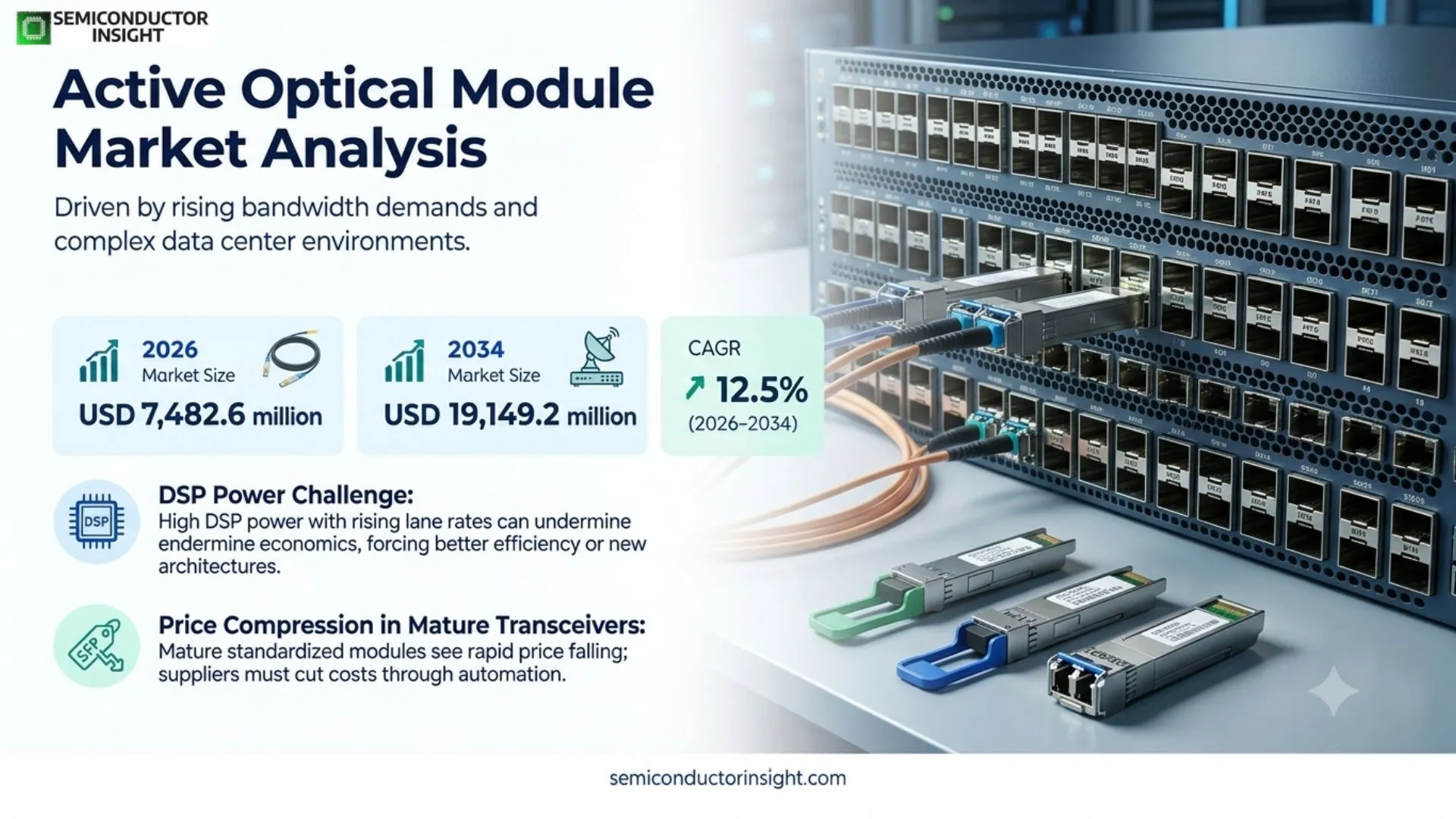
Active Optical Module Market was valued at USD 6,653.4 million in 2025, is estimated at USD 7,482.6 million in 2026, and is projected to reach USD 19,149.2 million by 2034. The anchor-implied growth path corresponds to a 12.5% CAGR during 2026–2034, while Asia Pacific is the largest regional market.
An active optical module is a field-deployable transceiver that contains powered electronic and photonic functions to convert electrical data into optical signals and receive optical signals back into electrical form. Unlike a passive cable or connector, the module includes active laser or modulator functions, photodetectors, driver and receiver electronics, control circuitry and often digital signal processing. It is therefore a complete electro-optical endpoint whose power, firmware, thermal behavior and interoperability directly affect the network equipment into which it plugs.
The commercial market spans mature XFP and SFP+ modules, multi-lane QSFP+ products, larger X2 and XENPAK formats and other active optical modules defined by the controlling report. These product families serve Optical Fiber Communication, Bandwidth and Other applications, with end users in Telecommunications, Data Centers, Enterprise Networks and Consumer Electronics. The technology scope also identifies Wavelength Division Multiplexing, Coherent Optical Communication and Short-Reach Communication, showing that the market crosses both high-volume datacom and specialized long-reach transport use cases.
The reason the category is expanding is not simply that more fiber is being installed. The more important change is the amount of data each active endpoint must carry. AI clusters and hyperscale data centers are compressing the transition from 400G to 800G and 1.6T, while 5G, fiber access and metro networks continue increasing aggregation traffic. The active module absorbs much of the engineering needed to make those links interoperable: optical power control, lane management, diagnostics, DSP equalization and thermal protection are packaged behind a standardized electrical and mechanical interface.
External evidence supports a structurally rising bandwidth requirement. IEA analysis projects data-center electricity consumption to grow sharply through 2030 as AI workloads expand, GSMA expects 5G to become a much larger share of mobile connections across major regions, and Ethernet Alliance plus OIF interoperability programs have moved beyond 800G toward 1.6T and new coherent links. Those trends raise active-module revenue potential but also make power efficiency and manufacturing yield central to commercial success.
Segment Analysis: By Type
By type, the active optical module market is segmented into XFP, SFP+, QSFP+, X2, XENPAK and Others. QSFP+ holds the leading position in the source-defined segmentation because its multi-lane architecture delivered a major density improvement over earlier 10G formats, while the broader market is now extending the same compact pluggable logic into much higher-rate generations.
| Type | Technical role | Market position |
|---|---|---|
| XFP | XFP is a hot-pluggable form factor developed for 10 Gigabit-class optical links with enough module volume for laser, receiver and electronic functions while keeping the optical interface replaceable. It is used across telecom, enterprise and legacy transport platforms that continue to require stable, qualified optics rather than the highest available bandwidth. | A mature installed-base segment. New designs generally prefer smaller or denser form factors, but XFP remains relevant in deployed network equipment, long-life telecom systems and replacement channels. The commercial opportunity is therefore driven more by availability, wavelength options, reach and interoperability with existing line cards than by rapid unit-growth in new equipment. |
| SFP+ | SFP+ reduced the size and power required for 10G optical connectivity compared with earlier 10G modules, helping it become a standard interface across switches, servers, storage, telecom access and enterprise networks. Its mature electrical and management ecosystem supports a wide choice of reaches, wavelengths and fiber types from numerous qualified vendors. | A large, cost-competitive category with broad replacement demand. SFP+ volumes persist because 10G remains sufficient for many access, enterprise and industrial links, but revenue growth is restrained by intense price competition and migration to multi-lane QSFP families at aggregation layers. Suppliers compete on reliability, compatibility, wavelength breadth and distribution efficiency. |
| QSFP+ | QSFP+ aggregates multiple electrical and optical lanes in a compact pluggable body, historically enabling 40G and breakout configurations with much higher front-panel density than single-lane 10G modules. The architecture established the multi-lane QSFP ecosystem that later evolved into higher-rate QSFP28, QSFP-DD and related products. | Leading type in the source segmentation. QSFP+ benefits from a broad installed base and the continuing value of high port density. Although frontier data-center demand has moved well beyond 40G, the QSFP architecture remains strategically important because it underpins successive generations of multi-lane pluggables and maintains substantial enterprise, telecom and replacement demand. |
| X2 | X2 modules provide a larger 10G-era form factor with significant thermal and component space. They were widely used in earlier enterprise and carrier equipment before smaller XFP and SFP+ interfaces became prevalent. The larger body can support robust thermal performance but consumes valuable faceplate and board area. | A declining but durable replacement niche. New platforms rarely select X2 because compact modules provide better density, yet installed chassis can remain in service for many years. Suppliers serving this segment benefit from limited competition and maintenance demand, but volume is tied to the aging installed base rather than new technology adoption. |
| XENPAK | XENPAK was one of the earliest standardized pluggable approaches for 10 Gigabit Ethernet and uses a comparatively large mechanical envelope. It integrated the optical conversion and active electronics needed for early 10G systems at a time when component power and size prevented today’s compact implementations. | A legacy service market. XENPAK demand is associated with field replacement, network spares and specialized installed equipment. The segment illustrates the long tail of optical module lifecycles: even after a form factor leaves new-system roadmaps, operators may need compatible units for years, creating a small but defensible aftermarket for qualified suppliers. |
| Others | The source-defined Others category captures active optical modules that do not fall into the named legacy families, including newer or application-specific pluggables and proprietary active interfaces. Commercially, this is where higher-speed module generations and specialized coherent or short-reach products can contribute even though the report’s primary labels remain historically established form factors. | Fastest-changing category. Market value is migrating toward newer high-rate active optics used in cloud and AI fabrics, coherent metro links and specialized interconnects. The opportunity carries higher ASPs and technology value than mature 10G products, but also more demanding DSP, thermal, firmware and qualification requirements, producing greater manufacturing and customer-concentration risk. |
The installed-base tail and the high-speed frontier coexist
Active optical modules have unusually long coexistence between generations. A hyperscale switch fabric may refresh every few years and adopt the newest high-rate optics, while telecom, enterprise and industrial chassis can remain operational for a decade or more. Suppliers therefore support legacy XFP, X2 or XENPAK replacement demand at the same time they invest in high-speed QSFP-derived and coherent products. This bifurcation affects inventory, test equipment and channel strategy: mature modules reward low-cost repeatability, whereas new modules reward engineering depth and fast qualification.
Segment Analysis: By Application
By application, the controlling source segments the market into Optical Fiber Communication, Bandwidth and Others. Optical Fiber Communication is the dominant application because active modules terminate fiber links across telecom, data-center and enterprise networks, while the Bandwidth category captures capacity-driven upgrades where higher line rates rather than new endpoints are the primary purchasing trigger.
| Application | Demand characteristics |
|---|---|
| Optical Fiber Communication | Largest application. Active modules are installed wherever network equipment must launch or receive optical signals across fiber, including access, metro, core, enterprise and data-center links. Purchasing is governed by reach, wavelength, link budget, platform compatibility and lifecycle requirements. Telecom operators favor long qualification and stable supply, while data centers emphasize power, density and rapid speed migration; both ultimately rely on interoperable active transceivers. |
| Bandwidth | This source-defined category represents demand created by capacity expansion rather than a distinct physical network. Operators and data-center owners often upgrade optics before replacing all underlying fiber because increasing line rate is faster and cheaper than building new routes. The category therefore benefits directly from traffic concentration, AI workload growth and higher aggregation speeds, with purchasing focused on throughput per port, watts per bit and the ability to reuse installed fiber plant. |
| Others | Other uses include specialized government, defense, industrial, storage and consumer-adjacent optical links that require active conversion but do not follow mainstream telecom or hyperscale economics. Volumes are smaller, yet qualification can be demanding because customers may need extended temperature ranges, unusual wavelengths, ruggedization or long service life. Suppliers can earn attractive margins when they support custom requirements without sacrificing production discipline. |
End-user and technology mix
Telecommunications is the principal end user in the source scope, followed by Data Centers, Enterprise Networks and Consumer Electronics. The technology split across Wavelength Division Multiplexing, Coherent Optical Communication and Short-Reach Communication explains why a single ‘active module’ market contains very different cost structures. Short-reach datacom favors high unit volume and low energy per bit; WDM and coherent links add lasers, DSP and optical complexity but support longer reach and higher value; enterprise products emphasize compatibility and channel availability.
Regional Analysis
Asia Pacific is the largest active optical module market, supported by module manufacturing scale, 5G deployment and regional cloud infrastructure. North America sets much of the hyperscale technology roadmap, Europe is driven by fiber modernization and standards-based procurement, South America is concentrated in major operator and cloud markets, and Middle East & Africa combine premium Gulf deployments with broader backbone expansion.
How do regional network architectures change active optical module purchasing?
The same module can have a different commercial role by region. In Asia Pacific it is often produced close to the network equipment and bought at high volume; in North America it may be qualified first for an AI or cloud platform; in Europe it enters through carrier and enterprise interoperability processes; in South America imported availability and platform compatibility dominate; and in Gulf markets greenfield data centers can move directly to high-rate optics while African networks place greater weight on reach and ruggedness.
| Region | Position | Growth outlook | Demand profile | What decides supplier selection |
|---|---|---|---|---|
| Asia Pacific | Largest | Fastest / high | Manufacturing + 5G + cloud | Cost, production yield, local OEM qualification and component access |
| North America | High-value leader | High | Hyperscale + AI data centers | Power efficiency, speed roadmap, firmware/telemetry and rapid platform qualification |
| Europe | Established | Moderate-high | Fiber + enterprise + carrier | Interoperability, lifecycle support, energy efficiency and distributor/OEM compatibility |
| South America | Developing | Moderate | Brazil-led telecom + cloud | Landed cost, stock availability, reach options and compatibility |
| Middle East & Africa | Smaller base | High from low base | Gulf data centers + telecom backbone | Project support, temperature robustness, global OEM approval and lead time |
Competitive Landscape
Active optical module competition is governed by qualification, manufacturing yield and access to fast-evolving photonic and electronic components. The source scope includes Daiichiseiko, Silicon Line, HiSilicon, Hisense Broadband, Accelink Technologies, Eoptolink, Amphenol, Hilink Technology, Gearlink, T&S Communication and GrenTech, spanning complete modules, connectivity, electronics and regional optical-network suppliers.
The core competitive capability is to deliver a complete transceiver whose optics, electronics, firmware and thermal behavior remain stable across millions of port-hours. Buyers do not purchase laser performance in isolation; they qualify the module inside a switch, router or transport system. That makes interoperability databases, firmware maturity, manufacturing traceability and field-return performance important intangible assets. A supplier that can prove compatibility across multiple OEM platforms gains access to replacement and expansion demand far beyond the first design win.
High-speed data-center modules create a different profit pool from mature enterprise optics. Legacy SFP+ and related products face heavy price pressure because electrical interfaces and optical components are standardized and many vendors can manufacture them. New 800G and 1.6T-class modules command more value but require expensive DSPs, high-speed test and stronger thermal engineering. Profitability therefore depends on how quickly a supplier raises yield and reduces component cost after launch rather than on the initial selling price alone.
Telecommunications suppliers compete on reach, wavelength, coherent performance and long service life, while hyperscale suppliers compete on bandwidth density and energy per bit. Vendors that serve both markets can reuse photonics and manufacturing capabilities, but the qualification models differ substantially. Carrier products may remain supported for many years; cloud buyers can migrate speed generations quickly and demand aggressive annual cost reductions. Portfolio balance is therefore a strategic hedge against abrupt technology transitions.
Connectivity and component specialists influence competition even when they do not sell a complete transceiver. Amphenol and other interface suppliers benefit as lane rates make connectors and signal integrity more critical, while silicon and optical-component providers shape DSP power and photonic integration. As active modules absorb more intelligence and thermal complexity, the competitive boundary expands beyond traditional optical assemblers into semiconductor, connector and system-design ecosystems.
| Competitive tier | Companies / roles | Positioning logic |
|---|---|---|
| Optical module specialists | Hisense Broadband; Accelink Technologies; Eoptolink; Hilink Technology; Gearlink; T&S Communication; GrenTech | Compete through broad transceiver portfolios, volume manufacturing, telecom and data-center customer access, and rapid introduction of new speeds. Their strongest advantage is the ability to turn photonic and electronic components into qualified, cost-down products at scale while supporting a long tail of mature module formats. |
| Electronics / silicon ecosystem | HiSilicon; Silicon Line and related active-interface suppliers | Influence module power, signal integrity and active electronic functions. As lane rates increase, equalization, DSP and high-speed electrical behavior become central to transceiver performance, giving semiconductor and interface technology providers greater leverage over module architecture and power consumption. |
| Connectivity / precision component ecosystem | Amphenol; Daiichiseiko and specialized connector/assembly suppliers | Supply connectors, electromechanical interfaces and precision components that determine insertion loss, mechanical reliability and serviceability. Their value rises with higher lane rates and denser form factors because a connector or contact system that was adequate at 10G can become a limiting element at 100G-per-lane or beyond. |
Companies profiled in the source scope
The controlling report profiles Daiichiseiko, Silicon Line, Hisilicon, Hisense Broadband, Accelink Technologies, Eoptolink, Amphenol, Hilink Technology, Gearlink, T&S Communication and GrenTech. The list is preserved exactly as the source scope presents it, although the companies participate at different levels of the active optical ecosystem, including complete modules, semiconductor interfaces, connectors and communications equipment.
Production Capacity Analysis
Active optical module capacity is constrained by qualified assembly and high-speed test more than by simple factory floor area. Mature 10G-class products can be produced on well-understood lines, but 800G and 1.6T products require more expensive DSPs, tighter optical alignment, faster electrical test and stronger thermal control. Effective capacity therefore varies dramatically by generation even within the same factory.
China and broader East Asia host much of the high-volume transceiver assembly ecosystem because component suppliers, contract manufacturers and optical specialists are geographically concentrated. This scale supports aggressive cost reduction in mature products and rapid line expansion for new generations. However, capacity for a legacy SFP+ module cannot be treated as equivalent to 800G capacity: the latter requires different test equipment, optical engines, thermal fixtures and process capability, so generation-specific bottlenecks can persist.
The production flow starts with qualified lasers, photonic devices, photodetectors, DSPs and PCB assemblies, then moves through optical alignment, fiber attach, module closure, firmware programming and high-speed verification. Test cost rises sharply with lane rate because manufacturers need equipment capable of validating eye quality, bit-error performance, wavelength stability and thermal behavior. Yield learning is therefore a major competitive asset; suppliers with more volume data can identify process tolerances that reduce rework and field failures.
Thermal design is increasingly part of manufacturing capacity. A high-rate module may need specialized heat spreaders, cages, interface materials or liquid-cooling features, each adding assembly and validation steps. Coherent modules introduce further DSP heat and optical calibration. This means future capacity expansion will include not only more assembly stations but also thermal chambers, high-speed testers and automated alignment tools, raising the capital barrier for suppliers attempting to enter the high-end segment.
Market Dynamics
Demand grows when network operators need more bandwidth without rebuilding all underlying fiber and switching infrastructure. Active modules provide a modular way to raise line rates, but the technology faces a power and thermal penalty as more DSP and photonic functionality is packed into smaller envelopes. Market growth therefore depends on whether new generations can deliver lower cost per bit faster than power, test and cooling costs rise.
Market Drivers
| Driver | Impact | Commercial mechanism |
|---|---|---|
| AI and hyperscale network upgrades | High | AI fabrics require dense east-west connectivity and are rapidly moving toward 800G and 1.6T, increasing active-module value and shortening qualification cycles. |
| 5G and fiber transport expansion | High | Growing mobile and fixed-network traffic increases optical aggregation and backbone capacity, supporting both mature telecom transceivers and higher-rate coherent products. |
| Reuse of installed fiber | Medium-High | Operators can often increase throughput by replacing active endpoints while retaining fiber, making transceiver upgrades an economically attractive way to add network capacity. |
| Standards and interoperability | Medium-High | Ethernet and OIF specifications reduce multi-vendor risk and turn emerging high-speed modules into broader markets rather than proprietary point solutions. |
AI clusters accelerate optical speed transitions
AI systems place unusually high bandwidth demand between accelerators, switches and storage. As cluster size rises, electrical reach becomes more difficult and optical links move closer to compute. This pushes active modules toward 800G and 1.6T while making watts per bit a central purchase metric. Suppliers gain when they can combine efficient DSPs, photonic integration and stable thermal control, because every watt saved in a transceiver reduces rack-level cooling and power overhead across thousands of links.
Mobile and fixed networks keep expanding the transport layer
GSMA’s 5G adoption outlook and public fiber programs in the U.S. and Europe indicate that access networks continue expanding even as headline attention shifts to AI data centers. Every access endpoint aggregates into higher-capacity metro and core links. This creates demand across multiple active-module generations: lower-rate optics remain relevant near the edge, while higher-speed WDM and coherent modules carry concentrated traffic deeper in the network.
Pluggability lets operators upgrade bandwidth incrementally
A key commercial advantage of active optical modules is that the electro-optical conversion is field-replaceable. When switch or line-card interfaces support a faster module, operators can raise link capacity without replacing the fiber route itself. That lowers the capital threshold for network upgrades and creates recurring module refresh demand. The benefit is strongest when suppliers maintain backward-compatible mechanical and management interfaces across multiple data-rate generations.
Interoperability work broadens the addressable supplier base
Ethernet Alliance and OIF implementation work converts high-speed optical technology into standardized procurement. Once electrical lanes, management interfaces and optical link behavior are defined, customers can qualify more than one supplier and deploy modules across a larger equipment base. Standardization lowers adoption risk but increases competitive pressure, so vendors must differentiate through power, reach, field reliability, firmware quality and manufacturing cost rather than basic protocol compatibility.
Market Restraints
| Restraint | Impact | Commercial mechanism |
|---|---|---|
| Power and thermal density | High | Higher lane rates require more DSP and optical performance inside constrained module envelopes, increasing cooling cost and sometimes limiting usable switch faceplate density. |
| Rapid ASP erosion | High | Mature active modules become highly standardized and face intense price competition, forcing suppliers to improve yield and component sourcing continuously. |
| Qualification and compatibility risk | Medium-High | Firmware, EEPROM mapping, optical performance and thermal behavior must match target platforms. Failed qualification can block access to large customer volumes. |
| Architecture substitution | Medium | Linear pluggable, externally packaged or co-packaged optics could shift some high-end links away from conventional DSP-heavy pluggable modules if power becomes the dominant system bottleneck. |
DSP power can undermine the economics of higher bandwidth
Traditional high-speed active modules use digital signal processing to compensate for electrical and optical impairments, but DSP power rises with lane rate and complexity. In dense AI switches, hundreds of watts of optical-module load can accumulate at the faceplate. If cooling and energy costs rise too quickly, system designers may favor linear or more tightly integrated optical architectures. Conventional module suppliers must therefore improve DSP efficiency and thermal design to preserve the pluggable value proposition.
Mature transceivers experience relentless price compression
Once an optical interface is standardized and multiple vendors achieve acceptable yield, average selling prices can fall rapidly. SFP+ and other mature products remain important in unit volume but offer less room for differentiation. Suppliers need automated assembly, efficient test and disciplined component sourcing to remain profitable. The risk is that a company invests in a new generation, reaches volume just as prices fall, and must simultaneously fund qualification of the next higher speed.
Platform qualification can be a hard commercial gate
Active modules interact with host equipment through electrical signal integrity, management firmware, thermal behavior and optical link budgets. A technically compliant module can still fail a customer’s qualification because of firmware details, power draw or marginal system performance. Large OEM and hyperscale design wins therefore require engineering support and repeated interoperability testing. The qualification burden protects incumbents but can exclude smaller vendors from the highest-volume platforms.
Alternative optical architectures challenge the conventional module boundary
At very high switch bandwidth, shortening the electrical path between the switch ASIC and optics can save power. Linear pluggable optics, externally packaged optics and co-packaged optics each attack this problem differently. They do not eliminate the need for active photonic components, but they can move DSP or optical engines out of the conventional transceiver envelope. Suppliers whose capability is limited to assembling standard modules may therefore face value migration unless they adapt to new integration models.
Market Opportunities
1.6T active pluggables for AI fabrics
The transition to 1.6T creates a high-value qualification window because customers need more switch throughput before the ecosystem has fully commoditized. Vendors that achieve stable 200G-per-lane electrical and optical performance, manageable module power and high manufacturing yield can capture large AI-cluster design wins. The opportunity extends to DSP, connectors, thermal hardware and automated test, so value is distributed across the active-module ecosystem rather than only the transceiver assembler.
Compact coherent optics for metro and data-center interconnect
Coherent technology is moving into smaller pluggable formats. OIF agreements for 800ZR and 800LR and commercial QSFP-DD products show that operators can deploy high-capacity coherent links without dedicated large transport cards in every application. Active-module suppliers that integrate tunable optics, coherent DSP and thermal management reliably can address data-center interconnect and metro networks where reach and operational simplicity justify higher selling prices.
Energy-optimized module architectures
Power has become a purchasing criterion rather than just a specification line. Suppliers can differentiate through lower-power DSPs, silicon photonics, linear-drive approaches, improved thermal paths and smarter module telemetry. Even a small reduction in watts per module can produce meaningful rack-level savings at hyperscale volumes. This creates a commercial opportunity for designs that reduce total network energy cost rather than merely increase nominal bandwidth.
Long-tail replacement and specialty modules
The active-module market retains old form factors for years after new-system adoption moves on. XFP, X2, XENPAK and specialized wavelength products can therefore support aftermarket revenue where customers value exact compatibility and cannot economically replace complete chassis. Suppliers with efficient small-batch manufacturing and broad inventory can earn attractive margins in these niches while high-volume competitors focus on the newest data-center generation.
Supply Chain Analysis
Lasers, photonic devices and electronics. The upstream bill of materials includes laser sources, photonic integrated circuits, photodetectors, drivers, TIAs, DSPs, microcontrollers and connectors. Component performance sets the module’s reach, power and cost. High-speed DSPs and advanced lasers can be concentrated among a small supplier group, so active-module vendors qualify alternate components where possible while balancing firmware, thermal and optical redesign risk.
Optical engine and subassembly. Photonic dies, fiber arrays, TOSA/ROSA functions and optical coupling are assembled into subcomponents that can be integrated efficiently at final module stage. Precision alignment and low-loss interfaces determine yield. Suppliers that automate this process gain a cost advantage because optical rework is expensive and can damage high-value components. At higher speeds, the subassembly also becomes a thermal and electrical design element rather than only an optical one.
Active module assembly and test. Final production combines the optical engine, PCB, DSP, firmware, connector and mechanical shell, followed by programming, calibration and high-speed verification. Testing across temperature and optical power ranges can consume substantial equipment time. Manufacturers with scalable test automation and strong yield analytics can lower cost faster after a new generation launches, which is crucial because customer price reductions usually begin well before the product becomes technologically obsolete.
Network OEM and operator deployment. Switch, router, server and transport-platform vendors qualify modules for electrical, optical, firmware and thermal interoperability. Hyperscalers may purchase directly at very high volume; telecom operators often buy through equipment platforms and require long lifecycle support; enterprises depend more on OEM and distributor compatibility. Once a module family is qualified, installed-base replacement and expansion can generate recurring demand even after newer products enter the market.
Recent Developments in the Active Optical Module Market
Developments tracked to September 2026. Entries are dated to the source publication or official milestone.
- 17 March 2026 Next-generation roadmap
Coherent demonstrated next-generation pluggable transceiver technologies spanning 1.6T, 3.2T and emerging 12.8T at OFC 2026. The roadmap demonstrates how active optics are moving toward much higher bandwidth while forcing suppliers to address DSP efficiency, thermal density and manufacturability inside serviceable module architectures.
Source - 12 March 2026 1.6T demonstration
Eoptolink demonstrated a 1.6T DR4 optical transceiver based on 400G-per-lambda technology and described the progression from high-volume 800G toward 1.6T. The development provides direct evidence that active-module suppliers are industrializing a new speed tier for AI and hyperscale data-center fabrics.Source - 12 March 2026 Cooling innovation
Eoptolink unveiled a liquid-cooled 12.8 Tbps pluggable-optics concept. Bringing liquid cooling to the module changes service, sealing and mechanical requirements and illustrates the pressure that active optical power density is placing on conventional air-cooled front-panel architectures.
Source - 27 October 2025 800G / 1.6T interoperability
Ethernet Alliance reported 800G interoperability as established while the ecosystem advanced toward 1.6T. Broader interoperability lowers the risk of multi-vendor active-module qualification and supports migration from early proprietary deployments into larger standardized purchasing programs.
Source - 28 March 2025 Commercial coherent module
Coherent announced general availability of 800G ZR/ZR+ coherent optics in QSFP-DD. Compact coherent pluggables extend the active-module model into data-center interconnect and metro transport, increasing module value but also raising power, thermal and optical-calibration requirements.
Source
Report Scope & Segmentation
| Attribute | Coverage |
|---|---|
| Market | Active Optical Module Market |
| Base Year | 2025 |
| Estimated Year | 2026 |
| Forecast Period | 2026-2034 |
| By Type | XFP; SFP+; QSFP+; X2; XENPAK; Others |
| By Application | Optical Fiber Communication; Bandwidth; Others |
| By End User | Telecommunications; Data Centers; Enterprise Networks; Consumer Electronics |
| By Technology | Wavelength Division Multiplexing (WDM); Coherent Optical Communication; Short-Reach Communication |
| Regions | North America; Europe; Asia Pacific; South America; Middle East & Africa |
| Companies Profiled | Daiichiseiko; Silicon Line; Hisilicon; Hisense Broadband; Accelink Technologies; Eoptolink; Amphenol; Hilink Technology; Gearlink; T&S Communication; GrenTech |
| Customization Scope | Free customization may add or alter country, regional or segment coverage within the agreed analyst-work allocation while keeping the source-defined market and segmentation clearly separated from any client-requested additions. |
Frequently Asked Questions
What is the size of the active optical module market?
The global active optical module market is rebased to USD 6,653.4 million in 2025, estimated at USD 7,482.6 million in 2026, and projected to reach USD 19,149.2 million by 2034, implying a CAGR of 12.5% during 2026-2034. The calculation uses the source-page anchors of USD 5,916 million in 2024 and USD 15,140 million in 2032; those anchors imply a lower rate than the page’s printed 14.7% CAGR.
What is an active optical module?
An active optical module is a powered transceiver that converts electrical data into optical signals for transmission over fiber and converts received light back into electrical data. It contains active photonic and electronic functions such as lasers or modulators, photodetectors, driver and receiver circuits, control logic and, in many high-speed products, digital signal processing. The module is therefore both an optical interface and an intelligent electrical subsystem inside network equipment.
Which type leads the active optical module market?
QSFP+ is the leading type within the source-defined segmentation because its multi-lane architecture delivered significantly greater port density than earlier 10G form factors and created a broad ecosystem across enterprise, telecom and data networking. Newer high-speed products increasingly use evolved QSFP-derived architectures beyond the named source categories, while SFP+ retains a large mature installed base and XFP, X2 and XENPAK serve long-tail replacement demand.
Which application dominates the active optical module market?
Optical Fiber Communication is the dominant application because active transceivers are the powered endpoints used to launch and receive optical signals across telecom, enterprise and data-center fiber links. The source also identifies Bandwidth and Others as application categories. Bandwidth-driven demand grows when operators can raise link capacity by upgrading transceivers while keeping existing fiber, making active-module replacement an economically efficient way to expand network throughput.
Which region is largest for active optical modules?
Asia Pacific is the largest and fastest-growing region because it combines major active-module manufacturing capacity with large telecom, 5G, cloud and enterprise-network demand. China is the central production and consumption hub, while Japan and South Korea contribute high-value component and system capabilities and India plus Southeast Asia expand digital infrastructure from a lower installed base. This regional concentration supports rapid cost reduction and shorter product-ramp cycles.
How is AI affecting the active optical module market?
AI infrastructure increases both the number of high-speed links and the bandwidth required per link inside data centers. As accelerator clusters grow, networks move from 400G toward 800G and 1.6T, raising demand for active modules with lower energy per bit and stronger thermal performance. The opportunity is substantial, but it also exposes a key constraint: DSP and optical power can consume a meaningful portion of rack energy if module efficiency does not improve alongside bandwidth.
What are the biggest restraints on active optical module growth?
Power density, thermal management, rapid price erosion, platform qualification and alternative optical architectures are the main restraints. Higher-speed modules need more sophisticated DSP and test, yet customers expect lower cost per bit over time. Mature products become commoditized quickly, while new products carry high development expense. If conventional pluggables consume too much power at future switch speeds, linear, externally packaged or co-packaged optics may shift value away from the traditional module envelope.
How do coherent optical modules expand the market?
Coherent active modules integrate advanced optical modulation, tunable laser functions and DSP to carry very high capacity over longer fiber distances than conventional short-reach datacom optics. OIF standards and commercial 800G ZR/ZR+ products are moving coherent capability into compact pluggable formats such as QSFP-DD. This lets data-center and metro operators deploy high-capacity links more simply, but increases module value, calibration complexity, thermal load and firmware requirements.
Who are the key companies in the active optical module market?
The controlling report profiles Daiichiseiko, Silicon Line, Hisilicon, Hisense Broadband, Accelink Technologies, Eoptolink, Amphenol, Hilink Technology, Gearlink, T&S Communication and GrenTech. These companies occupy different parts of the ecosystem, including complete optical modules, electronic interfaces, connectors and communications hardware. Competition therefore depends on more than transceiver assembly: component access, signal integrity, manufacturing yield, firmware maturity and platform qualification all influence supplier positioning.
What technology shift is most important through 2034?
The critical shift is the move from today’s mainstream pluggables toward 1.6T and later multi-terabit active optical links while keeping power and cooling manageable. The industry is exploring several paths, including more efficient DSPs, silicon photonics, coherent pluggables, linear-drive architectures, liquid-cooled modules and optics located closer to switch silicon. The winning architecture may vary by reach and application, but suppliers must evolve beyond legacy transceiver assembly toward integrated electro-optical and thermal system design.
Research Sources & Evidence Base

Get Sample Report PDF for Exclusive Insights
Report Sample Includes
- Table of Contents
- List of Tables & Figures
- Charts, Research Methodology, and more...



