
Active Matrix Organic Light Emitting Diode Market Insights
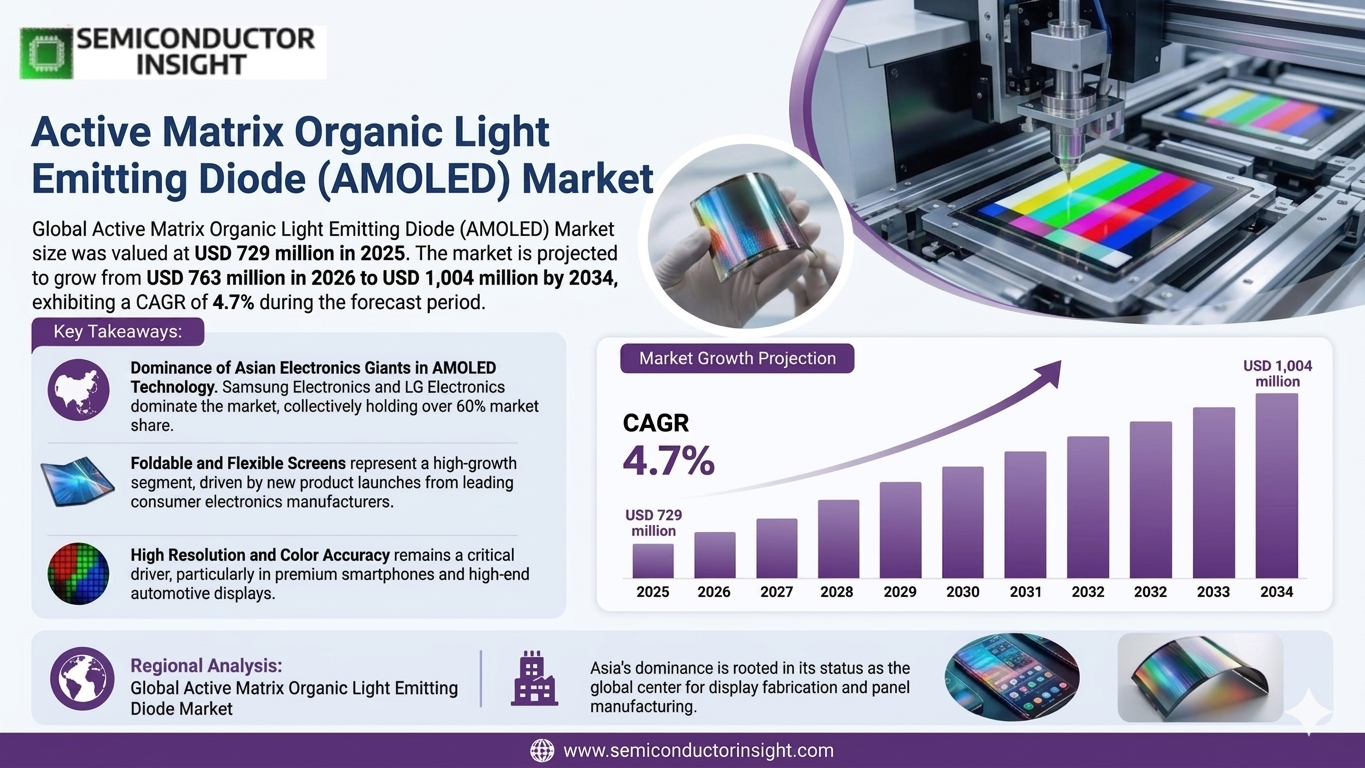
Global Active Matrix Organic Light Emitting Diode market size was valued at USD 729 million in 2025. The market is projected to grow from USD 763 million in 2026 to USD 1,004 million by 2034, exhibiting a CAGR of 4.7% during the forecast period.
Active Matrix Organic Light Emitting Diodes (AMOLED) are advanced display technologies that combine organic compounds with thinfilm transistor (TFT) arrays to enable highresolution, energyefficient screens. Unlike traditional LCDs, AMOLED displays emit their own light, eliminating the need for backlighting while offering superior contrast ratios and faster response times. These displays are widely used in smartphones, televisions, wearables, and automotive infotainment systems due to their flexibility and vibrant color reproduction.
The market growth is driven by increasing demand for premium consumer electronics and advancements in flexible display technology. Key players such as Samsung Electronics and LG Electronics dominate production through continuous innovation in panel efficiency and foldable screen applications. Additionally, rising adoption of OLED technology in automotive displays further accelerates industry expansion.
MARKET DRIVERS
Growing Demand for HighQuality Displays
Active Matrix Organic Light Emitting Diode (AMOLED) market is experiencing significant growth due to increasing consumer demand for superior display quality. AMOLED technology offers vibrant colors, deeper blacks, and faster response times compared to traditional LCDs, making it ideal for smartphones, televisions, and wearable devices. With over 60% of premium smartphones now adopting AMOLED displays, manufacturers are accelerating production to meet rising expectations.
Energy Efficiency and Flexible Displays
AMOLED displays consume less power than conventional LCDs, making them a preferred choice for batterysensitive applications. Additionally, the flexibility of AMOLED panels enables innovative form factors in emerging markets such as foldable phones and rollable TVs. Industry leaders are investing heavily in R&D to enhance flexible AMOLED durability and production scalability.
➤ Global AMOLED market is projected to grow at a CAGR of 15.2% from 2023 to 2030, driven by demand in consumer electronics and automotive displays.
Automotive manufacturers are also integrating AMOLED screens into dashboards and infotainment systems, further expanding market opportunities.
MARKET CHALLENGES
High Production Costs
Despite its advantages, AMOLED manufacturing remains expensive due to complex fabrication processes and low yield rates for larger panels. The use of rare materials and precision deposition techniques contributes to cost inefficiencies, limiting widespread adoption in budget devices.
Other Challenges
Burnin and Lifespan Concerns
AMOLED displays are susceptible to image retention and degrade faster than LCDs under prolonged static content display, posing challenges for applications requiring alwayson screens.
MARKET RESTRAINTS
Supply Chain Constraints
Geopolitical tensions and material shortages have disrupted the supply of key AMOLED components, including organic emitters and thinfilm transistors. These bottlenecks have forced manufacturers to seek alternative suppliers, potentially delaying product launches.
MARKET OPPORTUNITIES
Expansion in AR/VR and Healthcare
The AMOLED market is poised for growth in augmented/virtual reality headsets, where high refresh rates and slim form factors are critical. Medical device applications, such as surgical monitors and diagnostic equipment, also present untapped potential due to AMOLED’s superior contrast and readability.
Active Matrix Organic Light Emitting Diode Market Trends
Increasing Adoption in Premium Display Applications
Active Matrix Organic Light Emitting Diode market is witnessing significant growth driven by demand for highend display solutions. AMOLED technology enables superior contrast ratios, faster response times, and wider viewing angles compared to traditional LCDs. Major manufacturers are investing heavily in production capacity expansion to meet growing demand from smartphone and television manufacturers seeking premium display features.
Other Trends
Technological Advancements in Quantum Dot Integration
Recent developments in combining AMOLED with quantum dot technology (AMQLED) are creating new opportunities. This hybrid approach enhances color gamut and energy efficiency, making displays suitable for professional applications where color accuracy is critical. The technology is gaining traction in medical imaging and professional design displays.
Expanding Automotive Display Applications
The automotive sector is emerging as a key growth area for Active Matrix Organic Light Emitting Diode technology. Flexible AMOLED displays are being increasingly adopted for digital cockpits, center stack displays, and rearseat entertainment systems due to their superior performance in various lighting conditions and ability to conform to curved surfaces.
Regional Market Developments
AsiaPacific continues to dominate Active Matrix Organic Light Emitting Diode market, with South Korea and China as major production hubs. Several Chinese manufacturers are now competing with established players through aggressive capacity expansion and governmentsupported initiatives in display technology development.
Supply Chain Optimization Efforts
Industry leaders are focusing on supply chain localization and vertical integration to mitigate geopolitical risks and raw material shortages. This includes backward integration into OLED material production and partnerships with semiconductor manufacturers to ensure stable supply of driving ICs critical for Active Matrix Organic Light Emitting Diode production.
COMPETITIVE LANDSCAPE
Key Industry Players
Dominance of Asian Electronics Giants in AMOLED Technology
Samsung Electronics and LG Electronics dominate Global AMOLED display market, collectively holding over 60% market share. Samsung has pioneered production scale with its QDOLED technology, while LG focuses on largeformat OLED TV panels. Chinese manufacturers like BOE and CSOT are rapidly expanding production capacities with government support, challenging the Korean leadership through aggressive pricing strategies.
Japanese firms Sony and Sharp maintain technological excellence in highend professional displays, while Taiwanbased AU Optronics leads in automotive display solutions. Emerging players like Nanosys are driving innovation in quantum dot applications for AMOLED, with Tianma and TCL gaining ground in midrange consumer electronics segments.
List of Key Active Matrix Organic Light Emitting Diode Companies Profiled
- Samsung Electronics
- LG Electronics
- BOE Technology
- CSOT (China Star Optoelectronics Technology)
- Sony Corporation
- Sharp Corporation
- Nanosys Inc.
- Tianma Microelectronics
- AU Optronics
- TCL Technology
- Hisense
- Vizio
- Panasonic Corporation
- Visionox Technology
- EverDisplay Optronics
Segment Analysis:
| Segment Category | SubSegments | Key Insights |
| By Type |
|
High Performance displays dominate premium applications due to:
|
| By Application |
|
Mobile Device Industry shows strongest adoption due to:
|
| By End User |
|
Consumer Electronics dominates demand because:
|
| By Technology |
|
Flexible AMOLED shows most promising growth potential:
|
| By Component |
|
OLED Panels represent the core value component:
|
Regional Analysis: Global Active Matrix Organic Light Emitting Diode Market
AsiaPacific
AsiaPacific hosts the world’s most advanced AMOLED production facilities with cuttingedge Gen 10.5 fabs coming online. Cluster developments in China’s Yangtze River Delta and South Korea’s Gyeonggi Province optimize supply chain efficiency for AMOLED components including organic materials and thinfilm transistors.
Regional players pioneer flexible and foldable AMOLED technologies, with Samsung and BOE securing dominant patent positions. Research institutions collaborate closely with manufacturers to develop nextgen encapsulation techniques and highefficiency blue OLED materials critical for AMOLED performance.
National display industry policies in China and South Korea provide substantial R&D tax credits and production subsidies. Japan’s METI supports domestic AMOLED material suppliers through targeted funding programs aiming to reduce foreign dependency in critical display components.
Premium smartphone penetration exceeding 50% in developed APAC markets drives AMOLED demand. Chinese brands increasingly incorporate AMOLED across midrange devices, while South Korean manufacturers focus on highrefreshrate gaming displays and ultrathin form factors.
North America
North America maintains strong AMOLED market positions through design innovation and premium applications. Apple’s flagship iPhone series drives substantial AMOLED panel demand, while USbased tech firms invest in microdisplay applications for AR/VR headsets. The region boasts specialized AMOLED research centers focusing on militarygrade displays and medical imaging solutions. California’s display technology startups pioneer energyefficient AMOLED architectures while automotive companies integrate curved AMOLED dashboards in luxury vehicles. Content creation ecosystems in Hollywood and gaming hubs accelerate professionalgrade AMOLED monitor adoption for colorcritical workflows.
Europe
European markets emphasize highperformance AMOLED applications in automotive and industrial sectors. German automakers lead in adopting AMOLED for digital cockpits and headsup displays, while Swiss watchmakers integrate flexible AMOLED in luxury smartwatches. EU research programs fund organic semiconductor development through Horizon Europe initiatives. The region maintains strong positions in AMOLED production equipment with key players supplying evaporation systems and laser patterning tools to Asian manufacturers. Health and safety regulations drive innovation in lowbluelight AMOLED technologies for consumer devices.
Middle East & Africa
The MEA region shows growing AMOLED adoption through premium smartphone imports and expanding retail display applications. Gulf countries demonstrate increasing demand for largeformat AMOLED signage in luxury malls and airports. South Africa’s consumer electronics market shows gradual AMOLED penetration as Chinese smartphone brands expand distribution networks. Regional investments in smart city infrastructure create opportunities for AMOLEDbased public information displays, though adoption remains constrained by limited local manufacturing capabilities.
South America
Brazil and Argentina represent emerging AMOLED markets with growing premium electronics consumption. Smartphone manufacturers introduce AMOLED models targeting uppermiddleclass consumers, while retail chains deploy AMOLED digital signage in urban centers. Regional trade policies and import tariffs currently limit widespread AMOLED adoption, though local assembly initiatives may improve affordability. Brazilian research institutes collaborate with international partners on flexible display applications for industrial monitoring systems.
Report Scope
This market research report provides a comprehensive analysis of Active Matrix Organic Light Emitting Diode Market, covering the forecast period 2026–2034. It offers detailed insights into market dynamics, technological advancements, competitive landscape, and key trends shaping the industry.
Key focus areas of the report include:
- Market Overview: The report begins with an overview outlining its current market scenario, key growth indicators, and industry transformation drivers. It discusses macroeconomic factors, demand–supply balance, regulatory landscape, and the strategic role of semiconductors in powering advancements across industries such as automotive, telecommunications, consumer electronics, and industrial automation.
- Market Size & Forecast: Historical data and future projections for revenue, unit shipments, and market value across major regions and segments.
- Segmentation Analysis: Detailed breakdown by product type, technology, application, and enduser industry to identify highgrowth segments and investment opportunities.
- Regional Insights: Insights into market performance across North America, Europe, AsiaPacific, Latin America, and the Middle East & Africa, including countrylevel analysis where relevant.
- Competitive Landscape: Profiles of leading market participants, including their product offerings, R&D focus, manufacturing capacity, pricing strategies, and recent developments such as mergers, acquisitions, and partnerships.
- Technology Trends & Innovation: Assessment of emerging technologies, integration of AI/IoT, semiconductor design trends, fabrication techniques, and evolving industry standards.
- Market Drivers & Restraints: Evaluation of factors driving market growth along with challenges, supply chain constraints, regulatory issues, and marketentry barriers.
- Stakeholder Insights: Insights for component suppliers, OEMs, system integrators, investors, and policymakers regarding the evolving ecosystem and strategic opportunities.
Primary and secondary research methods are employed, including interviews with industry experts, data from verified sources, and realtime market intelligence to ensure the accuracy and reliability of the insights presented.
FREQUENTLY ASKED QUESTIONS:
What is the current market size of Active Matrix Organic Light Emitting Diode Market?
> Global Active Matrix Organic Light Emitting Diode Market was valued at USD 729 million in 2025 and is expected to reach USD 1004 million by 2034.
What is the growth rate of Active Matrix Organic Light Emitting Diode Market?
> The market is projected to grow at a CAGR of 4.7% during the forecast period 20262034.
Which key companies operate Active Matrix Organic Light Emitting Diode Market?
> Key players include Samsung Electronics, LG Electronics, BOE, CSOT, Sony, Sharp, Nanosys, Tianma, AU Optronics, and TCL. Global top five players held approximately % revenue share in 2025.
What are the key market segments?
> Market is segmented by:
- Type: Basic, High Performance
- Application: TV Industry, Display Industry, Mobile Device Industry, Automotive Industry, Others
Which region dominates Active Matrix Organic Light Emitting Diode Market?
> Asia holds significant market share with key countries including China, Japan, and South Korea. The U.S. market size was estimated at $ million in 2025.

Get Sample Report PDF for Exclusive Insights
Report Sample Includes
- Table of Contents
- List of Tables & Figures
- Charts, Research Methodology, and more...
 Download Sample Report PDF



