
Key Statistics
Key Takeaways
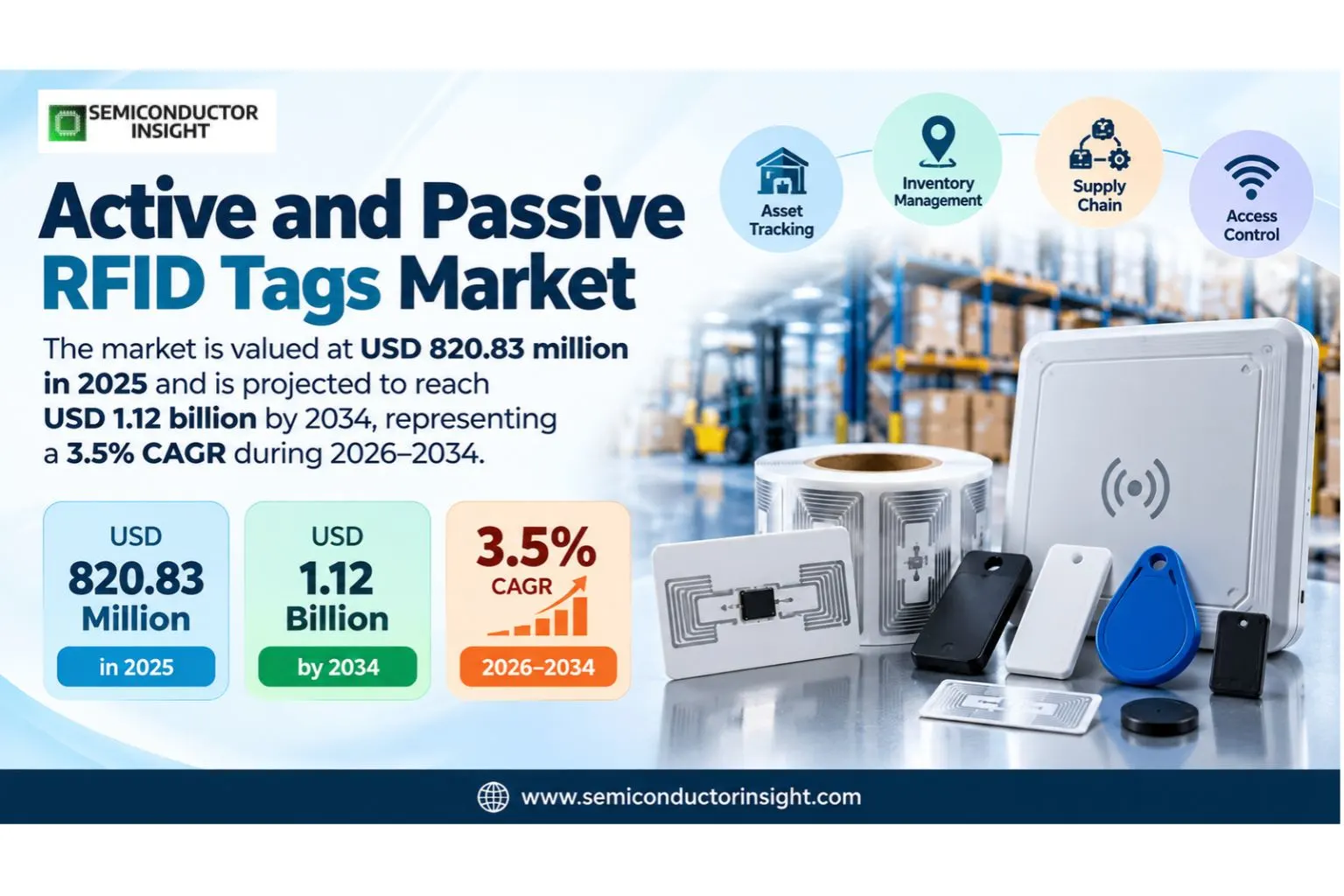
- Market size: The market is valued at USD 820.83 million in 2025 and is projected to reach USD 1.12 billion by 2034, representing a 3.5% CAGR during 2026–2034.
- Passive RFID tags dominate market share because their low cost enables large-scale retail, logistics and inventory deployments, while active tags are concentrated in high-value real-time tracking.
- Warehousing and logistics is the leading application, supported by supply-chain digitization, automated inventory and the need for faster non-line-of-sight identification.
- North America leads current revenue at about 38% in the reference analysis, while Asia Pacific has the strongest growth profile through manufacturing and logistics expansion.
- UHF is the most important frequency band for growth, while active BLE/UWB tracking expands the addressable market for high-value assets and real-time location.
Active and Passive RFID Tags Market Overview
Active and passive RFID tags market is valued at USD 820.83 million in 2025 and is projected to reach USD 1.12 billion by 2034, expanding at a 3.5% CAGR during 2026–2034. The 2026 market level is USD 849.64 million. North America leads current adoption across logistics, retail, healthcare and industrial tracking, while Asia Pacific grows fastest through manufacturing and smart-infrastructure investment. The market combines very low-cost passive tags with battery-powered active devices used for longer-range real-time visibility.
Active RFID tags contain a battery and can transmit over long range or support richer sensing, while passive RFID tags harvest energy from the reader and are optimized for low-cost, high-volume identification. The two technologies serve different economics: passive tags dominate item-level retail and inventory, while active tags are used for high-value assets, people, vehicles and environments where continuous location or condition monitoring creates enough value to justify higher tag cost.
Technology development spans UHF endpoint ICs, improved antenna designs, longer active-tag battery life and hybrid RFID with Bluetooth or ultra-wideband location. HID’s 2026 asset-tracking portfolio combines passive RFID and active IoT approaches, while Avery Dennison and Impinj continue advancing high-volume passive-tag performance. Cloud analytics increasingly connect tag events with warehouse, maintenance and inventory systems.
RFID tag economics depend on the value of the tracked object and the operational process being automated. Passive labels must be inexpensive enough for millions of items, while active tags can cost much more if they reduce asset loss, search time or downtime. Readers, middleware and integration remain part of the total project cost, so tag suppliers increasingly compete through complete application ecosystems and vertical solutions.
Segment Analysis: By Type
By type, the market is segmented into active and passive RFID tags. Passive tags account for the majority of revenue and an even larger share of unit shipments because they are low cost and maintenance-free. Active tags are smaller in volume but higher in value, serving real-time location, long-range tracking and environmental monitoring where battery power enables continuous transmission.
| Type | Commercial role |
|---|---|
| Active RFID Tags | Battery-powered beacon or transponder tags for long-range tracking, RTLS and high-value assets. |
| Passive RFID Tags | Reader-powered LF, HF and UHF tags for item-level inventory, access and identification. |
Additional Segmentation: By Frequency
Frequency determines read range, data rate, antenna size and sensitivity to materials. LF supports short-range identification and harsh environments, HF is widely used in cards, libraries and NFC-adjacent systems, and UHF provides longer read range and bulk scanning for retail and logistics. Active RFID may also use 433MHz, 2.4GHz, BLE or UWB depending on location and telemetry requirements.
| Frequency | Demand characteristics |
|---|---|
| Low Frequency (LF) | Short-range robust identification for livestock, access and industrial use. |
| High Frequency (HF) | Cards, ticketing, libraries and short-range item identification. |
| Ultra-High Frequency (UHF) | Longer-range passive identification for retail, logistics and industrial inventory. |
Segment Analysis: By Application
By application, warehousing and logistics is the leading segment, followed by retail, industrial manufacturing and healthcare. Logistics benefits from bulk reading and real-time tracking of pallets, containers and assets. Retail uses passive UHF at item level, industrial plants use both passive and active tags, and healthcare uses active location or passive identification depending on asset value and workflow.
| Application | Demand characteristics |
|---|---|
| Retail and Wholesale | Item-level inventory, shrink reduction and omnichannel fulfillment. |
| Warehousing and Logistics | Pallet, parcel, container and high-value asset visibility. |
| Industrial Manufacturing | WIP tracking, tools, returnable assets and maintenance. |
| Healthcare | Equipment location, patient flow, pharmaceuticals and device identification. |
| Others | Aviation, mining, agriculture, access and government applications. |
Additional Segmentation: By Material
Tag material affects durability, cost and RF behavior. Paper is common for low-cost labels, plastic supports durable industrial tags, glass is used in embedded or specialty identification, and metal or on-metal constructions are designed for conductive surfaces that would detune standard antennas. Material selection becomes especially important in healthcare, manufacturing and outdoor logistics where tags face cleaning, impact or temperature exposure.
| Material | Commercial relevance |
|---|---|
| Paper | Low-cost retail, logistics and disposable label applications. |
| Plastic | Durable industrial, healthcare and reusable asset tags. |
| Glass | Embedded and specialty tags for harsh or compact applications. |
| Metal | On-metal and ruggedized tags for industrial assets and containers. |
| Others | Textile, ceramic and specialized composite constructions. |
Regional Analysis
North America is the largest market, accounting for about 38% of revenue in the reference analysis, while Asia Pacific is the fastest-growth region. Europe is mature in retail and industrial tracking, whereas South America and the Middle East & Africa are earlier-stage markets with strong specialized opportunities in mining, aviation, smart cities and agriculture.
Why does regional demand differ across the Active and Passive RFID Tags market?
Regional adoption depends on retail sophistication, logistics automation, industrial IoT and local frequency regulation. North America has mature enterprise deployments, Europe emphasizes standards and sustainability, and Asia Pacific combines fast manufacturing growth with large passive-tag volumes. Active RFID adoption is more concentrated in high-value applications because tag and infrastructure cost remain higher.
| Region | Position | Demand profile | Supplier-selection factor |
|---|---|---|---|
| North America | Largest | Retail, healthcare, logistics | Mature enterprise adoption |
| Asia Pacific | Fastest growth | Manufacturing, logistics, retail | Scale and smart infrastructure |
| Europe | Mature | Industrial, retail, circularity | Standards and privacy |
| South America | Emerging | Mining, logistics, agriculture | Cost and imports |
| Middle East & Africa | Emerging | Aviation, smart cities, livestock | Project-led deployment |
Competitive Landscape
Zebra Technologies, Honeywell, Avery Dennison, SATO, TSC Printronix Auto ID, Beontag, Alien Technology, Invengo, HID Global and regional tag manufacturers compete across active and passive RFID. The market is fragmented because passive label manufacturing, secure access tags and active RTLS require different technologies and channels. For commercial decisions in the Active and Passive RFID Tags market, buyers also weigh qualification evidence, integration effort, operating reliability, lifecycle support, supply continuity and measurable system-level value rather than a single specification.
Passive-tag leaders compete on chip sensitivity, antenna design, converting cost and sustainable materials, while active-tag suppliers differentiate through battery life, location accuracy, ruggedness and wireless protocol. HID’s portfolio illustrates the convergence of passive RFID with active BLE-based asset tracking under one enterprise solution strategy. For commercial decisions in the Active and Passive RFID Tags market, buyers also weigh qualification evidence, integration effort, operating reliability, lifecycle support, supply continuity and measurable system-level value rather than a single specification.
Software and analytics increasingly influence hardware purchasing. Large customers want tags, readers and location data to integrate with warehouse, maintenance and cloud systems. Vendors that provide complete workflows can defend margins better than suppliers selling undifferentiated tag hardware alone. For commercial decisions in the Active and Passive RFID Tags market, buyers also weigh qualification evidence, integration effort, operating reliability, lifecycle support, supply continuity and measurable system-level value rather than a single specification.
| Competitive tier | Representative companies | Primary differentiation |
|---|---|---|
| Enterprise RFID platform leaders | Zebra, Honeywell, HID | Readers, active tracking, software and enterprise integration. |
| High-volume passive tag leaders | Avery Dennison, Beontag, SATO ecosystem | Inlays, labels, converting and retail/logistics programs. |
| RFID specialists | Alien Technology, Invengo, GAO RFID and regional vendors | Specialized passive and active tags for industrial and logistics use. |
Key companies profiled
Zebra Technologies, Honeywell, SATO, TSC Printronix Auto ID, Avery Dennison, Beontag, Metalcraft, Alien Technology, MPI Label Systems, Invengo, HID Global, GAO RFID, The Tag Factory, Xindeco IOT and Tatwah Smartech are included in the competitive scope. Their positions differ substantially between active RTLS and passive item-level tagging. For commercial decisions in the Active and Passive RFID Tags market, buyers also weigh qualification evidence, integration effort, operating reliability, lifecycle support, supply continuity and measurable system-level value rather than a single specification.
Production Capacity Analysis
Passive RFID tag capacity depends on antenna converting, IC attachment, lamination, encoding and high-speed test, with economics driven by very large unit volumes. Active-tag production adds batteries, microcontrollers, radios, sensors and rugged housings, resulting in lower volumes but much higher value per unit. For commercial decisions in the Active and Passive RFID Tags market, buyers also weigh qualification evidence, integration effort, operating reliability, lifecycle support, supply continuity and measurable system-level value rather than a single specification.
Supply planning differs sharply by type. Passive-tag manufacturers focus on reel-to-reel throughput and chip availability, while active-tag vendors must manage battery sourcing, firmware and long product lifecycles. Readers and cloud platforms can become deployment bottlenecks even when tags themselves are readily available. For commercial decisions in the Active and Passive RFID Tags market, buyers also weigh qualification evidence, integration effort, operating reliability, lifecycle support, supply continuity and measurable system-level value rather than a single specification.
Market Dynamics
The market grows with supply-chain digitization, retail automation, IoT asset tracking and healthcare visibility. Passive tags dominate by volume, while active tags grow faster in specialized high-value applications. Implementation cost, frequency regulation and privacy remain restraints. Hybrid location systems, sustainable tags and cloud analytics create the most attractive opportunities. For commercial decisions in the Active and Passive RFID Tags market, buyers also weigh qualification evidence, integration effort, operating reliability, lifecycle support, supply continuity and measurable system-level value rather than a single specification.
Market Drivers
| Driver | Impact | Commercial mechanism |
|---|---|---|
| Supply-chain visibility | High | Warehouses need faster automated identification and tracking. |
| Retail item-level tagging | High | Low-cost passive tags improve inventory and omnichannel operations. |
| Industrial IoT | Medium-High | Factories need visibility into tools, WIP and reusable assets. |
| Healthcare tracking | Medium | Hospitals benefit from equipment location and traceability. |
Supply-chain visibility
RFID can read many items without line-of-sight and connect physical assets with warehouse software. This improves inventory accuracy, reduces manual scanning and supports more resilient logistics operations. For commercial decisions in the Active and Passive RFID Tags market, buyers also weigh qualification evidence, integration effort, operating reliability, lifecycle support, supply continuity and measurable system-level value rather than a single specification.
Retail item-level tagging
Retailers use passive UHF to increase stock accuracy, reduce out-of-stocks and support faster fulfillment. Large deployments create recurring tag demand across millions of items. For commercial decisions in the Active and Passive RFID Tags market, buyers also weigh qualification evidence, integration effort, operating reliability, lifecycle support, supply continuity and measurable system-level value rather than a single specification.
Industrial IoT
Passive tags identify parts and containers, while active tags can provide real-time location of high-value equipment. Integration with maintenance and production systems increases the business value of each tag event. For commercial decisions in the Active and Passive RFID Tags market, buyers also weigh qualification evidence, integration effort, operating reliability, lifecycle support, supply continuity and measurable system-level value rather than a single specification.
Healthcare tracking
Active RTLS can reduce time spent searching for pumps, beds or devices, while passive RFID supports medicines, instruments and inventory. Regulatory and safety needs strengthen the use case. For commercial decisions in the Active and Passive RFID Tags market, buyers also weigh qualification evidence, integration effort, operating reliability, lifecycle support, supply continuity and measurable system-level value rather than a single specification.
Market Restraints
| Restraint | Impact | Commercial consequence |
|---|---|---|
| Implementation cost | High | Readers, software and active-tag infrastructure raise project cost. |
| Battery maintenance | Medium-High | Active tags require battery-life management. |
| Frequency regulation | Medium | Regional spectrum rules complicate global deployments. |
| Privacy and security | Medium | Tracking technologies require clear data governance. |
Implementation cost
The tag is only one part of an RFID system. Reader networks, middleware, integration and process changes can delay return on investment, especially for smaller organizations. For commercial decisions in the Active and Passive RFID Tags market, buyers also weigh qualification evidence, integration effort, operating reliability, lifecycle support, supply continuity and measurable system-level value rather than a single specification.
Battery maintenance
Battery replacement adds operational cost and can interrupt visibility if maintenance is not planned. Long-life tags reduce this burden but increase device cost or size. For commercial decisions in the Active and Passive RFID Tags market, buyers also weigh qualification evidence, integration effort, operating reliability, lifecycle support, supply continuity and measurable system-level value rather than a single specification.
Frequency regulation
UHF and active-radio power limits differ by jurisdiction. Global logistics operators must qualify hardware and configuration for multiple regions, adding deployment complexity. For commercial decisions in the Active and Passive RFID Tags market, buyers also weigh qualification evidence, integration effort, operating reliability, lifecycle support, supply continuity and measurable system-level value rather than a single specification.
Privacy and security
Consumer and employee tracking concerns can limit deployment if tag identifiers are linked to personal data. Encryption, access control and transparent policy are important in sensitive applications. For commercial decisions in the Active and Passive RFID Tags market, buyers also weigh qualification evidence, integration effort, operating reliability, lifecycle support, supply continuity and measurable system-level value rather than a single specification.
Market Opportunities
Hybrid active-passive systems
Combining passive identity with BLE or UWB location can provide low-cost item tracking and precise real-time visibility for selected high-value assets. For commercial decisions in the Active and Passive RFID Tags market, buyers also weigh qualification evidence, integration effort, operating reliability, lifecycle support, supply continuity and measurable system-level value rather than a single specification.
Sustainable RFID tags
Paper-based, lower-material and recyclable tags can expand adoption where brand sustainability targets influence packaging decisions. For commercial decisions in the Active and Passive RFID Tags market, buyers also weigh qualification evidence, integration effort, operating reliability, lifecycle support, supply continuity and measurable system-level value rather than a single specification. For commercial decisions in the Active and Passive RFID Tags market, buyers also weigh qualification evidence, integration effort, operating reliability, lifecycle support, supply continuity and measurable system-level value rather than a single specification.
Healthcare RTLS
Hospitals can use active tags to improve equipment utilization and passive tags for medication or instrument traceability. For commercial decisions in the Active and Passive RFID Tags market, buyers also weigh qualification evidence, integration effort, operating reliability, lifecycle support, supply continuity and measurable system-level value rather than a single specification.
AI-enabled logistics analytics
Machine learning can use RFID event streams to predict bottlenecks, optimize inventory and identify abnormal asset movement. For commercial decisions in the Active and Passive RFID Tags market, buyers also weigh qualification evidence, integration effort, operating reliability, lifecycle support, supply continuity and measurable system-level value rather than a single specification.
Supply Chain Analysis
Components. Passive tags use an RFID chip and antenna, while active tags also require batteries, radios, processors and sometimes sensors. Component choice determines range, memory, battery life and tag cost. For commercial decisions in the Active and Passive RFID Tags market, buyers also weigh qualification evidence, integration effort, operating reliability, lifecycle support, supply continuity and measurable system-level value rather than a single specification.
Tag manufacturing. Passive tags are converted at high speed into labels or rugged tags. Active devices are assembled and programmed more like compact IoT products, often with environmental sealing and replaceable or long-life batteries. For commercial decisions in the Active and Passive RFID Tags market, buyers also weigh qualification evidence, integration effort, operating reliability, lifecycle support, supply continuity and measurable system-level value rather than a single specification.
Infrastructure. Readers, antennas, gateways and software capture tag events and connect them to ERP, WMS, maintenance or location systems. Integration quality determines whether RFID creates operational value. For commercial decisions in the Active and Passive RFID Tags market, buyers also weigh qualification evidence, integration effort, operating reliability, lifecycle support, supply continuity and measurable system-level value rather than a single specification.
Deployment. Retailers, warehouses, factories and hospitals redesign workflows around automated identification. Tag placement, reader tuning and data governance are critical to reliable operation. For commercial decisions in the Active and Passive RFID Tags market, buyers also weigh qualification evidence, integration effort, operating reliability, lifecycle support, supply continuity and measurable system-level value rather than a single specification.
Recent Developments in the Active and Passive RFID Tags Market
Developments tracked through September 2026 and limited to events that materially affect technology, capacity, adoption or competition.
- 12 June 2026
HID published an updated asset-tracking and logistics RFID tag portfolio covering passive RFID and active IoT technologies, including BLE-based real-time location solutions for physical assets. Source - 25 February 2026
Avery Dennison launched AD IdentiFresh RFID inlays for bakery, meat, deli and produce, expanding passive UHF into fresh-food categories with high inventory-turnover and waste-reduction needs. Source - 2026 Enterprise Portfolio
HID continued offering combined passive RFID and active real-time location solutions for asset tracking, reflecting convergence between low-cost identification and higher-value location intelligence. Source
Report Scope & Segmentation
| Attribute | Scope |
|---|---|
| Base year | 2025 |
| Estimated year | 2026 |
| Forecast period | 2026–2034 |
| 2025 market size | USD 820.83 million |
| 2026 estimated size | USD 849.64 million |
| 2034 projected size | USD 1.12 billion |
| CAGR (2026–2034) | 3.5% |
| Largest market in 2025 | North America |
| By Type | Active RFID Tags; Passive RFID Tags |
| By Application | Retail and Wholesale; Warehousing and Logistics; Industrial Manufacturing; Healthcare; Others |
| By Frequency | Low Frequency (LF); High Frequency (HF); Ultra-High Frequency (UHF) |
| By Material | Paper; Plastic; Glass; Metal; Others |
| Companies profiled | Zebra Technologies; Honeywell; SATO; TSC Printronix; Avery Dennison; Beontag; Alien Technology; Invengo; HID Global; GAO RFID and others |
Frequently Asked Questions
What is the active and passive RFID tags market size in 2025?
The global market is valued at USD 820.83 million in 2025 across passive item-level tags and higher-value active tracking devices.
What is the market forecast for 2034?
The market is projected to reach USD 1.12 billion by 2034, representing a 3.5% CAGR during 2026–2034. The 2026 market level is USD 849.64 million.
Which tag type is largest?
Passive RFID tags dominate because their low cost supports large-scale retail, logistics and inventory deployments.
Which application is largest?
Warehousing and logistics is the leading application because RFID improves supply-chain visibility and reduces manual scanning.
Which region leads the market?
North America leads current revenue, while Asia Pacific has the fastest growth profile.
What is the difference between active and passive RFID?
Active tags contain a battery and can transmit over long range, while passive tags harvest power from the reader and are much lower cost.
Which frequency band is most important?
UHF is the strongest growth band for retail and logistics because it supports longer range and rapid multi-tag reads.
Who are the major suppliers?
Zebra, Honeywell, Avery Dennison, HID, Alien Technology, Invengo, SATO and other RFID specialists participate.
What limits adoption?
System cost, active-tag battery maintenance, frequency regulation and privacy or security concerns are the main barriers.
What will drive growth through 2034?
Supply-chain digitization, item-level retail tagging, industrial IoT, healthcare tracking and hybrid location systems will support expansion.
Research Sources & Evidence Base
View research sources used in this market overview
- HID Global — RFID Asset Tracking & Inventory Management. Active RTLS and passive RFID asset-tracking evidence.
- HID Global — Asset Tracking & Logistics RFID Tags. 2026 tag portfolio evidence.
- Avery Dennison — AD IdentiFresh. 2026 passive UHF expansion into fresh-food categories.

Get Sample Report PDF for Exclusive Insights
Report Sample Includes
- Table of Contents
- List of Tables & Figures
- Charts, Research Methodology, and more...
 Download Sample Report PDF


