Acoustic Wave Sensors in Biology Market Insights
Acoustic Wave Sensors in Biology market size was valued at USD 1,031 million in 2025. The market is projected to grow from USD 1,159 million in 2025 to USD 2,159 million by 2034, exhibiting a CAGR of 11.5% during the forecast period.
Acoustic wave sensors in biology are biosensing devices that exploit acoustic wave propagation or resonance shifts on piezoelectric substrates to monitor biological interactions instantly. The portfolio primarily comprises quartz crystal microbalance (QCM/QCM‑D), surface acoustic wave (SAW/SH‑SAW) and bulk acoustic wave (BAW/FBAR) platforms that enable label‑free detection of proteins, antibodies, nucleic acids, cells and pathogens.The sector benefits from rising investment in life‑science instrumentation, expanding demand for rapid point‑of‑care diagnostics and continuous improvements in sensor miniaturisation and frequency stability. Average selling prices hover around USD 18,500 per unit with shipments of roughly 61 000 units worldwide in 2025; gross margins typically range between 32%–58%. Leading suppliers such as Biolin Scientific (QSense), AWSensors, Attana and Murata are actively broadening their portfolios through higher‑frequency designs and integrated fluidic modules.
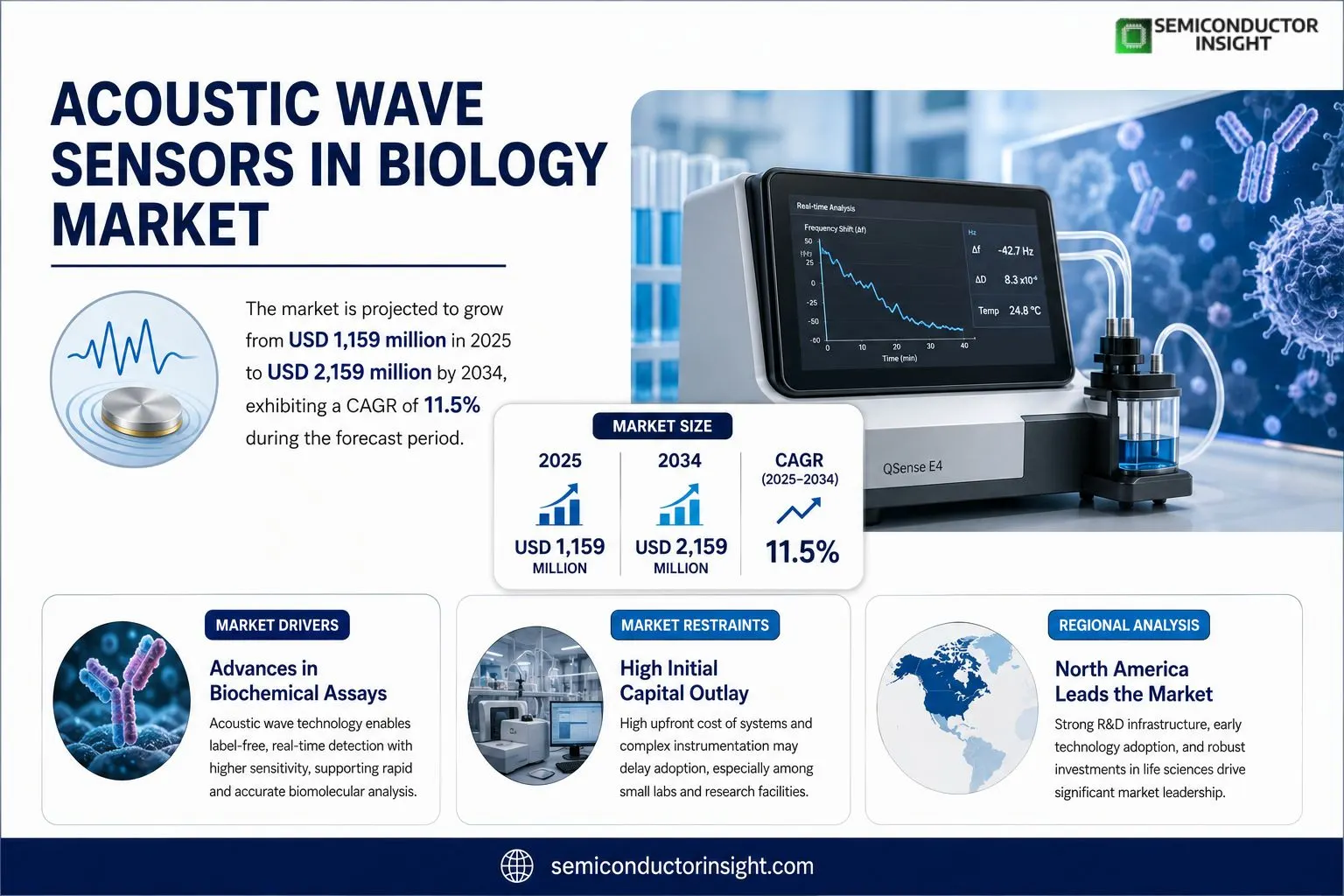
MARKET DRIVERS
Advances in Biochemical Assays
The integration of acoustic wave technology into enzyme‑linked immunosorbent assays has lowered detection limits, allowing laboratories to quantify trace biomarkers that were previously undetectable. Manufacturers are capitalising on this capability by launching kits tuned for niche applications such as pathogen‑specific antigen monitoring.
Regulatory Acceptance
Regulators in major jurisdictions have begun to reference acoustic wave platforms in their guidance documents for point‑of‑care diagnostics, signalling a shift away from purely optical methods. Compliance pathways are therefore shortening, encouraging early‑stage adopters to allocate budget toward these sensors.
➤ “The ability to deliver label‑free, real‑time data is reshaping how biologists validate molecular interactions.” – Senior R&D Director, biotech firm
Because the technology supports multiplexed read‑outs without additional reagents, cost structures are flattening for high‑throughput screening programmes, making Acoustic Wave Sensors in Biology Market attractive for both academic and commercial pipelines.
MARKET CHALLENGES
Complex Instrumentation Requirements
Operating acoustic wave devices demands precise temperature control and vibration isolation, which can overwhelm smaller laboratories lacking dedicated facilities. Investment in ancillary equipment represents a non‑trivial barrier for widespread adoption.
Other Challenges
Signal Interpretation
Translating frequency shifts into biologically meaningful concentrations requires sophisticated algorithms; many end‑users rely on vendor‑provided software that may not be fully customisable, limiting flexibility for unconventional assays.
MARKET RESTRAINTS
High Initial Capital Outlay
The upfront cost of a fully equipped acoustic wave workstation often exceeds that of conventional spectrophotometers, prompting decision‑makers to justify expenditure through projected return on investment. Budget cycles in public research institutions can therefore delay procurement.
Limited Vendor Ecosystem
Only a handful of manufacturers dominate the niche, resulting in constrained negotiation leverage for buyers. Supply chain volatility for specialised components, such as piezoelectric crystals, can further impede scaling efforts.
MARKET OPPORTUNITIES
Integration with Microfluidic Platforms
Coupling acoustic wave sensors with lab‑on‑a‑chip architectures unlocks continuous monitoring of cellular metabolites in real time. Start‑ups that can deliver turnkey solutions are positioned to capture contracts from pharmaceutical companies seeking to accelerate lead optimisation.
Expansion into Environmental Biosensing
Beyond medical diagnostics, Acoustic Wave Sensors in Biology Market can leverage its label‑free detection to address emerging needs in water quality monitoring and food safety. Regulatory pressure for rapid, on‑site testing in these sectors creates a clear growth corridor.
Acoustic Wave Sensors in Biology Market Trends
Shift Toward Integrated Point‑of‑Care Platforms
The latest wave of development centres on compressing the full sensor suite into a single, handheld enclosure that can operate outside conventional laboratories. By embedding piezoelectric transducers, microfluidic channels and RF electronics on a compact printed‑circuit board, manufacturers are delivering instruments that fit into a clinical pocket or a field‑testing kit. This transition is spurred by the growing demand for rapid, label‑free diagnostics in remote clinics, agricultural sites and emergency rooms. For suppliers, the move creates a dual‑track business model: legacy benchtop systems continue to serve high‑throughput research, while a new revenue stream emerges from consumable‑light, low‑margin handheld units. The supply chain is responding with tighter tolerances on crystal cuts and cost‑effective MEMS fabrication, which together lower the average selling price of a complete system to a range that supports wider adoption.
Other Trends
Higher‑Frequency Sensors Elevate Liquid‑Phase Sensitivity
Surface‑acoustic‑wave and bulk‑acoustic‑wave devices operating above 200 MHz now dominate the high‑sensitivity niche. The higher resonant frequency translates into a finer mass‑loading detection limit, allowing the identification of protein fragments and nucleic‑acid targets present at sub‑nanogram concentrations in aqueous media. Companies that have re‑engineered their transducer geometry to minimise acoustic attenuation report a measurable boost in signal‑to‑noise ratio, which in turn shortens assay times for pathogen screening. From a commercial perspective, the enhanced performance justifies premium pricing on specialized kits aimed at clinical laboratories, while also opening licensing opportunities for third‑party assay developers seeking to leverage the superior detection capability.
Convergence of Multi‑Parameter Analytics
Another notable direction is the integration of mass‑based sensing with complementary measurement modes such as viscoelastic spectroscopy and electrical impedance. By sampling the same biological event through multiple physical lenses, platforms are delivering a richer, quantitative picture of molecular interactions, including binding kinetics and conformational changes. This holistic data set is valuable for pharmaceutical R&D teams that need to de‑risk candidate molecules early in the pipeline. The market response includes a rise in bundled software licences that fuse raw sensor output with advanced analytics, creating recurring revenue streams beyond the initial hardware sale. As Acoustic Wave Sensors in Biology Market embraces this multi‑parameter approach, firms that can package hardware, consumables and data services together are positioning themselves as one‑stop solutions for both research and clinical customers.
COMPETITIVE LANDSCAPE
Key Industry Players
Acoustic Wave Sensors in Biology – Competitive Overview
Biolin Scientific, best known for its QSense platform, dominates the high‑end segment where laboratories demand sub‑nanogram sensitivity and integrated fluidic handling. The company’s revenue comes primarily from a mix of instrument sales and recurring consumables, a model that sustains gross margins above 50 %. Its strategic acquisitions of micro‑fabrication assets in Europe have sharpened its control over piezoelectric crystal quality, allowing the firm to price units near the US$ 18,000 mark while preserving profitable volume. The market structure under Biolin’s influence bifurcates into two tiers: large‑scale system integrators that bundle QSense with proprietary assay kits, and niche OEMs that embed the core sensor into portable diagnostics. This hierarchy forces new entrants to either specialize in ultra‑compact form factors or to pursue differentiated assay chemistries to avoid head‑to‑head pricing battles.A second tier of innovators is carving out meaningful share by targeting specific application niches. AWSensors and Attana, for instance, have concentrated on surface acoustic wave (SAW) solutions tailored for real‑time pathogen detection, leveraging higher operating frequencies to boost liquid‑phase sensitivity. Companies such as openQCM and Quartz Pro focus on modular quartz crystal microbalance (QCM) modules that can be retro‑fitted into existing laboratory equipment, creating a low‑entry barrier for academic users. Meanwhile, firms like MicroVacuum, SAW COMPONENTS Dresden, and TDK capitalize on bespoke MEMS fabrication capabilities, offering customized chip geometries that support multi‑parameter read‑outs (mass, viscosity, impedance). This diversification of expertise across the value chain cushions the market against concentration risk and encourages collaborative development among sensor manufacturers, instrument makers, and assay developers.
List of Key Acoustic Wave Sensors in Biology Companies Profiled
- Biolin Scientific
- AWSensors
- Attana
- BioNavis
- Semilab
- Gamry Instruments
- openQCM
- Quartz Pro
- MicroVacuum
- SAW COMPONENTS Dresden
- tstbio
- BioSAW
- TDK
- Murata
- Qorvo
- Vectron
- Rakon
Segment Analysis:
| Segment Category | Sub-Segments | Key Insights |
| By Type |
|
Surface Acoustic Wave (SAW) is emerging as the preferred technology for biologically relevant measurements due to its adaptability to liquid environments and ability to operate at higher frequencies, which enhances sensitivity.
|
| By Application |
|
Clinical & Diagnostics drives the most intense adoption of acoustic wave sensors, propelled by the need for rapid, label‑free detection of pathogens and biomarkers at the point of care.
|
| By End User |
|
Biotechnology Companies are leveraging acoustic wave sensors to accelerate drug discovery pipelines and to validate biologics, emphasizing multiplexed and high‑throughput capabilities.
|
| By Trend |
|
Miniaturization & Portability is reshaping the market, as manufacturers target point‑of‑care and field‑deployed diagnostics.
|
| By Deployment Mode |
|
Portable POCT Devices are gaining traction as end‑users demand rapid, on‑site testing without sacrificing analytical depth.
|
Regional Analysis: Acoustic Wave Sensors in Biology Market
Investment dollars gravitate toward university spin‑outs that fuse microfabrication with bio‑recognition layers, resulting in prototypes capable of detecting nanogram concentrations of biomarkers. Funding agencies prize projects that demonstrate multiplexing, prompting a shift from single‑analyte to panel‑based acoustic platforms.
The FDA’s guidance on nanomechanical diagnostics outlines validation steps that align closely with acoustic sensor performance metrics, encouraging manufacturers to embed compliance checkpoints early in the development cycle.
Established instrumentation firms have broadened their portfolios by acquiring niche acoustic sensor startups, creating hybrid offerings that meld legacy electrochemical expertise with emerging surface wave technology.
Clinical laboratories are piloting acoustic wave kits for rapid pathogen identification, valuing the technique’s label‑free nature and its ability to integrate into existing workflow automation platforms.
Europe
European nations exhibit a collaborative model where consortium‑led projects bind academic labs, equipment manufacturers, and health ministries. The emphasis on standardization has propelled the development of interoperable data formats, facilitating cross‑border clinical studies. Nations such as Germany and the United Kingdom invest in translational hubs that speed the movement of acoustic sensor prototypes from bench to bedside, often supported by EU research frameworks that prioritize sustainability and patient‑centred outcomes. This coordinated approach nurtures a steady pipeline of niche applications, ranging from food safety monitoring to personalized oncology diagnostics.
Asia‑Pacific
In Asia‑Pacific, rapid industrialization and expanding public‑health initiatives create a fertile backdrop for acoustic sensor adoption. Countries such as China, Japan, and South Korea emphasize low‑cost manufacturing techniques, driving down component prices and enabling broader market penetration. Governments are introducing incentives for home‑grown biotech firms, which in turn partner with sensor developers to address endemic health challenges. While the regulatory environment varies widely, a trend toward harmonized safety standards is emerging, allowing multinational players to replicate successful models across multiple jurisdictions with limited adaptation.
South America
South American markets are driven by an urgent need for affordable diagnostic tools in remote and underserved areas. Brazil and Argentina host a growing community of university spin‑outs focused on rugged acoustic devices that can operate without extensive laboratory infrastructure. Partnerships with non‑governmental organizations facilitate field trials in agricultural and medical settings, revealing the technology’s versatility beyond conventional laboratory use. The region’s modest yet increasing R&D budget signals a willingness to invest in home‑grown solutions that reduce dependence on imported equipment.
Middle East & Africa
The Middle East and Africa region presents a landscape where strategic healthcare investments intersect with emerging biotech ecosystems. Gulf Cooperation Council states allocate substantial funds toward smart‑hospital concepts, where acoustic wave sensors could integrate with digital health records for real‑time monitoring. In Sub‑Saharan Africa, pilot projects explore low‑power acoustic platforms for infectious disease surveillance, capitalizing on the technique’s minimal reagent requirements. Although the market remains nascent, the combination of government‑backed health initiatives and a growing cadre of regional innovators suggests a gradual expansion of sensor‑based solutions across clinical and environmental sectors.
Report Scope
This market research report provides a comprehensive analysis of the Acoustic Wave Sensors in Biology Market , covering the forecast period 2026–2034. It offers detailed insights into market dynamics, technological advancements, competitive landscape, and key trends shaping the industry.
Key focus areas of the report include:
- Market Overview: The report begins with an overview outlining its current market scenario, key growth indicators, and industry transformation drivers. It discusses macroeconomic factors, demand–supply balance, regulatory landscape, and the strategic role of semiconductors in powering advancements across industries such as automotive, telecommunications, consumer electronics, and industrial automation.
- Market Size & Forecast: Historical data and future projections for revenue, unit shipments, and market value across major regions and segments.
- Segmentation Analysis: Detailed breakdown by product type, technology, application, and end-user industry to identify high-growth segments and investment opportunities.
- Regional Insights: Insights into market performance across North America, Europe, Asia-Pacific, Latin America, and the Middle East & Africa, including country-level analysis where relevant.
- Competitive Landscape: Profiles of leading market participants, including their product offerings, R&D focus, manufacturing capacity, pricing strategies, and recent developments such as mergers, acquisitions, and partnerships.
- Technology Trends & Innovation: Assessment of emerging technologies, integration of AI/IoT, semiconductor design trends, fabrication techniques, and evolving industry standards.
- Market Drivers & Restraints: Evaluation of factors driving market growth along with challenges, supply chain constraints, regulatory issues, and market-entry barriers.
- Stakeholder Insights: Insights for component suppliers, OEMs, system integrators, investors, and policymakers regarding the evolving ecosystem and strategic opportunities.
Primary and secondary research methods are employed, including interviews with industry experts, data from verified sources, and real-time market intelligence to ensure the accuracy and reliability of the insights presented.
FREQUENTLY ASKED QUESTIONS:
What is the current market size of Acoustic Wave Sensors in Biology Market?
-> Acoustic Wave Sensors in Biology Market was valued at USD 1031 million in 2025 and is expected to reach USD 2159 million by 2034, representing a CAGR of 11.5% during the forecast period.
Which key companies operate in Acoustic Wave Sensors in Biology Market?
-> Key players include Biolin Scientific (QSense), AWSensors, Attana, BioNavis, Semilab, Gamry Instruments, openQCM, Quartz Pro, MicroVacuum, SAW COMPONENTS Dresden, tstbio, BioSAW, NDK, KYOCERA, TDK, Qorvo, Murata, Vectron, Rakon, Abracon, CSIMC, SungThai, Microbalance Tech.
What are the key growth drivers?
-> Key growth drivers include miniaturization and portability enabling point‑of‑care testing, higher‑frequency sensors improving sensitivity, multi‑parameter sensing integration, expansion of rapid diagnostics and biologics development, and the increasing demand for real‑time label‑free detection technologies.
Which region dominates the market?
-> North America holds the largest market share, while Asia‑Pacific is emerging as the fastest‑growing region.
What are the emerging trends?
-> Emerging trends include compact and integrated portable systems for decentralized analysis, higher‑frequency acoustic devices for improved liquid‑phase sensitivity, and multi‑modal platforms that combine mass, viscoelastic and impedance measurements for comprehensive biological interaction profiling.
Get Sample Report PDF for Exclusive Insights
Report Sample Includes
- Table of Contents
- List of Tables & Figures
- Charts, Research Methodology, and more...
 Download Sample Report PDF