USB Y-Cable Market Insights
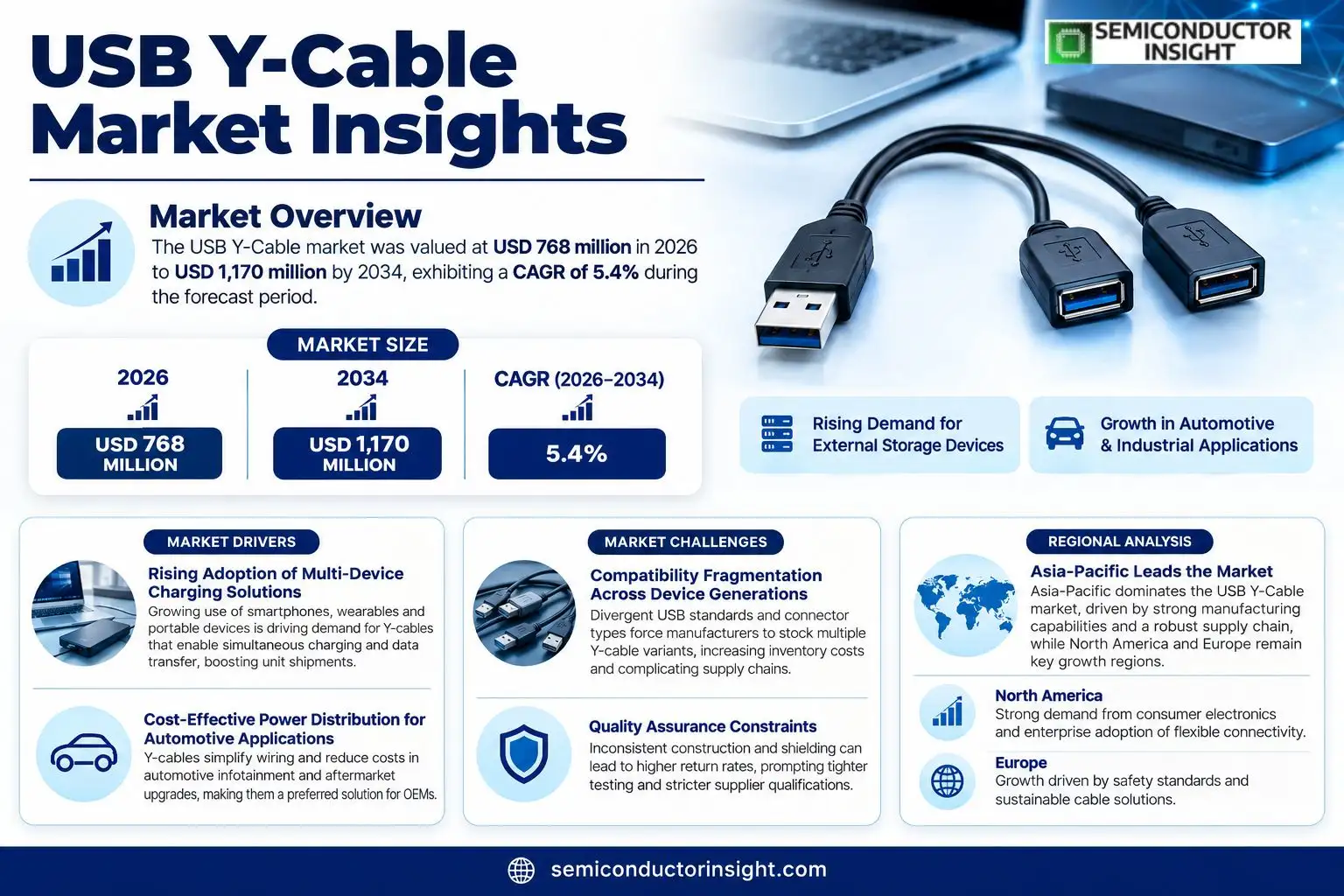
USB Y‑Cable market size was valued at USD 768 million in 2026 to USD 1,170 million by 2034, exhibiting a CAGR of 5.4% during the forecast period.
A USB Y‑Cable is a split‑type connector that provides one host plug and two downstream plugs, allowing separate power delivery and data transmission paths or boosting current capacity when a single port cannot meet device requirements.The market remains steady because external storage devices, industrial control equipment, and legacy USB applications continue to rely on dual‑power solutions despite broader adoption of USB‑C standards; however, intense price competition and migration toward higher‑current specifications pose challenges for manufacturers seeking margin expansion.
MARKET DRIVERS
Rising Adoption of Multi‑Device Charging Solutions
The proliferation of smartphones, wearables, and portable power banks has heightened demand for cables that can simultaneously charge and sync data. Manufacturers are integrating Y‑cables into accessory kits to address the convenience factor, prompting a measurable uptick in unit shipments across consumer electronics retailers.
Cost‑Effective Power Distribution for Automotive Applications
Automotive infotainment systems increasingly rely on external power sources for aftermarket upgrades. By leveraging a single power input to feed two downstream devices, Y‑cables reduce wiring complexity and material costs, a benefit that OEMs are quantifying in bill‑of‑materials analyses.
➤ Design engineers cite the ability to halve connector inventory as a decisive factor when specifying Y‑cables for new product lines.
Beyond hardware, the regulatory environmentparticularly RoHS compliancehas nudged suppliers toward lead‑free, recyclable cable constructions. This shift not only satisfies sustainability goals but also opens doors to contracts with environmentally conscious brands.
MARKET CHALLENGES
Compatibility Fragmentation Across Device Generations
Legacy devices still rely on older USB standards, while newer products adopt USB‑C or proprietary connectors. This divergence forces manufacturers to stock multiple Y‑cable variants, inflating inventory costs and complicating supply‑chain forecasting.
Other Challenges
Quality Assurance Constraints
Inconsistent solder joints and inadequate shielding have led to higher return rates, prompting retailers to tighten acceptance criteria and press suppliers for stricter testing protocols.Furthermore, price volatility of raw copper adds uncertainty to margin calculations; sudden spikes can erode profitability for low‑margin cable assemblers, compelling them to renegotiate pricing with component vendors.
MARKET RESTRAINTS
Stringent Electromagnetic Interference (EMI) Regulations
Regulatory bodies in North America and Europe impose tight EMI limits for data lines that run in close proximity. To meet these standards, manufacturers must invest in additional shielding or redesign cable geometry, actions that raise per‑unit costs and can deter small‑scale entrants.
MARKET OPPORTUNITIES
Emergence of High‑Power Fast‑Charging Protocols
The rollout of 65 W and higher fast‑charging standards presents a clear opening for Y‑cables engineered to handle elevated currents without overheating. Companies that certify their products against these protocols stand to capture premium pricing tiers and secure long‑term OEM contracts.Simultaneously, the growth of remote work environments fuels demand for docking stations that rely on a single power feed to support multiple peripherals. Tailoring Y‑cable offerings to this niche can generate recurring revenue streams through bundled solutions.
USB Y-Cable Market Trends
Shift Toward High‑Current Y‑Cables in Industrial Settings
In 2026, manufacturers delivered roughly 210 million units worldwide, with a gross margin near 32 %. The incremental price pressure from commoditized consumer segments is offset by a growing proportion of high‑current variants that satisfy the power‑intensive needs of factory automation and data‑center backup equipment. Companies that have re‑engineered their product lines to handle up to 2 A per leg are seeing order books expand faster than the overall volume growth, because legacy devices cannot meet the power draw of newer solid‑state drives without supplementary supply. This trend reflects a strategic pivot: instead of competing solely on unit cost, producers are differentiating through compliance with IEC‑60950‑1 safety standards and offering customized shielding for electromagnetic interference‑prone environments.
Other Trends
Regional Consolidation of Supply Chains
Asia‑Pacific continues to host over 70 % of the production capacity, yet the past twelve months have witnessed a modest reshoring of key component sourcing to North America and Europe. The move is driven by tighter electromagnetic‑compatibility regulations and a surge in demand for certified, traceable cables in medical‑equipment refurbishments. Suppliers that can provide end‑to‑end visibilityfrom copper extrusion to finished‑product testingare securing contracts with OEMs that are unwilling to tolerate supply disruptions. As a result, price competition in the low‑end segment is intensifying, while premium pricing persists for verified, low‑latency cables used in robotics.
Emergence of Dual‑Power Boost Y‑Cables for Legacy Devices
Legacy external drives still represent a sizable portion of installed base, especially in small‑business environments that have not yet migrated to USB‑C. Dual‑power boost models, which combine a dedicated power feed with a data line, are gaining traction because they extend device lifecycles without necessitating full hardware replacement. Vendors that integrate smart‑chip monitoring to report voltage drop are positioning themselves as service‑oriented partners, allowing end users to schedule preventive maintenance based on real‑time cable health metrics. This approach not only creates a recurring‑revenue stream but also mitigates the risk of sudden data‑loss incidents, a concern that resonates strongly with compliance‑focused enterprises.
COMPETITIVE LANDSCAPE
Key Industry Players
USB Y‑Cable Market: Competitive Dynamics and Player Positioning
At the apex of the USB Y‑Cable segment, a handful of globally recognised brands dominate volume and revenue. Anker, with its extensive supply chain anchored in Shenzhen, leverages high‑volume manufacturing to keep unit costs low while retaining a modest gross margin. StarTech, operating out of the United States, differentiates through rigorous certification programmes and a deep catalog that serves enterprise‑level procurement. UGREEN, a Chinese‑origin brand, complements its consumer‑focused pricing with a rapid‑response distribution network across Europe and North America, enabling it to capture a sizable share of the installed‑base replacement market. HP, while primarily known for computing hardware, channels its OEM relationships to secure bulk contracts for data‑center peripherals, ensuring a steady flow of Y‑Cable orders that align with its broader accessory portfolio. Collectively, these firms benefit from scale economies, well‑established channel partners, and the ability to invest in compliance testing that satisfies both regulatory bodies and demanding industrial customers.Beyond the headline manufacturers, a cohort of specialised and regionally focused players adds depth to the competitive picture. CableCreation and Mbientlab cater to niche applications such as medical instrumentation and wearable devices, where custom gauge and shielding specifications are non‑negotiable. UNITEK and Mimo Monitors concentrate on industrial automation, supplying ruggedised Y‑Cables that meet higher current thresholds and extended temperature ranges. Epson and Shenzhen Witarea Technology maintain a foothold in printing and embedded systems, leveraging legacy relationships with equipment OEMs to sustain modest but consistent shipments. ASUSTeK, while better known for motherboards, offers a boutique line of high‑performance Y‑Cables aimed at gaming rigs and enthusiast PCs. ABB, a heavyweight in industrial automation, treats Y‑Cables as a peripheral component within its wider connectivity solutions, emphasizing reliability over cost. These firms often operate on tighter margins but extract value through product differentiation, bespoke engineering services, and long‑term service contracts that lock in recurring revenue.
List of Key USB Y-Cable Companies Profiled
- Anker
- UGREEN
- StarTech
- CableCreation
- Mbientlab
- UNITEK
- Mimo Monitors
- HP
- Epson
- Shenzhen Witarea Technology
- ASUSTeK
- ABB
Segment Analysis:
| Segment Category | Sub-Segments | Key Insights |
| By Type |
|
USB‑A
|
| By Application |
|
Industrial & Equipment Power Y‑cables
|
| By End User |
|
Industrial Automation
|
| By Specification |
|
High‑current Y‑cables
|
| By Functional Purpose |
|
Data and Power Split Y‑cables
|
Regional Analysis: USB Y-Cable Market
North America
The surge in 2‑in‑1 laptops and portable gaming rigs fuels a subtle shift toward Y‑cables that enable simultaneous charging and peripheral connectivity, prompting retailers to expand shelf space for varied connector lengths.
IT departments reconfigure test benches to incorporate Y‑cables, reducing cable clutter and improving workflow efficiency, a practice that trickles down to service‑provider maintenance contracts.
Near‑shore component sourcing mitigates lead‑time volatility, allowing manufacturers to keep inventory levels lean while still meeting quarterly demand spikes.
Compliance with federal e‑waste directives pushes firms toward recyclable materials, influencing design choices that balance durability with environmental responsibility.
Europe
European markets exhibit a nuanced appetite for USB Y‑cables, shaped by a blend of consumer preference for sleek, low‑profile designs and stringent safety standards. Manufacturers respond by offering slim‑profile jackets and harmonized voltage specifications that satisfy both home users and professional technicians. Cross‑border e‑commerce platforms amplify visibility across the EU, yet local certification requirements preserve a competitive edge for regional players who tailor their product catalogs to country‑specific plug variants. The push for sustainable packaging, driven by EU circular‑economy policies, nudges firms to adopt minimal‑waste solutions, creating a subtle but measurable differentiation factor for brands that can advertise fully recyclable bundles.
Asia‑Pacific
In the Asia‑Pacific corridor, rapid urbanization and a burgeoning maker community generate an expansive, albeit price‑sensitive, consumer segment. Hobbyists and small‑scale manufacturers favor Y‑cables that combine affordability with reliable data integrity, prompting local OEMs to fine‑tune cost structures without sacrificing shielding effectiveness. The region’s heterogeneous power‑grid standards also encourage the production of multi‑regional adapters, further cementing Y‑cables as a versatile conduit in both consumer gadgets and industrial IoT deployments. Trade fairs across Shanghai, Singapore, and Bangalore serve as launchpads for innovative form factors, reinforcing a culture of incremental technical improvement.
South America
South American demand is anchored by a growing middle class that increasingly adopts multifunctional devices, thereby creating a latent need for flexible connectivity options. Retail chains in Brazil and Chile prioritize shelf‑ready packaging that highlights cable durability, while informal market channels still lean toward basic, low‑cost solutions. Partnerships between regional distributors and Asian manufacturers help bridge the gap, ensuring that newer specificationssuch as higher amperage handlinggradually permeate the market. Environmental awareness is emerging, prompting a modest rise in preference for cables with biodegradable sheathing.
Middle East & Africa
The Middle East & Africa region reflects a dichotomy between high‑end corporate procurement and fragmented consumer purchasing. In Gulf states, enterprise contracts often stipulate premium‑grade Y‑cables with enhanced shielding to meet data‑center reliability criteria, whereas many African markets remain dominated by cost‑effective variants that prioritize basic functionality. Supply routes that traverse maritime hubs in Dubai and Lagos influence inventory turnover, making logistical efficiency a pivotal factor for success. Emerging sustainability mandates in South Africa are beginning to shape supplier decisions toward recyclable materials, hinting at a gradual shift in market expectations.
Report Scope
This market research report provides a comprehensive analysis of the USB Y-Cable Market , covering the forecast period 2026–2034. It offers detailed insights into market dynamics, technological advancements, competitive landscape, and key trends shaping the industry.
Key focus areas of the report include:
- Market Overview: The report begins with an overview outlining its current market scenario, key growth indicators, and industry transformation drivers. It discusses macroeconomic factors, demand–supply balance, regulatory landscape, and the strategic role of semiconductors in powering advancements across industries such as automotive, telecommunications, consumer electronics, and industrial automation.
- Market Size & Forecast: Historical data and future projections for revenue, unit shipments, and market value across major regions and segments.
- Segmentation Analysis: Detailed breakdown by product type, technology, application, and end-user industry to identify high-growth segments and investment opportunities.
- Regional Insights: Insights into market performance across North America, Europe, Asia-Pacific, Latin America, and the Middle East & Africa, including country-level analysis where relevant.
- Competitive Landscape: Profiles of leading market participants, including their product offerings, R&D focus, manufacturing capacity, pricing strategies, and recent developments such as mergers, acquisitions, and partnerships.
- Technology Trends & Innovation: Assessment of emerging technologies, integration of AI/IoT, semiconductor design trends, fabrication techniques, and evolving industry standards.
- Market Drivers & Restraints: Evaluation of factors driving market growth along with challenges, supply chain constraints, regulatory issues, and market-entry barriers.
- Stakeholder Insights: Insights for component suppliers, OEMs, system integrators, investors, and policymakers regarding the evolving ecosystem and strategic opportunities.
Primary and secondary research methods are employed, including interviews with industry experts, data from verified sources, and real-time market intelligence to ensure the accuracy and reliability of the insights presented.
FREQUENTLY ASKED QUESTIONS:
What is the current market size of USB Y-Cable Market?
-> USB Y-Cable Market was valued at USD 729 million in 2026 and is expected to reach USD 1017 million by 2034, growing at a CAGR of 5.4% during the forecast period.
Which key companies operate in USB Y-Cable Market?
-> Key players include ABB, StarTech, CableCreation, UGREEN, ANKER, Mbientlab, UNITEK, Mimo Monitors, HP, Epson, Shenzhen Witarea Technology, ASUSTeK.
What are the key growth drivers?
-> Key growth drivers include increasing demand for external storage devices, industrial control equipment, and legacy USB applications that require additional power or data‑split functionality.
Which region dominates the market?
-> Asia-Pacific dominates the market, driven by extensive manufacturing capabilities and a robust supply chain, while North America and Europe remain important for branded and industrial‑grade applications.
What are the emerging trends?
-> Emerging trends include development of higher‑current Y‑cables, integration with USB‑C power‑delivery solutions, and customized designs for industrial and embedded system applications.
Get Sample Report PDF for Exclusive Insights
Report Sample Includes
- Table of Contents
- List of Tables & Figures
- Charts, Research Methodology, and more...